
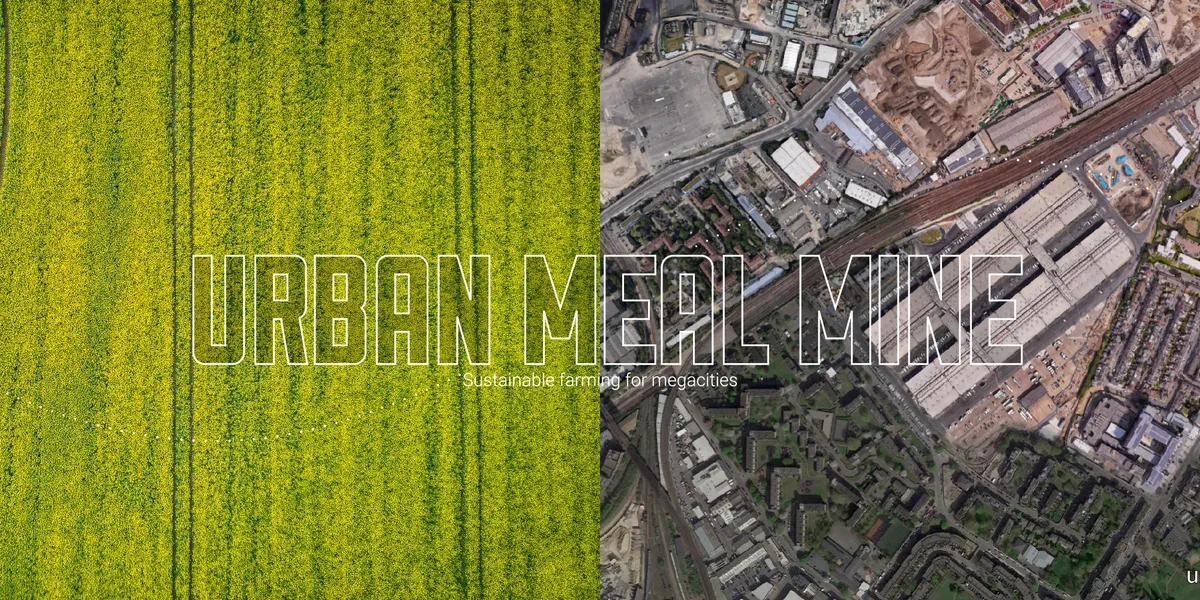
Urban Meal Mine
Sustainable farming for megacities
OVERVIEW
The Premise
Food is one of the most fundamental elements of human existence. Looking back, the way we produce, store and consume food has evolved greatly. Humans have thrived because our ancestors learned how to gather, produce and consume food, all with their bare hands. And mankind has sustained due to these crucial elements of knowledge passed through generations. With industrialization came mass production, and with mass production came an influx of consumers - who started paying instead. Skills and crafts related to agriculture and food production are now mostly obsolete in the urbane environment. Mass consumerism through supermarkets and even online mediums is slowly changing how we perceive, acquire and consume food.
In perspective
The paradigm shift in food production and consumption interspersed with the rising population of our cities creates a bigger problem. We are now wholly reliant on global networks of production and distribution and are dependent on the organizations that control these processes.
As individuals, we are losing access to crucial, self-sustaining knowledge in the name of comfort, making us vulnerable to concepts like food insecurity. We know of disasters that can lead to unexpected catastrophes that are capable of impairing cities for long periods of time. At the same time, food production and consumption currently stand at alarmingly varied rates, which is extremely unsustainable in the bigger picture.
What lies ahead?
An unsustainable and fast-growing population catalyzed by a rapid rate of urbanization, paints the picture of a dystopian society in the near future.
Reality
The Industrial Revolution has provided us with a highly consistent supply of processed food reaching markets of the megacities we reside in. This has raised issues like overconsumption, poor quality, high wattage, and an over-dependence on manufacturing agencies.
On the other hand, we cannot deny mechanization, which successfully meets the soaring demands of consumers. Artificially increasing the speed of production and boosting longevity by the addition of preservatives/additives is a hidden yet common practice, gravely affecting the quality of items we consume. In the long run, our perception of fresh foods/fruits will be completely eroded by advertisements and fancy packaging, which can have irreversible impacts on health, and hence, the human evolution cycle.
If we were to look at this on a larger scale, the time to produce is shrinking, set against ever-exceeding consumers. Farmers are expected to yield more to supply more to industries that are catering to never-ending consumer demands. The value and quality of food items are deteriorating giving rise to various health problems for all ages.
Urban meal mine1 (n),
A place where people can generate/create/learn/contribute to grow food for their city. This is usually located in the heart of the city where skilled labor + abundant transport + short distance logistics + faster production technologies can break even revenue over the high-cost land it occupies.
It is not really a mine.
The Challenge
The design challenge here is to bring farming to the city where people can see, participate, indulge, and involve themselves in understanding how the food they eat is actually made. This is not just a plan to make people aware but a place where they can learn to contribute to the food cycle, consume responsibly, and create a more sustainable ecosystem for the rampantly growing cities. The space has to be in the core city, which implies being a revenue-oriented business and has to leverage profits by inducing modern equipment and machinery at the same time, has to be permeable enough to involve an enthusiastic urban population.
The challenge is to design a place where skills and crafts related to food which was once handed down through generations, can be created again. An intervention which lets people learn how to prepare and grow their own meals effortlessly, using technologies of today; learn setting up makeshift food preparation supply systems in an event of a disaster; learn plugin farming through workshops which can enable them to cultivate hassle-free at their own homes and get packed seeds/manure kits in the designed area. And there can be different mediums to explore farming in an urban context.
SITE
The site for this intervention is the New Covent Market located in the Nine Elms District, London opposite to historic Battersea power station. The site is close to the river Thames and is a part of the Nine Elms regeneration plan.
The New Covent Garden Market is a 4-decade old market structure that houses a wide variety of wholesalers of foods, fruits, vegetables, and flowers. The site is surrounded by residential and commercial developments of various scales and is expected to invite people from around the city. It also has two brand new tube stations proposed in an attempt to rejuvenate transport links to the Nine Elms district.
Only bylaws to be considered:
Permissible Ground Coverage: 30%
Maximum Builtup area: 200,000m2
Maximum buildable height: 24m
Similar Competitions
Discover competitions you might be interested in




Design challenge to reuse E-waste


Illustrate the lost glory of Angkor Wat - Render Challenge


Photograph architecture without architects


Challenge to reimagine the Iron Throne

