If only one entry is submitted to a competition, or very few are, the competition is not cancelled and your entry is still judged. Your entry is judged on its merits, and the awards it is judged for are the ones attached to the round the competition finishes in. The number of people who entered changes how large that award set is. It does not change whether your entry is evaluated.
Two things decide the answer for any competition: whether it uses static or dynamic pricing, and, if it is dynamic, how many entries it ends up with.
Static competitions: the awards are fixed before it opens
In a static competition the organizer sets the awards in advance. They do not move with participation. Whether the competition draws five entries or five hundred, the award set is the one published from the start.
Dynamic competitions: a round is a number of entries, not a date
In a dynamic competition the awards grow with the field. The competition publishes a ladder of rounds, and a round is a band of entry counts rather than a stretch of time. Each round carries its own registration fees and its own set of awards.
Three things follow from that, and they are the parts people most often read the wrong way.
- The round is chosen by the competition's total number of entries. Not by entries received since the last round closed, and not by any date.
- There is one award set for the whole competition. It is the set belonging to the round the competition finishes in, and everyone who entered competes for it.
- Registering early does not tie you to the awards showing on the day you registered. If you register while the competition is in round 2 and it goes on to reach 42 entries, you compete for the round 9 set along with everyone else.
What registering early does lock in is your fee. You pay the price of the round you register in, and later entrants pay more. Static and dynamic entry fees covers how the fees move.
What each round carries
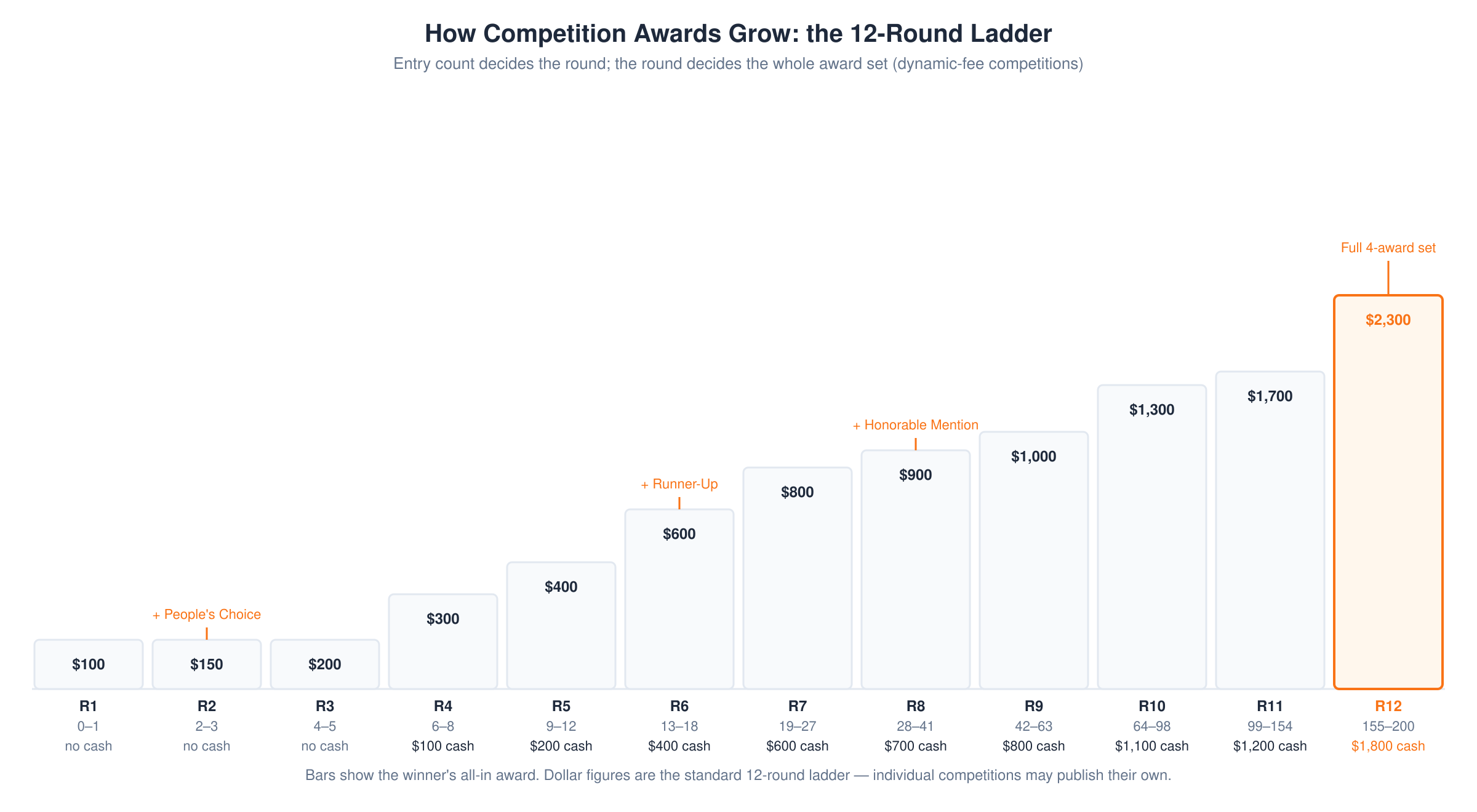
Most dynamic competitions on UNI use the same twelve round ladder.
| Round | Entries | Awards in the set | Cash for the winner | Winner's award, all in |
|---|---|---|---|---|
| 1 | 0 to 1 | 1 | none | $100 |
| 2 | 2 to 3 | 2 | none | $150 |
| 3 | 4 to 5 | 2 | none | $200 |
| 4 | 6 to 8 | 2 | $100 | $300 |
| 5 | 9 to 12 | 2 | $200 | $400 |
| 6 | 13 to 18 | 3 | $400 | $600 |
| 7 | 19 to 27 | 3 | $600 | $800 |
| 8 | 28 to 41 | 4 | $700 | $900 |
| 9 | 42 to 63 | 4 | $800 | $1,000 |
| 10 | 64 to 98 | 4 | $1,100 | $1,300 |
| 11 | 99 to 154 | 4 | $1,200 | $1,700 |
| 12 | 155 to 200 | 4 | $1,800 | $2,300 |
The awards arrive in a fixed order. Round 1 carries a Winner and nothing else. People's Choice is added at round 2, Runner-Up at round 6, and Honorable Mention at round 8. From round 8 on, the set is Winner, Runner-Up, Honorable Mention and People's Choice.
The part of the winner's award that is not cash is a UNI Membership, an e-certificate and a featured article or interview about the work. At rounds 11 and 12 it also carries an invitation to work with UNI as a curator.
Individual competitions can publish their own ladder, so read the one on the competition page rather than this example.
Rounds 1 to 3 carry a membership, not cash
Below 6 entries there is no cash anywhere in the standard ladder. The winner's award at rounds 1, 2 and 3 is a UNI Membership worth $100, $150 or $200, together with an e-certificate and a featured article or interview. Cash first appears at round 4, from the sixth entry onward.
A membership award is described by what it is worth rather than by a plan name, and it is arranged for you after the result rather than switched on automatically. Cash and membership awards are both settled through an award closure form, which you are emailed a link to. See Competition awards.
Finishing in an early round is normal
Most dynamic competitions do not climb far. About six in ten finish in round 1 or round 2, so an award set with no cash in it is the ordinary outcome rather than a sign that something went wrong. It does not mean the competition was cancelled, was not taken seriously, or will be judged any differently.
Judging does not depend on how many entries there are
No stage of a competition waits for a minimum number of entries. A competition with one entry runs the same path as one with five hundred: moderation, the shortlist stage if that competition has one, jury evaluation, public voting if it has one, the result announcement, and certificates.
What is not automatic is the award itself. Winners are named by the jury and the UNI team. A jury award is not calculated from a score, and it is not handed out simply because there is a slot for it in the round's set. The one calculated award is People's Choice: it goes to the entry with the highest Public Score, which combines the juror's rating, the community rating and likes. Where a competition has no dedicated jury, the Public Score decides the result, with the community rating and likes carrying the weight. So the honest way to read your position is this: your entry is judged, and the awards it can be judged for are the ones in the round the competition finished in.
What happens if only one entry is submitted to the competition?
Nothing is cancelled, and your entry is still judged. If you are the only person who entered, if nobody else entered, or if the competition closed with very few entries, the competition runs to its published schedule and your entry goes through every stage it would have faced in a crowded field. What a small field changes is the size of the award set, not whether the work is evaluated.
Nothing is cancelled. Registration closing with a single live entry is a normal outcome and the competition carries on:
- The entry goes through moderation, then through whichever stages that competition has scheduled.
- The jury evaluates it. Once the submission deadline has passed you can read your own scores and any juror remarks on the entry's Analytics page.
- On the result date the outcome is published and you are emailed.
- The award set in play is round 1's: a single Winner award carrying a UNI Membership worth $100, an e-certificate and a featured article or interview. On the standard ladder there is no cash at that level.
- Your certificate is produced as usual, whether or not the entry carries an award.
Being the only entry neither guarantees the Winner award nor rules it out. That decision sits with the jury and the organizer.
Where to read the awards for your competition
Open the competition and select Awards & Fees in the left sidebar. On a narrow screen it is one of the tabs across the top. The section is a timeline of rounds:
- Each round is headed Current round grants or Next round grants. The awards and their descriptions sit on one side, the registration fees on the other. Rounds are not numbered on the page.
- Each round shows how many registrations are left before it closes, written as "N registration(s) left in this round".
- Select Load More to see rounds further ahead.
Read every award from its description rather than from its name. Most of them carry more than one thing.
Awards & Fees is the section to read for the round by round figures. A competition may also carry a separate Awards section, which describes its awards at greater length but is not laid out by round.
How to view the awards and fees for the next round walks through the section in detail.