
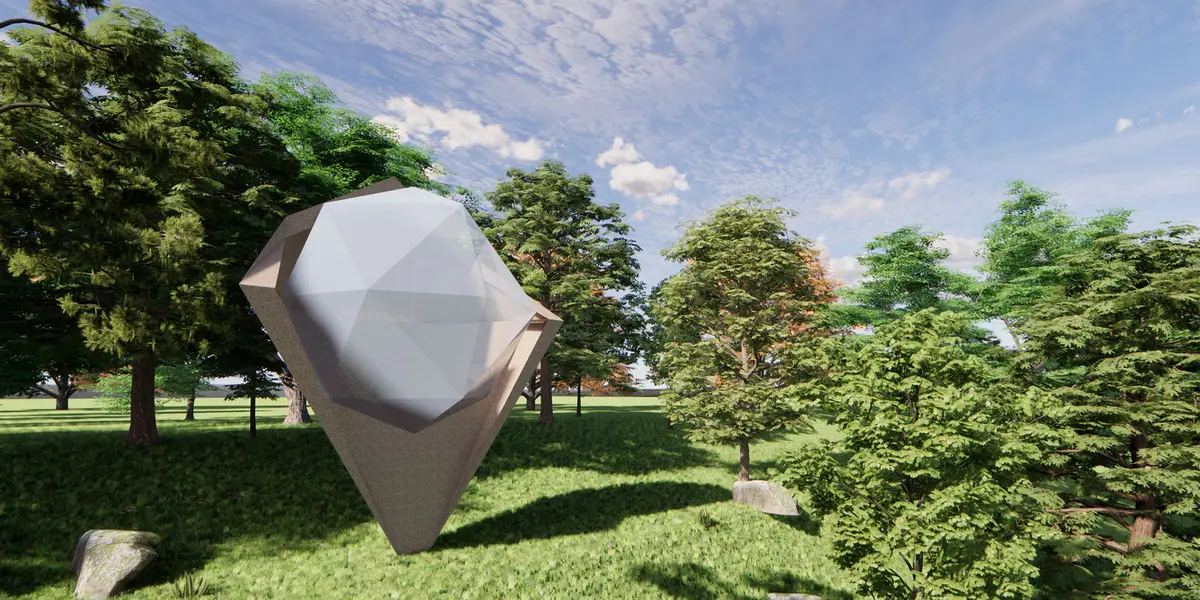
Abode in Woodlands
Calming retreat within the nature

Self-sufficient design for nature lovers -
Initial ideas
Initial project idea was to create a structure within a tree.
While looking for an ispiration I decided to focus on natural superpowers in nature. I have choosen Koala bear with its ability to mazine water and resistance to heat.
In case of architectural inspirations I decided to focus on water harvesting facades.
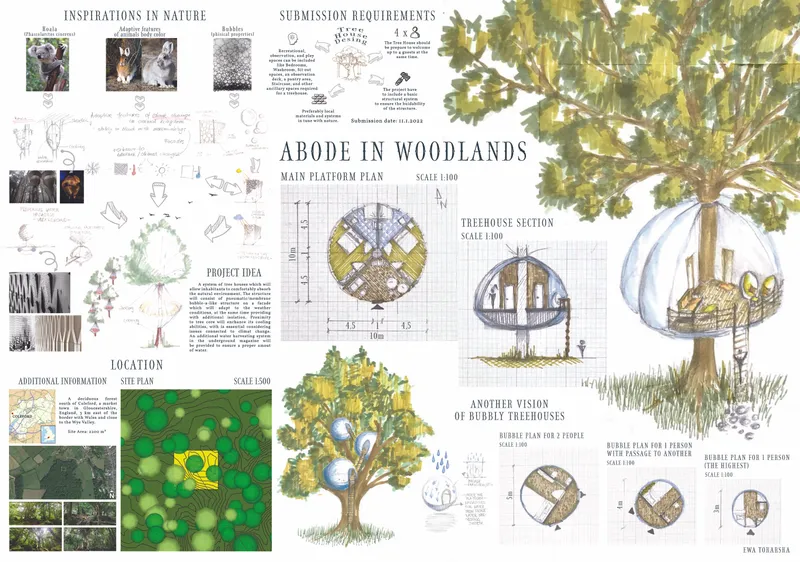
Change of the idea due to organizers guidelines
1.There are multiple shrubs and plants found on the site, although these trees are the most prominent natives of the region in and around the site.
•Yew (Taxus Baccata) Yew trees are 15-20m in height and have a dark reddish bark. With strong roots they continue to strong tall irrespective of a hollow bark.
•Oak (English Oak) The oaks on site are about 20-40m in height and have a canopy that is fairly open and widespread.
•Ash Tree This is the most common on given location, they are 15-35m wide with a strong and wide root system. Similar to oaks they have large canopies.
•Lime (Tilia x Europaea) Lime on site is 30-40 high and is home to many insects/ bug with fairly restricted canopy as compared to the above trees.
•Beech (Fagus Sylvatica) 40m is the maximum height of a beech tree has its branches spread-out with a dense canopy. There are usually truffle or multiple fungi growing at its base to help them in photosynthesis.
You can propose the treehouse in close proximity to any of the above trees or near other tree species on the site location.
Apart from trees, there are numerous species of fungi and lichens all-year round in the puzzle wood forest.
2.Structural Integrity
•The treehouse or its design elements (bridges, platforms) in no way should harm or rely/hang on support for the tree. Structurally independent interventions are allowed within the given area.
•Participants have to design a Treehouse for a capacity of four. You can divide, innovate, connect and experiment with spaces or user type, though it should function as a treehouse not as treehouses.
•The height (5m) has to be considered from the ground level you decide to design from.
• Four inhabitants counts for the whole built-up area. The color, number and type of trees in the SketchUp model are for representation purposes, it can be replaced/changed by participants in accordance with the native flora and fauna.
Project development
With those guidelines in mind I started to develope another idea. I focused on few issues trying to solve each one of them.
Issue 1 – Materials
Assumptions:
1.ecological
2.biodegradable (if possible)
3.localy sourced
4.transfluent to see surroundings
5.with good isolating properties
Issue 2 – Energy efficiency
Things to solve:
1.heat & air conditioning - heat pumps
2.cooking - biomass digester
3.energy (light, utilities) - power generating home bicycle
- solar panels (not sufficient under the trees - change of the idea)
Issue 3 – shape
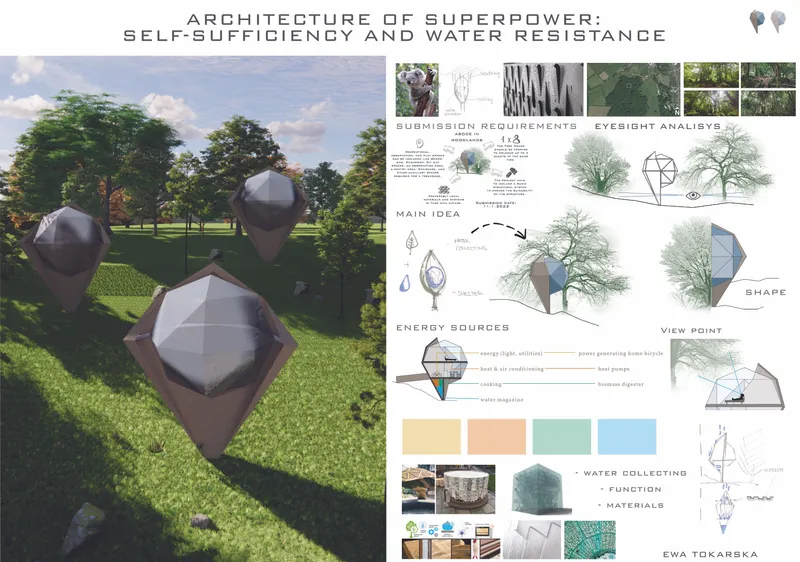
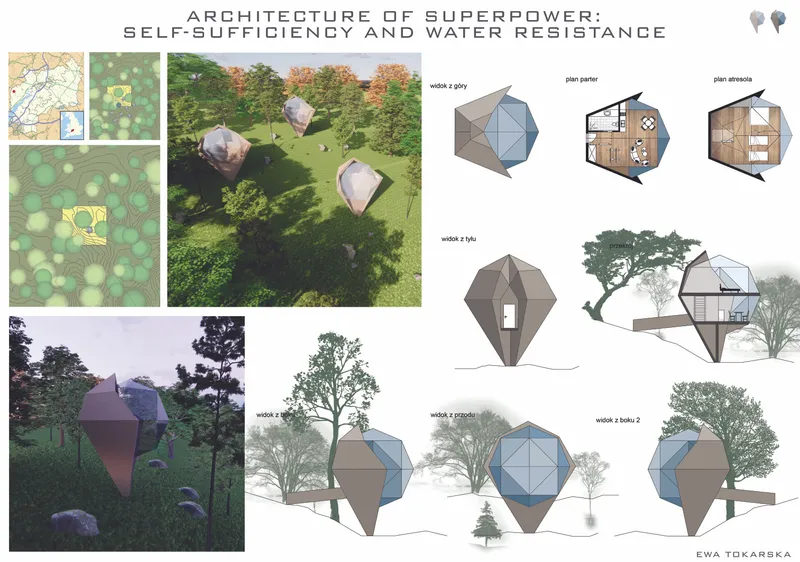
- Futher idea development -
Final project
Abode in Woodlands design is a modern structure with a shape relating to the trees covering the plot. Raising the main part of the structure also allows the temperature variations (the strongest at ground level) to be reduced. Following the design guidelines, it was decided to use ecological materials such as wood and mycellium. The wooden structure is covered with a biodegradable material created with the help of mycelium and subjected to thermal treatment. Organic tissue processed in this way becomes an excellent building material with high thermal insulation properties.
In terms of obtaining energy, the focus was on self-sufficiency. The appropriate temperature inside the building is provided by the air heat pump. Cooking is possible thanks to the biomass digester, the additional advantage of which is the possibility of using the resulting fertalizer to fertilize the undergrowth. Light and electricity is generated by the treehouse users themselves by a power generating bicycle installation. The objects stores rainwater for its own needs in a magazine located on the lower level.
There are three levels within the structure. Core level where technical support devices and a rainwater storage are placed. The main level which can be reached via a footbridge. It contains a living space, a kitchenette, a bathroom and a place for electricity-generating bicycles. The highest level is the level of rest and the closest contact with nature. A panoramic window allows visitors to admire the beauty of surrounding forest.

Popular Articles
Popular articles from the community


Conexión: Biophilic Design Reimagines High-Rise Living in Hong Kong
Conexión reimagines high-rise living in Hong Kong through biophilic design, green facades, shared spaces, daylight, water and nature within.

Hill & Cross Opera: Sculptural Opera House Architecture Shaped by Tallinn’s Landscape and Identity
Hill & Cross Opera reimagines opera house architecture in Tallinn through its sculptural hill, civic plaza, glass wave and a luminous cross.

Lunar Spiral: Space Architecture Shaped by the Mathematics of the Universe
Lunar Spiral reimagines space architecture through Fibonacci geometry, lunar regolith, levitating habitats, and self-sustaining Moon living.

ALGAL REALM: A Bio-Integrated Lunar Habitat Design for Life Beyond Earth
ALGAL REALM reimagines lunar habitat design with algae-powered life support, 3D-printed regolith, and vertical living for a lunar future.

Similar Reads
You might also enjoy these articles

Day and Night Park: A Time-Based Urban Newsstand in Beijing
A temporary urban newsstand in Beijing blending travel, light, and reading through poetic colors, compact form, and community-focused design.

Modernist Patio Renovation in El Masnou, Barcelona by Oliver Segura Arquitectura + Cebrià Arquitectura
Modernist patio renovation blending tradition and innovation with a movable pool, leveled floors, and Catalan materials in El Masnou.

Alto Residencial Coop: Cooperative Housing Development in Santiago de Compostela by Carbajo Barrios Arquitectos
A linear cooperative housing complex blending white volumes and perforated metal façades, enhancing community living, natural light, privacy, and urban integration.
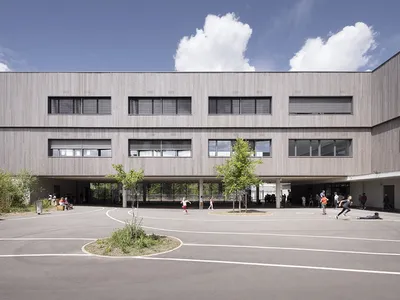
Vil Genis School by BPA ARCHITECTURE – Massy, France
Vil Genis School in Massy, France, features sustainable design, south-facing classrooms, community integration, accessible spaces, and modern educational architecture.


Comments (0)
Please login or sign up to add comments
No comments yet. Be the first to comment!