

Sustainable Design
Design approaches that balance environmental responsibility with human needs across architecture and spatial planning.





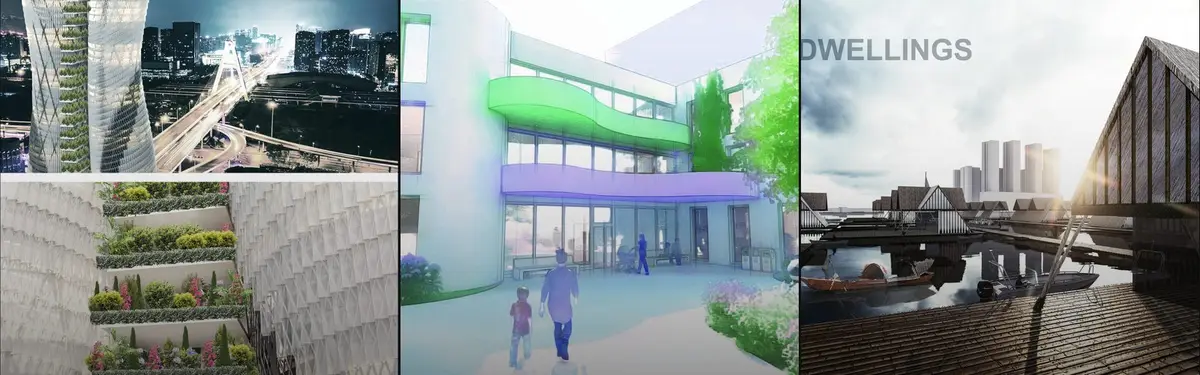
Humans have taken over everything and all elements of the natural world, building over almost every terrain in the process. The spaces we inhabit and the massive infrastructure to support our lives destroy anything that might have previously existed. Unfortunately, the conflict between nature and civilization is ongoing; and with this current standard of living, it's sometimes difficult to turn back the hands of time. Therefore, as architects and designers, we must take steps not only to simply reconsider what our environment looks like but also actively attempt to blend into the very forms of these natural spaces. Img 1: Sustainable design can take many forms - A sketch from Moray 2 (Runner-up for Urban Meal Mine) Thriving on this objectively sustainable architecture is creating an awareness in itself about environmental issues. Limited not only towards spaces and architecture - sustainable development holistically is managing finite resources with the need to ensure that these resources are used wisely and in a way that long-term priorities don't suffer. Carrying this philosophy sustainable design seeks balance between the economy, environment, and equity through design thinking and building technologies. Sustainable architecture is a rapidly growing discipline with the need to design basic typologies consciously. It is constantly providing innovative solutions and sustainable design strategies for effective urban environments, commercial and industrial buildings and housing. These technologies thereby foster a sustainable future that can build better environments. Sustainable design is a branch under a larger umbrella of sustainable development - to understand how to design better for the world, it's immensely important to know the what, why and how of sustainability/sustainable development. What is sustainability? In the 21st century, sustainability refers to the capacity for Earth's biosphere and human civilization to co-exist without critical impacts on each other's ability to thrive. In terms of the philosophical and analytical framework, sustainability draws from and integrates concepts from a number of fields. Img 2: The spectrum of sustainability spreads across various fields (Credits-Wikipedia) Sustainability is a holistic approach that considers ecological, social, and economic dimensions. At its core, sustainability is simply about ensuring we are considering the impacts our activities have on current and future generations' ability to live well on this planet. To be truly sustainable results must be socially just , environmentally positive and economically viable. Moreover, moving towards a better tomorrow offers social challenges such as individual lifestyles and ethical consumerism. Sustainable living can help to reduce environmental impacts by altering the built environment to create more sustainable cities and features including zero-emission housing and sustainable architecture. What is sustainable design? A sustainable design (also called a green design, eco-design, etc.) pertains to the design of physical objects, the built environment, and services according to the principles of ecological sustainability. Before the term “sustainability” was used, design pioneers like Victor Papanek and Buckminster Fuller were trying to deduce methodologies to reduce the impact of built structures, produced goods and services through effective design thinking. Sustainability as a concept has evolved with time, and so have the tools for thinking and doing, which we can now incorporate into our practices routinely to help understand impacts and design in higher value. Sustainably designed buildings and environments consider the health of their occupants in addition to their impact on the environment. Few objectives of sustainable design are: • To reduce consumption of non-renewable resources • Minimize waste • Promote healthy productive environments • Protect and conserve natural resources • Reduce operational and maintenance costs With the advancement in the design industry, sustainable design now is connected to thinking and considerations around circular thinking, life cycle analysis, systems thinking, and regenerative design. These approaches provide us with a toolbox for change that can be created by an architect or designer to advance their ability to create responsive designs that offer back more than they take. How does sustainable design/architecture affect the environment? Sustainable design is the approach to designing and creating anything that has considered the environmental, social, and economic impacts from the initial phase through to the end of life. The presence and awareness of sustainable strategies and philosophies can encourage decisions at each phase of the design process and can help reduce negative impacts on the environment and the health of the occupants. This integrated approach has the ability to positively impact all phases of a building's/product’s life-cycle, including design, construction/assembly, operation and decommissioning/packaging. When sustainability is applied to design, it makes the designer/architect conscious of the impacts that the product/structure will have across its full life cycle. Thus enabling the creator to ensure that all efforts have been made to design something that fits within a sustainable structure and that it offers a higher value than what was lost in its making. These processes also ensure that the designed product or elements in an environment won’t intentionally break/malfunction or be designed to be discarded when it is no longer useful. This process is otherwise known now as the circular economy and the practice of enabling this is circular systems design. Such crafted sustainable systems and strategies help not only in life cycle analysis but also offer an understanding of the environments we are designing for. What are some strategies for sustainable designs? Sustainable architecture is the use of design strategies that help preserve or improve environmental quality over a time period. While cost is always a top consideration for any construction project, spending more money on sustainable strategies and technologies can effectively reduce long-term energy costs as well as save natural ecosystems from being destroyed. Img 3: These are a few sustainable strategies used in architecture and construction Architecture competitions Architecture contests have a long history, dating back over 2,500 years. Several cathedrals throughout the Middle Ages, as well as the Acropolis in Athens, were built as a result of design competitions around 448 B.C. Many of the Church's efforts during the Renaissance were decided through design competitions in which all kinds of artists brought their varied talents to build up to something grand in every sense of that word. In recent times an architectural competition form has taken on many forms. One form is a design challenge in which a company or the government planning to build a new structure invites architects to submit designs and plans. Architectural competitions are a great way to find creative design enthusiasts who not only have the relevant skills for designing and developing your project but who also share your vision regarding the problems affecting our society today. Types of architecture competitions: -Competitions that are open to all (international, national, or regional) -Competitions for projects or for ideas: based on whether the intention is to build the project or to generate new ideas. -Anonymous or cooperative procedures: anonymity supports greater objectivity during the evaluation and award-granting deliberations. -Student or institute design competitions (held on university/state/country level for individual or group of students only) Which were/are the popular competitions for sustainable design? • Architecture at Zero • Form Follows Climate • International Green Design Award •Accelerate the city Img 4: Oasis Daycare: Runner-up for Form Follows Climate • Urban Meal Mine • Eco-Ware • Right-Live-Stock • Open International Competition on Climate Change - Be the Change 2020-2021 Img 5: We are how we eat: Runner-up for Urban Meal Mine • Senegal Elementary School "Sambou Toura Drame" • Layer 2.0 • What is sustainable architecture? - Essay Writing Competition • Weave • Conversations about Climate Change • LAGI 2020 Fly Ranch Img 6: Interweaving: Editor’s Choice for Weave • Sync • PACKit • SeedBank 2.0 • Bio-Home • Haven Img 7: A Haven for Australia: Editor’s Choice for Haven Explore more projects in sustainable architecture: UNI Design competitions UNI is a global network of architects and designers who are solving some of the most challenging problems around the globe. UNI brings together the world's largest pool of design challenges that are curated by the finest architecture academicians and professionals globally. Since 2017, UNI has hosted more than 200+ architecture competitions for various idea level to realization level briefs. In the past, UNI has helped 50+ organizations, universities, and government bodies to use our platform to generate architecture and design solutions through competitions. Discover other competitions: https://uni.xyz/competitions


