
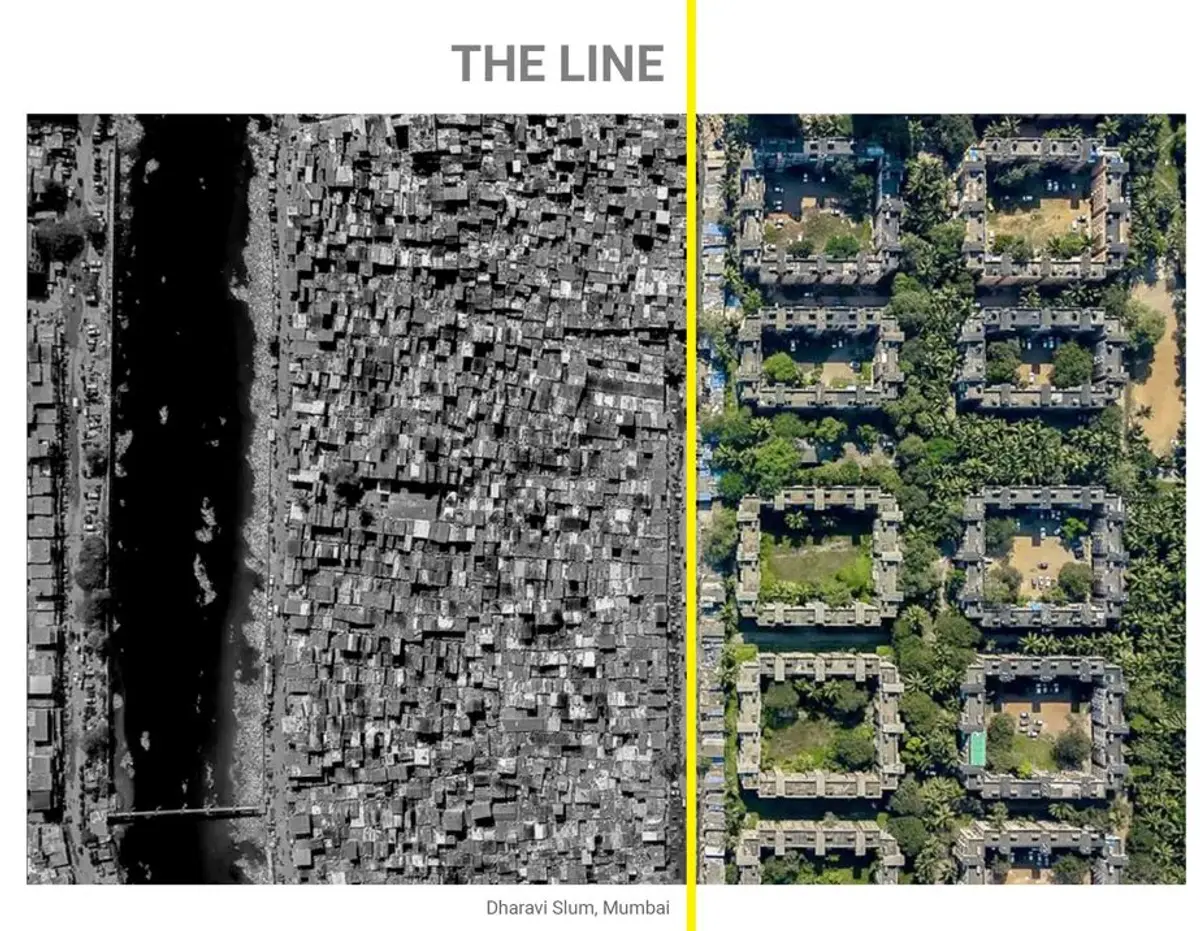
Blurring The Line:
Rejuvenating Entrepreneurial potential to develop the socio-economic scenario of urban slums

In developing countries like Bangladesh, every year thousands of people comes to the cities like Dhaka, in search of better job opportunity. This poor migrated group take place near rich urban areas where they can give services. As, here transportation cost is very high and their economic status is not good enough, they end up living in slums. However, their dream of economic solvency remains unsuccessful, as they cannot reach to their desired goal. As there is always a fine line between these different economic classes. The most service-providing group always stays hidden and unrecognized under these lines.
Urban slums, having both the elasticity of slums and the staticity of urban structures tend to create a distinct line that divides them. This physically visible line is only a glimpse of the contrast between urban poor and city dwellers, which is eventually an outcome of more profound economic and social differences these communities hold. The economical difference creates difference in social status, which further turns into a visible line, The Boundary. These economic, social and physical partitions have been a hindrance to the slums as they keep piling up day by day leaving no space for their socio-economical growth ultimately transforming them into a burden for future cities.
This project approached this problem harnessing the energy of 'Slum Entrepreneurs' that fuels Sattola slum making it resilient in economic sector. It is situated at the area between Mahakhali, Neketon, Hatijheel and Tejgaon Industrial zone. It act as a service center of these zones but their entrepreneurial potentiality is reflected in their central roadside market area showcasing their rich skillset as they are migrated from different areas from Bangladesh. In this project, economic redevelopment is achieved by redistributing Sattola's existing market layout and integrating entrepreneur friendly approaches into existing scenario. Three types of module is designed at three thresholds to blur economic, social and physical lines to build up an interdependent relationship between these two communities.
ENTREPRENEUR (BAZAR) MODULE:
Proposed location: In-between areas of two communities of different economic classes, which are currently divided by several boundary lines, can be connected and benefitted through an interdependent economic system.
The existing market area is located alongside the central road of slum which is proposed to be shifted to the boundary areas, which solves the problem of inaccessibility and avoids unnecessary congestion in the primary roads so that the roads and market both can function properly.
This structure holds the existing market area in an organized way with necessary infrastructure, while fulfilling the needs of surrounding communities and slum people ,it also creates harmony instead of boundary.
The structure will be built in two stages -
Stage 1: Construction of Ground floor with the help of NGOs’ and Bazar committee. Less temporary structures with reused material, for example, leftover steel scaffolding members used in the other construction sites around the city could be collected during their life span.
Stage 2: Entrepreneur layer consists of working and living unit at upper levels. Temporary and lightweight structure. Variety in the material can be seen according to individual’s economic status (such as-corrugated sheet and bamboo).
The structures are connected at all levels ensuring access for both communities.
Ground floor is open for permanent and temporary stalls along with basic service areas. The open area gives users the freedom of shaping the space according to their need and allows continuous transformation and multipurpose use of the space. Water channels and furniture’s like sittings, shelves are designed according to that.
The upper level is designed for the accommodation of entrepreneurs, providing both working and living areas with necessary facilities and technical support. Privacy along with necessary accessibility are provided according to need. It was a major concern to ensure visibility, natural lighting and ventilation as the design area was too narrow. The structure provides highest use of space, as there is lack of space in ground.
Roof can also be used for gathering and drone delivery space. Possible transformation, modification, alteration and temporariness is achieved as per context.
This structure gives the entrepreneurs the opportunity of practicing their idea and thoughts. Infrastructural and technical support provided by this structure helps to reach the greater range of customers, which will play a vital role in their economic upgradation.
Removing the physical boundary this structure can become a bridge between those communities which will eventually blur the social line via economical exchange.
URBAN (COMMERCIAL) MODULE:
Proposed location: Near primary roadsides, so that hawkers, vendors, slum dwellers can easily display their best products without causing any havoc in traffic as well cover a greater range of customers and merge into the urban fabric. The structure fulfills the demand of urban people, the need of the Market, and the need for Slums. The visual and physical interaction provided by this structure blurs the social and economic line and drives them toward solvency.
Refurbished building and partition materials are used concerning with economic status of the users.
COMMUNITY MODULE:
Project location:
The unused water bodies, which are used as waste dump yards and affect their hygiene and healthy lifestyle can be transformed into useful spaces. Community gathering training centers, schools etc which will ensure the education of future entrepreneurs as well as their social growth and check natural damage caused by urban slums.
A continuous pathway connects these three structures in three levels ensuring universal access to facilities beyond the social, economic, and physical boundaries.


Popular Articles
Popular articles from the community


Hill & Cross Opera: Sculptural Opera House Architecture Shaped by Tallinn’s Landscape and Identity
Hill & Cross Opera reimagines opera house architecture in Tallinn through its sculptural hill, civic plaza, glass wave and a luminous cross.

Play: Fragments of Their World
Familiar architecture becomes modular playground design, creating safe spaces where displaced children can learn, connect, imagine and play.

Lunar Spiral: Space Architecture Shaped by the Mathematics of the Universe
Lunar Spiral reimagines space architecture through Fibonacci geometry, lunar regolith, levitating habitats, and self-sustaining Moon living.

The Musturak Paradise: Senior Living Architecture for a Connected Future in Temara, Morocco
The Musturak Paradise reimagines senior living architecture in Temara via private homes, social spaces, culture, community, and shared care.

Similar Reads
You might also enjoy these articles
The Rhythm of Seasons
A Farmers' Market Connecting Nature and the City

More Than a Building-Designing a Living System
More Than a Building-Designing a Living System
Base Beyond
DESERT COMPOUND ARID: TOURISM OF ABSENCE AND ABUNDANCE

Explore Slumscraper Competitions
Discover active competitions in this discipline


Challenge to reimagine the Iron Throne

Photograph architecture without architects

Illustrate the lost glory of Angkor Wat - Render Challenge

Design challenge to reuse E-waste
Comments (0)
Please login or sign up to add comments
No comments yet. Be the first to comment!