
Capturing The Ephemeral
Digital Arts and Technology Center

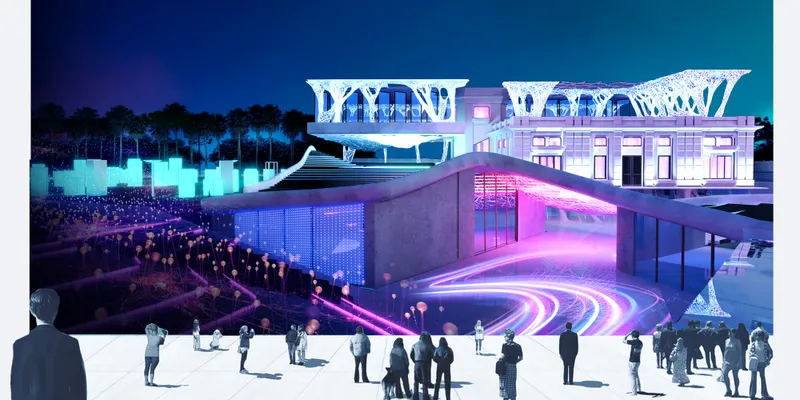
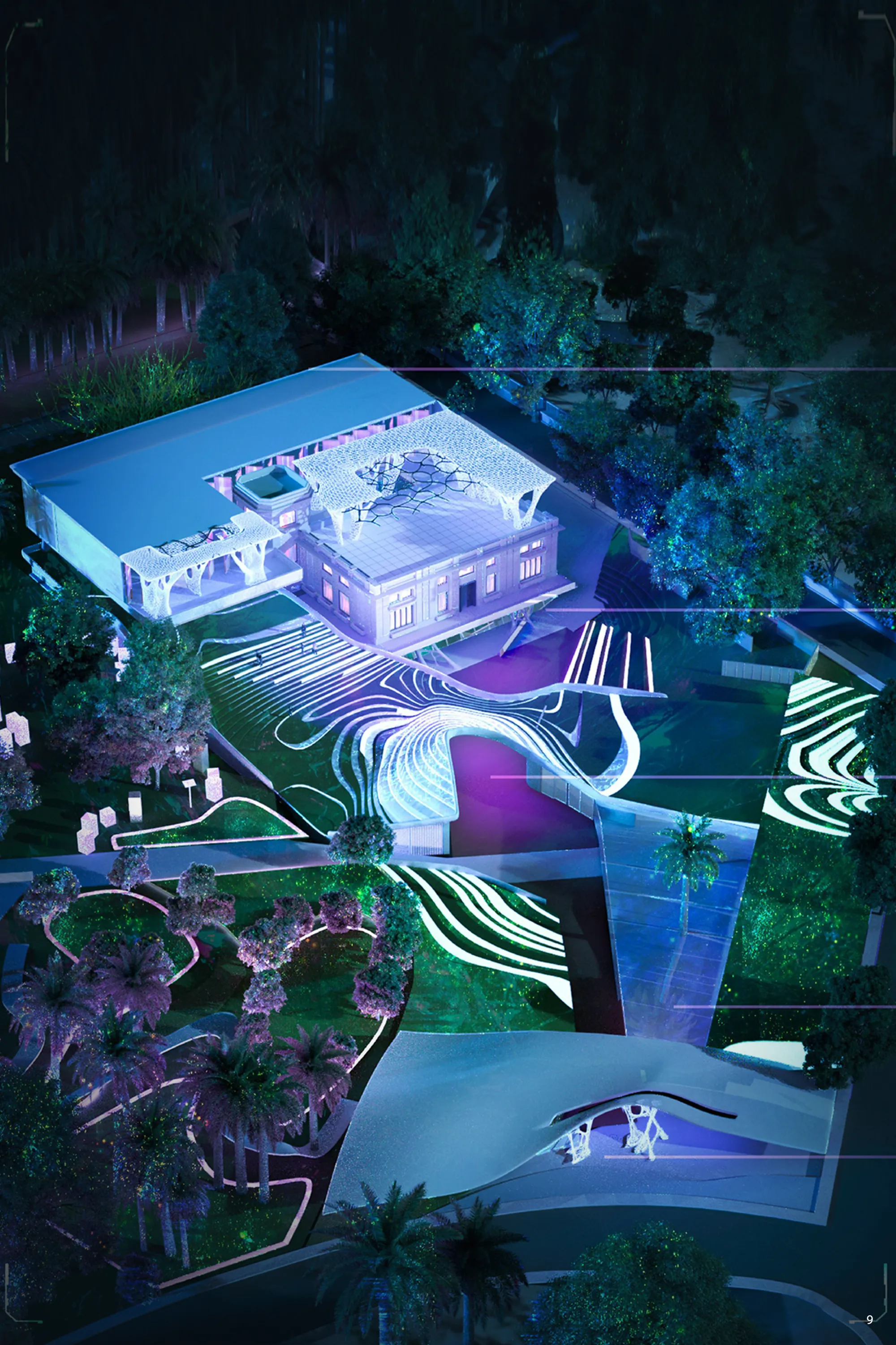
Capturing the ephemeral has no walls, it is a constellation of spaces, people, platforms, Ideas and products. Everything exists in a fragile yet miraculous continuity over an extremely long period of time. The Digital Arts and Technology Center is an adaptive reuse of Nouzha Casino. The building and landscape extension aims to create an experience through which visitors recognize this continuity itself as beautiful, thereby changing or increasing the ways in which humans perceive the world. It is an interactive way to achieve unity in duality, duality of the main elements available in the site: The past and the future, the landscape and the architecture, the day and the night, the physical and the digital and so much more.
How can a building existing around the forefront of technology also become rooted in the history of the surrounding context? Modern art, in a sense, is a feedback loop that binds history and culture together and manifests within the physical environment so that people living members of Alexandria's urban society - can interpret it. The Digital Arts and Technology Park is an entity that brings arts, heritage, digital experiences and learning together under one roof. That leads to the following question: Where should digital art be presented? We believe it should become a place merging the analog with the virtual, a place allowing for constant redefinition of how digital can interact with the physical. By not replicating the typology of a typical art center, a flexible open source experiencing of the art is provided. The project is a hub that connects artists and scientists together to realize projects using Machine Intelligence implemented in the historical site. By supporting this emerging form of artistic collaboration, we open our research to new ways of thinking about and working with intelligent systems. Revival of Nouzha garden by implementing interactive entities and installations focusing on highlighting Alexandria's rich cultural heritage that was visible in the selected site. Adaptive reuse of Casino de Nouzha as part of the experience showcasing cosmopolitan Alexandria.
This project is considered the nation's first innovative art destination dedicated to the intersection of art, science, and technology. The proposed park is where curiosity-seekers of all ages go to experience creative innovation without limits, by being a premier destination, both online and offline, for genre pushing, technology-driven art. The project offers visitors and artists alike the most technologically an advanced art platform.
Taking over the abandoned Nouzha Casino, once famous for the parties and the weddings that happened there and retrofitting it to create a versatile Art center, whilst blurring the lines between architecture and landscape. Nouzha Casino represents cosmopolitan Alexandria in many ways as it was originally owned by a French administrator and then it was rented by a Greek businessman to create a restaurant that acted like a social hub for people from different backgrounds. It is shown in history that this place was an important spot for renown visitors to rest in when they came to visit Alexandria.
The project strives to provide the most advanced exhibition platforms so that pioneering new media artists can create and show their work. without limitations, and so that the public can have the most enhanced experiences of this new type of art. The project is considered an incubator, working hand-in-hand with artists to develop new commissions and re-imagine ambitious presentations of previous work, as well as regularly producing art experiments and experiences ourselves!
The design scheme is inspired by Banyan tree, located behind the chosen site. As we've known, Banyan tree is the great murderer killing most trees in forests, yet it is the great giver providing habitat and food to most animals. Even though Banyan tree is categorized as a parasite plant, it is peculiarly special. After it slowly leeches and consumes all nourishment from another tree, the tree will be killed and then crested interior space that's covered up with Banyan tree's limbs and roots as structure. This space will become homes for little animals and its enormous branches will create shades and provide food to all creatures. Contributing one life is worth lots of life. In this project, the Banyan tree's growing process is adopted as the main concept proposing how human could develop our world and sustainably grow up into the futuristic era. It enables for the smooth transition between the horizontal and vertical planes and blurring the lines between art, sculpture, and landscape. The design is not restricted to the imitation of nature’s geometry, it was an experimental journey where the morphogenesis of the banyan tree was studied and structurally analyzed. Then, using advanced computational methods the method of structural optimization was adopted to create an interactive exhibition that blurs the lines between what is natural and what is artificial.
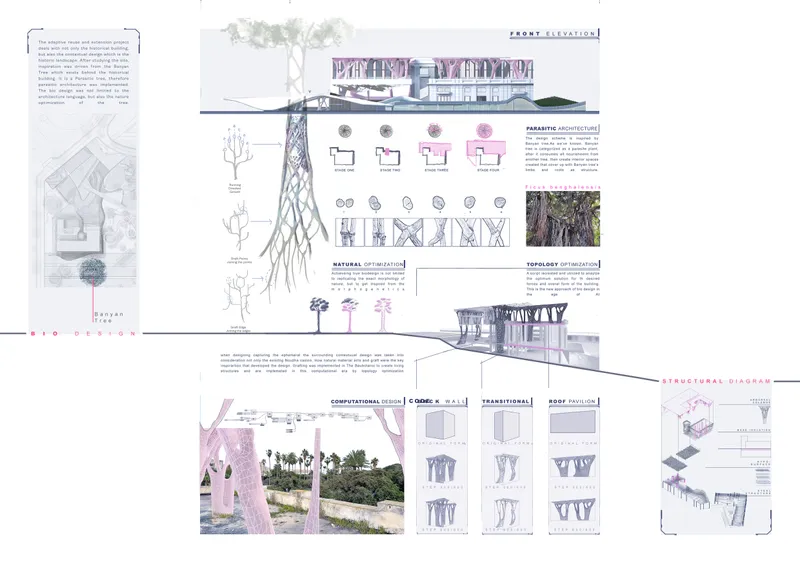
Topology optimization, sometimes known as homogenization method, evolutionary structural optimization, and homogenization methods, is a mathematical framework that tackles the performance of various iterations with the purpose of achieving the optimal structural performance with the best material distribution to avoid material waste. Most of Topology optimization programs follow a gradient-based algorithm, where a set of constraints and boundary conditions have direct impact on the user-specified design geometry and therefore the optimized form. Sometimes, other constraints are implemented that are more relatable to real life conditions, including symmetry, stress, and frequency constraints. The assumed design domain is analyzed in an iterative method, resulting in the determination of whether this area needs to be solid or void for the purpose of achieving a lightweight unit with maximum stiffness and minimal deflection. The results are refined and evaluated for performance, resulting in highly complex and optimized geometry. In this project, Topos plugin in grasshopper was used to achieve the optimized geometry seen in the proposed design.
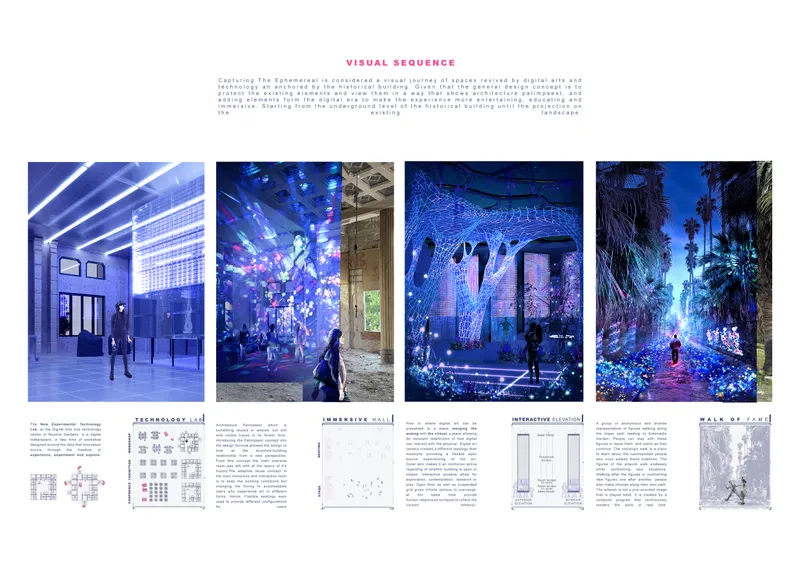
Also, the visual sequence of the user was studied to create a more interesting approach for the users by smoothly integrating with the existing access points. The old building marking an important part of the history was the forefront of the proposed circulation. The journey starts from the underground extension of the existing basement level of the heritage building, where users can experience the physical forms of art available. Entering the heritage building from the same level, the user can witness the visual contrast between the past and the future as the building accommodates the most advanced technology known. The main hall of Nouzha Casino was used as an immersive exhibition hall used for interactive projections all around, giving the user a new method of experiencing digital art. The one floor building’s roof was used for an interactive exhibition using the topology optimized columns where the user can witness the incredible view of the Nouzha Garden. The main purpose is to intrigue the user to extend the exploration towards the garden itself in order to experience firsthand the history of this ancient garden. The approach used in this design is to defy the problem that art related architecture is monumental and introverted, a more human-scaled approach was used to attract more users.



Popular Articles
Popular articles from the community


The Earth Pod: 3D Printed Homes for Resilient Refugee Communities
The Earth Pod reimagines refugee housing through 3D printed homes made from clay, combining resilience, self-sufficiency, and rapid shelter.

Conexión: Biophilic Design Reimagines High-Rise Living in Hong Kong
Conexión reimagines high-rise living in Hong Kong through biophilic design, green facades, shared spaces, daylight, water and nature within.

Hill & Cross Opera: Sculptural Opera House Architecture Shaped by Tallinn’s Landscape and Identity
Hill & Cross Opera reimagines opera house architecture in Tallinn through its sculptural hill, civic plaza, glass wave and a luminous cross.

The Musturak Paradise: Senior Living Architecture for a Connected Future in Temara, Morocco
The Musturak Paradise reimagines senior living architecture in Temara via private homes, social spaces, culture, community, and shared care.

Similar Reads
You might also enjoy these articles

Day and Night Park: A Time-Based Urban Newsstand in Beijing
A temporary urban newsstand in Beijing blending travel, light, and reading through poetic colors, compact form, and community-focused design.

Modernist Patio Renovation in El Masnou, Barcelona by Oliver Segura Arquitectura + Cebrià Arquitectura
Modernist patio renovation blending tradition and innovation with a movable pool, leveled floors, and Catalan materials in El Masnou.

Alto Residencial Coop: Cooperative Housing Development in Santiago de Compostela by Carbajo Barrios Arquitectos
A linear cooperative housing complex blending white volumes and perforated metal façades, enhancing community living, natural light, privacy, and urban integration.
Vil Genis School by BPA ARCHITECTURE – Massy, France
Vil Genis School in Massy, France, features sustainable design, south-facing classrooms, community integration, accessible spaces, and modern educational architecture.






Comments (0)
Please login or sign up to add comments
No comments yet. Be the first to comment!