
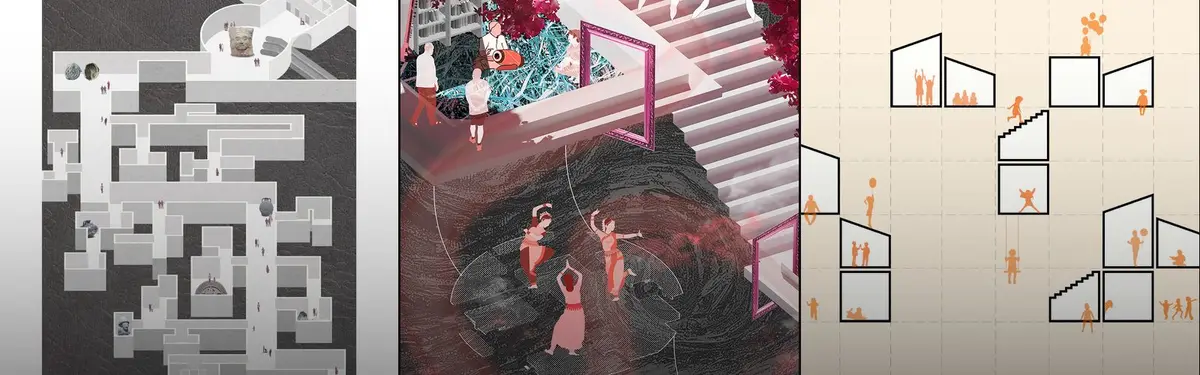


Exhibition Design
Design and curation of physical spaces that present collections, narratives, and experiences to audiences.
The purpose of exhibition design is to communicate information through visual storytelling and curated environments. Interior design, graphic design, architecture, interaction design, multimedia and technology, lighting, audio, and other disciplines are integrated to form a multi-layered story around a theme, integrated and interdisciplinary. Physical space and visual communications are essentially used in exhibit design to create an environment for communication.
It dates back to the early days of human development but was not formalized until the 16- 17th century when people travelled the world and began exhibiting treasures from their personal/stolen collections. Today's displays/exhibits are little like these early exhibition design attempts, but they are still rooted in human curiosity and the need to learn more about the world around us. Exhibition design, regardless of the role of technology, remains evolving and a collaborative process that requires a balance between space, objects, and information by skillfully integrating technology with the role of the audience.

Img 1: Sambacor - Winner for carnival 365
Why is exhibition design important in today’s day and age?
In today's world, the development of all sectors and start-ups in the market create a highly competitive business environment. Producing, delivering and selling products/services to attract viable customers is not enough. One of the most common challenges for many companies doing business in different industries is the physical distance between producers and consumers. The information and personal gap between these factors have increased resulting in limited communication with each other. Due to the spatial and temporal distance between them, companies/start-ups these days carry out measures that help them display their services in a much better light for their audience.
Similarly, despite being popular and cherished, distinct cultures due to accessibility, affordability or other factors are unable to share their art and culture (clothes, artefacts, intangible talents/cultural aspects) with different people across the world. During such situations NGO’s, companies provide a common platform for people to experience and interact with these forms of culture and art.

Img 2: Exhibitions are instruments of social interaction across different communities
Exhibitions, the most vital part of cultural/business interaction, become one of the rare activities that can bring producers/artists and consumers/audience together. They involve different factors, people and activities according to the nature of exhibitions.
What are the types of exhibition design?
Exhibitions can be classified into two general types: Trade exhibitions and Consumer exhibitions (public expos, shopping expos etc). Trade exhibitions are usually designed to meet the needs of a particular type of business, product, or country. Only those who work in the field can participate. Consumer exhibitions are horizontal markets. They usually include different products from different industries that are open to the public. Consumer exhibitions may also be designed to attract a particular demographic (young women, retirees) or people with a specific hobby or interest (craft, gardening, pets). Shows may be built around a particular product or service (car shows, boat shows, computer shows, travel shows) or a particular theme (homemaking). Overall exhibit design involves the fabrication and installation of immersive environments, through interactive art. Exhibition design spans a wide range of applications including :

Img 3: Buildings where exhibition design can be applicable
The design of an exhibition can be limited to a single display or can be expressed in immersive integrated environments. With the rapid adoption of new technologies in the public domain, exhibition design is becoming social, media-driven, and democratized. A few main elements that go into exhibition design are:
• Interior design
• Audio engineering
• Graphic design
• Architecture
• Marketing/Company signages
• Lighting design
• Multimedia systems

Img 4: The nature of exhibition design has evolved with technology
Architecture competitions
In the times of pandemic and digital world, the physical distance has increased more than ever, facilities and provisions for exhibitions have changed drastically. While online collaboration of communities is highly effective in the fields of visual communication, social interaction is second nature to humans. How can we revive this middle-man between cultures/companies and their audience/ consumers, while also taking the recent occurring and trends into the bigger picture?
Architecture competitions are a great way to find such creative and revolutionary ideas and design enthusiasts who not only have the relevant skills for designing and developing projects but who also share their vision regarding the problems affecting our society today. Architectural and design competitions offer a wide array of challenges that have the potential to be utilized inbuilt projects of permanent as well as temporary exhibits. Few competitions held recently were:
• Carnival 365
• CinemaBox
• Madrid Art Bioscope
• Shadow Pavillion
• Terra x Terra
• World Expos- National Pavillion Design
• Haptic
Explore more projects in exhibition design:

UNI Design Competitions
UNI is a global network of architects and designers who are solving some of the most challenging problems around the globe. UNI brings together the world's largest pool of design challenges that are curated by the finest architecture academicians and professionals globally. Since 2017, UNI has hosted more than 200+ architecture competitions for various idea level to realization level briefs. In the past, UNI has helped 50+ organizations, universities, and government bodies to use our platform to generate architecture and design solutions through competitions.




Open competitions in Exhibition Design
See all Exhibition Design competitions

VR headsets Storefront design competition

The Global Benchmark for Architecture Dissertation Awards
Popular projects
View all 192 projects




















Latest journals
View all 122 journals

T and T Projetos Spread an Exhibition on Artistic Contagion Across a Brazilian Plaza, Library and Gallery
In Brazil, Contaminations scatters portrait totems, inflatable reading towers and text-clad walls, letting image, word and sound infect each other.

MMBB, JPG.ARQ and Ben-Avid Flood Brazil's Expo 2020 Dubai Pavilion with a Walkable Sheet of Water
In Dubai, Brazil's Expo pavilion stretches a tensile fabric box over a shallow flooded square, inviting visitors to wade through projected rivers.


Faces of the Soviet Avant-Garde: Turning Moscow's Street Names into an Open-Air Museum
A network of sculptural installations across a Moscow residential district transforms forgotten architect names into spatial encounters with cultural memor
TOP-OF-ART'sy: An Opera Complex That Becomes Tallinn's Waterfront Public Ground
A shortlisted entry for Opera by the Sea distributes cultural programming across linear volumes, bridges, and a newly created island on Tallinn's shore.


