
Set Design
Design of physical environments for film, television, theatre, and performance productions.

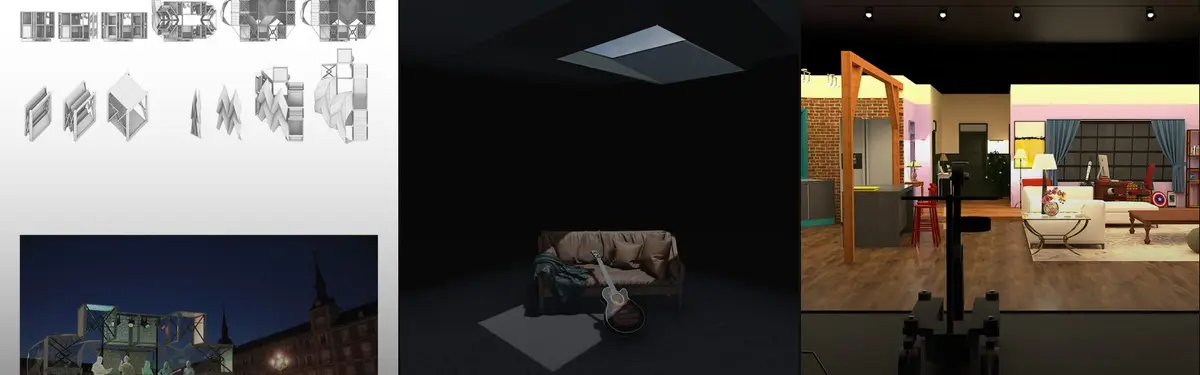
Set design is the creation of the physical space wherein the action of a play, act or scene takes place. Primarily used to describe theatre productions, it constitutes all the surroundings, fixtures, props, appearance, and typical appearance of the stage. Set designers create sets and landscapes aimed at supporting the overall artistic goals of the production. An associated and recent term, scenography, encompasses the sound, costume, lighting, and all different technical designs of theatrical manufacturing. Production design is the term used for a similar craft in cinema or television. Evolution and importance of Set Design Acting and theatre have always existed in one form or another, the origins of theatre and set design come to us as far back as ancient Greece. Greek plays combined storytelling and the ritual practice of acting out sacred stories to entertain the audience. Eventually, these plays upgraded in actors as well as in scale and gave birth to scenery for better storytelling and positioning of actors. Thus, the art of 2D landscape painting became one of the first visual languages in the Greek theatre and was also used very early by its Roman counterpart. The plays also inspired the typology of theatres and help construct many legendary structures in the history of architecture. Img 1: Roman theatre in Ephesus is still used for concerts and special events (Credits: QuartierLatin1968 / Flickr) Img 2: Otto Schenk's production for the Met's old production of Rigoletto. Sets by Zack Brown - Example of perspective sets in the Renaissance. While these early sets used only a few painted sets, the Italian Renaissance brought the art of landscape painting to life using the development of perspective painting to create depth and depth. Different heights for action on stage. During the Baroque period, Giacomo Torelli developed changers using chariots, ropes, and pulleys that allowed for more complex sets. Interest in realism in the 19th century spurred the development of landscape painting with the introduction of suitable props in each set and the creation of caskets or triplets aimed at simulating interior rooms with entrances and doors. Finally, in the 20th century, the famous set designer and architect Adolf Appia created a new standard in set design by using performance props to represent a fully stocked set without overloading the stage. Today, Appia's detailed symbolic approach with computer-generated projections adds realism to the sets while keeping the audience's focus on the actors. Img 3: Appia’s vision for thearte acts that transformed set design and production (Credits: Socks) With the advent of filmography in the same era, the design of sets became even more significant to showcase never heard of scenery and various intangible situations. One of the first short films ‘A trip to the Moon’ by Georges Méliès designed ingenious sci-fi scenery with available props and intelligent camerawork. Such film sets and effects inspired a range of movies for over 100 years and developed advanced technology in cinematography. Img 4: A still from ‘A trip to the moon’ 1902 The significance of a set layout became common within the indicates of the 80s and 90s, specifically on film and sets of emerging sitcoms like Cheers, Frasier, Modern Family etc. wherein architecture and interiors described characters, plot and set a bar for coming sitcoms. Such shows normally had a live audience which challenged the designers to make sets that felt grand and at the same time make people warm to look at characters passing around in the same space/room or years. Img 5: Original "Frasier" set design in the '90s (Credits: Today) With the evolution in architecture and interior visualization, set designs today range from a well-designed bedroom room to a full-fledged city environment. What are current and evolving trends in set/scenic design? Digital scenography Digital scenography has been framed as something of a magic bullet in theatre artwork - where it may solve many of the long-standing issues going through the industry. Over a century, the theatre is reliant on canonical works from the 18th, nineteenth and early 20th centuries in a monotonous manner, virtual scenography is set to revitalise and reinterpret those historic works. Concerns about ageing audiences and financial instability have further fuelled interest in virtual scenography as an approach for making plays, opera and conventional forms of art more cheap and accessible. Img 6: Digital scenography in Moby Dick directed by Leonard Foglia (Credits: Karen Almond) Digital scenography combined with other disciplines also has the power to generate strong public statements in urban environments without physical barriers. For instance, Spanish activists staged the world's first-ever virtual (hologram) political demonstration against a controversial law banning protests outside government buildings. Img 7: ‘Holograms for freedom ‘-As physical protests were banned in Spain - a group sought to a virtual demonstration against recent laws against freedom of speech (Credits: Branding. news) Technology ruling the scene of set design has added different dimensions to production design. Elements like Computer graphics, green screens and LED walls are the present and evolving future of set design in movies. Competitions Like architecture, the design of the set stands out and works in a limited capacity while at the same time evoking a strong sense of place. The two areas work within the same constraints of budget, program requirements, and site-specificity. Just as acting is a simple representation of real life, a theatre set is a representation of a part of the architectural and building environment. The set design includes fashion, trends, research, essence capture, historical understanding, duplication or reproduction of past spaces and objects as needed, sketches, graphic illustrations, product design and much more. With new frontiers due to technology architecture and set design seem to merge in real built/unbuilt environments in form of interactive urban design strategies, media architecture, interior design, in museums, private/public installations for awareness or marketing, Although the set design is quite active in theatres, on movie sets, there are only a few online prospects regarding the set design that challenges set designers to create groundbreaking collaborative ideas. Few set design competitions in recent years were/are READY. SET- Modular set design competition, A’Design Awards for Scenery Design, Simulation, Stage Machine design challenge and The one with Sheldon. Explore projects in Set Design: UNI Design Competitions UNI is a global network of architects and designers who are solving some of the most challenging problems around the globe. UNI brings together the world's largest pool of design challenges that are curated by the finest architecture academicians and professionals globally. Since 2017, UNI has hosted more than 200+ architecture competitions for various idea level to realization level briefs. In the past, UNI has helped 50+ organizations, universities, and government bodies to use our platform to generate architecture and design solutions through competitions. Discover other competitions: https://uni.xyz/competitions