
Endow: Report
Find Your Color

Necessary theoretical research on place and space has been carried out for the design of a skill center that women can use as a socializing and living space in Abuja, Nigeria.
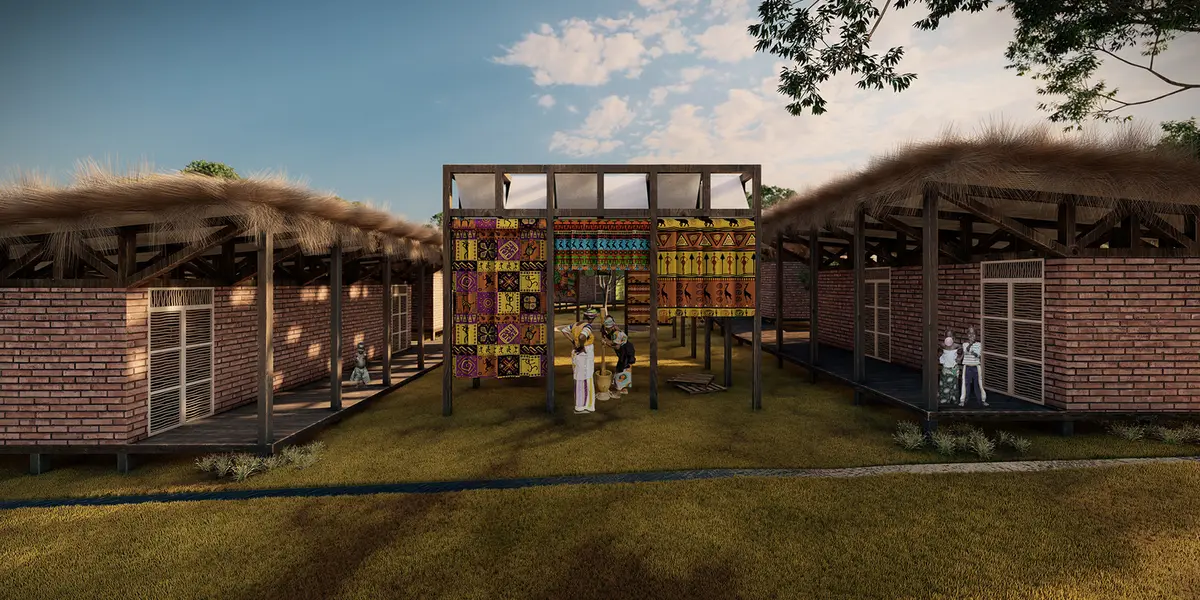
The project is designed to create a living space for the users rather than just being a project area. Spatial setup, social areas, connection points and hierarchical arrangements are organized according to this design approach. The project creates a social space design where women can spend a long time of the day rather than being a social space they visit in a day, which will establish an integrity with their daily lives and open new spaces for them while not disrupting these works.
Spatial gradation is seen in traditional architecture. The hierarchy that moves from the public to the private sphere also refers to traditional culture. A hierarchical order was provided while approaching the area during the design process. Entrances and exits are arranged in a way that adapts to the current environment and culture. Area; It is planned in three stages as public, semi-public and private space. Considering this hierarchy, functions are loaded into the fields. In this way, functions are created to reference the hierarchical order. It is aimed to create a space where people can adapt in daily life, taking into account the cultural construction techniques and spatial setup.
The approach and concept to the project is important for understanding and designing the spirit of the project. When planned from this point of view, the region was intensively researched in the first quarter of the time allocated for the project; Life, historical process, traditional and cultural characteristics, geography, land structure, economic activities, socio-cultural situation, agricultural activities in Nigeria were analyzed. Understanding the region and identifying existing problems has been the main objective. In addition, gender inequality, women's rights and social life have been investigated in the current situation. By perceiving the situation in the region, it was aimed to create possible solutions with the project. The planned first quarter provided important data in terms of creating the spirit of the project and creating the main concept. It covers the process of creating design approaches based on the data obtained in the second quarter of the project development process. In this period of time, an intensive case study was carried out, and materials, structures and structural features suitable for the region were revealed. The sample projects supported the ideas about the region and the area. With the superposition of the obtained data, design decisions started to be made. The contextual approach and the design process have been extensively discussed at this temporal scale. In the third quarter of the project progress, the design decisions created were translated into the drawing language. In this temporal planning scale; plan schemes, spatial organizations, operation are designed. The formations have been completed in a way that reflects the spirit of the project; There were discussions on facade and material decisions. In this progressing time period, the existence of the user in the project was perceived through three dimensions and the project was developed by making revisions. In the fourth quarter of the project progress, discussions were made on the project and revisions were added, and new data obtained as a result of ongoing research were added to the project. Detailed diagrams and figures describing the concept of the project were prepared during this period where the project was developed and completed.
The sociocultural situation in Nigeria has been researched. Information was obtained about human rights, ethnic groups, problems and conflicts in society. Climatic conditions in Nigeria and accordingly forms and local material types were examined. By determining the suitability of the materials used according to the climatic conditions, theoretical information about the construction processes of them in the existing area was obtained. Indigenous people's participation in the construction process and information gathered about local materials make reference to the feasibility of the project. Nigeria has a tropical climate. High temperature and heavy rainfall showed that different solutions were used in spatial analysis. Thermal comfort and air circulation must be provided under suitable conditions. It has been observed that climatic features clearly affect many architectural elements from building structure to form and material. . In the current typology researches, the roof and cover systems have been researched and it has been learned that it has revealed techniques that can solve the main problems in the region. Technical systems for air flow, climate and water harvesting are studied. The main goal has been to design water harvesting and agricultural water collection methods together with existing typology and spatial analysis. The choice of material and form affecting the design of the project was made according to the regional analyzes and research results, and the selection was made for the application.
Although the project is an education center, it contains many social, public, semi-public and open activity areas. The fact that these spaces are connected to each other by the main courtyard and green spaces has an important role in the spatial organization design. By creating a strong communication and interaction, the project works in a fragmented and self-contained system. The hierarchical division of spaces from private to public spaces and the fictional progression of spaces have been effective in the design of this organizational chart.
The project serves the social needs of women. In addition, it contributes to women's self-development with their fields of education and skills. One of the main materials chosen in the design is hard (dried soil) and the other soft (fabric). At this point, what is wanted to be emphasized is the inequality between men and women. Fabrics emphasizing women were chosen from ethnic patterns and it was aimed to explain how women color life. Women who develop themselves in workshops and skills and contribute to production can exhibit these products in open spaces provided by the project. In this way, the project, which contributes to daily business life rather than being just a social space design, is also presented to the outside environment through the spaces designed in the courtyard. Women in the region are provided with the opportunity to demonstrate, develop and actively use their talents and skills.

Popular Articles
Popular articles from the community


Co-Life: Senior Housing Design That Reconnects Older Adults With the City
Co-Life reimagines senior housing design through healing gardens, shared streets, workshops, and a sustainable community across generations.

Co-life: Sustainable Architecture for Age-Friendly Community Living
Co-life reimagines sustainable architecture for seniors through courtyards, rammed earth, shared gardens, and spaces designed for belonging.

Conexión: Biophilic Design Reimagines High-Rise Living in Hong Kong
Conexión reimagines high-rise living in Hong Kong through biophilic design, green facades, shared spaces, daylight, water and nature within.

Little Red Riding Hood: Architectural Design as a Journey Through Fear, Light, and Storytelling
Little Red Riding Hood reimagines the fairy tale through architectural design shaped by fear, light, scale, memory, uncertainty, and choice.

Similar Reads
You might also enjoy these articles

The Rhythm of Seasons
A Farmers' Market Connecting Nature and the City


More Than a Building-Designing a Living System
More Than a Building-Designing a Living System
Base Beyond
DESERT COMPOUND ARID: TOURISM OF ABSENCE AND ABUNDANCE

Explore African Architecture Competitions
Discover active competitions in this discipline


Challenge to reimagine the Iron Throne

Photograph architecture without architects

Illustrate the lost glory of Angkor Wat - Render Challenge

Design challenge to reuse E-waste
Comments (0)
Please login or sign up to add comments
No comments yet. Be the first to comment!