
Journal Reflections
Jounral For Competition

What was the concept behind the project?
The concept we represent as the new definition of Athenaeum is” Journey.”
The Idea of “Journey” connect “Past”, “Now”, and “Future” of Danish architecture and city Development. Moreover, a range of journey can offer different experiences for users when they are travelling in and out of the building. The journey itself should never just be a flat one, instead, it should incorporate all kinds of experience, such as acoustic, visual and feelings. By integrating all of them together, the journey will become more three dimensional and more immersive for people to interact and share their experiences.
In this project, we have four journeys, Materiality, Time, Light, and Cultural Diversification, to emphasise the transition from Past, Now to Future.
Firstly, the journey of Materiality is found by a variety of material from concrete, traditional toward the glass and lightweight structure.
Secondly, the Journey of Light is defined by the play with the different height of each section and the creation of an immersive light installation which not only allows the users to “see” the light but also to feel the light. In this way, light is now not a mere phenomenon but something that serves a more monumental purpose.
● What was the intent behind the organization of elements across various levels (Architectural, Site, Urban)?
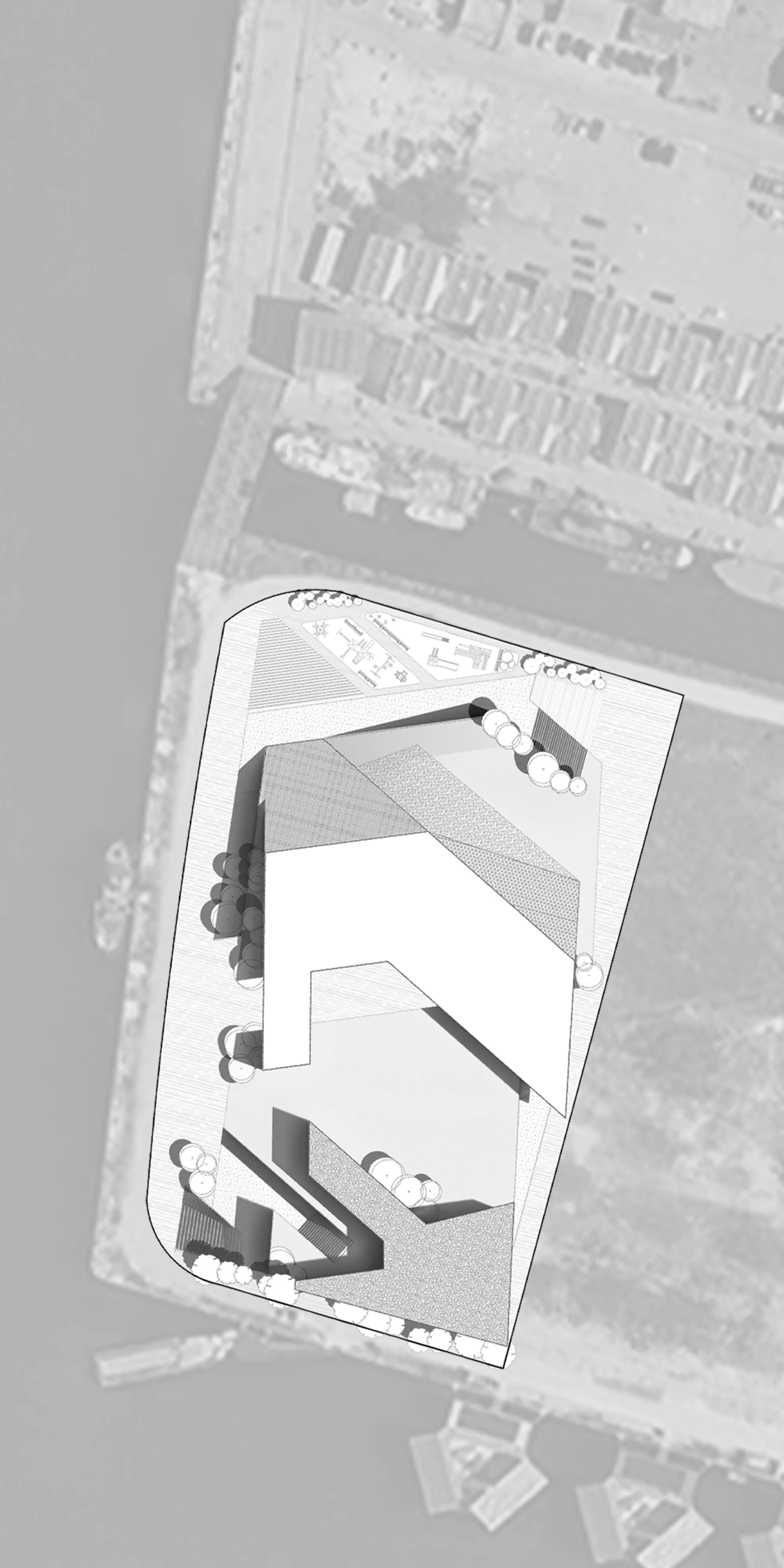
The project aims to strike contemporary architecture, engage public spaces and an abundance of human activity in the public building. The programs are organised in a way that it can tell the story of Danish history and provide suggestions and possibilities of what the future looks like. The whole complex is mainly divided into two parts, with one of the parts symbolising the Danish past and the other reflecting the contemporary and interpreting the future. The project also aims to creating/framing spaces for a wide range of users such, families, students, children allowing unprogrammed space for all visitors. To illustrate in detail, in architectural elements’ style, they are mainly organised in a chronological order to align with the historical timeline. The use of material also varied according to the change of the time to reflect the diversity within Danish history. In the scale of the site, the building is designed with close consideration to the surrounding. The form is designed to respond to the shape of the site and the style and aesthetic of the surrounding buildings to allow it to be naturally blended in the context. Therefore, the project is to reflect its thoughtful approach to being unique to Denmark. Finally, in regard to the urban scale, the building also tries to pay attention to the urban fabric to have some of the circulations within mimicking the urban roadmap, thus accentuating the connection with Denmark.
● How many iterations were tried to arrive at the outcome?
There are four major steps in the iterative princess of the form determination. starting from the pure geometries (ref to the surrounding buildings), we tried out different compositions to showcase the urban connection. We also aimed to create something that abstractly resonates with the historical architecture of Denmark. After we first explored through some forms, in our second round of iteration, we expand the research area (far to the other side of the harbour)- - refine the grid and orientation of the building to have the form mode rigorously developed and by adding on the layering of the grid system, it also helps us to define the internal space for a different program. In our third iteration, we took a step back to the form again to see the parts where it is not working very comfortably as a habitable human space and rationalise those part to maximise the user experience within the architecture. Finally, design features were thought in the final stage to have the design become a unique and unforgettable experience. In this case, sculptural stairs connect were designed as the feature of the program. It connects different levels, which allow people to access the building from different orientations. This feature links the terrace, waterfront, and different areas of the building, which enhance the fluidity of journeys. The rotation and the transforming of the building emphasise the freedom to access the 360-degree views of the waterfront.
● Which methods of design investigation?
In terms of the design methodology, we took a traditional approach by first looking at the site conditions and the history of Denmark. By extensively researching the overall and architectural history, we drew some commonalities from history and use these commonalities to first develop the general programs that were to be included in the design. We then looked at the part that is unique to Denmark’s history, which distinguished it from other countries all over the world and use such differences to form the idea of 4 journeys, which later became our design idea. After that, we did some extra research on famous Danish architects and designers across time to look at their unique “Danish Style” and to study the linkage between their ideas and the Danish context. By realising the humanitarian approach taken by the Danish architects and designers, we try to accentuate this sense in our project to make it more Danish. And by drawing comparison and contrast between different works across different times, we tried to create something that can hold the commonalities but meanwhile allowing the differences and contradictions to co-exist.
● How was the programme condensed into the final?
according to the idea of the journey and the aim of future perception of the city, the building is found to stimulate creative collaboration and form a knowledge community. Therefore, it contains operable spaces for creativity and interaction such as tech lab and studios, libraries and seminar room, theatres and large public communal space to allow people with different cultural background to exchange their experience. Initially, we tended to add an overwhelming amount of program into our project to illustrate the idea of past, present and future but then we discovered that by segmenting the space into too many small units the fluidity is largely weakened and diminished. Therefore, we cut down the programs to only the ones that are representative of each stage of history and some of the programs even abstractly reference the historical development rather than in a literal sense. We also try to alter and redefine some of the space to accentuate the idea of a connection between space. For example, the meeting room here is no longer just a mere place for people to encounter and communicate, it is designed with different textures from different cultures to symbolise the idea of cultural diversity. It is a representation of the diverse and harmony of Denmark and is to attract people from all background to unite and embrace each other.
● What/How were the materials chosen?
Because of the concept of Journey, multiple materials, which express the time path of architecture, are adopted into the project. form solid material such as concrete, steel towards lightweight structure like the combination of the glass panel and steel structure.
● How was a specific objective attempted to be met?
The project aims to strike contemporary architecture, engage public spaces and an abundance of human activity with cultural diversity in the public building. the contemporary architecture provides diverse experience spatially and rich the
● What is the expansion plan of the project?
Instead of imaging an architecture that can continuously grow and expand just like the famous architectural movement Metabolism once proposed, we imaged out architecture not to grow in the sense of adding or subtracting the components but rather by altering the internal space and redefining the social space and some of the programs that contain a certain degree of ambiguities. The building is designed with a combination of different material with different lifespan to illustrate the idea of natural decaying and deteriorating. The part of dying and rebirth is also crucial to the design as this process naturally symbolise the movement of time from past to future. Therefore, the form of the building will stay the same throughout time and it is only the programs that are going to change and redefine the space. The architecture itself is a statement to the design of Danish architecture, which last forever in the sense of its cultural significance but can also be temporary due to the use of material such as timber.
● How will the project transform with the passing time?
Light & Material: Day-Night (Concrete)
During the Day, the solid structure such as concrete columns creates a diverse experience of light, which riches the Daily Journey of Light. At night, the lightweight structure with transparent skin offers a phenomenal experience between the inside and the outside.
Cultural Diversification (Functional & Abstract)
To enhance the cultural diversification of the project with the passing time, organising the multiple and interactive programs within the building. Allowing diverse events to happen in the same space, which encourages people with a variety of ideas, culture and fields to communicate with each other. When people exchange their knowledge, feasible.


Popular Articles
Popular articles from the community


The Earth Pod: 3D Printed Homes for Resilient Refugee Communities
The Earth Pod reimagines refugee housing through 3D printed homes made from clay, combining resilience, self-sufficiency, and rapid shelter.

The Ocean Hive: Sustainable Architecture for a Self-Sufficient Civilization at Sea
The Ocean Hive imagines sustainable architecture at sea, where modular habitats, algae, wave power and ocean waste sustain a growing colony.

Play: Fragments of Their World
Familiar architecture becomes modular playground design, creating safe spaces where displaced children can learn, connect, imagine and play.

Co-Life: Senior Housing Design That Reconnects Older Adults With the City
Co-Life reimagines senior housing design through healing gardens, shared streets, workshops, and a sustainable community across generations.
Similar Reads
You might also enjoy these articles
The Rhythm of Seasons
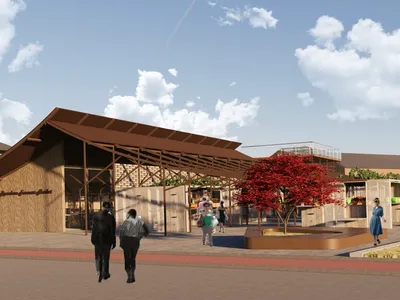
A Farmers' Market Connecting Nature and the City

More Than a Building-Designing a Living System
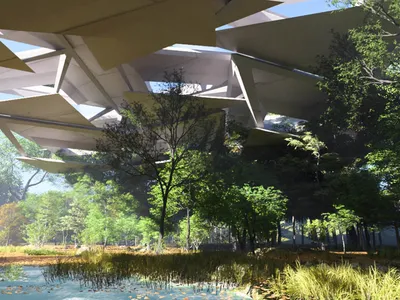
More Than a Building-Designing a Living System
Base Beyond
DESERT COMPOUND ARID: TOURISM OF ABSENCE AND ABUNDANCE


Comments (0)
Please login or sign up to add comments
No comments yet. Be the first to comment!