

K(art)zuni
The basic idea and intention was to create a stimulating space for artistic activity. How can space encourage creativity among its users? The answer that the "K(art)zuni" project offers is a variety of spatial situations, qualitative and quantitative richness of the interrelationships of the elements used. The most important and final element are the residents of the settlement themselves, who complete the whole process with their creative contribution. The foundation is set in an abstract system of larger and smaller points and the rest is up to the artists
The main design inspiration of the accommodation units was found in one of the oldest and most recognizable architectural forms of the Croatian region of Istria, "Kazun". "Kazuni" are small dwellings built by the drywall method that served as a storehouse for farmers' tools and shelters in case of bad weather. Thus the past interpreted in a modern way, the familiar form repetitively multiplied to the extent that it creates a new topography with its roofs. The 21st Century housing unit is made of concrete, instead of the ancient drywall technique, so that history leaves its integrity, whilst today current method of construction is being used. The structure is perforated on the roof creating zenithal lighting and on the north side to create ideal conditions for painting inside the unit. The floor plan of the unit is organized according to the "served and servant" principle, where the utilitarian core is decentralised, creating spaces of smaller and larger scales at the micro level, as well as in the organisation of settlements.
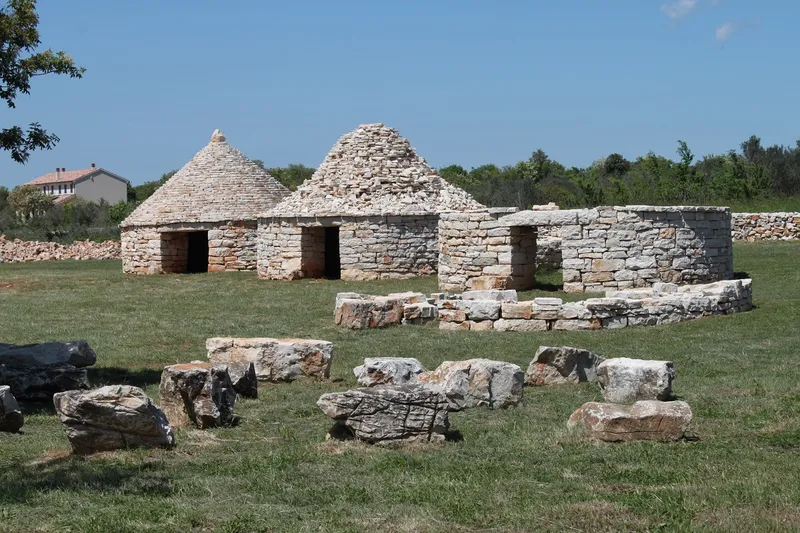 Kazuni
Village organisation:
Accommodation units are arranged so that with other contents they form a pulsating space that is in the service of the program - the resort for painters. The interrelationship between closed and open spaces creates stimulating situations for artistic creation. The location of the resort is in a predominantly undeveloped suburban area. To the north is a vineyard, to the south a stream while to the west there is a sea view. Each unit has its main opening oriented from west to north to allow sea views and good quality diffused lighting suitable for painting. Social facilities distributed throughout the plot bring added dynamism to the whole complex. The micro-urban concept has the possibility of expanding to a larger area, towards the sea, thus creating a completely new situation and potential.
The network of communications within the settlement was solved according to the principle of taking smaller and larger circles from the plot area. Such an irregular system creates unpredictable scenarios that occur within it. The walking surface acts as an adhesive for all the contents of the settlement, but also as an equal creator of space.
Greenery is organized in the islands within the structure. Different surfaces and types of green spaces are being created. Green gardens, trees, shrubs for birds, green oases for rest, growing fruits and vegetables are just some of the scenarios of using this layer. The green structure is “cut out” by the edge of the plot but the potential to expand into a narrower and wider urban context remains.
The social facilities of the resort are randomly scattered throughout the plot to create as complex and vibrant a space as possible. Entrance area with reception, areas for workers and a small shop, centrally positioned bar with kitchen for food, roof terrace and sea view, amphitheater that receives various facilities and a gallery for exhibitions along the stream in the south. Additional social spaces are located next to larger or smaller groups of housing units and with their flexible use (micro-exhibitions, group work or discussion, workshop, rest and socializing ...) create additional value of the settlement.
Accommodation units make up the bulk of the structure. They are arranged randomly and grouped into larger or smaller clusters (2-5) with common outdoor spaces. Their structure with accentuated roofs forms a new recognizable topography. Each unit is oriented to provide the best possible view and lighting for the painter’s work.
The last layer of the system are the artists themselves, who create unimagined scenarios through their interactions, work and creative contribution. Space and structure is just a tool and a flexible basis in their work, while they are the main creative part.
/Program/
The organisation of the settlement is in the service of the program. Throughout their lives, artists draw inspiration from a variety of sources, this resort is organized to find it in different interactions with other artists and encounters with spaces of different scales. "No child who sticks to himself will want to play in a fenced playground" Aldo van Eyck, just as no artist will be inspired to create in a strictly defined space. The fluid organisation of both units and settlements, with frequency zones, provides an ideal basis for artistic creation.
/ materials /
The material used for the settlement is in-situ concrete, with a red pigment for a climate characterized by red soil. Thermal insulation is located on the inside of the load-bearing structure, inversion occurs due to the hot Mediterranean climate and more intensive use of the resort during the summer months, in which case this option is more energy efficient due to the heat capacity of concrete on the outside (heat will accumulate from the heat and drop through the night.) The inner lining is plasterboard painted white so that the very interior of the unit would not distract the artist from his work.The project brings a new impulse to the suburban area, the vision is to extend that impulse to the wider area. The set urban matrix enables expansion to the outside and coverage of a larger area.
The future of project
The concept of focal points and areas in fluid space is flexible and can take on many functions. The question is whether the set program will come to life only on a given plot, in a nearby neighborhood, or has the possibility of becoming a point within a much larger system. The point is a basic element of all geometric shapes and painting movements, the body or image is created only by merging them in an innovative way, it remains to be seen over time how artists will transform given larger and smaller spatial points and what work they will do.


Popular Articles
Popular articles from the community


Conexión: Biophilic Design Reimagines High-Rise Living in Hong Kong
Conexión reimagines high-rise living in Hong Kong through biophilic design, green facades, shared spaces, daylight, water and nature within.

The Ocean Hive: Sustainable Architecture for a Self-Sufficient Civilization at Sea
The Ocean Hive imagines sustainable architecture at sea, where modular habitats, algae, wave power and ocean waste sustain a growing colony.

Lunar Spiral: Space Architecture Shaped by the Mathematics of the Universe
Lunar Spiral reimagines space architecture through Fibonacci geometry, lunar regolith, levitating habitats, and self-sustaining Moon living.

Riyadh For All: Intergenerational Urban Design for Active Aging in Rabat
Riyadh For All reimagines urban design in Rabat with intergenerational co-living, adaptive courtyards, and Moroccan cultural exchange today.

Similar Reads
You might also enjoy these articles

Day and Night Park: A Time-Based Urban Newsstand in Beijing
A temporary urban newsstand in Beijing blending travel, light, and reading through poetic colors, compact form, and community-focused design.

Modernist Patio Renovation in El Masnou, Barcelona by Oliver Segura Arquitectura + Cebrià Arquitectura
Modernist patio renovation blending tradition and innovation with a movable pool, leveled floors, and Catalan materials in El Masnou.

Alto Residencial Coop: Cooperative Housing Development in Santiago de Compostela by Carbajo Barrios Arquitectos
A linear cooperative housing complex blending white volumes and perforated metal façades, enhancing community living, natural light, privacy, and urban integration.

Vil Genis School by BPA ARCHITECTURE – Massy, France
Vil Genis School in Massy, France, features sustainable design, south-facing classrooms, community integration, accessible spaces, and modern educational architecture.

Explore Interactive Art Competitions
Discover active competitions in this discipline




Challenge to reimagine the Iron Throne


Photograph architecture without architects


Illustrate the lost glory of Angkor Wat - Render Challenge


Design challenge to reuse E-waste
Comments (0)
Please login or sign up to add comments
No comments yet. Be the first to comment!