
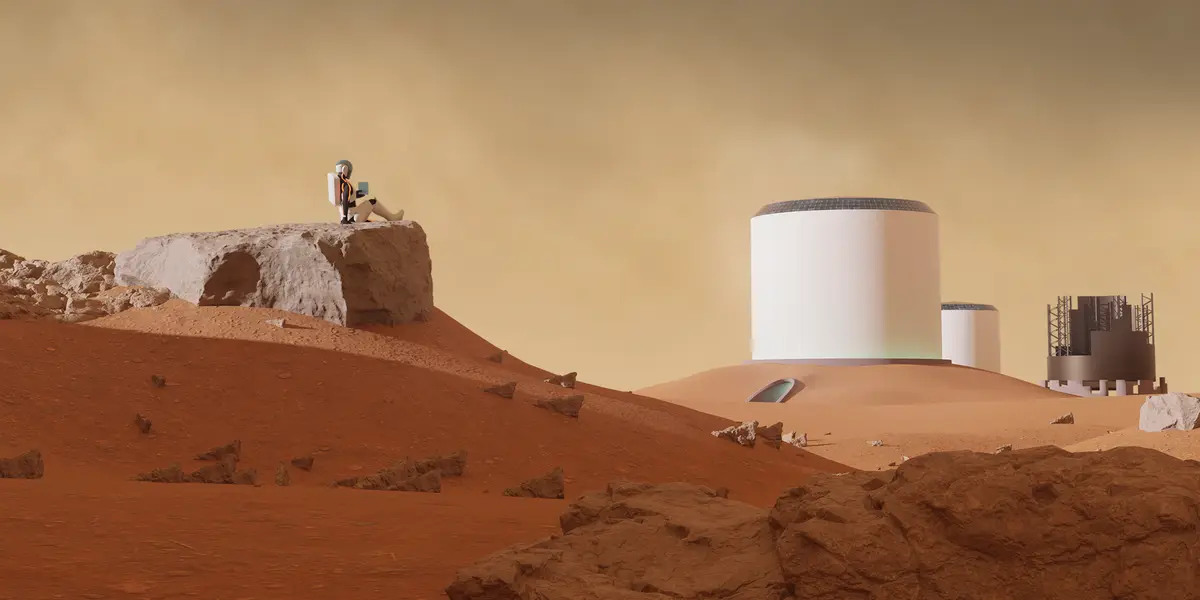
MARS ROTOR
Humans evolved with Earth’s gravity and atmospheric conditions, adapting to anything else will take many generations. As we spread out from our home planet our basic biological needs and functions will remain the same - so replicating the conditions in which we evolved will be critical to sustaining civilisation away from home. Mars has 40% of Earth’s gravity and 1% of Earth’s atmosphere - however it’s proximity as well as the scientific and economic potential of the planet makes it one of mankind’s most promising first outposts, despite it’s inhospitable nature. As colonisation begins, many missions will spread out to different areas - some large outposts alongside many small scientific sites - and with the multi-year (likely permanent) nature of these missions, there will be a need for centralised rest, recuperation and coordination facilities, which provide more earth-like conditions and better amenities than possible with smaller mission-focussed scientific camps. Utilising the low gravity, near vacuum conditions, magnetically levitated spinning centrifuge habitats are able to recreate earth-like conditions, making them perfect for medical and time-off centres. Beginning as a generalised facility, as the population grows different habitats would begin to specialise their roles, for example pregnancy would very likely be problematic in micro-gravity; therefore a specialised midwife and early childhood habitat would give young Martians the best chance at growing up healthy in the conditions their biology is adapted to, from millions of years evolving on Earth. 3D printed out of carbon-fibre composites, contruction of the habitats could (through energy intensive processes like electrocatalysis) utilise the 95% Carbon Dioxide native Martian atmosphere to create Carbon and Oxygen - for building and life - meaning growth isn’t reliant on building supplies from Earth. The Rotors are located strategically between the bases of Valles Marineris and the Tharsis Uplands.
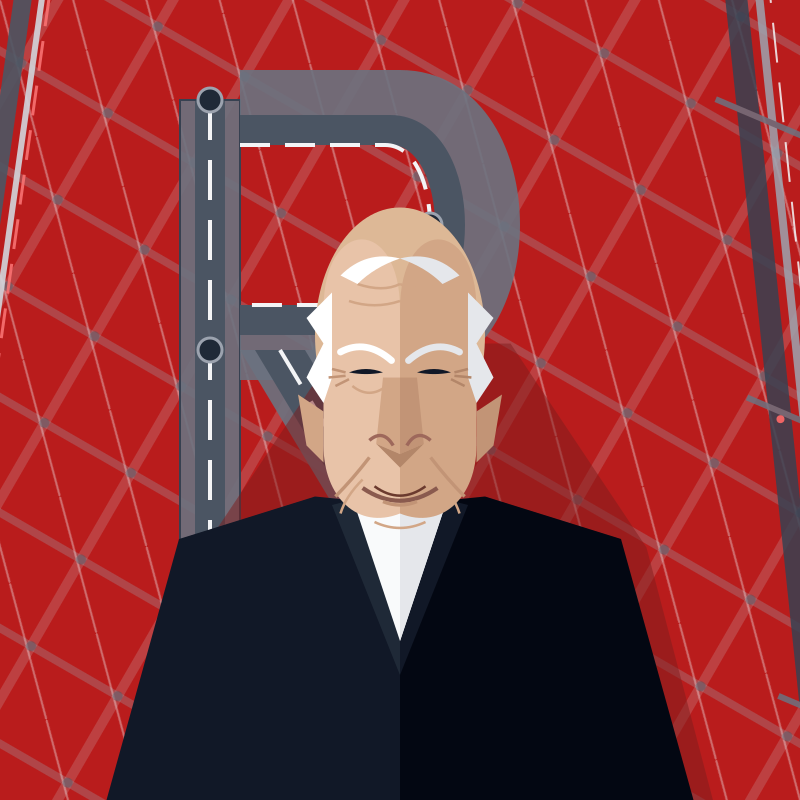
The Rotor augments natural gravity with centrifugal force by spinning (like a carnival ‘rotor’ ride). In order to achieve the perception of Earth gravity - with an internal maximum width of 30 metres - a spin rate of 6rpm must be maintained (1 rotation every 10 seconds). This means critical areas for 1g are located at the edge of the internal space of the Rotor (the 40 crew and visitor cabins, gyms etc).
The physics of the Rotor are much more suited to Mars than such a structure would be on Earth; by magnetically levitating the Rotor, only 40% of the power would be required compared with Earth (as the weight of any structure is only 0.4x normal on Mars due to lower gravity). Similarly the fact that Mars has just 1% the atmosphere of Earth means that atmospheric effects such as aerodynamic and parasitic drag are nearly non-existent, so once the Rotor is spinning - so long as magnetic levitation is maintained - there is next to no energy required to keep the structure spinning in Mars’ near-vacuum.
The can-like shape of the Rotor is also most efficient for maintaining a normal Earth atmosphere,
as the pressure difference between the internal and external space is 100 to 1.
At the centre of the spinning Rotor, the experienced gravity would be neutral with gravity on the planet (0.4x Earth gravity). However as occupants move towards the edges, this perceived gravity is augmented by the centrifugal force exerted, reaching 1x Earth gravity at the edge. In order to maintain the perception of flat ground, the surface of the levels arc to match the ratio of natural gravity-to-centrifugal force, at its maximum this ratio is 2:3 (40% vertical force, 60% horizontal force).
Storage of large amounts of water (+recycled materials) in the outer walls provides not only ample supply, but acts as a barrier to cosmic radiation (water can harmlessly absorb ionizing radiation that would otherwise be dangerous to biological life). The water stores also maximise the inertial energy of the Rotor, meaning fluctuations in energy to the maglev engines, or large movements of mass within the structure would be imperceptible to the occupants. From their frame of reference, the perception of occupants in the ‘Sky dome’ would simply be that the sun rotates in the sky once every 10 seconds. This is also the reason there are no side-facing windows, as seeing features on the horizon would introduce a disorienting frame of reference unsuited to a centrifugal augmented gravity environment.

Popular Articles
Popular articles from the community


Co-Life: Senior Housing Design That Reconnects Older Adults With the City
Co-Life reimagines senior housing design through healing gardens, shared streets, workshops, and a sustainable community across generations.

Conexión: Biophilic Design Reimagines High-Rise Living in Hong Kong
Conexión reimagines high-rise living in Hong Kong through biophilic design, green facades, shared spaces, daylight, water and nature within.

Hill & Cross Opera: Sculptural Opera House Architecture Shaped by Tallinn’s Landscape and Identity
Hill & Cross Opera reimagines opera house architecture in Tallinn through its sculptural hill, civic plaza, glass wave and a luminous cross.

Co-life: Sustainable Architecture for Age-Friendly Community Living
Co-life reimagines sustainable architecture for seniors through courtyards, rammed earth, shared gardens, and spaces designed for belonging.

Similar Reads
You might also enjoy these articles

The Rhythm of Seasons
A Farmers' Market Connecting Nature and the City

More Than a Building-Designing a Living System
More Than a Building-Designing a Living System
Base Beyond
DESERT COMPOUND ARID: TOURISM OF ABSENCE AND ABUNDANCE

Comments (0)
Please login or sign up to add comments
No comments yet. Be the first to comment!