

DAFdf Arquitectura y Urbanismo Builds a Maya Train Terminal That Breathes Like an Ancient House
Palenque Station channels King Pakal's jade mask and vernacular ventilation into 10,250 square meters of civic infrastructure in Chiapas, Mexico.


A train station should never be just a shed for waiting. At Palenque, where the jungle wraps around one of the most consequential archaeological sites in Mesoamerica, DAFdf Arquitectura y Urbanismo has built something that negotiates between deep cultural memory and the functional demands of a national rail network. Palenque Station is the terminal stop of the Maya Train, a nearly 1,500-kilometer circuit threading through the Yucatán Peninsula, and it needed to announce its civic ambition without shouting over the landscape that makes the region extraordinary.
What is actually interesting here is not the surface-level nod to Maya geometry, though that is present and considered. It is the way the building performs: open on four sides, relying on passive ventilation drawn from the logic of the traditional Maya house, with a folded green-tile roof that reads from the air like an undiscovered ruin half-swallowed by terrain. The station sits on the site of Palenque's first airport, a levee that elevates it above the surrounding lowlands, and it is conceived as the first structure of a new civic center bridging the towns of Palenque and Pakal Ná. At 10,250 square meters, completed in 2024, it is infrastructure designed to seed urbanism rather than merely serve it.
A Roof That Reads as Landscape

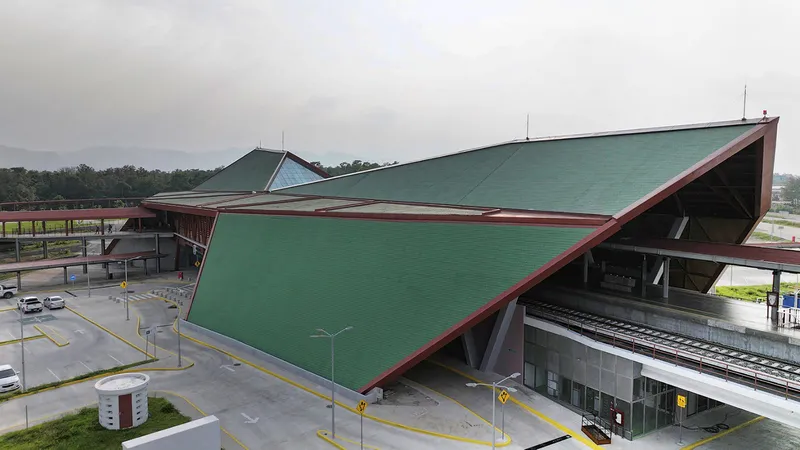

Seen from above, the station's defining gesture is unmistakable: a series of sloping roof planes clad in green metal tiles that fold and pitch like geological strata. The effect is deliberate. DAFdf wanted the roof to evoke the archaeological topography of the region, where temple platforms hide beneath jungle canopy and mounds of earth. The green cladding reinforces this reading, dissolving the boundary between built form and planted ground plane.
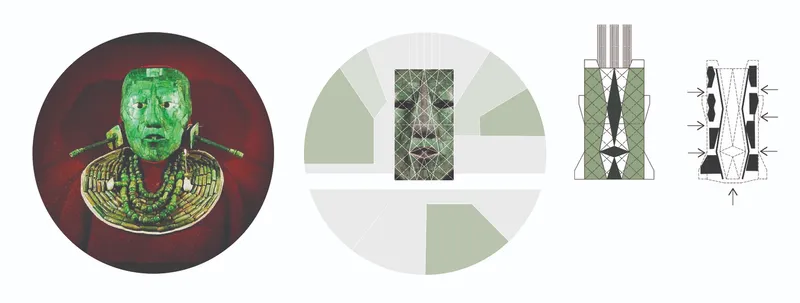
The angular silhouette is not arbitrary. The building's geometry traces, at a remove, the contours of King Pakal's jade funeral mask, an artifact of the Maya classical period found in Palenque's Temple of the Inscriptions. It is a subtle reference, legible more in the overall massing and faceted planes than in any literal figuration, and the restraint is welcome. The roof also functions as a bridge structure, spanning across four primary supports to clear the tracks below.
Circular Forecourt and Red Colonnade
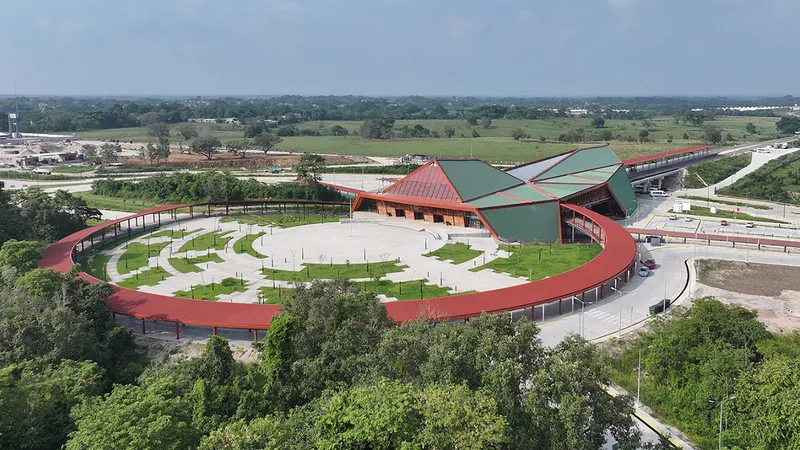
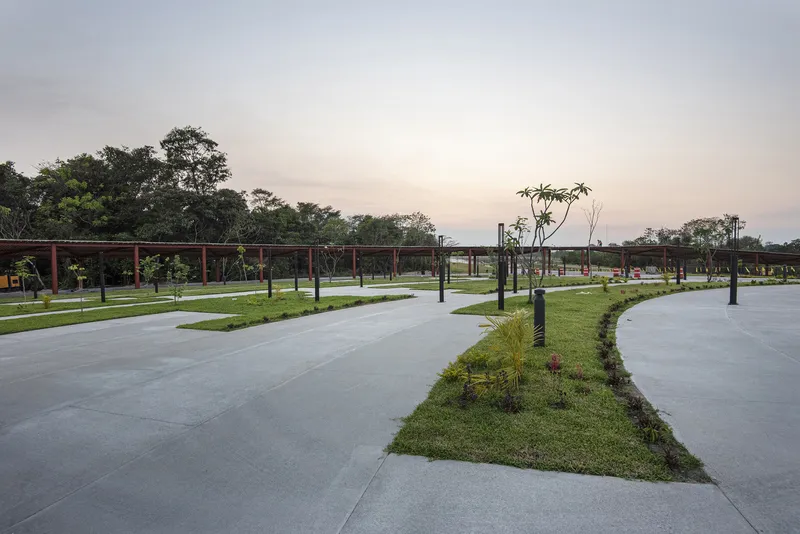

The station's ground-level arrival sequence is organized around a circular plaza ringed by a red-painted steel colonnade. Young trees fill the planted beds between paving zones, and curved concrete seating walls direct movement toward the entrance. The colonnade wraps the forecourt with a rhythm that is orderly without being rigid, its repetitive bays offering shade while framing views back toward the surrounding terrain.
There is a generosity to the public space at the base of the building that goes beyond the minimum requirements of a transit hub. The circular geometry sets up a civic room, a gathering point that anticipates the planned urban development around the station. The pergola and gardens accessible from the upper level extend this logic vertically, giving passengers reasons to linger rather than merely pass through.
Timber Screens and Bamboo Ceilings
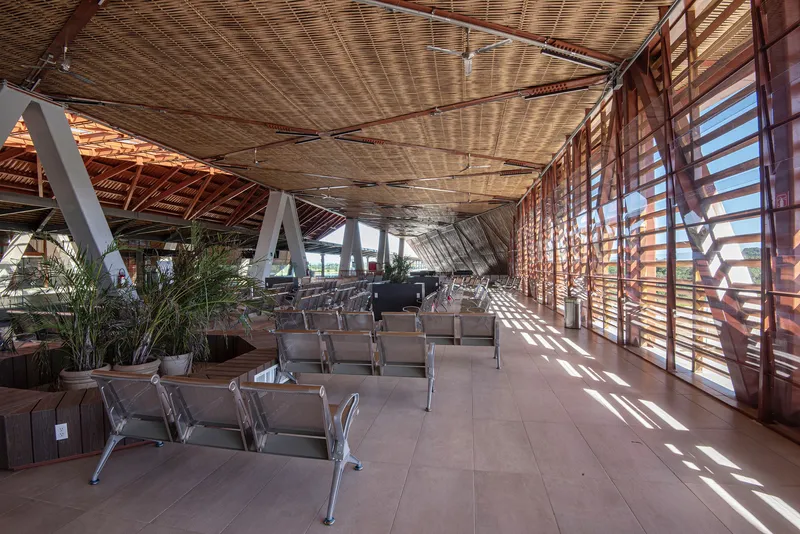
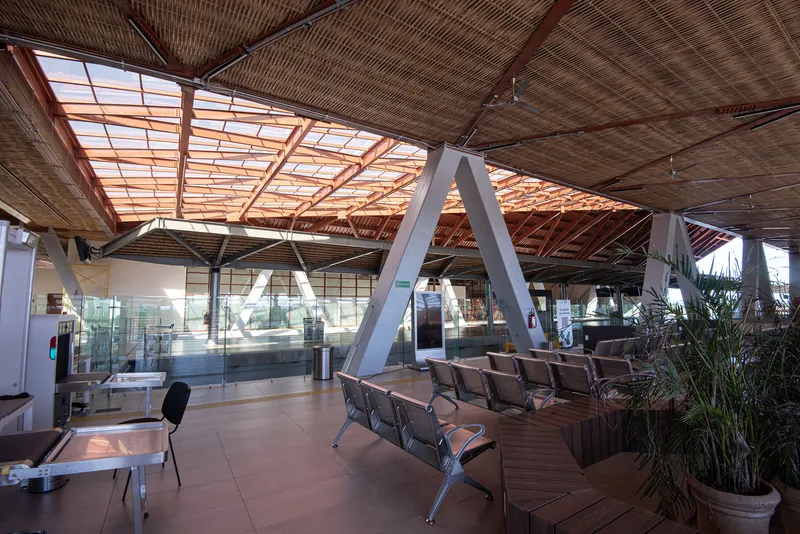
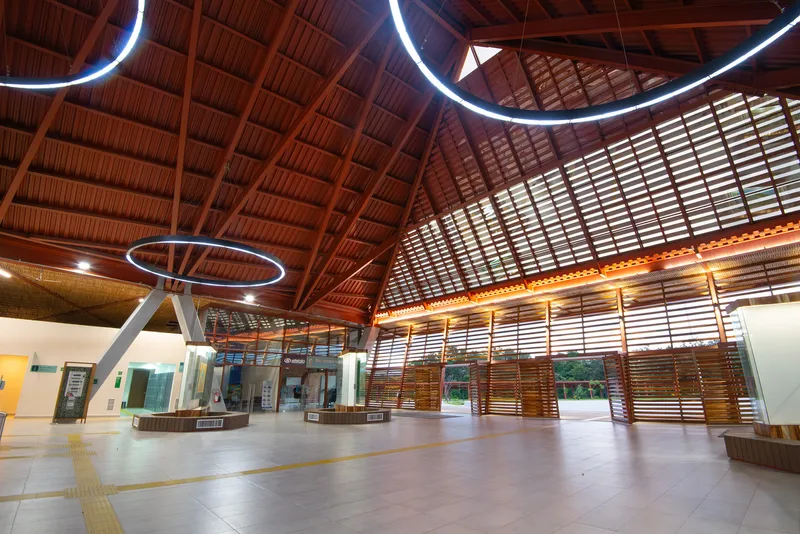
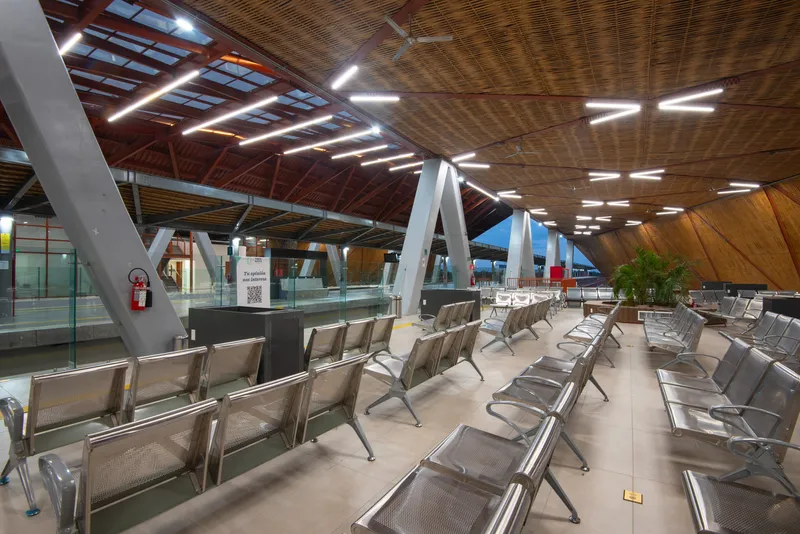
Step inside and the material palette shifts decisively. Local wooden screens line the facades, filtering tropical light into sharp horizontal bands across waiting areas. Overhead, woven bamboo ceiling panels stretch between structural bays, their warm tone and handcrafted texture countering the steel trusses and concrete columns that carry the building's primary loads. The bamboo does double duty in several zones, serving as roof beams for the platform canopy and the pergola.
The choice of bamboo and local timber is more than aesthetic. These are materials rooted in the region's vernacular building tradition, and their deployment here signals that a piece of national infrastructure can draw on local craft without retreating into nostalgia. The effect is warm, tactile, and specific to place, a marked contrast to the anonymous finishes of most transit architecture.
Ventilation as Architecture
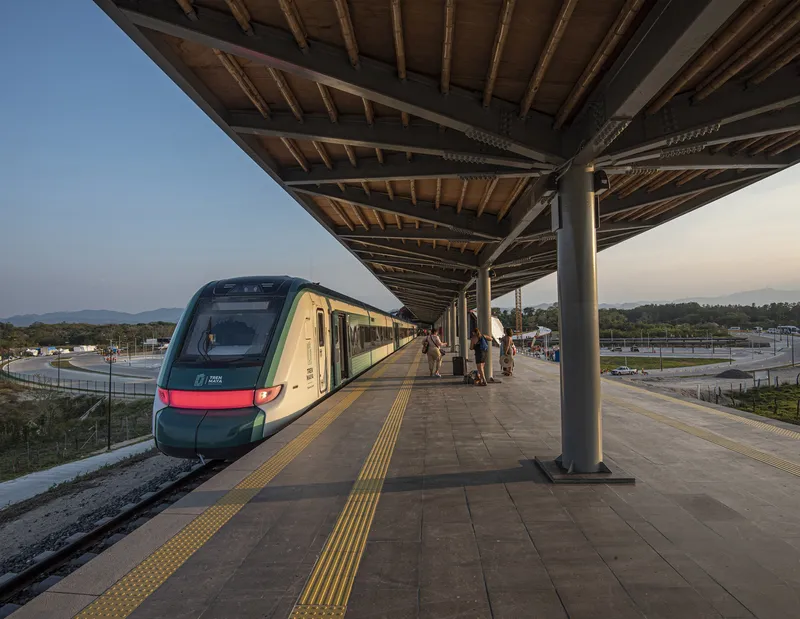
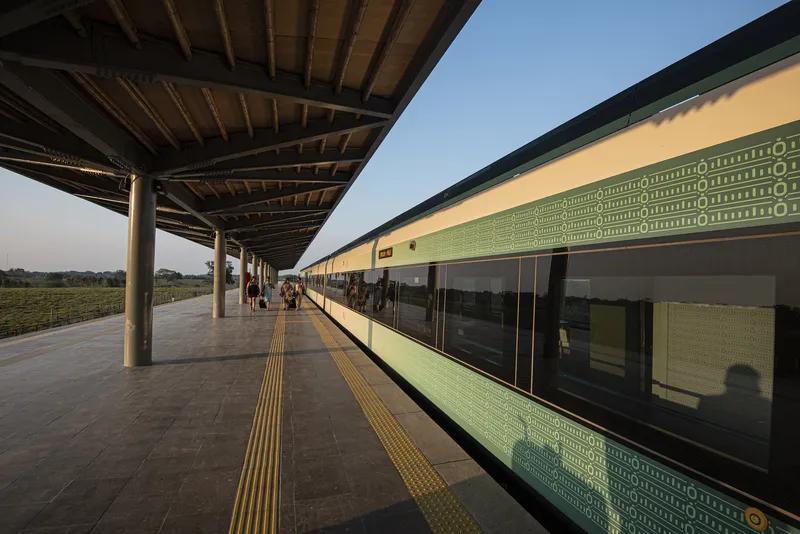
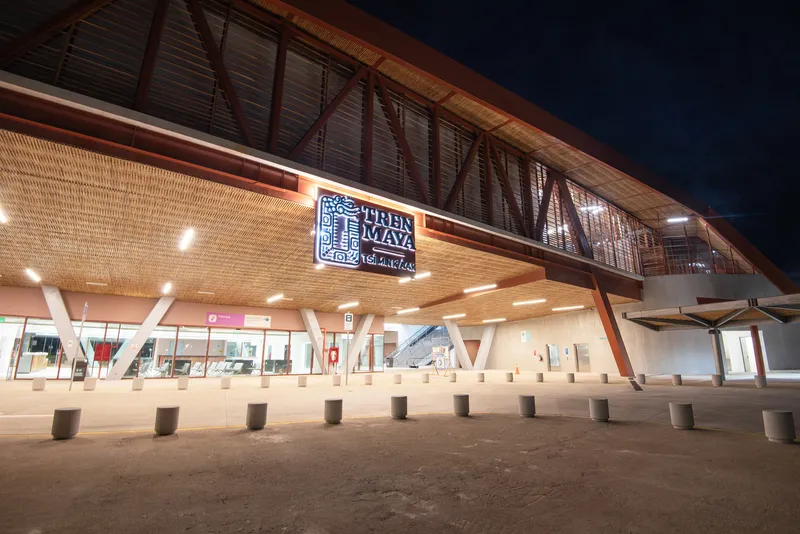
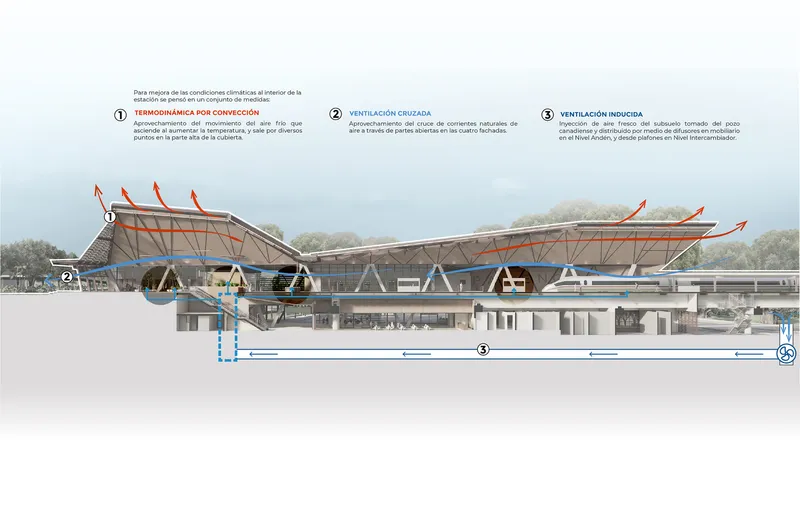
The station's most consequential design decision may be its openness. With the building left largely unenclosed on all four sides, fresh air enters laterally while rising heat escapes through the elevated roof volume. This is the principle of the traditional Maya house applied at the scale of public infrastructure, and it eliminates or drastically reduces the need for mechanical cooling in a hot, humid climate.
At dusk, the platform canopy comes alive with warm light filtering through the timber structure, and the absence of glass walls means the boundary between inside and outside is a gradient rather than a line. Passengers move through a building that feels porous and generous, not hermetically sealed. In the tropics, this is not just a sustainability strategy; it is a fundamentally different spatial experience.
Interior Concourse and Structural Expression
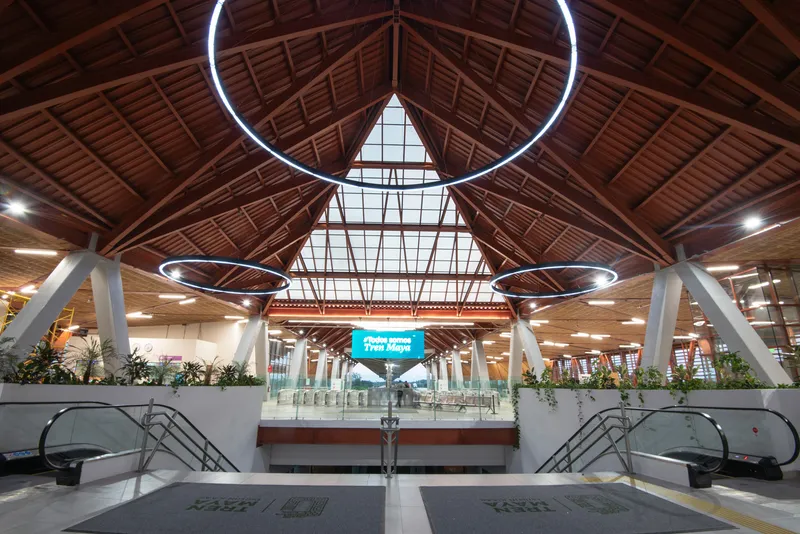
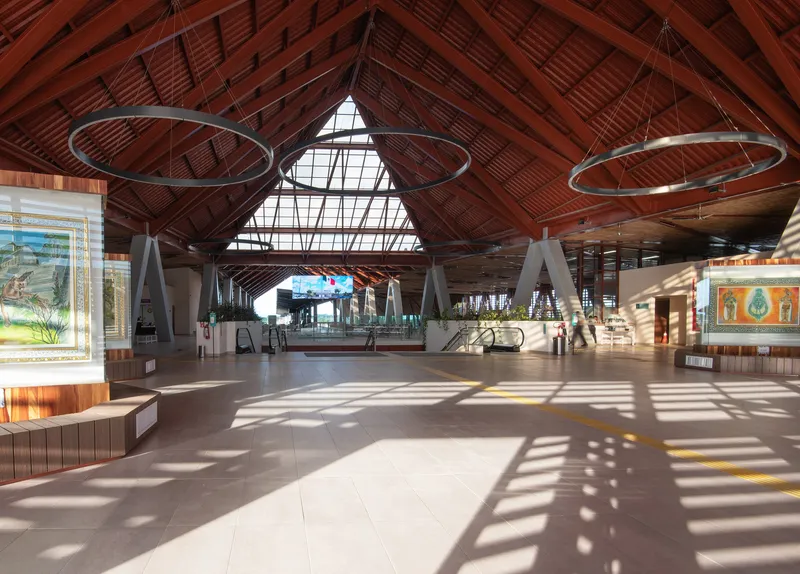
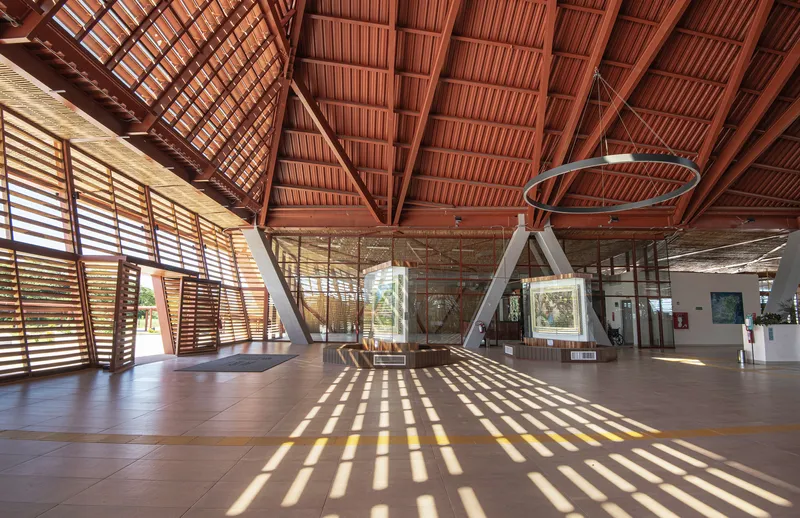
The main concourse is where the building's structural logic is most visible. Pitched timber-clad ceilings rise to triangular skylights that draw daylight deep into the plan, framed by steel trusses whose diagonal members create a lattice of shadow across the polished floor. Circular pendant lights hang at intervals, their geometry rhyming with the circular plaza outside.
Concrete columns in the central zone delimit the space where tracks penetrate the building, and the steel triangular framing above provides the rigidity needed for the roof's bridge-like span. The result is a hall with the proportions and ambient quality of a public market or a cathedral nave, not a turnstile corridor. The architects clearly understood that the journey through the station should feel as significant as the train ride it enables.
Elevated Connections and Multilevel Organization
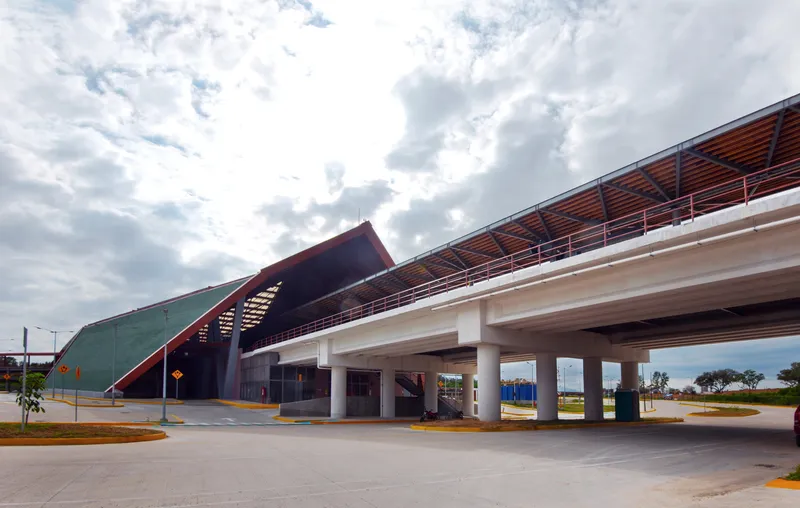


Because the station sits on the former airport levee and receives the train on a viaduct, its program is organized across multiple terrain levels. An elevated pedestrian bridge with a timber-louvered canopy crosses the roadway below, connecting arrival points to the upper concourse. The underside of the canopy at the drop-off level reveals exposed timber ceiling panels and steel columns, creating a sheltered threshold that mediates between car, bus, and rail.
Technical spaces are tucked beneath the platform and tracks, keeping the public-facing zones clean and legible. The lower level uses landscape to connect the roadway with the multimodal transport platform, threading pedestrian paths through planted beds. It is a layered section that manages a complex transit program without letting engineering overwhelm the experience of arrival.
Ticket Hall and Departure Sequence
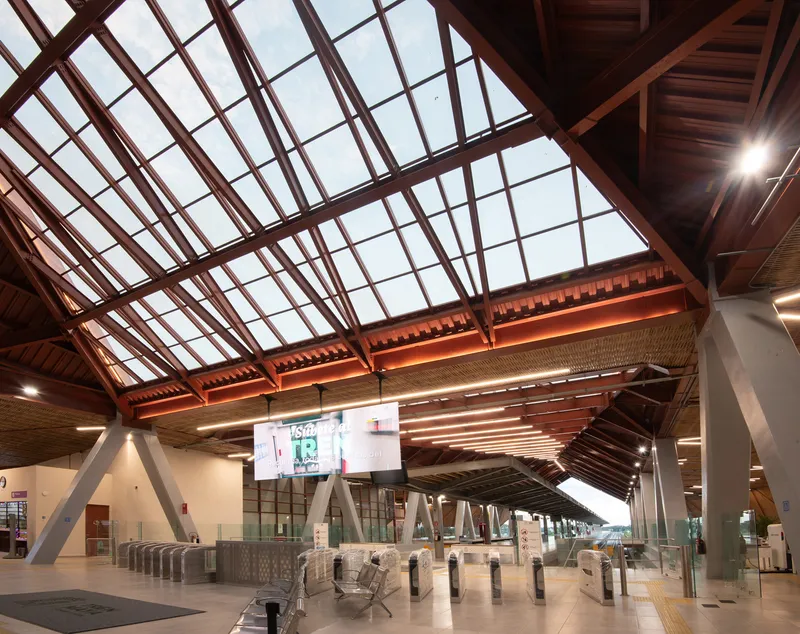
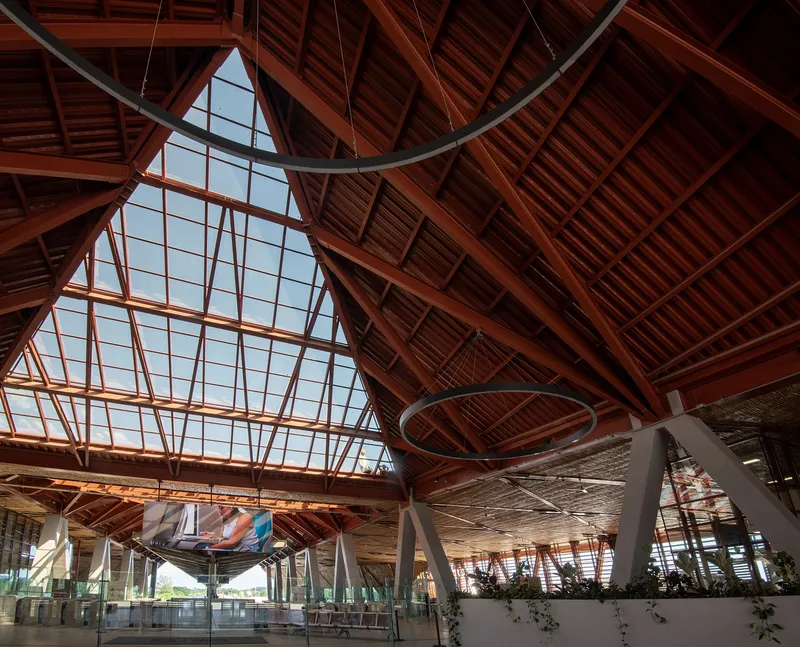
The ticket hall deploys a gridded skylight with steel structure and timber ceiling panels to create a luminous zone above the access gates. It is a controlled moment of compression before the expansive platform beyond. The departure hall uses exposed diagonal trusses and a triangular glazed skylight to pull light along the spine of the ceiling, reinforcing the directionality of movement toward the train.
In the terminal hall, rows of metal seating sit beneath bamboo ceiling panels and linear fluorescent fixtures that run the length of the space. The atmosphere is calm and orderly, with enough visual richness in the overhead structure and louvered walls to hold attention without overwhelming. White V-shaped columns in certain zones recall the angular vocabulary of the roof above, carrying the building's formal language consistently through every scale.
Plans and Drawings
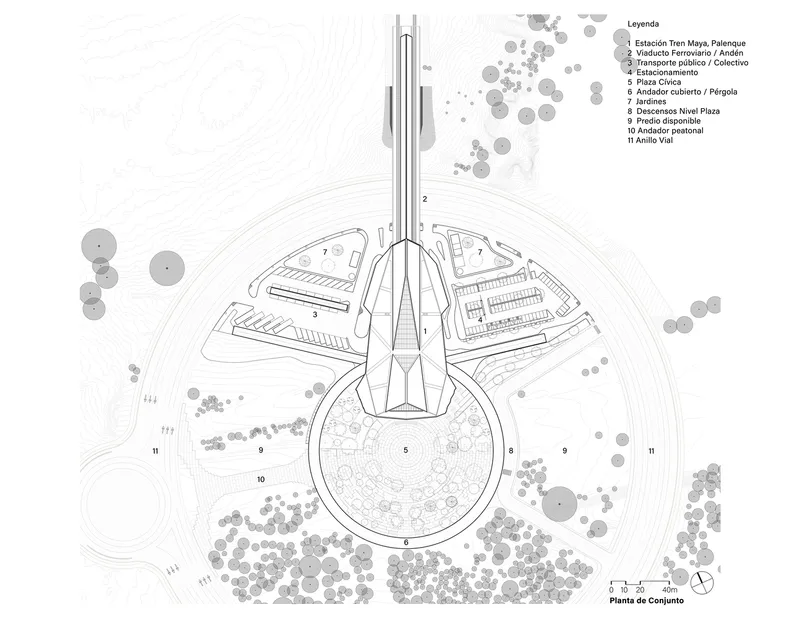
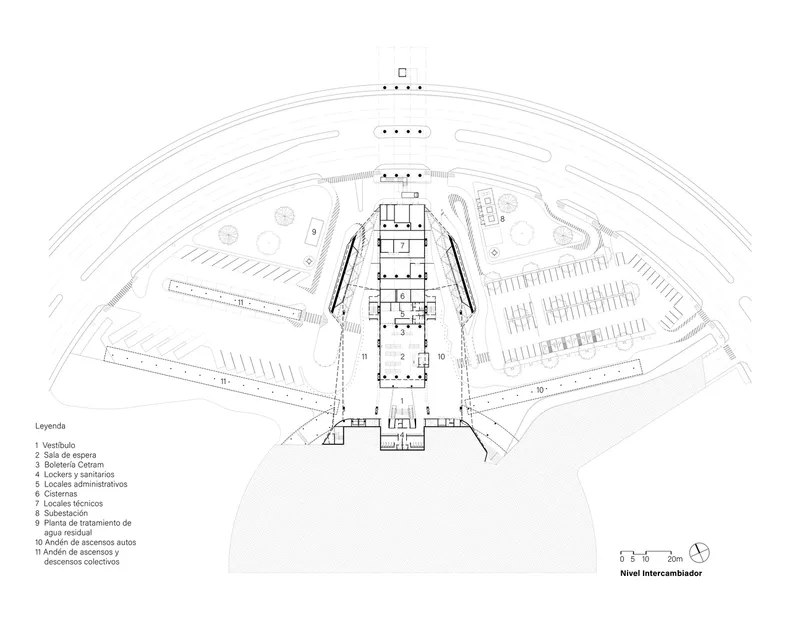
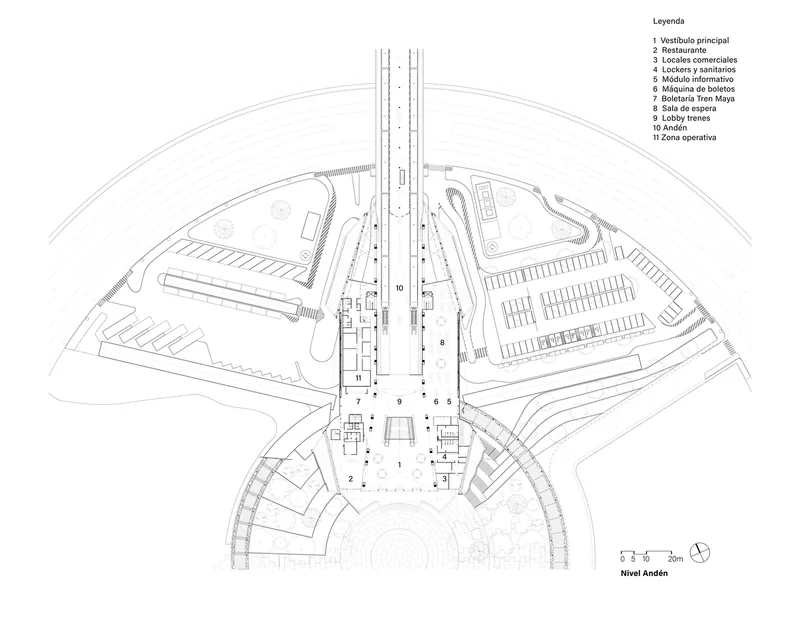
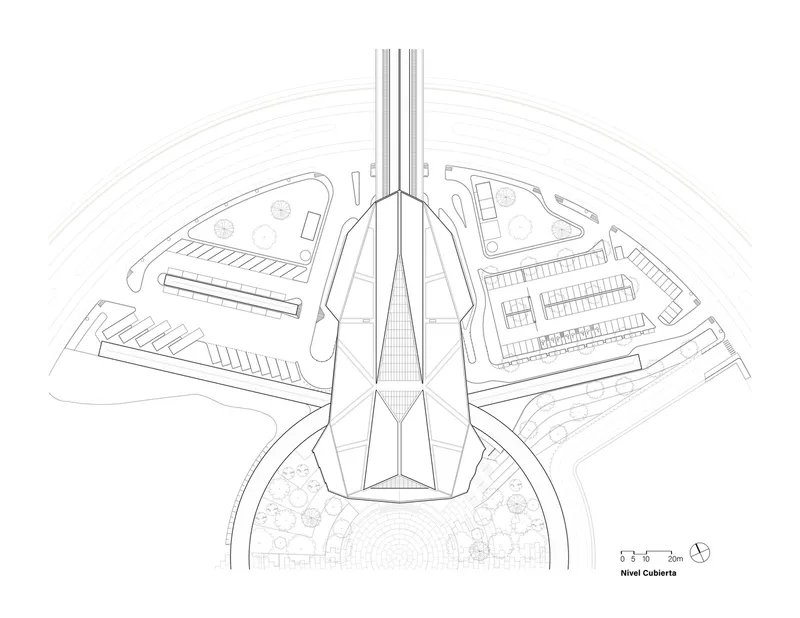
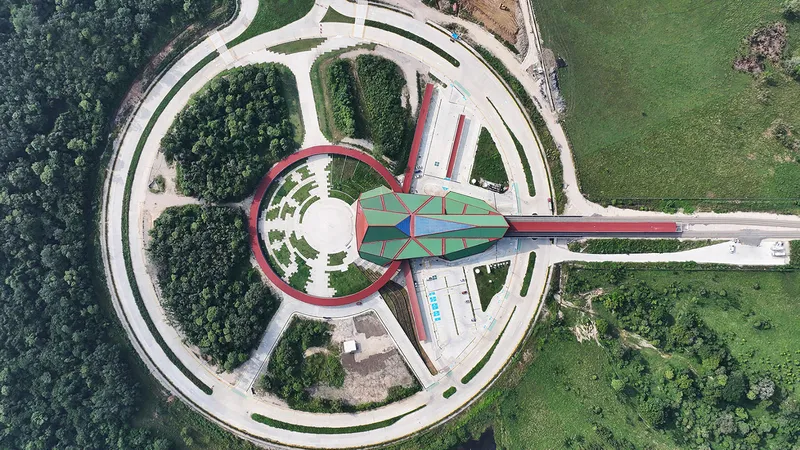
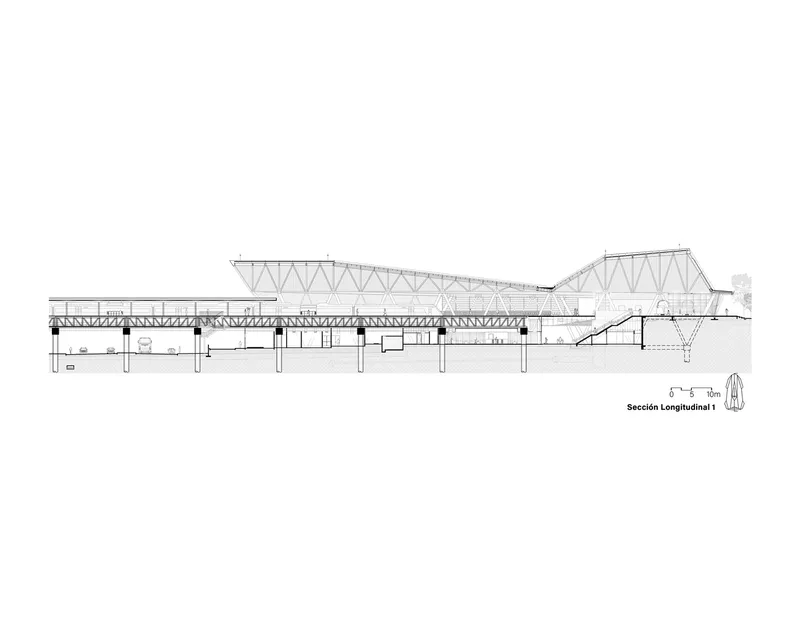
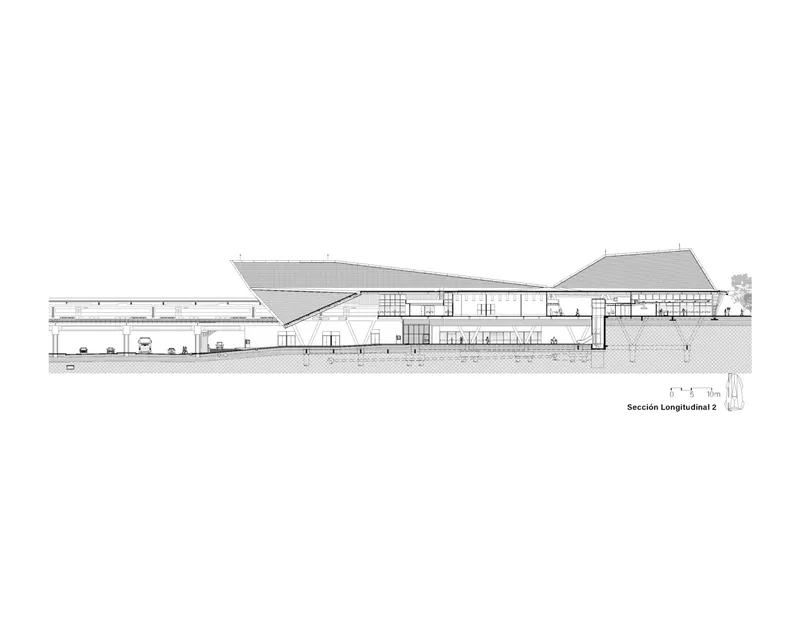
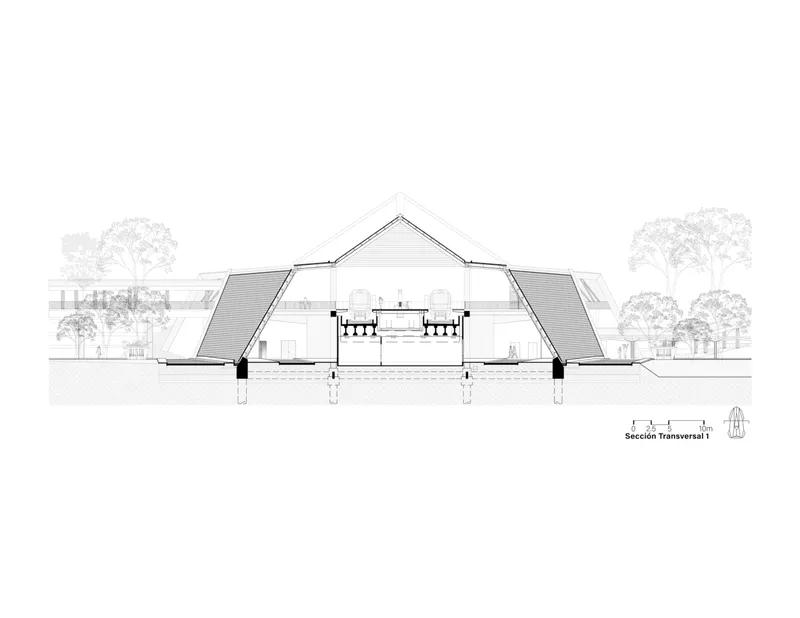
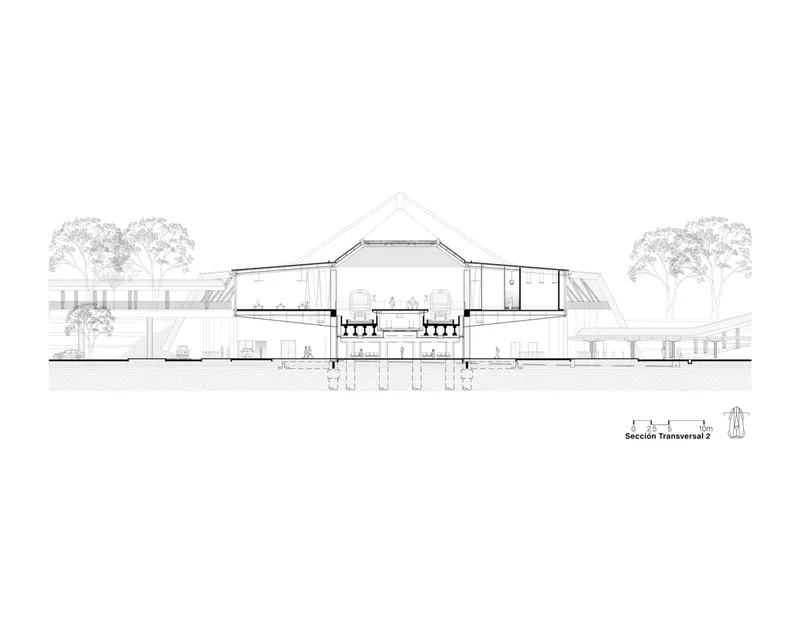
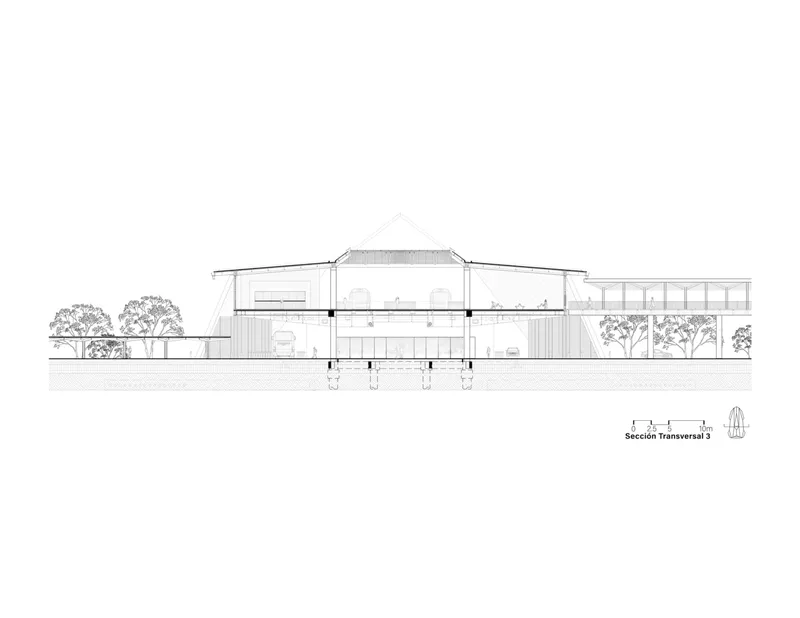
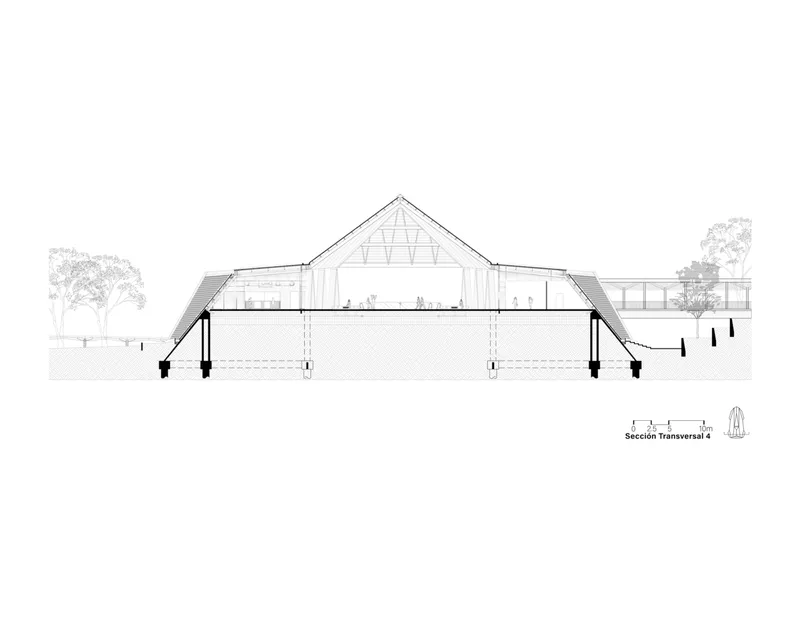
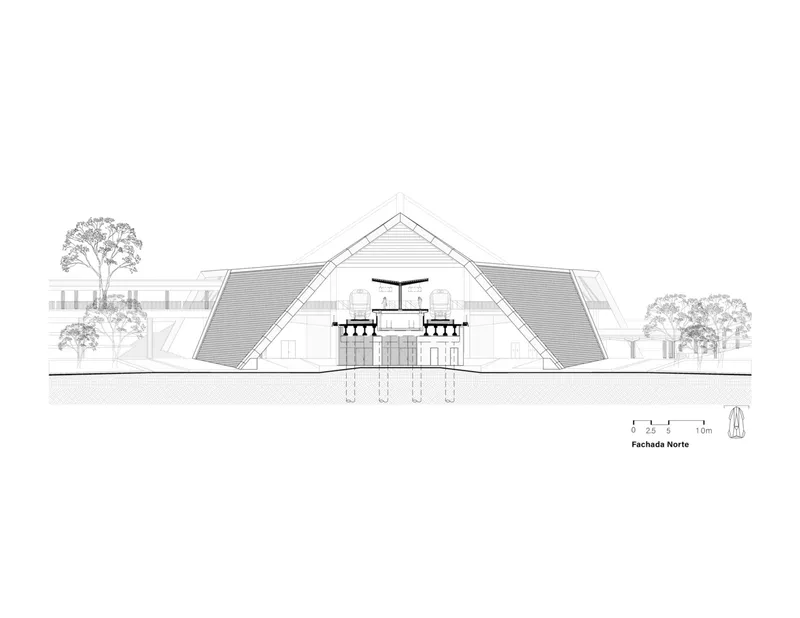
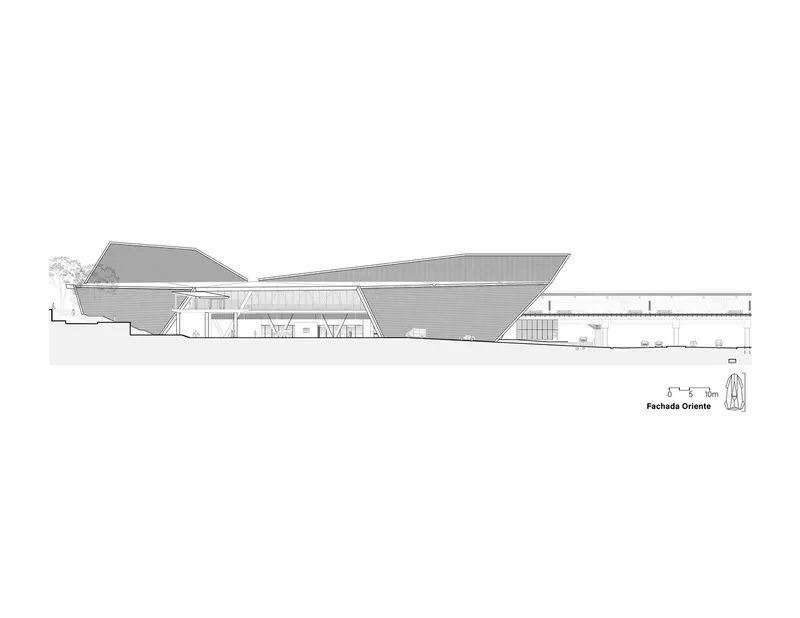
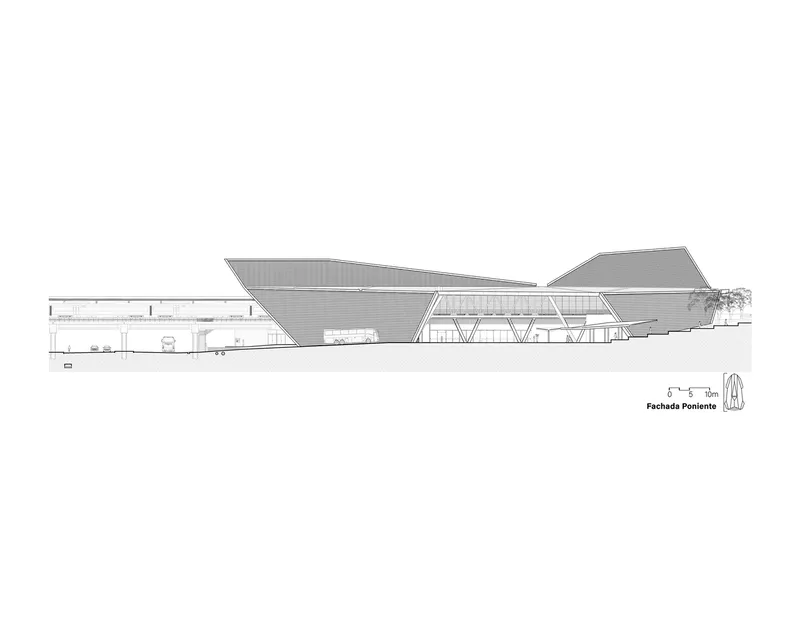
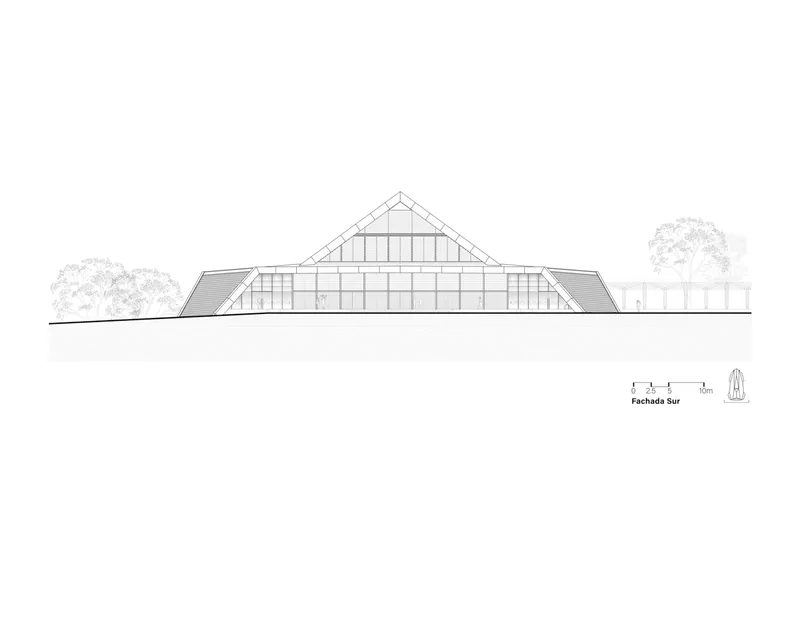
The drawing set reveals the full logic of the station's organization. The site plan confirms the triangular footprint with a central spine flanked by platforms, wrapped by circular access roads and landscaped islands. Floor plans at the mezzanine and concourse levels show service zones pushed to the periphery, leaving the central circulation spine unobstructed. Longitudinal sections expose the trussed roof structures spanning above the elevated platform, while the transverse sections display the pitched double-height volumes that give the interior its monumental scale.
The diagram sequence tracing the jade mask, arch geometries, lattice patterns, and human figure studies lays out the formal research behind the design. It is a useful document of how cultural reference becomes architectural form without lapsing into pastiche. The ventilation section, with arrows illustrating air movement through the building, confirms that the passive strategy is not incidental but engineered into the cross-section from the outset.
Why This Project Matters
Transit infrastructure in Latin America is too often treated as a utilitarian afterthought, a concrete platform with a corrugated metal roof. Palenque Station refuses that default. By grounding its design in both the vernacular intelligence of the Maya house and the symbolic weight of the region's archaeological patrimony, DAFdf has produced a building that takes its context seriously at every scale, from the passive ventilation strategy to the geometry of the roof. The use of local timber and bamboo alongside steel and concrete demonstrates that regional materials can participate in high-performance structures, not just decorative trim.
More broadly, the station stakes a claim about the civic role of infrastructure. Positioned between two urban cores and designed as the anchor of a future civic center, it is meant to catalyze controlled development rather than simply accommodate train schedules. As the terminal stop of the Maya Train, it carries the weight of first and last impressions for a railway that will reshape mobility across the Yucatán Peninsula. That DAFdf met this responsibility with architecture that breathes, literally and figuratively, is no small achievement.
Palenque Station, designed by DAFdf Arquitectura y Urbanismo. Located in Palenque, Chiapas, Mexico. 10,250 m². Completed 2024.
About the Studio
Share Your Own Work on uni.xyz
If projects like this are the kind of work you want to make, uni.xyz is a place to publish your own, find collaborators, and enter design competitions.


Popular Articles
Popular articles from the community

Opera on the Sea: Driftwood Logic Shapes a Timber Opera House on Estonia's Coast
Trevor Orgill's opera house translates the entangled drift of floating timber into a civic building where wood, water, and music converge.
Extended Shell: Retrofitting Kolkata's Balconies as Living Urban Thresholds
A modular retrofit system recovers the social and environmental intelligence of Kolkata's historic verandas for contemporary Park Street residents.
Cloaked Colonization: A Mobile Underwater Habitat That Moves Like a Fish
Micah Abaya's shortlisted EHC Pacific entry reimagines ocean settlement as a dispersed network of self-sustaining architectural organisms.
Temporary Home for Dogs: A Reversed Zoo Rethinks Animal Shelter Architecture
In Bucharest, a sinuous corridor and freed landscape flip the logic of containment, designing a shelter that works to make itself unnecessary.

Similar Reads
You might also enjoy these articles


Hodi-Mandai Geram
Project Function: Preservation and revitalization of the Intangible heritage and socio-spatial identity of the Hodi by Housing, Cultural Memory Center, Sacred Grove, landscape, local tourism economy


Olio Towers: A Mid-Rise for Performers That Fuses Housing, Rehearsal, and Stage
Located blocks from Houston's Theater District, this modular tower stacks living units around a central performance atrium.

Oasis: Modular Green Housing Carved into Dhaka's Urban Fabric
A shortlisted Plugin Housing entry reclaims unauthorized settlements in Dhaka with stepped concrete volumes, green roofs, and ventilation-driven design.

Black Hole: A Floating Megastructure for the Post-Physical Era
Emiliano Mazzarotto envisions a spherical, self-scaling arena where e-sports, digital hotels, and holographic stadiums replace traditional public space.

Explore Architecture Competitions
Discover active competitions in this discipline

Challenge to reimagine the Iron Throne

Photograph architecture without architects

Illustrate the lost glory of Angkor Wat - Render Challenge

Design challenge to reuse E-waste
Comments (0)
Please login or sign up to add comments
No comments yet. Be the first to comment!