
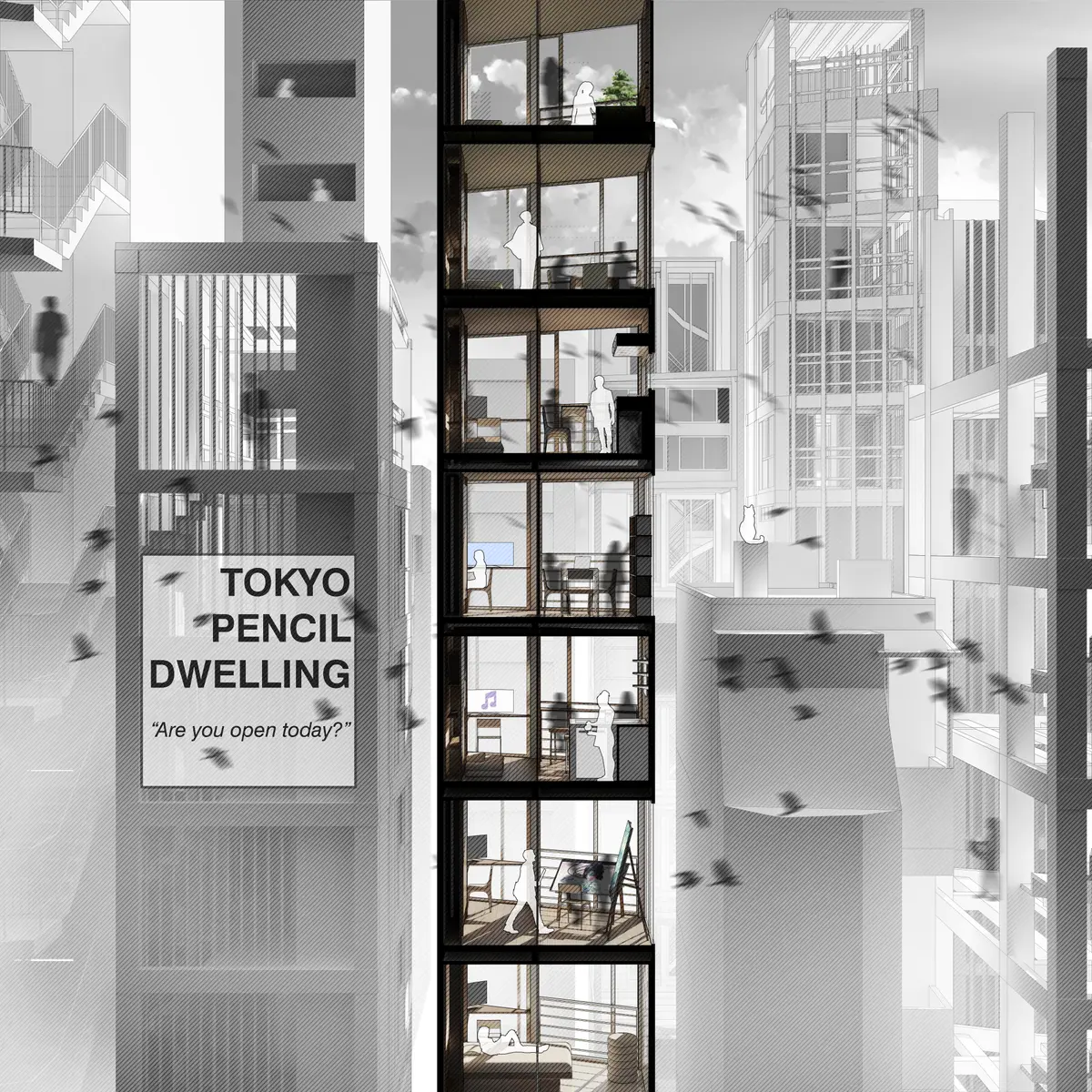
PENCIL DWELLING
Embracing Solo


1. DWELLING-FOR-ONE IN TOKYO
Dwelling-for-one has been an urban norm in Tokyo under Japan's decades of declining birthrate (少子化) and low marriage rate (未婚化) in a post-bubble economy. Despite the country's overall population decline, Tokyo still holds its attractiveness in education and employment opportunities to incoming migrants from across and beyond Japan, fostering a competitive housing market in its urban centers. Given the flexible residency and mobility of single-person household, dwelling-for-one often materializes as short-term rental units in collective housings, in contrast to the 20th-Century paradigms of Danchi (团地) or single-family home (一戸建) that had been targeting family households.
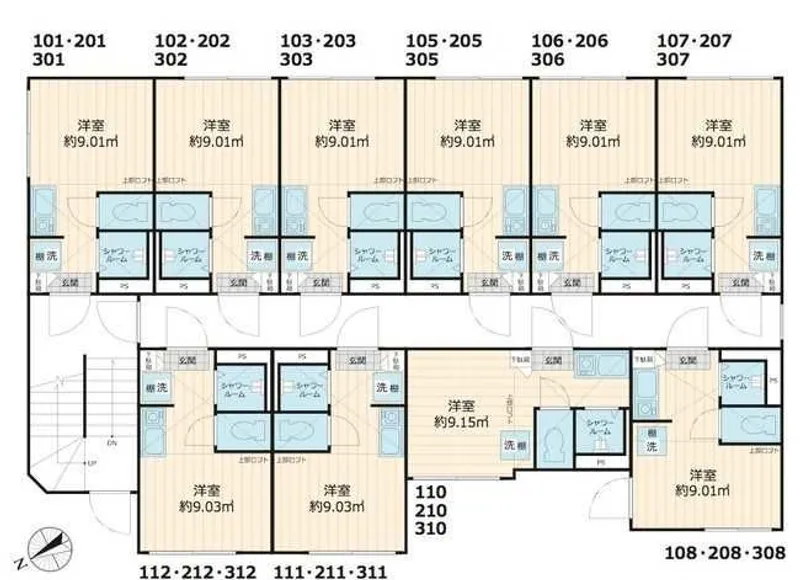 A typical solo apartment layout in Tokyo:
Floor plan of the Ququri Complex.
Source: https://www.nippon.com/en/news/fnn20200211001/tokyo%E2%80%99s-micro-apartments-see-a-surge-in-popularity-the-secret-of-living-in-a-shoe-box.html
2. TOKYO PENCIL BUILDING
The demand for independent and affordable space shines lights on pencil building: a vernacular typology of tall buildings standing on tiny footprints resulted from subdivision of land ownership. Pencil building has been an adaptive form in the urban process of Tokyo's high-density neighborhoods, where frequent land redistribution meets intense land use.
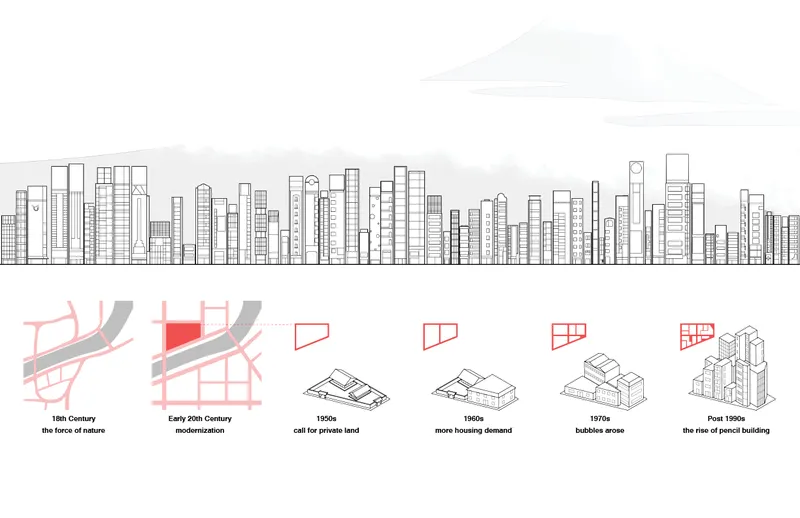 Typological Study on Tokyo Pencil Building My first encounter with Tokyo pencil buildings happened during my independent study for the 2016 summer studio at the University of Miami School of Architecture. Under Prof. Cure Adib and Prof. Teofilo Victoria's supervision, I documented 61 pencil building samples in 7 Tokyo neighborhoods. Despite having a humble figure with spatial constraints for design, pencil buildings fascinated me for their compact layouts that make self-contained units on each floor for solo programs. Besides, pencil building's high-density contexts usually offer dining and recreational amenities within walking distances to fulfill one's daily living. In 2018, I returned to Tokyo and lived in a pencil building unit in Ueno for a week. My experience saw efficient use of a 25-sqm floor area filled with a circulation core in the back and my Airbnb studio facing the street. With convenience stores, restaurants, cafes, cinemas, gyms, and onsen baths under a 5-minute walk, I had minimal chance to complain about my kitchenette and bathroom size.
On the other hand, the market-driven paradigm of dividing a pencil building by floor informs social isolation problems in solo living, which has become a Japanese challenge as reflected in the 2021 administrative appointment of 'Minister of Loneliness' (孤独担当大臣) against increasing incidents of lonely suicide and undiscovered death. In a solo living scenario with digital communication redefining our social life, neighbors could play significant roles in one's safety and belongingness to a place. While offering spatial independence without a 'troublesome next-door,' the vertical separation of pencil building dwellings reduces residents' daily interaction to occasional noddings at elevators and mailboxes. When recalling my pencil-building experience, I often find myself closer to the unseen person living across the street than anyone above or beneath my unit: at least we could discover each other's flower tastes by showing off our bonsai on the facing balconies.
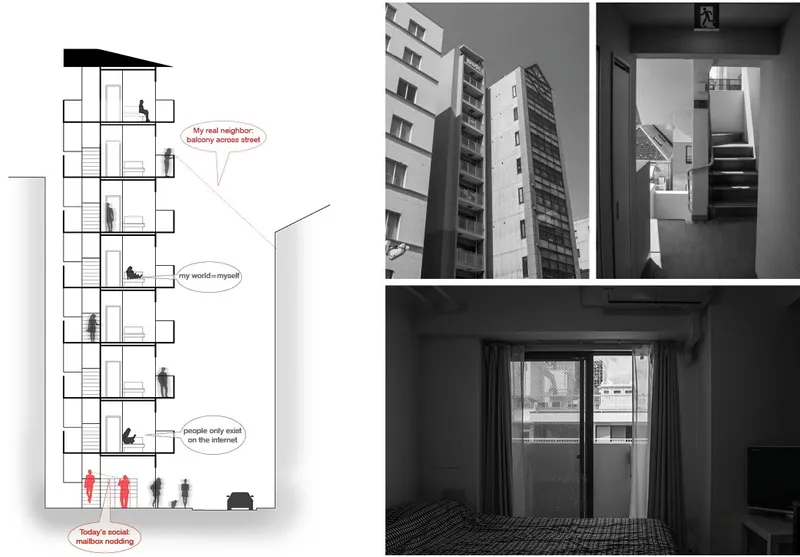 My pencil-building experience and a diagram of the social isolation issues
3. REINVENTING TOKYO PENCIL DWELLING
This project aims to advance pencil building's spatial efficiency and dwelling independence for a solo future while challenging the isolation issues of existing paradigms. Given the one-unit-per-floor layout, the project asks questions on how one may engage with neighbors:
- what space do you want to keep completely to yourself?
- which part of life would you like others to join?
- when to be together and when to solo?
By arranging the interior space upon specifications of "private realm", "sharable realm upon my will," and "other person's realm," the project creates an alternative concept that allows one to customize a sharable space for activities of personal interest, open it to the others for participation or simply show-off, and visit next-floors for their sharable activities. To fit both the private and sharable space within a pencil building's tiny footprint, I rediscover the traditional Japanese concept of shoji panels which divides and recombines space by sliding upon circumstances.
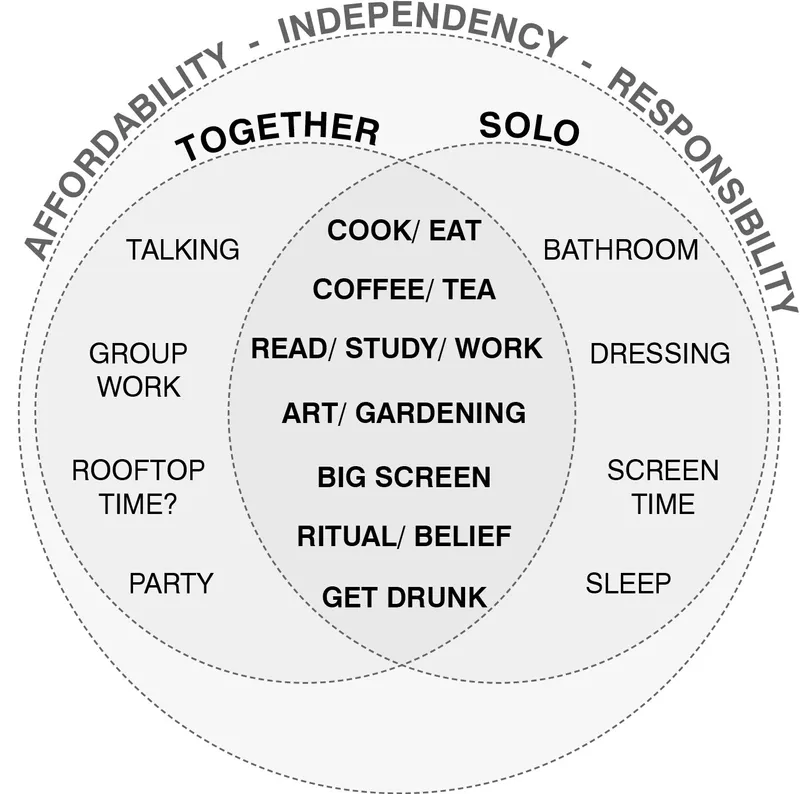 Conceptual diagram of solo-living scenarios
4. A DEMONSTRATIVE DESIGN IN JIMBOCHO
My demonstrative design for future pencil dwelling lands on a perfect site that I documented during my Tokyo internship in 2017. It was a solo parking lot measuring 21sqm in Tokyo's high-density neighborhood of Jimbocho, where bookstores and academic resources attract wandering scholars to stay upon limited budgets. The proposal envisions a 9-story pencil building to fit within the block's 25-meter height allowance while occupying the 21sqm buildable area with a 14sqm inhabitable space served by a 7sqm circulation core. The design takes a frame structure to define the interior grid while allowing flexible configuration on individual floors.
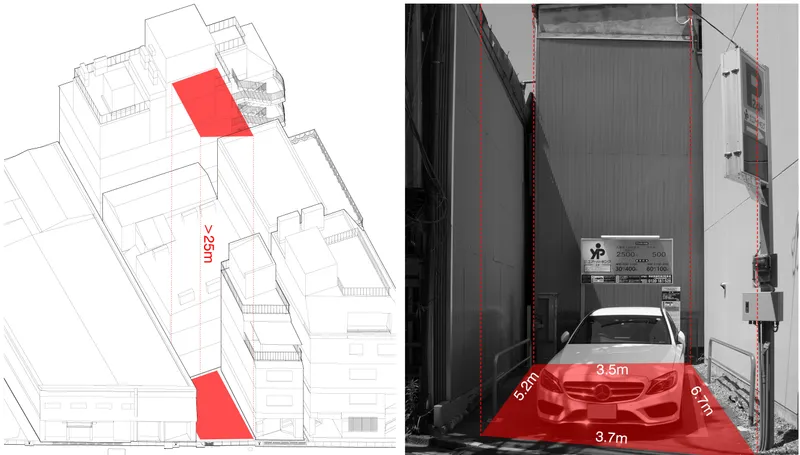 SITE CONDITION & ALLOWANCE
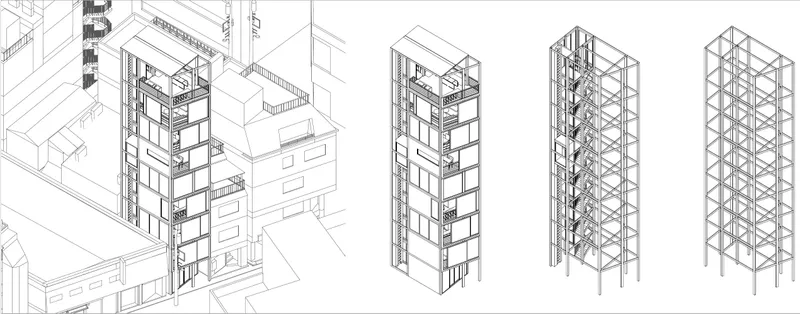 STRUCTURAL DIAGRAM
The building contains a laundry lounge at the entrance, a covered activity deck on the top, and 7 solo dwellings occupying inhabitable floors. Each unit includes a module of private space that can be filtered by shoji panels when the dweller opens his/her sharable space to the next-floors. The other side of the shoji rails presents a configurable program that embodies the dweller's identity, interests, and expertise that he/she wants to share, serve, and show-off to others. After finishing a shared activity, the dweller can slide the panels aside, pull down the Murphy beds or roll out the futons from the closet, and reclaim the unit as integrated space for a peaceful solo moment. In addition to the shoji panels as room dividers, the proposal also advances the 'sliding' concept at unit entrances and the street facades to adjust its openness within spatial constraints.
 FLOOR PLAN DIAGRAMS
The proposal demonstrates the concept with the seven units accommodating a gamer, an artist, a bartender, a scholar, a chef, a tea master, and a gardener. Whether professional or amateur, registered or self-claimed, they acquire opportunities to announce and fulfill their favorite identities as part of a lively community within and beyond the building. On the personal level, the diverse shareable activities may complement each other to enrich one's residential experience beyond his/her familiar zones and maintain a physically intimate social network in the increasingly distant society of the digital age.
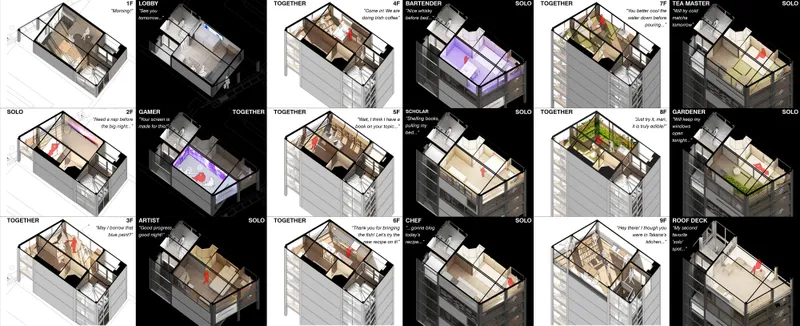 FLOOR AXON DIAGRAMS
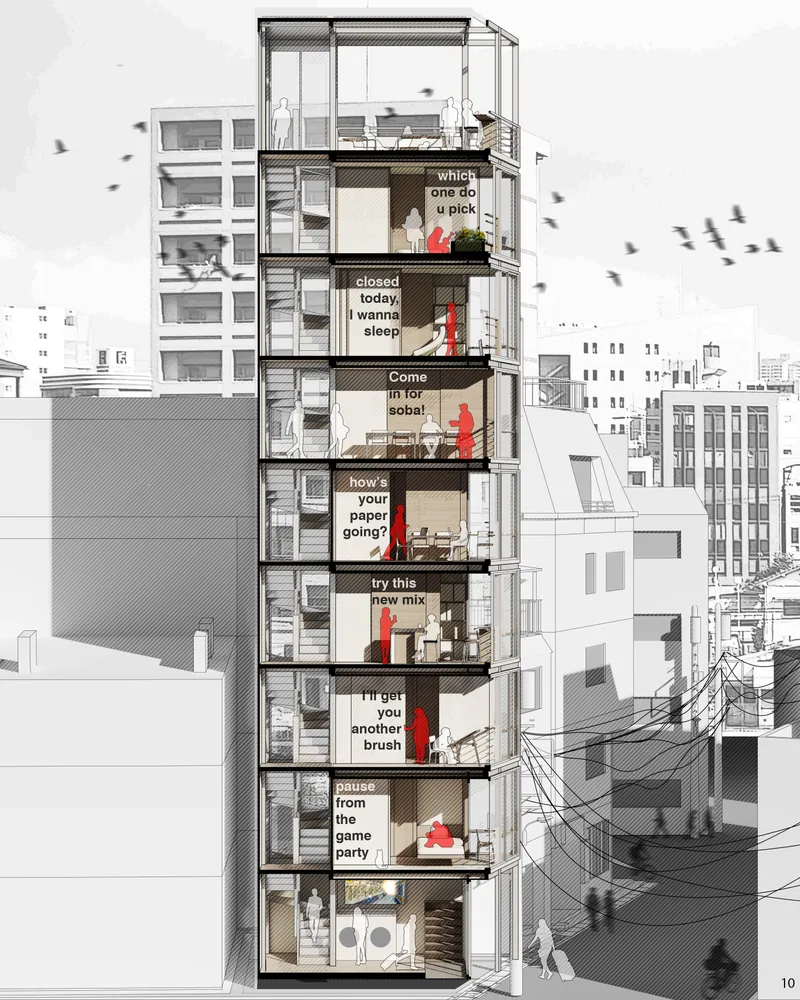 CROSS-SECTION PERSPECTIVE


Popular Articles
Popular articles from the community


Hill & Cross Opera: Sculptural Opera House Architecture Shaped by Tallinn’s Landscape and Identity
Hill & Cross Opera reimagines opera house architecture in Tallinn through its sculptural hill, civic plaza, glass wave and a luminous cross.

The Ocean Hive: Sustainable Architecture for a Self-Sufficient Civilization at Sea
The Ocean Hive imagines sustainable architecture at sea, where modular habitats, algae, wave power and ocean waste sustain a growing colony.

Co-Life: Senior Housing Design That Reconnects Older Adults With the City
Co-Life reimagines senior housing design through healing gardens, shared streets, workshops, and a sustainable community across generations.

Little Red Riding Hood: Architectural Design as a Journey Through Fear, Light, and Storytelling
Little Red Riding Hood reimagines the fairy tale through architectural design shaped by fear, light, scale, memory, uncertainty, and choice.

Similar Reads
You might also enjoy these articles

Day and Night Park: A Time-Based Urban Newsstand in Beijing
A temporary urban newsstand in Beijing blending travel, light, and reading through poetic colors, compact form, and community-focused design.

Modernist Patio Renovation in El Masnou, Barcelona by Oliver Segura Arquitectura + Cebrià Arquitectura
Modernist patio renovation blending tradition and innovation with a movable pool, leveled floors, and Catalan materials in El Masnou.

Alto Residencial Coop: Cooperative Housing Development in Santiago de Compostela by Carbajo Barrios Arquitectos
A linear cooperative housing complex blending white volumes and perforated metal façades, enhancing community living, natural light, privacy, and urban integration.
Vil Genis School by BPA ARCHITECTURE – Massy, France
Vil Genis School in Massy, France, features sustainable design, south-facing classrooms, community integration, accessible spaces, and modern educational architecture.

Comments (0)
Please login or sign up to add comments
No comments yet. Be the first to comment!