

Región Austral Weaves a Network of Public Spaces into a Buenos Aires Informal Settlement
Playón Red turns former railway land in Chacarita into courts, gardens, and gathering spaces co-designed with residents.


Informal settlements rarely get the sustained, thoughtful spatial investment they deserve. In Playón de Chacarita, a neighborhood that took root on disused railway tracks in Buenos Aires around 2000, Región Austral architects Soledad Patiño and Stefano Romagnoli have delivered exactly that: a 1,058 square meter network of public interventions, collectively titled Playón Red, completed in 2024. The project threads courts, gardens, and covered gathering spaces through the tight urban grain of the barrio, each element co-designed with residents in workshops facilitated alongside local cooperatives.
What makes Playón Red genuinely interesting is not just the participatory rhetoric, which is common enough in social architecture discourse, but the hard specificity of the results. A rain garden that doubles as a pocket park. A sports court that also functions as an open-air community room. A tensile canopy that shelters assembly without walling anyone off. Each move is small, surgically placed, and legible to the people who will maintain it. Backed by the re:arc Institute and the Housing Institute of Buenos Aires City, and built by Cooperativa 8 de Septiembre, the project demonstrates what happens when design intelligence meets genuine community agency.
A Settlement Within a City

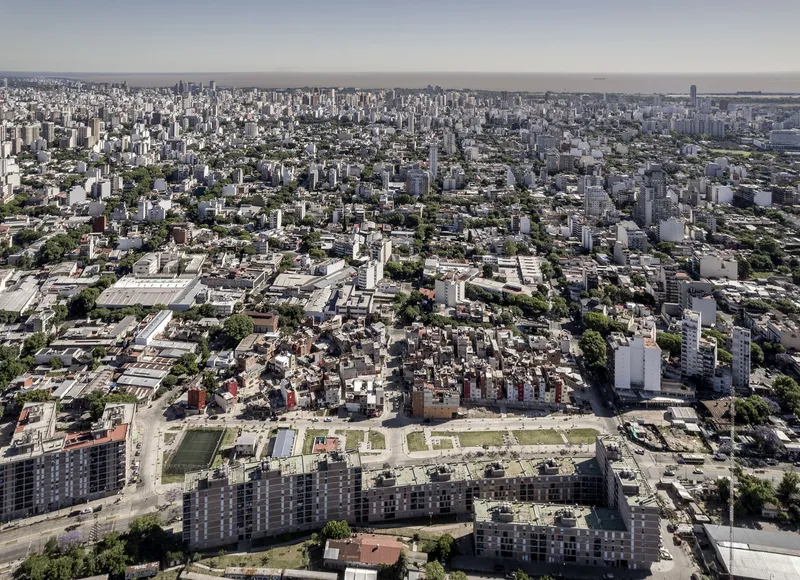

Seen from above, Playón de Chacarita reads as a distinct morphological island within the regular street grid of Buenos Aires. The settlement's organic block structure, dense rooflines, and narrow internal passages contrast sharply with the formalized urban fabric that surrounds it. That tension is the project's starting point: how do you introduce public space into a neighborhood where nearly every square meter is already claimed by domestic necessity?
Región Austral's answer was to identify residual gaps, leftover slivers of land adjacent to perimeter walls, forgotten corners at block edges, and activate them with precise interventions. The aerial views reveal just how tightly these new public spaces are wedged into the existing tissue. Nothing is demolishing homes; everything is negotiating with what already exists.
Co-Design as Construction Method
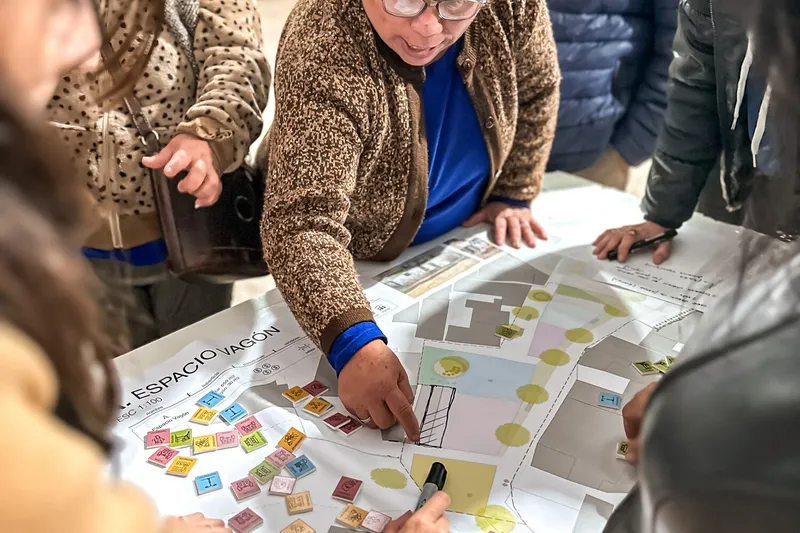

Participatory design is easy to claim and hard to execute. The workshop images here tell a story of actual collaboration: residents hunched over printed site plans, marking preferences and debating options. A separate gathering under the white tensile canopy shows the same community in dialogue, seated in a circle with no podium and no hierarchy. These are not consultation sessions; they are working meetings.
The collaborative management model integrated local organizations, cooperatives, and the construction team from Cooperativa 8 de Septiembre throughout the process. That continuity matters. When the people who build the space are also the people who use it, maintenance becomes a civic act rather than a municipal line item.
The Court as Neighborhood Anchor
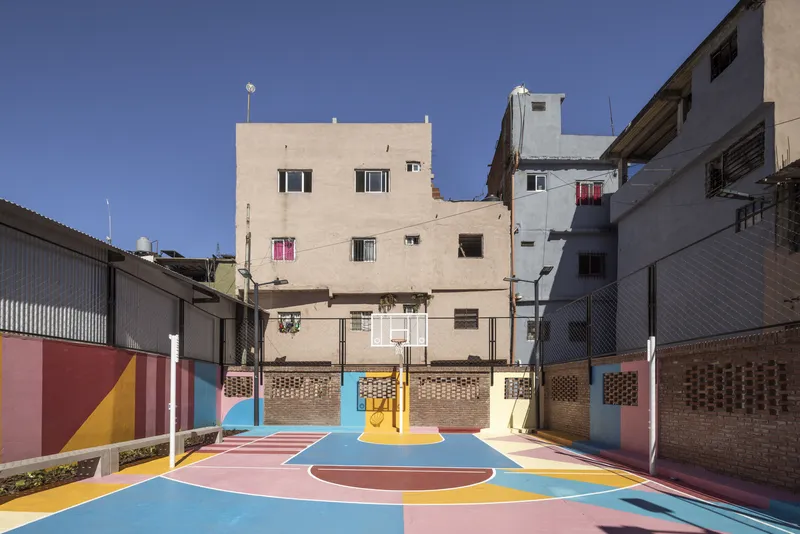
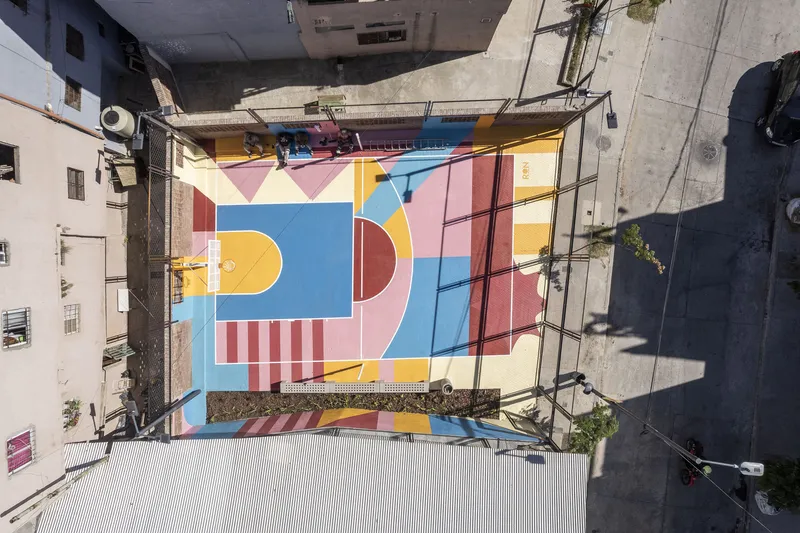
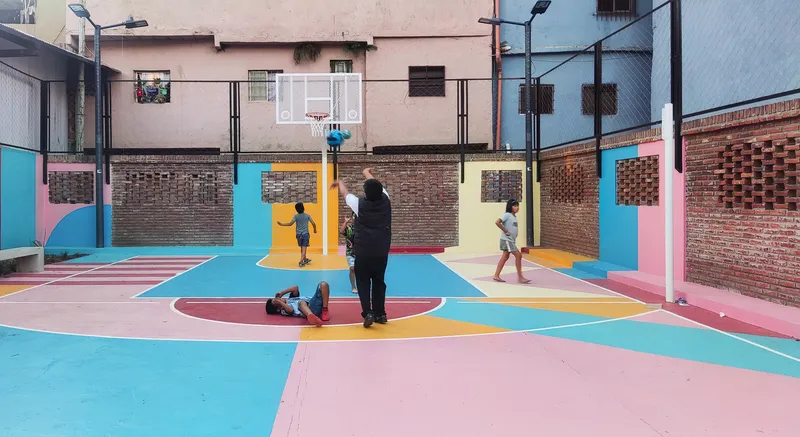
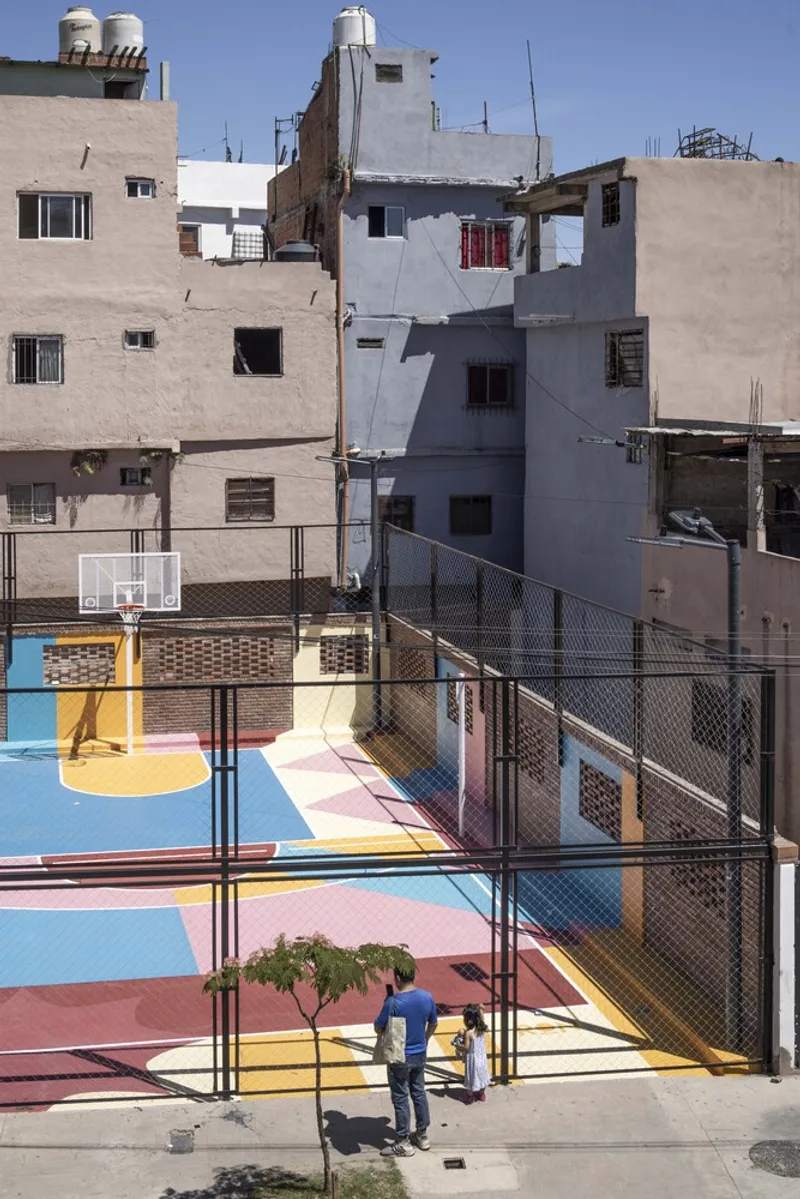
The multicolored basketball court is the most immediately striking element of Playón Red. Painted in bold geometric patterns of pink, blue, yellow, and green, its surface reads almost like a land-art installation when viewed from above. But this is no gallery piece. The court sits between low-rise residential buildings, chain-link fencing on its perimeter allowing visual porosity while defining territory.
The perforated brick walls that border parts of the court serve a dual purpose: they mediate between the public zone and adjacent private residences while allowing air circulation and filtered light. The color palette, developed in conjunction with muralist Martín Ron, does not just decorate; it claims the space as distinctly belonging to this community. In a neighborhood that has historically lacked recognizable public landmarks, the court now functions as a civic address.
Play and Gathering
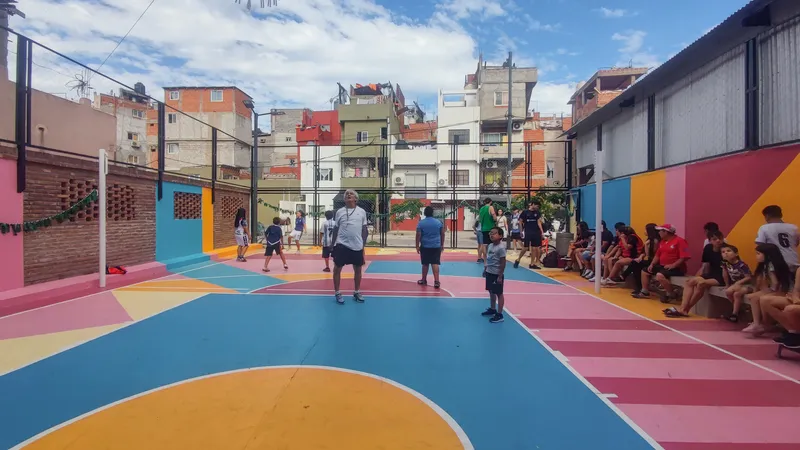


The court's value becomes most apparent when it is populated. Children shooting hoops, spectators seated along the perimeter wall, adults leaning against the chain-link fence watching from outside: these images capture the space performing exactly as intended. In a neighborhood where safe recreational environments were previously absent, the court serves children and youth as both an athletic facility and a social magnet.
What is notable is the informality of the gathering. No one appears to be following a schedule or a program. The space simply works because its dimensions, its visibility, and its material warmth invite occupation. The surrounding urban context is always present through the fencing, a reminder that this is not an enclave but an extension of the neighborhood's daily life.
Green Infrastructure and Climate Response
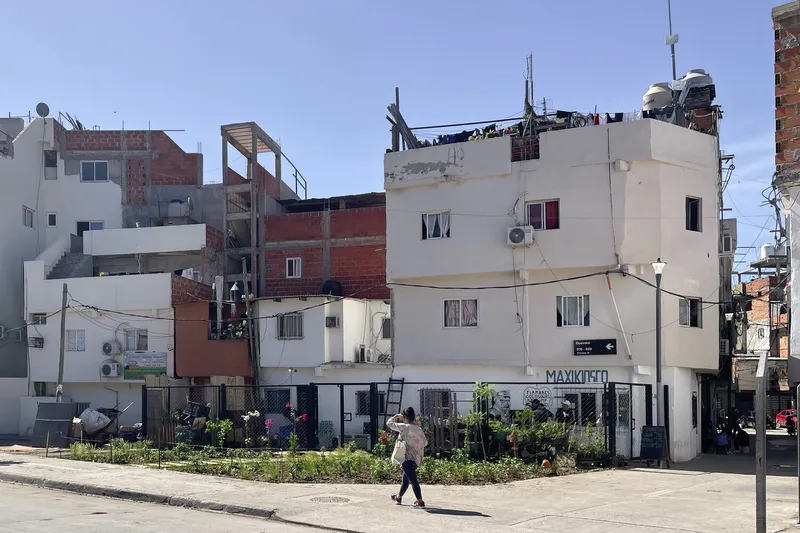

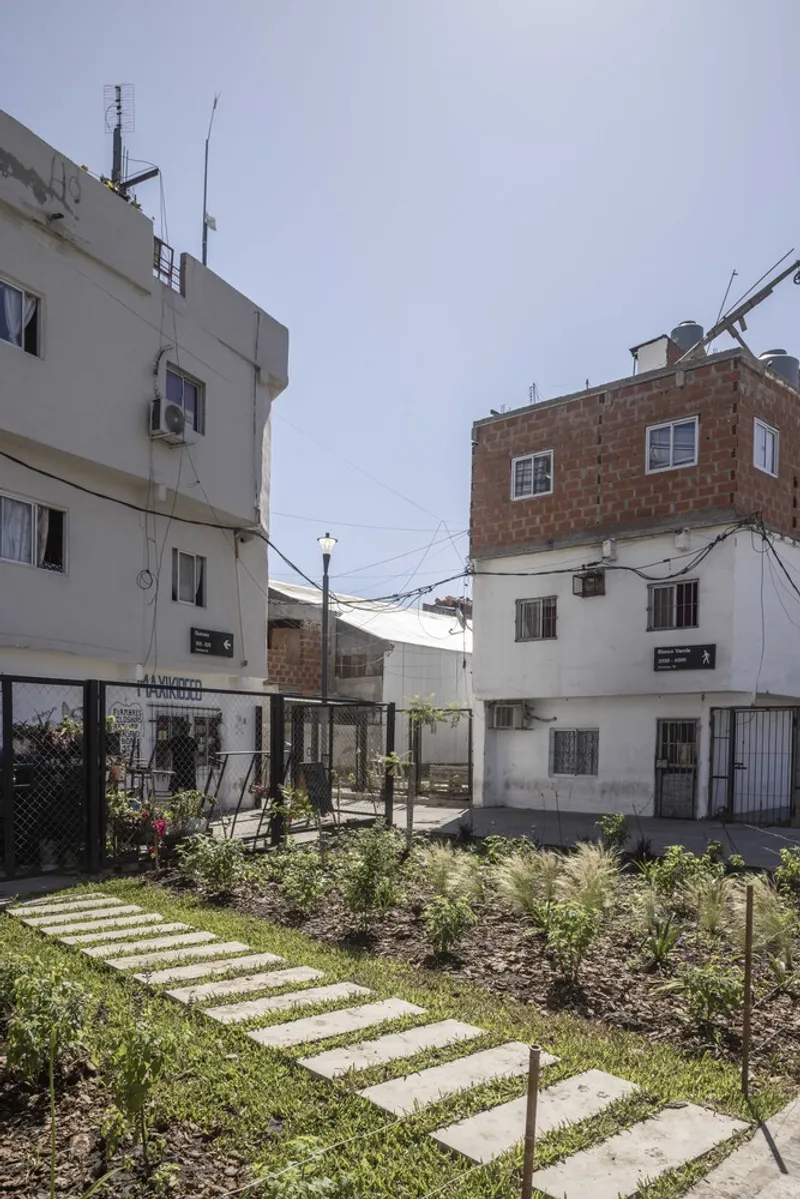
The Guevara Garden, designed as a rain garden, addresses one of the settlement's most pressing environmental vulnerabilities: flooding. Planted beds with young vegetation sit alongside concrete seating benches and perforated brick walls, absorbing rainwater that would otherwise pool in the narrow streets. The garden pathway, laid with concrete pavers through planted beds, introduces permeable ground cover into a neighborhood previously dominated by hard surfaces.
These are not ornamental gestures. In a low-income area with limited municipal drainage infrastructure, every square meter of absorptive soil matters. Manufacturers Durban and Sinteplast supplied the coatings and finishes, contributing to material durability in a climate that swings between heavy rain and high summer temperatures. The garden also serves as a social space, a shaded corridor for conversation and rest that connects otherwise disconnected parts of the block.
Walls That Speak


Muralist Martín Ron's contribution extends the project's identity onto the vertical surfaces of the neighborhood. The mural-painted side facade visible from the street transforms a blank party wall into a neighborhood marker, visible to passersby and legible from a distance. Combined with the planted garden beds fronting the white stuccoed corner building, the streetscape gains a layered quality: color, vegetation, and occupation.
At ground level, the relationship between the painted court surface, the mural walls, and the adjacent residential structures creates a unified visual field. The project does not attempt to mask the settlement's informality. Instead, it elevates it, treating existing walls and rooflines as a given context that the new interventions complement rather than correct.
The Canopy and Its Reach


The white tensile canopy that shelters part of the court area is a deceptively simple element. Stretched over the gathering space, it provides shade and rain protection without enclosing the area. From above, it reads as a bright interruption in the settlement's corrugated roofscape, signaling the presence of something collective among the private rooftops.
Structurally lightweight and visually open, the canopy allows the space beneath it to shift between uses: assembly, sport, celebration, rest. It is the kind of architectural move that costs relatively little but multiplies the usability of the ground plane beneath it. In a project constrained by budget and footprint, that efficiency is its own form of generosity.
Plans and Drawings


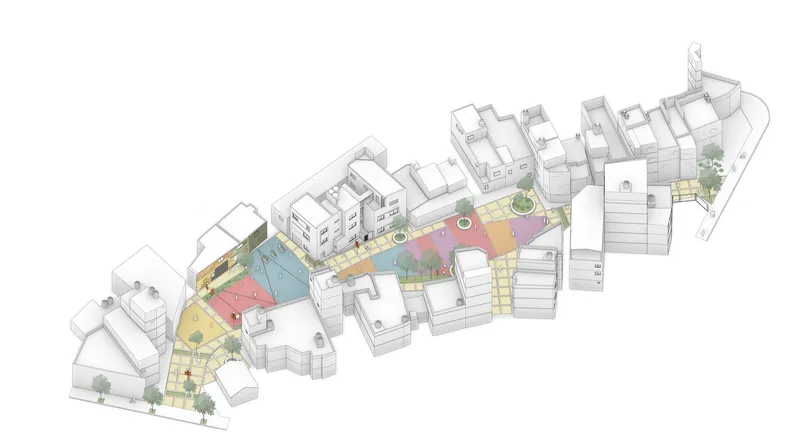


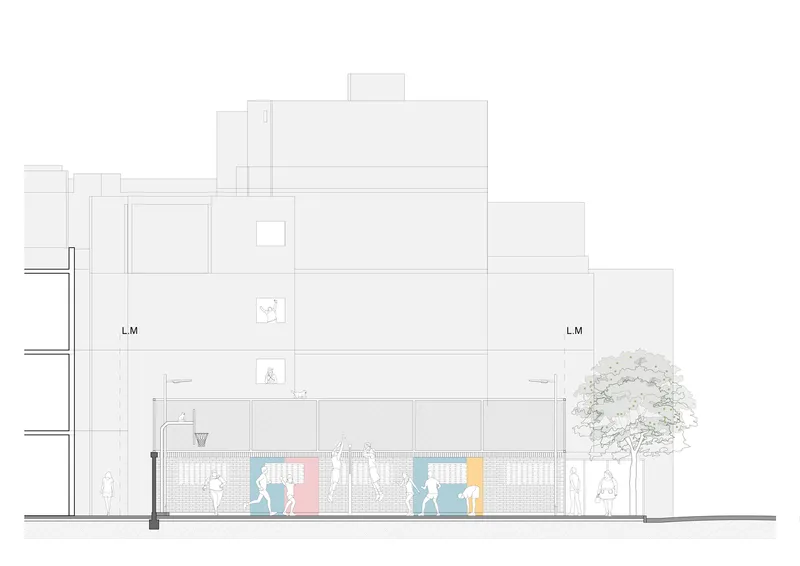
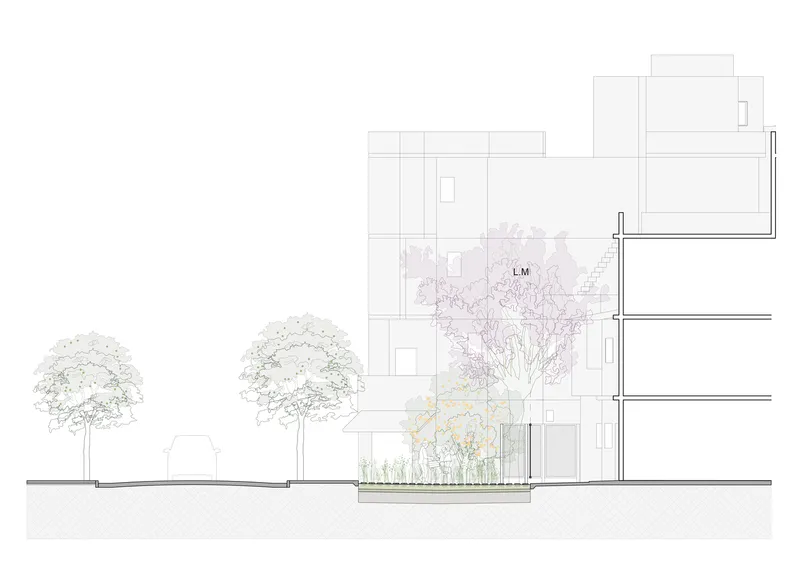

The drawing set reveals the full ambition of the Playón Red masterplan. The site map positions the neighborhood within its broader urban context, color-coding intervention zones to illustrate a phased strategy. Axonometric views show green corridors threading between white building volumes, with the courtyard spaces operating as social clearings within the dense residential fabric.
Detail plans expose the careful geometry of each intervention: curving streets with circular tree placements, rectangular buildings with color-coded interior zones, and courtyard layouts that balance recreational use with planted buffers. The section and elevation drawings are particularly telling, showing planted facades, string lights, and pedestrian activity at ground level. These drawings communicate a project that thinks beyond the single intervention toward a systemic transformation of the neighborhood's public realm.
Why This Project Matters
Playón Red matters because it refuses the false choice between community empowerment and design quality. Too many social architecture projects settle for one or the other: either a slick formal gesture that does not survive contact with its users, or a well-intentioned process that produces aesthetically unremarkable results. Región Austral has delivered spaces that are visually compelling, functionally precise, and genuinely owned by the people who live around them. The involvement of local cooperatives in construction and the participatory workshops are not bolted-on social credentials; they are the method by which the architecture was produced.
The project also offers a replicable model for how small-scale interventions, each under a thousand square meters, can begin to restructure an entire neighborhood's relationship to public life. No single court or garden will solve the systemic inequities of informal settlement in Buenos Aires. But a network of them, threaded through the existing fabric with care and ambition, starts to build something larger: a precedent for urban policy that treats informal communities not as problems to be solved but as neighborhoods to be invested in.
Playón Red by Región Austral (lead architects Soledad Patiño and Stefano Romagnoli), Buenos Aires, Argentina. 1,058 m². Completed 2024. Mural design by Martín Ron. Construction by Cooperativa 8 de Septiembre. Photography by Luis Barandiarán.
About the Studio
Share Your Own Work on uni.xyz
If projects like this are the kind of work you want to make, uni.xyz is a place to publish your own, find collaborators, and enter design competitions.


Popular Articles
Popular articles from the community


Opera on the Sea: Driftwood Logic Shapes a Timber Opera House on Estonia's Coast
Trevor Orgill's opera house translates the entangled drift of floating timber into a civic building where wood, water, and music converge.

The Amber Palace Opera: A Geological Fiction Surfaces on Tallinn's Baltic Waterfront
Pierre Brillard reimagines a Baltic legend as a public landscape, opera house, and waterfront promenade rooted in Tallinn's coastal identity.

Aquadapt: An Underwater Habitat That Rewrites Its Rooms by the Hour
Curved modules ring the seabed while one shell shifts from breakfast room to cinema, farm and football pitch as residents' needs change.


ETEH Reworks the Shared Spaces of São Domingos School in Brazil Around Timber, Color and Hanging Plants
At São Domingos School in Brazil, 436 m² of hall, refectory and library are recast with timber joinery, a yellow and blue code and trailing greenery.

Similar Reads
You might also enjoy these articles


Hodi-Mandai Geram
Project Function: Preservation and revitalization of the Intangible heritage and socio-spatial identity of the Hodi by Housing, Cultural Memory Center, Sacred Grove, landscape, local tourism economy


Olio Towers: A Mid-Rise for Performers That Fuses Housing, Rehearsal, and Stage
Located blocks from Houston's Theater District, this modular tower stacks living units around a central performance atrium.

Oasis: Modular Green Housing Carved into Dhaka's Urban Fabric
A shortlisted Plugin Housing entry reclaims unauthorized settlements in Dhaka with stepped concrete volumes, green roofs, and ventilation-driven design.

Black Hole: A Floating Megastructure for the Post-Physical Era
Emiliano Mazzarotto envisions a spherical, self-scaling arena where e-sports, digital hotels, and holographic stadiums replace traditional public space.

Explore Architecture Competitions
Discover active competitions in this discipline

Challenge to reimagine the Iron Throne

Photograph architecture without architects

Illustrate the lost glory of Angkor Wat - Render Challenge

Design challenge to reuse E-waste
Comments (0)
Please login or sign up to add comments
No comments yet. Be the first to comment!