

Train travels in future: Envisioning train stations based on the upcoming hyperloop technology in India.
‘Cease Speed’ - Transport design competition - Result story


Humans have always attempted to find convenience, to make lives better and easier. Hence we have striven to compress time and space from city to city. With the invention of the steam engine in 1804, railway tracks formed a network that began connecting cities to regions with rich natural resources. Gradually, it became a principal mode of transport for labour and heavy goods.
As time passed networks started coming up and train stations also evolved from basic sheds to buildings of prominence. Cities thrived around these stations, main city centres were shifted near stations to function easily. Becoming important, they formed architectural expressions and created new engineering feats. Stations became city gates and social centres that represented celebrations of arriving war troops.
Over the years, this evolution of transport constantly ran parallel with the evolution of technology. Train transport has changed rapidly from electric locomotives to high-speed rails, and stations from a place to leave to a place to be.
Cities have an impeccable ability to adapt to change. Invention and technological advancement over the years have always affected the way our cities function. The city in turn influences our ambitions and aspirations, which are a driving force for humans to live and work.
Hence, the development of transportation has, is still revolutionizing work, travel, and social life. It has established connectivity and collaboration between different regions.
Transportation networks prove to be of the fundamental tools and an efficient design of a transportation network for a country cannot be overstated. The promise of jobs, prosperity, faster travel and standard of living pulls people to cities. Though this attraction and demand for city life have created problems of overpopulation.
Transport systems all over the world are attempting to keep ahead of their masses and transient technologies are introducing faster means and innovation in travel every year.
The introduction of innovation that enhances life while taking responsibility for its impact, has worked wonders. In July 2012, several firms unveiled their vision of a new transport system, a ‘Hyperloop’. A system that would never crash and would be immune to weather’s vagaries.
Said to be safer than cars, faster than trains, and less damaging to the environment than aircraft, hyperloop technology is quickly gaining traction.
Noted as the 21st century’s biggest and fastest travel breakthrough, it is challenging all modes of transport in the race against time. It is considered to be the most sustainable form of transport that may reduce carbon emissions of flights by 58 percent.
Aside from low impact and travel time reduction, the hyperloop is expected to solve the housing crisis. It can enable people to live in suburbs due to fast travel and thus reduce the pressure on cities and people. This technology is supposedly the change we need.
Hyperloop engineering promises to set up supersonic travel. Since 2014, the technology is planned to establish its roots in major cities worldwide. Since then the technology is under test and evolving with time. In 2020, it crossed its first milestone of carrying human passengers in ultra-fast pods, bringing it close to reality. However, the construction complexity of this system is still under resolution, so it may take a few more years for the system to be established.
So, with the technology on its way, how will the nearby future of train travel look like?
How will it affect its surroundings? And most importantly, what modifications will the station typology undergo?
Brief: Envision a train station based on the upcoming hyperloop technology.
With the transformation of train vehicles into pods and tracks as means to float using magnetic levitation, visualize a hyperloop station and its services.
Some of the Best competition projects are as follows:
Winning Project: HYPERSTEM
By: Tiffany Nguyen & Dallal Thibian

Fig: 1 Overview
Description: Hyperloop technology is a huge advancement and calls for a redefining of typology to celebrate such technological progress. Similar to a hyperloop, Hyperstem offers efficiency and sustainability practices. It focuses on a variety of local issues including transportation, living, and nutrition.
-----------------
People’s Choice: The Deployable City
By: Scott Bojanowski & Walter Perez

Fig: 2 The Deployable City, Cover Page
Description: The Deployable City allows for modularized hyperloop pods to be loaded and unloaded from the hyperloop network and immediately deployed within the local context of individual stations.
-----------------
Editor’s Choice: Integrated Assemblage Of Transport In Rotation
By: Andrew Mendoza & Raúl Morales

Fig: 3 Integrated assemblage of transport in rotation
Description: An organization of multilayered hyperloop chambers integrated in the stations structure creates an efficient cycle for maximum pod. This Hyperloop station becomes a hub of social and economic growth that promotes sustainability through advanced transit.
------------------------
Editor’s Choice: Maneuver Station
By: Melisa Ayala & Dina Elmatboli

Fig: 4 Cover image
Description: In new era of technologies the Maneuver Station brings us a step closer to refine transportation from overly crowded suburban areas to a more preempt anteroom. The connection within the station to the Hyperloop in a hybrid movement involving the wind vector that go against the purpose of the Hyperloop.
------------------------
Editor’s Choice: Magnetic Receptor
By: Alexia Simioni & Vanessa Huerta

Fig; 5 Exploded view
Description: The Magnetic Receptor serves as a conceptual hyperloop station that focuses on creating accessibility to commuters from suburb to the city of Mumbai. The station's main concept comes from the hyperloop's magnetic technology that allows for increased speed and is translated as a kinetic magnetic skin that creates a sense of weightlessness.
------------------------
Editor’s Choice: The Grotto Station
By: Gerardo Alvarez
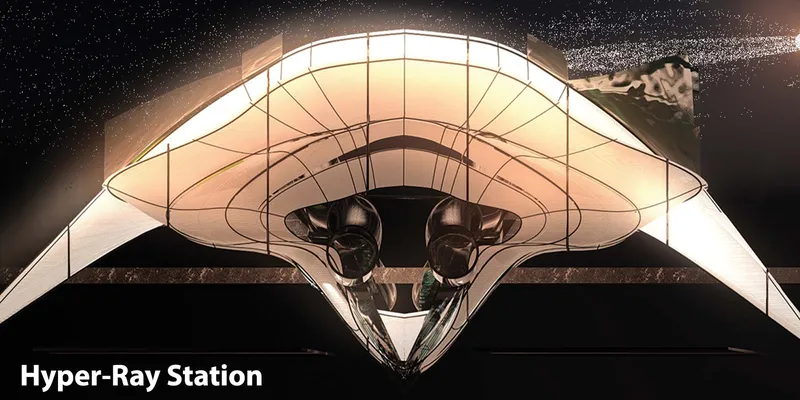
Fig: 6 Cover image
Description: An adaptive shell abstracted by the concepts of the Aerodynamics and these formative processes of erosion and weathering. Using site conditions, such as the highway, bridge and hyperloop, were deployed as major wind vectors to gather a base form.

Follow us on social media: Facebook | Instagram | LinkedIn | Twitter | Youtube
References (3)




Popular Articles
Popular articles from the community


The Musturak Paradise: Senior Living Architecture for a Connected Future in Temara, Morocco
The Musturak Paradise reimagines senior living architecture in Temara via private homes, social spaces, culture, community, and shared care.

Co-life: Sustainable Architecture for Age-Friendly Community Living
Co-life reimagines sustainable architecture for seniors through courtyards, rammed earth, shared gardens, and spaces designed for belonging.

Play: Fragments of Their World
Familiar architecture becomes modular playground design, creating safe spaces where displaced children can learn, connect, imagine and play.

Co-Life: Senior Housing Design That Reconnects Older Adults With the City
Co-Life reimagines senior housing design through healing gardens, shared streets, workshops, and a sustainable community across generations.


Similar Reads
You might also enjoy these articles

Lunar Spiral: Space Architecture Shaped by the Mathematics of the Universe
Lunar Spiral reimagines space architecture through Fibonacci geometry, lunar regolith, levitating habitats, and self-sustaining Moon living.
The Main Dream: Modular Architecture for Play, Learning, and Community
A modular playground turns recycled plastic into adaptable spaces where refugee children can play, build, learn, and reconnect.
Play: Fragments of Their World
Familiar architecture becomes modular playground design, creating safe spaces where displaced children can learn, connect, imagine and play.

Wadi Rum Observatory: Desert Architecture Designed for the Night Sky
Wadi Rum Observatory turns desert architecture into a quiet instrument for astronomy, hiding research spaces under Jordan's starlit terrain.


Comments (0)
Please login or sign up to add comments
No comments yet. Be the first to comment!