

a coffee bean
The Coffee Bean Pavilion

Coffee is a daily dose of joy, peace, excitement and indeed a necessity for millions of people across the globe. It helps make one feel more awake and lively. The Coffee Bean Pavilion - takes its inspiration from a simple coffee bean to generate a surge of emotions in the user. The simple connection of the user with the coffee bean helps the pavilion to achieve an environment that generates liveliness and stimulates energy.

The major driving concepts of the coffee pavilion were to establish a connection with the user while achieving a sustainable design that could be achieved parametrically which would in turn allow for an efficient modular replication.
Simplicity of the design and repetition of the units makes it possible to have an easy, efficient and fast construction enabling it to be modular and made at different sites. For the ease of visual understanding the site chosen is the rooftop of ‘The Heights Building’ of BIG architects located in the USA. Coffee for Americans is a hot and classic beverage, thus making the location of the site an appealing place for the set up of the coffee pavilion. The Heights Building opens as a cascade of green terraces fanning from a central axis, addressing the academic needs of Arlington’s two county-wide school programs while forming a vertical community within its dense urban context.
Coffee here lays the ground for offering a sense of connectivity with the pavilion, as the design offers a sense of familiarity with the shape of a coffee bean and one’s experience after its consumption.
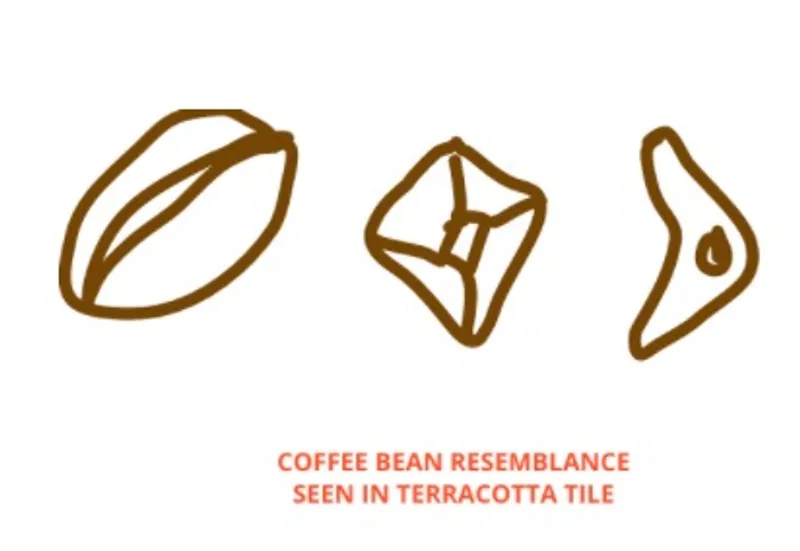
The primary material used for the design is terracotta which is a highly eco-sustainable material and steel rebars are added for support. Terracotta is an easily manufactured material which also makes it easily available in the local market. In addition to it, factors such as fairly easy resistance to heat and climate, its high strength and durability makes it an appropriate choice of material for the pavilion. The sense of contrast that the materiality of the pavilion brings, in terms of the surrounding context and design is a direct interpretation and analogy of how the use of terracotta for a design of parametricism placed in an absolute urban setting is being depicted through the mix of contemporary and local vernacular.
While the skin is made out of terracotta the skeletal framework of horizontal and vertical reinforcement bars are made out of steel. They are welded together. Terracotta tiles in the first column are horizontally slided on the steel rods. These tiles can be rotated along the rod allowing user engagement with the pavilion. Alternate layers of terracotta tiles are treated differently. The tiles in the second column are cladded onto the vertical steel bars, with the use of screws. Each terracotta tile has a cavity resembling a coffee bean that repeats itself to achieve parametricism and is uniquely made with varied sizes of the cavity. The cavity’s size changes from top to bottom of the pavilion. The aim was to achieve lesser sunlight infiltration from the top and more cross ventilation thus, resulting in the lower panels having a bigger cavity/hole and a gradually decreasing size of the cavity as it goes to the top. Light enters the pavilion through these openings keeping the inside lit and energised. Coffee aims at awakening the senses resulting in an increase in one’s work productivity. This is precisely what the pavilion offers via its openings and coffee bean like form. The warmth that the pavilion offers through the earthy color tone of terracotta tiles drives in a sense of similarity with the color of coffee, further familiarizing the user’s visual perception of the pavilion.
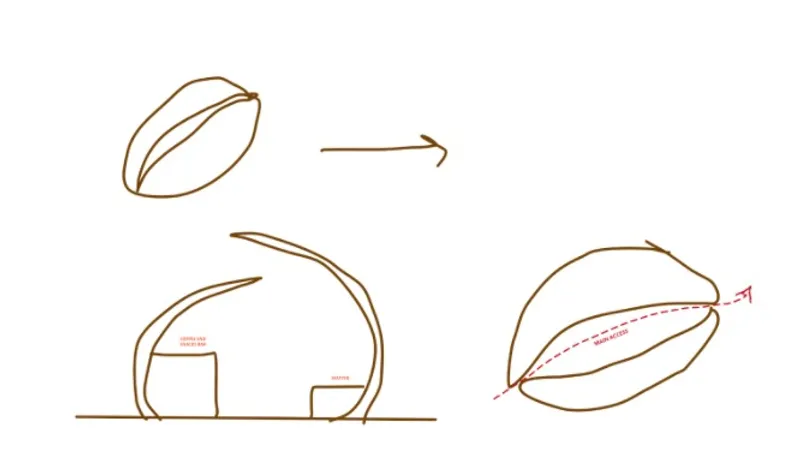
The pavilion offers a multitude of activities. In addition to acting as a meeting, relaxing point there's also a coffee bar present with an eatery joint connected. It makes it an actively social interactive zone while offering a comfortable environment for the user to enjoy the activities emphasizing on the proposition of placemaking as a brewing concept. In all, the pavilion acts as a visually attractive meeting point to a variety of users that provokes connectivity and social engagement.

Popular Articles
Popular articles from the community


Cube Design Draws an Ecological Corridor Between Two Shenzhen Hills with the Nankai Building
Beside Shenzhen's container docks, the Nankai Building pairs stacked balconies with a climbing green screen to connect two hillsides across its height.

ETEH Reworks the Shared Spaces of São Domingos School in Brazil Around Timber, Color and Hanging Plants
At São Domingos School in Brazil, 436 m² of hall, refectory and library are recast with timber joinery, a yellow and blue code and trailing greenery.

graciastudio Turns a Viewless Tijuana Lot Inward Around a Courtyard of Concrete, Timber and Trees
In Tijuana, Jorge Gracia's GA2 House stacks a timber-clad private floor over exposed concrete and replaces a missing view with a planted interior patio.


The Amber Palace Opera: A Geological Fiction Surfaces on Tallinn's Baltic Waterfront
Pierre Brillard reimagines a Baltic legend as a public landscape, opera house, and waterfront promenade rooted in Tallinn's coastal identity.

Similar Reads
You might also enjoy these articles

Juan García Correa, John González and Claudia Rueda Sink a Circular Amphitheater into a Manizales Engineering Building
On the La Nubia campus in Manizales, Colombia, the S1 Building folds labs and offices into a hillside of ramped lawns that double as a campus route.

Arealis Brasil Wraps a São Paulo Office for Everis's Creative Arm Around a Glowing Curved Counter
In Brooklin Paulista, a 300 m² office for the creative agency Chazz uses timber, metal mesh and ribbed green glass to blur workspace and pub.

LT2A and OPEN Architectes Thread a Brick and Glass High School Through a Wooded Belgian Campus
In Braine-l'Alleud, a 3,000 m² wing for Collège Cardinal Mercier pairs pale brick with a glazed colonnade, deferring to a small chapel and a dense wood.

Atelier Diving Bell Stitches a Hangzhou Food Court Together with a Louvered Steel Canopy
In Hangzhou's Liangzhu Culture Village, a 1,400 m² food court renewal uses canopies, tree benches and props to turn a passage into a place.

Comments (0)
Please login or sign up to add comments
No comments yet. Be the first to comment!