
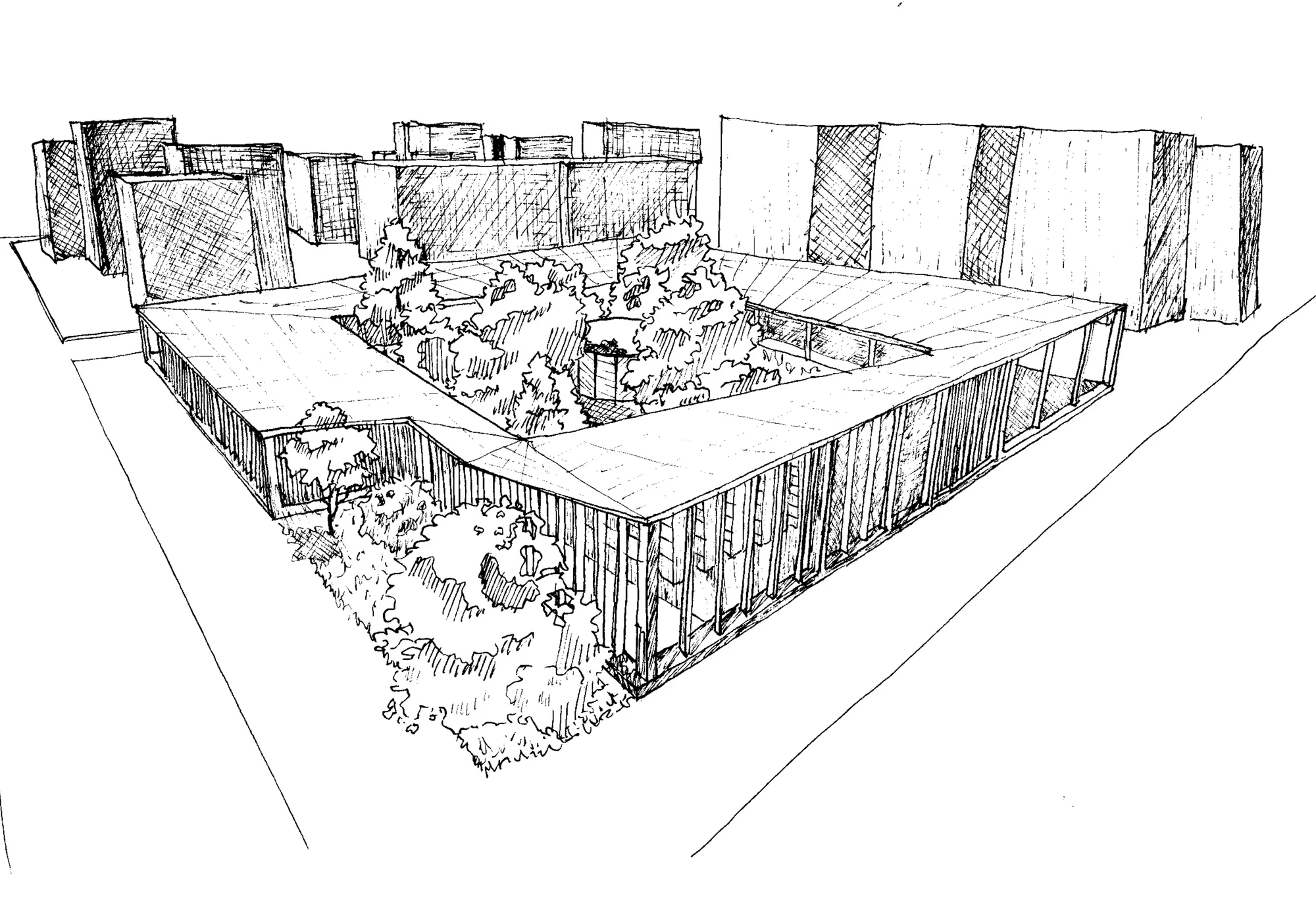
A HOUSE FOR THE SOCIETY
Why this building ?

A town is a place of expression of diversity at every scale, whether it be cultural, ideological, human, architectural. Outside the private realm, it is also a place of shared spaces and fate, which implies a common patrimony among citizens. Therefore, it is necessary to conciliate diversity and resemblance to create a society that works, thinks, imagines solutions together to prosper.
To do so, a society needs culture, interactions between citizens, and political life. Culture because it gives everyone a common background that allows mutual comprehension. Interactions and social life because they convey exchange of opinions, and link one to others’ opinions and concerns, which makes these moments where a debate first emerge. Political life because it is the tool that frames the various debates of a society, and the place where decisions are taken.
The townhall of Salzburg must express this ideal, as a welcoming place for every citizen and every usage. A house for all the citizens. Thanks to the different kinds of usage, diversity is generated in a single venue, which leads to exchanges and mixing, which is a source of enrichment and discoveries for all. Now that citizens gather at the same place, the townhall finally needs to highlight politics as a human creation that commits everyone to be concerned with. When it is done, the townhall provides for the needs of a society, culture, interactions, and politics, and can represent the essence of this society.
CULTURE
The program specifies a library, an exposition, and a conference hall. The first is the place where knowledge is stored and made freely accessible. Hence, it must be opened towards the street, so that the view of books and peoples reading them prompt others to enter. Inside, the view of nature and the filtration of light through the leaves offer a peaceful and warm-lighted environment for studying on the south-oriented tables. Moreover, the passageway gives the opportunity to find the perfect reading spot, once again surrounded by nature and light.
The exposition and conference hall are spaces dedicated to idea exchanges and mixing, confronted to the public’s judgement. While the conference hall has to be closed and private for the speaker to have the regard of people he speaks to, the exposition hall is made available at any time and appealing to everyone through transparency. The architecture erases its presence to put people and usages at the foreground.
These two buildings are linked by a plaza, where to gather with friends, but also a space that acts like a welcoming entrance, by its volume and its placement in the corner, it seems to escape from the facade.
INTERACTIONS
Stimulating interactions means offering an atmosphere of openness and well-being, in order to create a mood where people are willing to meet each other. This is achieved by permitting visitor to freely flow around or inside the garden: the liberty to sit anywhere, the liberty to wander, protected inside the passageway and with the presence of nature, one of the few things most people can connect with. The opposition between the possibility to sit or circulate inside a same space creates the conditions for two persons to encounter unexpectedly. Those two persons are helped by transparency which offers the view of the building’s public and their activities, whether it be in the offices, the library, or the cafeteria. Therefore, a visitor is offered the choice of how he wants to experience the building, and he’s constantly given the example of what his peers are doing. Architecture is made quiet and humble because it is here to serve visitors and Nature.
But peers also need a place to meet, this is the cafeteria. A comforting place by essence, effect enhanced by the chimney. This is the perfect place to meet and discuss after assisting to a conference or taking a break away from the offices or the council chamber. This sort of public, there, mixes with other citizens, who come here to share a drink, but will eventually be encouraged to think about politics, the close by council chamber acting as a constant reminder.
POLITICAL LIFE
The outer part of the townhall regroups activities that are meant to be shared, that can benefit everyone willing to take part, that make up the daily life of citizen: cultural exchanges, social exchanges, and organization. This is a political choice, where having the conditions for reunion of different individualities is of the utmost importance. Once interactions between the diversity of humankind occurs, there is the need to centralize the debate in a building accessible to all, and demonstrating to all, at the core of the townhall.
A citizen acquires knowledge at the library, he uses that knowledge to discuss with citizens he meets at the cafeteria or along the passageway, and discussions lead to concrete decisions after being brought to the council chamber. Having a garden inside the townhall is a political choice. It is here to remind constantly of Nature, therefore Ecology, by offering the chance to experience it. By circling the council chamber with gardens, we create a peaceful space and hoping to anchor ecology in politicians and citizens’ thoughts and concerns. Transparency helps us to express a political architecture, where the townhall disappears to serve the relation between society and nature.



Popular Articles
Popular articles from the community


The Ocean Hive: Sustainable Architecture for a Self-Sufficient Civilization at Sea
The Ocean Hive imagines sustainable architecture at sea, where modular habitats, algae, wave power and ocean waste sustain a growing colony.
AL-JANNAH: Sustainable Architecture and Permaculture for Afghan Widows
AL-JANNAH uses sustainable architecture and permaculture to create resilient oasis of housing, learning, work and renewal for Afghan widows.

Riyadh For All: Intergenerational Urban Design for Active Aging in Rabat
Riyadh For All reimagines urban design in Rabat with intergenerational co-living, adaptive courtyards, and Moroccan cultural exchange today.

Conexión: Biophilic Design Reimagines High-Rise Living in Hong Kong
Conexión reimagines high-rise living in Hong Kong through biophilic design, green facades, shared spaces, daylight, water and nature within.

Similar Reads
You might also enjoy these articles

The Rhythm of Seasons
A Farmers' Market Connecting Nature and the City

More Than a Building-Designing a Living System
More Than a Building-Designing a Living System
Base Beyond
DESERT COMPOUND ARID: TOURISM OF ABSENCE AND ABUNDANCE


Comments (0)
Please login or sign up to add comments
No comments yet. Be the first to comment!