

Centro Habana Urban Regeneration, Desde Adentro: Rebuilding Havana's Dragones One Street at a Time
A five-phase, street-led strategy for Havana's Dragones district that turns vacant lots and decaying buildings into cultural and public space.


Most regeneration plans for historic cities arrive from above: a masterplan, a demolition schedule, a signature building. Centro Habana Urban Regeneration, Desde Adentro takes the opposite route. Its title means "from within," and the proposal holds to that idea. It renews a dense, fragile neighbourhood through the lots, facades and street life it already has, rather than replacing them.
Designed by Sara Venturini and Carolina Solis Bonini, the project focuses on the Dragones area of Centro Habana. The district sits between two very different parts of Havana. Habana Vieja draws heritage tourism investment, and Vedado has a more open urban fabric. Centro Habana, by contrast, remains crowded and short of resources. Its compact blocks hold mixed typologies, historic facades in uneven states of repair, vacant lots and very little accessible green space. The designers treat these gaps as the raw material for a fine-grain, incremental strategy built on community engagement and adaptive reuse.
The Roadway Is Already a Public Square
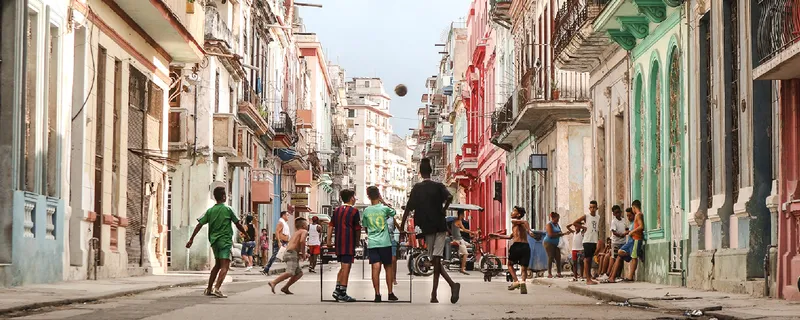
The opening image makes the argument before any drawing does. Boys play football in the roadway, framed by pastel colonnades and balconies, with the ball caught in mid-air. In Dragones the street already works as shared space. What it lacks is the design support to keep that use safe, comfortable and permanent.
That observation shapes the whole project. Instead of applying one transformation across the area, the designers build a catalogue of intervention types. Each site is sorted by building condition, level of decay and ownership structure. This sorting matters. It turns a broad wish for renewal into a set of specific, feasible moves that can happen site by site as resources allow.
Calle Perseverancia Starts Small: Insertions, Squares and Slower Traffic
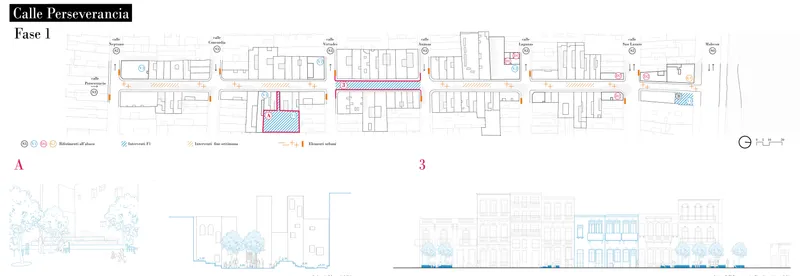
Calle Perseverancia is the pilot corridor, the place where the full process is tested along a single street. The Phase 1 plan marks scattered interventions along one long block. Its sections show a planted square and a row of facades. These are deliberately modest: small public space insertions, temporary programming and traffic calming. They cost little, but they begin to change how residents see and use the street.
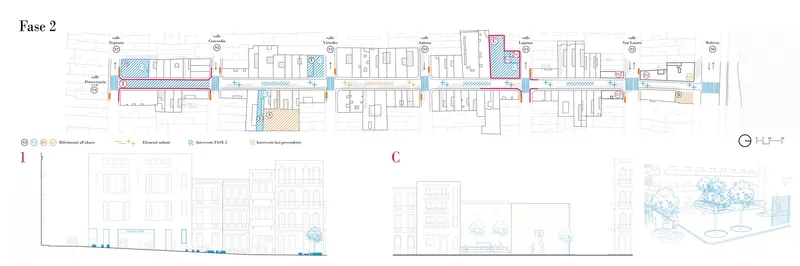
Phase 2 moves from activation toward consolidation. The plan highlights specific lots and crossings. The sections now include a sloped facade, a courtyard and another planted square, which signals that the work is reaching into the block itself and no longer stops at the street edge. Selected buildings enter adaptive reuse and take on cultural and artistic functions. Because the drawings repeat the same street phase after phase, the change reads as a process over time rather than a single finished image.
Intersections Become Pedestrian Nodes
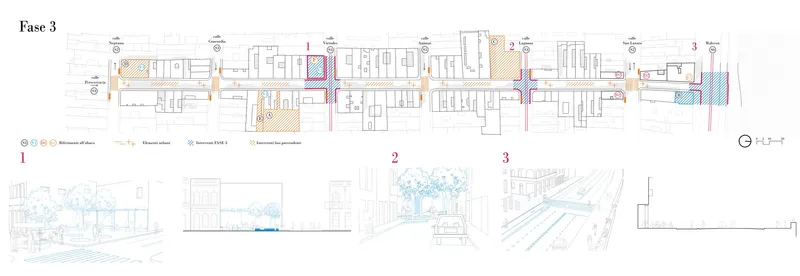
In Phase 3 the intervention sites are numbered, and the perspective sketches focus on planted crossings. Intersections are redesigned as pedestrian priority nodes. This is a sharp choice: in a grid of tight blocks, the corners are where the most people meet. The sketch of a street with a car still in it is honest about the outcome. Vehicles are not banned. Instead, the corridor shifts its balance step by step, from a purely vehicular route toward a multifunctional spine for commerce, culture and everyday social life.
Ateliers, Galleries and Laboratories Stacked Inside Rehabilitated Shells
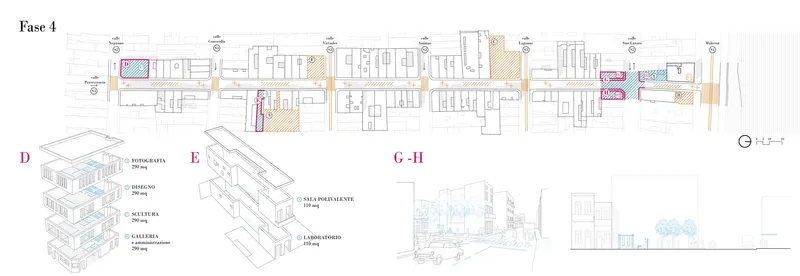
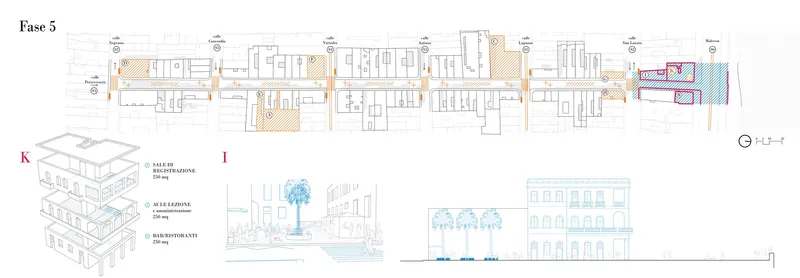
Phases 4 and 5 bring in the programmatic anchors. Exploded axonometrics of two buildings show uses labelled floor by floor. A three-storey building in the final phase gets the same treatment. Larger structures are rehabilitated to house photography studios, drawing ateliers, sculpture workshops, galleries, multipurpose halls and laboratories. Stacking these uses vertically inside existing shells keeps the historic street wall intact and makes each building denser in activity.
The palm-tree plaza perspective and the street view with a vintage car keep this new cultural infrastructure tied to a recognisable Havana. The designers present the anchors as an economic engine as well as a cultural one. The workshops and halls are meant to sustain the regeneration financially and to strengthen neighbourhood identity, rather than turning the area into a gallery district for visitors.
Blue Line-Work Fills the Gaps Between Real Facades

The street elevation may be the most telling drawing in the set. Real photographs of existing buildings sit beside blue line-art outlines of proposed infill and new trees. The method itself states the design position. What already exists stays as it is, documented as found. New work is drawn lightly, in the spaces left by decay and vacancy. The proposal adds to the street wall where it is broken and leaves the rest alone.
Why This Project Matters
Desde Adentro treats participation as infrastructure, not consultation. In this proposal, residents are active agents in shaping their neighbourhood, and regeneration becomes a framework for civic empowerment as much as a building programme. For a district that has missed out on the investment flowing into Habana Vieja, that matters. Renewal that grows out of existing social structures is less likely to push those structures out.
The project's lasting lesson is its timing. Five phases, each building on the last, allow the street to change continuously instead of abruptly. Every stage stays legible and useful even if the next one is delayed. By testing the full sequence on one corridor, Venturini and Solis Bonini offer a model that could repeat across the grid of Centro Habana, one street at a time.
View the Full Project
About the Designers
Designers: Sara Venturini, Carolina Solis Bonini
Enter a Design Competition on uni.xyz
uni.xyz runs architecture and design competitions year-round that reward proposals with spatial conviction and real site intelligence.
Project credits: Centro Habana Urban Regeneration by Sara Venturini, Carolina Solis Bonini.


Popular Articles
Popular articles from the community


Singing Woman: An Opera House That Performs Before the Curtain Rises
Ovidiu Cristian Pavel's conceptual opera house translates Estonia's choral identity into a sculpted waterfront landmark facing the Baltic Sea.

The Amber Palace Opera: A Geological Fiction Surfaces on Tallinn's Baltic Waterfront
Pierre Brillard reimagines a Baltic legend as a public landscape, opera house, and waterfront promenade rooted in Tallinn's coastal identity.


Cube Design Draws an Ecological Corridor Between Two Shenzhen Hills with the Nankai Building
Beside Shenzhen's container docks, the Nankai Building pairs stacked balconies with a climbing green screen to connect two hillsides across its height.

FCC Arquitectura Expands a Portuguese Granite House with a Board-Marked Concrete Wing
In Portugal, JV House pairs a cleaned-up whitewashed and granite dwelling with a timber-shuttered concrete extension, courtyards and a garden pool.

Similar Reads
You might also enjoy these articles
Healing Façade: A Modular Chapel System That Restores Ethiopia's Sacred Forests
Winner of the Eco-Chapel competition, this circular timber façade collects water from air to rebuild soil and reforest degraded Ethiopian landscapes.
Kaffeebühnen: Where Coffee Shop Architecture Becomes a Civic Stage in Vienna
A linear sequence of timber boxes, transparent shells, and open yards turns the Viennese café tradition into a public performance space.
Eco Chapel: A Modular Forest Pavilion That Grows Like the Landscape It Protects
Hexagonal timber modules weave through existing trees, turning a chapel into a living system for prayer, education, and reforestation.


Urban Forest: A Vertical Ecosystem for 5,000 Workers in Singapore's Changi Business Park
Radially stacked pods and layered green decks turn a 7-acre plot into 47 acres of ecological workspace projected for 2040.

Comments (0)
Please login or sign up to add comments
No comments yet. Be the first to comment!