
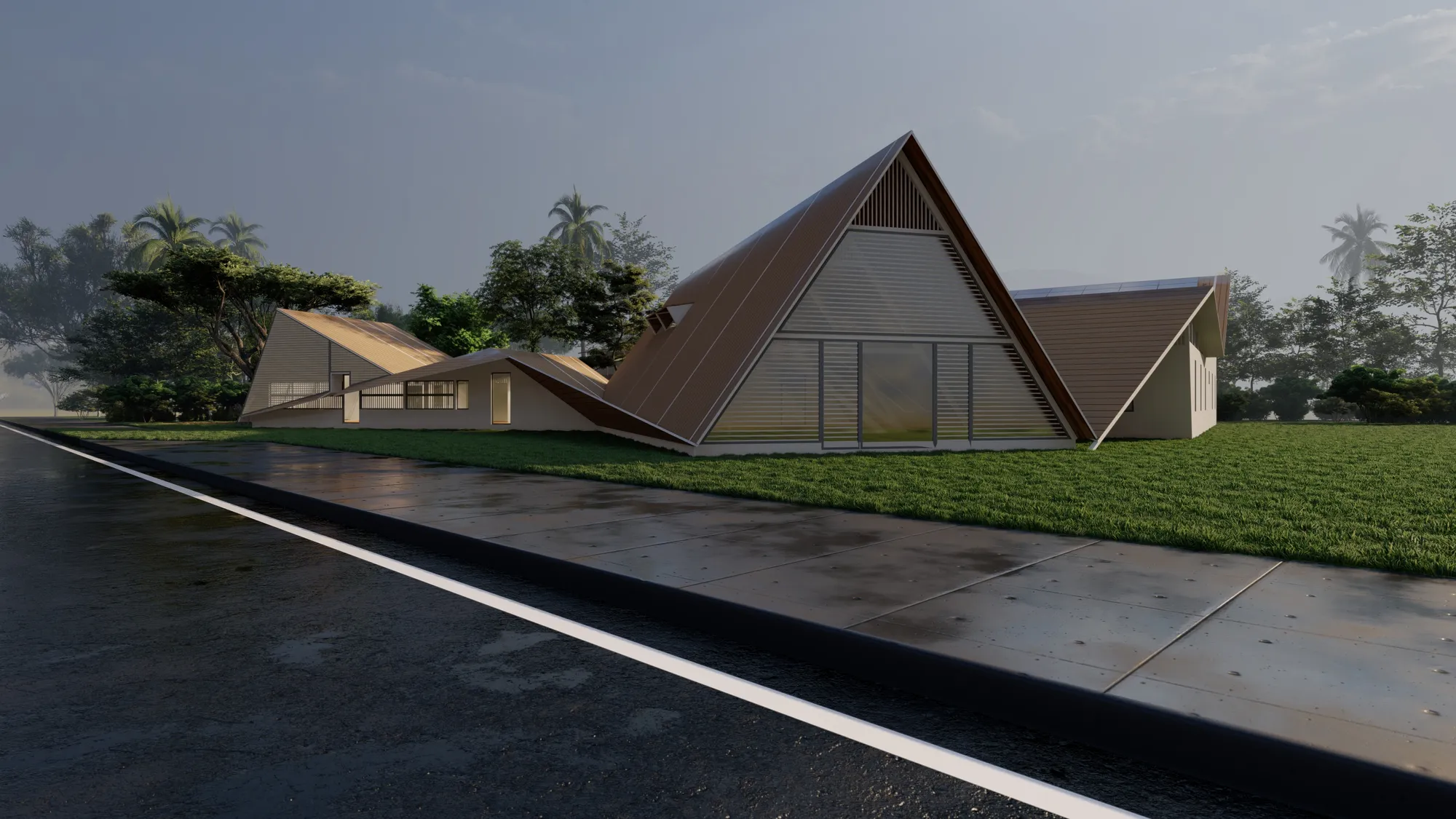
A respite - on the way
An oasis of tranquility for the trucker

The Premise
Think about the trade network of India, and you can picture the endless National Highways, the paddy fields dotted along its sides and the multicolored inter state trucks - parked when the sun is up and darting across as the lights go down.
As mentioned in the project brief, the human element who makes modern day trade and transport possible, are a stressed lot; with low pay, poor infrastructure, unhygienic rest conditions and limited food choices - the profession seems too lackluster a trade in comparison to other jobs they could take up in their hometown. It is time we integrated a well designed hospitality infrastructure for the heroes who keep our trade lines running.
The site
The 2202 Sq.m site located beside the NH 544 at Kannadi in Palakkad, Kerala is a lush green haven offering some much needed respite to tired eyes. The surrounding parcels of land sporadically used for agriculture ensures that this locale would stay green and untouched in the near future.
The district has a humid climate with a very hot season extending from the months of March to June. The rainy season - South West Monsoon sets in during the second week of June and extends up to September is complete with heavy rains during which 75 per cent of the annual rain is received. The temperature of the district ranges from 20°C to 45°C . Trade winds blow from the South-Western to North-Eastern direction.

Design Development
Conceptualization began keeping 2 major tenets in mind - that the built unit should be replicable across the country yet visually and functionally be an organic inclusion to the landscape.
Basing the form study on Kerala homes and their passive ventilation strategies, using courtyards and sloping roofs to aid in creating a stack effect; the slope further aids in homogeneous collection of rainwater and the overhanging eaves offer protection during the rains.

The hills of Palakkad offered a style we could try to mimic creating a rather non disruptive inclusion against a similar backdrop of mountain ranges and trees.

The design of a rest stop for about 100 truck drivers for the purpose of quick pitstops for refreshing, spaces to share and consume meals and spaces for sleep or longer rest necessitated a design brief which included an admin area, toilet and dormitory block (with bunk beds), kitchen and dining area (with a pantry space to cook by oneself if needed), relaxation and games zone, essential utilities like Grocery for those who wish to stay longer and an ATM.
The next parameter we considered as part of the design development is how best to create a feeling of respite in the truckers - a break to the monotony of endless roads that mar their vision. We decided to make the building inward facing - towards an artificial micro forest that would be created as an oasis of tranquility, one where the truckers could relax and rejuvenate before setting off on their journey. This space would also aid in improving social sustainability - interaction and cohesion among the peers.

Being a public infrastructure project, cost efficiency through material usage and energy conservation is key. Kerala as a state is relatively smaller in land area compared to its neighbors, with fewer open land availability for utility-scale solar projects; the Kerala Solar Energy Policy of 2013 mandates that the state needs to focus on rooftop solar PV reforms to encourage solar installations. In addition, the MoUD has made rainwater harvesting mandatory in all new buildings with a roof area of more than 100 sq. m. and in all plots with an area of more than 1000 Sq.m, that are being developed.
We have provided South facing roofs with solar panels which would be connected to the grid and act as energy generator. The buildings have roofs which double up as walls to reduce heat gain and lesser maintenance during rains. An artificial pond is provided in the south-west corner of the plot and blocks oriented in a way that cool breeze is drawn in towards the central micro forest where the truckers could relax.
Material Usage
In regions such as the Indian subcontinent with extreme weather conditions, aluminum is the preferred material for fenestration and has been used in the pitstop since it is non-reactive, non-corrosive, resilient and recyclable.
The pitstop has been provided with Coir corrugated Sheet on a steel framework. Coir fibre is one of the natural fibres abundantly available in tropical regions, and is extracted from the husk of the coconut. The many advantages include providing insulation against temperature and sound, not easily combustible, unaffected by moisture, tough, durable, resilient and easy to clean. Coir has found desirable applications in the field of construction with the advent of light-weight concrete technology and cheap availability of the raw material; it can reduce the production costs and hence the housing expenditure on roofing, thereby total cost can be considerably truncated.
External walls using coconut fibre cement panels have been used which provides a cost effective thermal insulation strategy. Vertical louvres using Mild steel has been applied in facades to bring in ventilation and daylighting. The Internal partitions have been kept to a minimum and only in areas which require privacy like the dormitories; in other places polycarbonate sheets have been placed. The floor is covered in grey Polyurethane.
Conclusion
A respite - 'on the way' has been designed using pre-fabricated materials to reduce labour requirement and construction time. It is also easily replicable according to site requirements keeping the spatial and functional layouts similar. This pit stop acts as an oasis of tranquility for the trucker, and a green lung along the NH.
References (4)
Development of Coir-Fibre Cement Composite Roofing Tiles
Publisher: Elsevier ltd
Vol. 2212-0173
Coconut Fiber Cement Panels as Wall Insulation and Structural Diaphragm
Publisher: Frontiers in Energy Research
Vol. 72296-598X



Popular Articles
Popular articles from the community


Co-Life: Senior Housing Design That Reconnects Older Adults With the City
Co-Life reimagines senior housing design through healing gardens, shared streets, workshops, and a sustainable community across generations.

Hill & Cross Opera: Sculptural Opera House Architecture Shaped by Tallinn’s Landscape and Identity
Hill & Cross Opera reimagines opera house architecture in Tallinn through its sculptural hill, civic plaza, glass wave and a luminous cross.

Riyadh For All: Intergenerational Urban Design for Active Aging in Rabat
Riyadh For All reimagines urban design in Rabat with intergenerational co-living, adaptive courtyards, and Moroccan cultural exchange today.

The Musturak Paradise: Senior Living Architecture for a Connected Future in Temara, Morocco
The Musturak Paradise reimagines senior living architecture in Temara via private homes, social spaces, culture, community, and shared care.


Similar Reads
You might also enjoy these articles

The Rhythm of Seasons
A Farmers' Market Connecting Nature and the City

More Than a Building-Designing a Living System
More Than a Building-Designing a Living System
Base Beyond
DESERT COMPOUND ARID: TOURISM OF ABSENCE AND ABUNDANCE

Explore Oasis Competitions
Discover active competitions in this discipline




Challenge to reimagine the Iron Throne


Photograph architecture without architects


Illustrate the lost glory of Angkor Wat - Render Challenge


Design challenge to reuse E-waste
Comments (0)
Please login or sign up to add comments
No comments yet. Be the first to comment!