
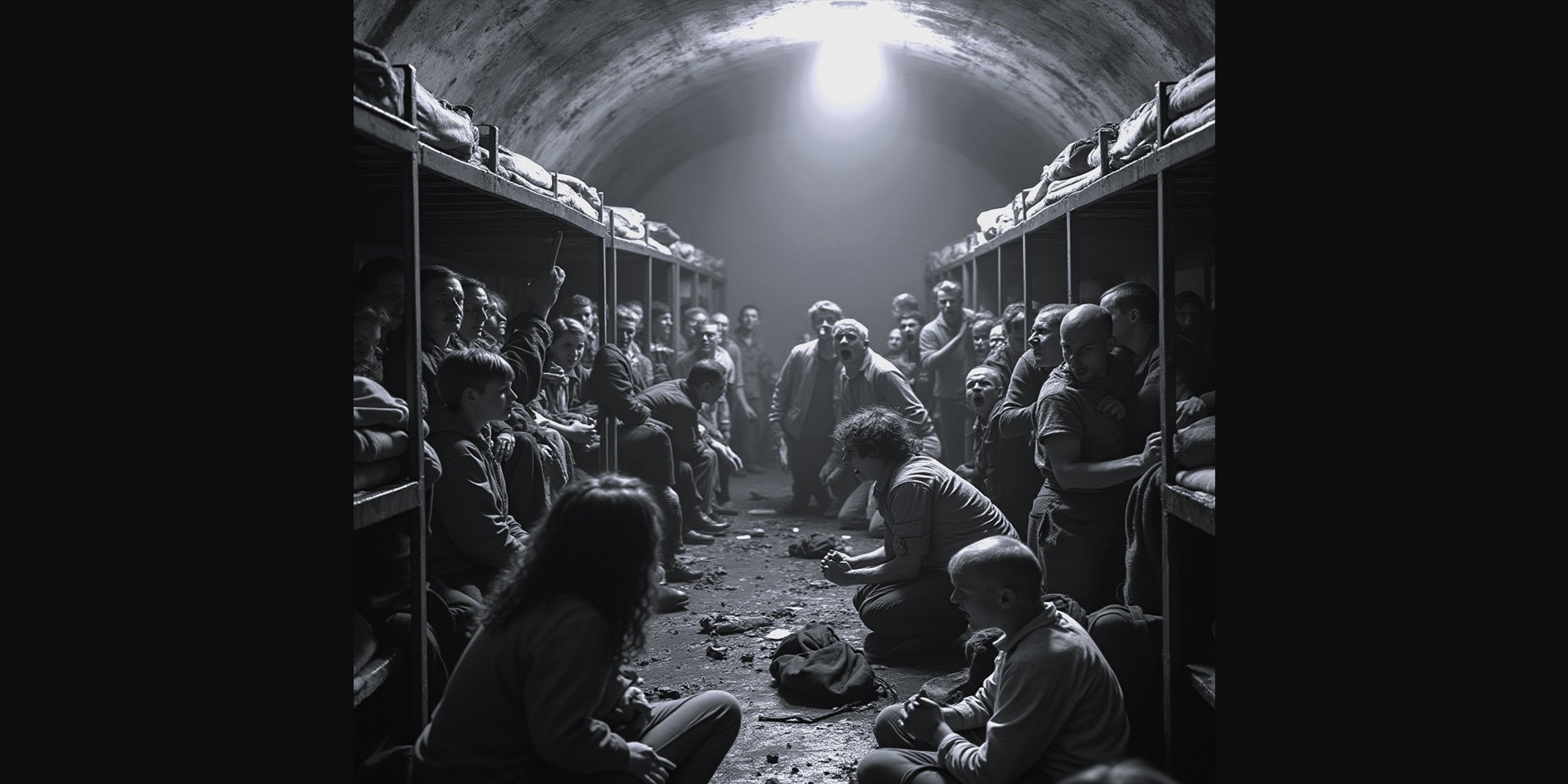
Adaptation of post-war civilian shelters as a tool of contemporary protective architecture
From forgotten relics to foundations of resilient cities

Where would you go if the sirens sounded today? Do you know the nearest civil shelter? Would it be accessible in the moment of crisis? Could you stay there safely for hours, days, maybe weeks? For most people in Poland, and in many other parts of the world, the answer is “no.”
The urgency of resilient infrastructure
We live in an age defined by uncertainty. Climate change, geopolitical tensions, technological risks, and civilizational crises force us to rethink the very foundations of urban safety. Civil protection cannot remain an afterthought, left to improvisation when disaster strikes. It must become an integral part of our cities, embedded in their everyday functioning.
This project responds to that urgent need. It focuses on how urban infrastructure can adapt to growing environmental, military, and societal challenges by reimagining post-war civil shelters as active, multifunctional components of urban life.
Civil shelters as a hidden resource
Across Poland, thousands of protective facilities exist, many of them relics of the Cold War era. Today, they are mostly degraded, forgotten, or unused. Yet these structures embody a unique potential: they can be transformed into resilient nodes within the urban fabric.
The vision is simple but powerful:
- In times of peace, civil shelters can serve education, culture, and recreation — enriching community life and strengthening public awareness of such spaces.
- In times of crisis, they can return to their original function—protecting the population against threats.
This dual role ensures that safety infrastructure is never wasted, never idle. It remains relevant every day, not just in emergencies.
Learning from international models
Poland is not alone in facing the challenge of modernizing protective infrastructure. Other countries have already developed effective strategies that integrate civil protection into daily urban life.
- Finland requires civil shelters in all new residential and public buildings. These spaces function daily as sports halls, parking garages, or community centers — ready to transform within about a dozen hours into carefully designed civil protection facilities.
- Switzerland has a nationwide shelter system with capacity for the entire population, linked to detailed crisis management protocols.
- Sweden has recently reinvested in protective infrastructure, reconnecting it with civic education and preparedness.
- Israel treats civil shelters as part of everyday urban life, blending them into the social and cultural fabric of cities.
These examples demonstrate that civil shelters are not obsolete structures—they can be central to a resilient society.
The Polish context: a system unprepared
Against this international backdrop, Poland’s situation is critical. Protective infrastructure here suffers from:
- Insufficient preparedness – most facilities cannot serve their intended purpose.
- Fragmented legal responsibility – no clear system of management or modernization.
- Lack of systemic solutions – policies remain outdated, while threats evolve rapidly.
The result is a society vulnerable to crisis. Without adaptation, Poland risks relying on improvisation in moments where human safety is at stake.
The design proposal: resilience in Silesia
The architectural part of this research addresses this gap through a model proposal for adaptive reuse of existing civil shelters in the Silesian metropolitan area.
Why Silesia?
- It is one of the densest urban agglomerations in Poland.
- It possesses one of the richest networks of underutilized protective facilities.
- It represents both the challenges and the opportunities of transformation.
The project combines international experience with local needs, proposing a scalable model for the modernization and adaptive reuse of civil shelters in Poland and beyond.
Resilience architecture: a new paradigm
This concept aligns with the broader idea of “resilience architecture.” It is not only about buildings—it is about trust, participation, and the social value of space.
Resilience architecture means:
- Embedding safety into everyday urban fabric.
- Empowering communities to engage with protective infrastructure.
- Ensuring that preparedness becomes a shared responsibility, not a hidden system.
It transforms fear into agency. It replaces abandoned relics with active urban spaces. And it creates a culture where protection is not an exception, but a foundation.
Call to action
Because when crisis comes, politics, borders, and wealth lose meaning—human safety matters. Can we allow the future of our civilization to depend on improvisation? The answer must be “no.”
Poland’s case is urgent, but the message is universal. The need to adapt and build civil protection facilities is not an option—it is a necessity. A last chance to act before improvisation becomes our only defense.
Final words
Safety is not optional — it is infrastructure.
Civil shelters are not relics — they are the blueprint for tomorrow’s resilient city.
Resilience begins where fear ends.



Popular Articles
Popular articles from the community



Inverted Architecture Installation by Studio Link-Arc: Exploring the Intersection of Architecture and Living Organisms
Inverted Architecture Installation by Studio Link-Arc blends mycelium, sustainability, inverted design, ecological cycles, and urban adaptive architecture in Shenzhen.


The Ken Roberts Memorial Delineation Competition (Krob)
As the most senior architectural drawing competition currently in operation anywhere in the world, it draws hundreds of entries each year, awarding the very best submissions in a series of medium-based categories.

Free Architecture Competitions You Can Enter Right Now
No entry fees, real prizes. Here are the best free architecture competitions open for submissions in 2026.
Similar Reads
You might also enjoy these articles
Scientific and Educational Monitoring Center of the Yenisei, Krasnoyarsk
Architecture as an instrument for ecological research, education, and environmental awareness along Russia’s largest river.
Development of Andretta Artist’s Village, Palampur, Himachal Pradesh, India
Reimagining Andretta as a living cultural landscape where art, architecture, and community converge to shape a global creative village.

The NEON Culture: Experiential Architecture Shaping Contemporary Urban Life
Exploring how experiential architecture responds to accelerated lifestyles through immersive spaces, adaptive programs, and sensory-driven urban design.

Narwall: Autonomous Offshore Architecture for Extreme Environments
A visionary model of sustainable offshore architecture, Narwall redefines public life, energy autonomy, and resilience in extreme Arctic waters.


Explore Architecture Competitions
Discover active competitions in this discipline




The International Standard for Design Portfolios


The Global Benchmark for Architecture Dissertation Awards


The Global Benchmark for Graduation Excellence


Challenge to reimagine the Iron Throne
Comments (0)
Please login or sign up to add comments
No comments yet. Be the first to comment!