

AgriFlex: A Modular Marketplace Where Farmland Meets the City Block
In Roeselare, Belgium, a linear steel and glass structure transforms the boundary between agriculture and urban life into a living public plaza.


What happens when you place a greenhouse and a café on opposite sides of the same axis and let a marketplace grow in between? AgriFlex answers that question with a linear architectural proposition that treats the rural-urban boundary not as a line to defend but as a threshold to inhabit. Sited in Roeselare, Belgium, where farmland and city blocks press against one another, the project organizes transparent agricultural greenhouses on one flank and urban program modules on the other, leaving the center open for a public plaza that can shift from farmers' market to seasonal festival to exhibition space on any given day.
Designed by İrem Büyükpolat, AgriFlex is a People's Choice Award entry in the Farm to CITY competition. The project positions itself as a prototype for resilient community architecture, exploring how agricultural production and social interaction can coexist within a single adaptive structure. Its ambitions are both spatial and civic: to merge production, culture, and human connection without collapsing them into one generic enclosure.
A Steel Frame That Doubles as Public Furniture
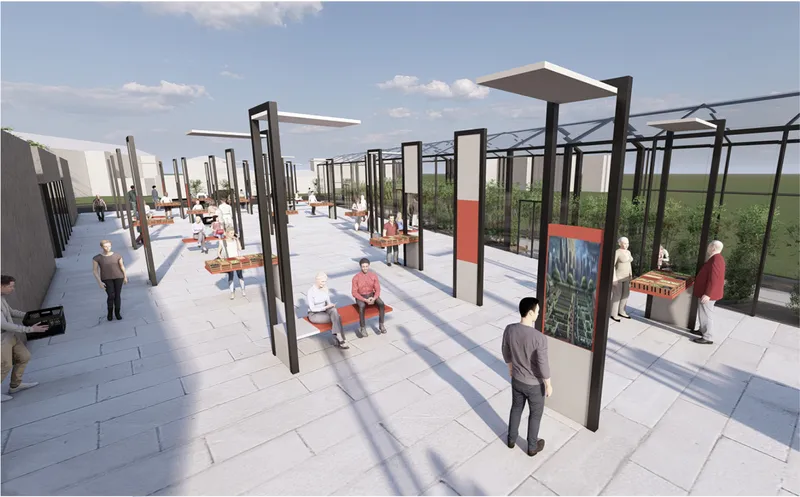
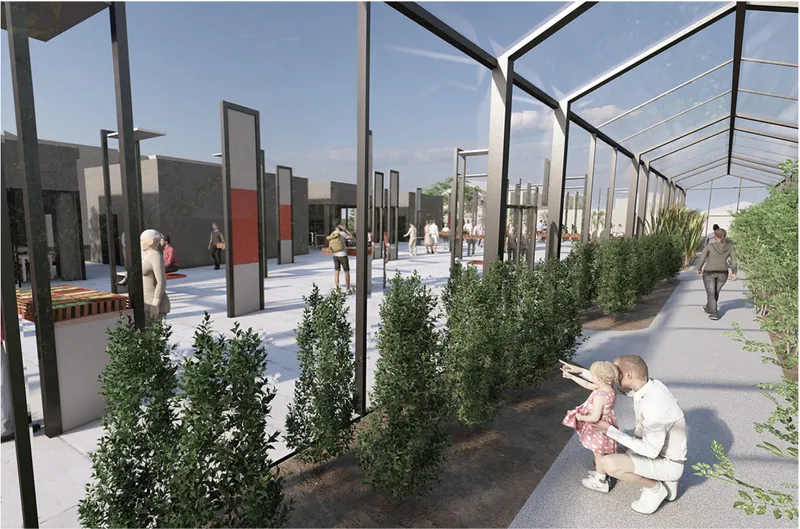
The structural logic of AgriFlex rests on modular steel frames paired with lightweight aluminum composite panels. These panels are the project's most inventive detail: they function as movable units that unfold into seating, display counters, or shading elements depending on the occasion. Rather than designing fixed furniture and then fitting it into an open plaza, Büyükpolat treats the architecture itself as the furniture system. The steel pergola structures visible in these renderings define outdoor rooms without closing them off, while planted beds along the walkways soften the hard infrastructure and signal the agricultural identity of the place.
The covered walkway, framed by tubular steel and flanked by garden beds, is telling. Children and visitors move through it casually, which suggests the scale is right. The frame is tall enough to feel generous but repetitive enough to create rhythm and orientation along the linear axis. Transparency is a recurring theme: you can always see through the structure to what lies beyond, whether that is a greenhouse, a market stall, or the city street.
Reading the Site from Above
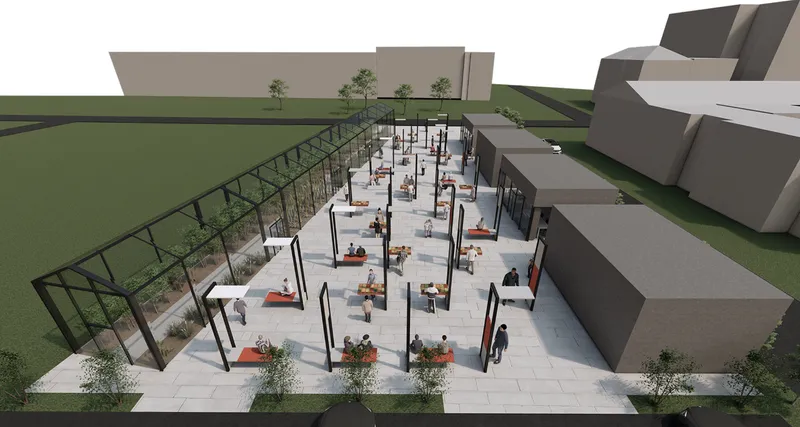
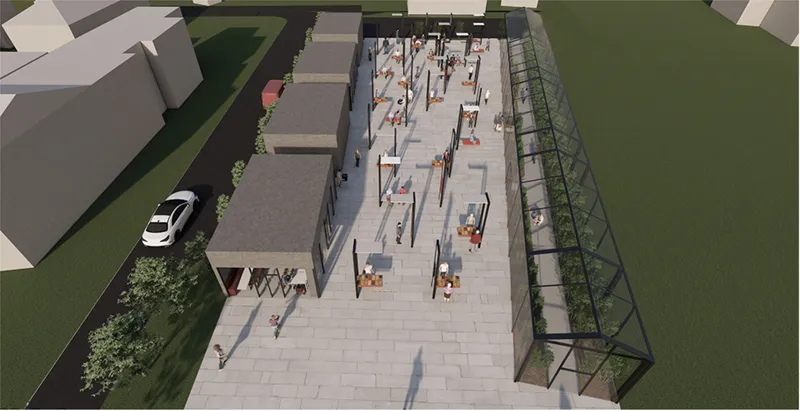
The aerial view makes the organizational strategy legible. The paved plaza is enclosed on its long edges by steel and glass frames, with planted beds and scattered seating breaking up what could otherwise read as an empty expanse. The project's linear axis is clear: one side faces the agricultural landscape, the other addresses the urban fabric of Roeselare. Between them, the marketplace occupies the in-between, a zone calibrated to be neither fully rural nor fully urban but something productively hybrid.
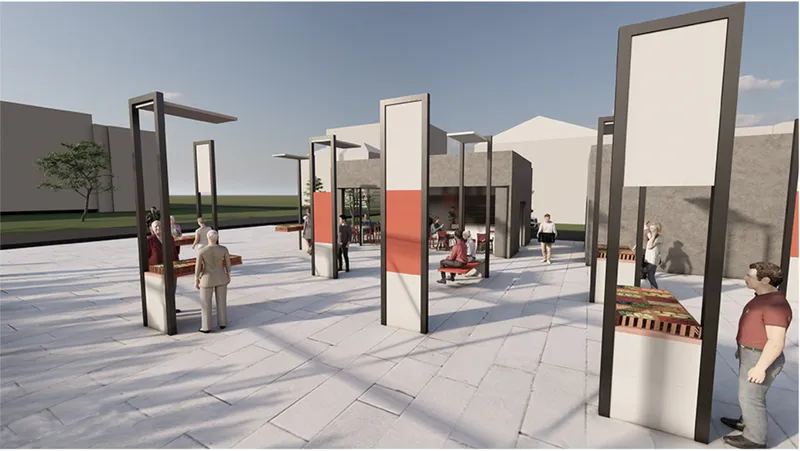
At ground level, freestanding steel portal frames support canopies over seating areas, creating a series of semi-enclosed zones within the open plaza. These frames act like picture frames for the surrounding context, directing views toward the greenhouses or the adjacent streetscape. The modular system adapts to population density and event scale, allowing the number of countertops and spatial divisions to be reconfigured. On a quiet weekday, the plaza might host a handful of produce vendors; during a festival, it could accommodate a full public gathering.
Looking Out from the Urban Edge

The interior perspective from the café captures what the project feels like from the urban program side. Glass walls dissolve the boundary between inside and outside, framing the steel pergola structures and the activity of the plaza beyond. The café, workshops, and restrooms occupy functional modules along this edge, providing the everyday amenities that keep people coming back. The transparent greenhouse on the opposite flank does similar work for the agricultural side: it enhances daylight penetration and natural ventilation while educating visitors about sustainable cultivation methods.
The top-down rendering reveals how AgriFlex sits within its broader context: adjacent buildings, street trees, and the steel pergola structures create a layered composition that mediates between the existing urban grain and the open agricultural land. Circulation paths are deliberately loose, encouraging informal encounters rather than prescribing rigid routes. The alternation between transparent and solid surfaces controls visibility and social engagement, making the marketplace legible from multiple vantage points while preserving moments of enclosure and intimacy.
Why This Project Matters
AgriFlex works because it resists the temptation to over-design. The steel frames, aluminum panels, and glass enclosures constitute a disciplined material palette that does multiple jobs: structure, shading, display, and seating all emerge from the same modular kit. Material consumption stays low while spatial versatility stays high. That efficiency is not just an environmental strategy but a social one, ensuring the marketplace can respond to its community's changing needs without requiring demolition or wholesale renovation.
More importantly, the project proposes a useful model for sites where agricultural and urban territories overlap. Instead of buffering these zones apart, Büyükpolat collapses them into a single inhabitable threshold. The greenhouse teaches the city about production; the café invites farmers into urban social life. The open plaza between them is the space where those exchanges actually happen. If the rural-urban boundary is going to be renegotiated in the coming decades, projects like AgriFlex suggest that architecture's role is not to resolve the tension but to give it a productive, flexible, and genuinely public home.
View the Full Project
About the Designers
Designer: İrem Büyükpolat
Enter a Design Competition on uni.xyz
uni.xyz runs architecture and design competitions year-round that reward proposals with spatial conviction and real site intelligence.
Project credits: AgriFlex by İrem Büyükpolat Farm to CITY (uni.xyz).


Popular Articles
Popular articles from the community


The Amber Palace Opera: A Geological Fiction Surfaces on Tallinn's Baltic Waterfront
Pierre Brillard reimagines a Baltic legend as a public landscape, opera house, and waterfront promenade rooted in Tallinn's coastal identity.
Faces of the Soviet Avant-Garde: Turning Moscow's Street Names into an Open-Air Museum
A network of sculptural installations across a Moscow residential district transforms forgotten architect names into spatial encounters with cultural memor
Tsunami Convergenics: Turning Catastrophic Ocean Forces into Underwater Housing Infrastructure
A speculative underwater settlement off the coast of Onagawa, Japan, treats tsunamis and typhoons as energy sources rather than threats.
Opera by the Sea Estonia: Three Shells Dissolving Architecture into Tallinn's Coastline
A winning opera house proposal replaces monumental form with interconnected shells that blur the boundary between building, park and Baltic Sea.

Similar Reads
You might also enjoy these articles

Play: Fragments of Their World: Remembered Architecture Rebuilt as a Modular Playground for Refugee Camps
Tom Gardner abstracts domes, arches and towers from the homelands of displaced families into a kit of child-scaled play parts for camp settlements.
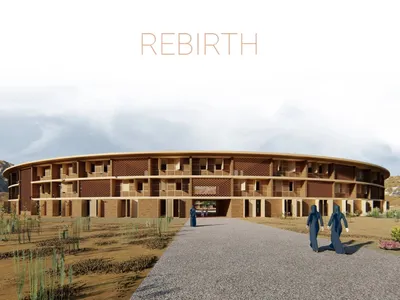
REBIRTH: A Circular Settlement Where Afghan Widows and Their Children Rebuild Life Together
A shortlisted Resile entry turns the circle into a protective ring of timber and brick, gathering homes, classrooms and gardens around a shared landscape.
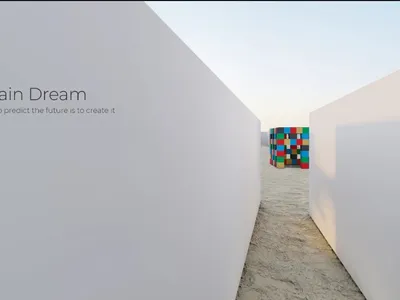
The Main Dream: A Recycled Plastic Kit That Lets Refugee Children Build Their Own Playground
Thirty-centimetre interlocking cubes that connect on three axes turn play into construction, letting children author the spaces they occupy.

Lunar Spiral: A Fibonacci-Driven Moon Settlement Rising from Shackleton Crater
Golden-spiral geometry organises buried infrastructure and orbiting habitable spheres into a lunar base designed to grow as life on the Moon expands.

Comments (0)
Please login or sign up to add comments
No comments yet. Be the first to comment!