
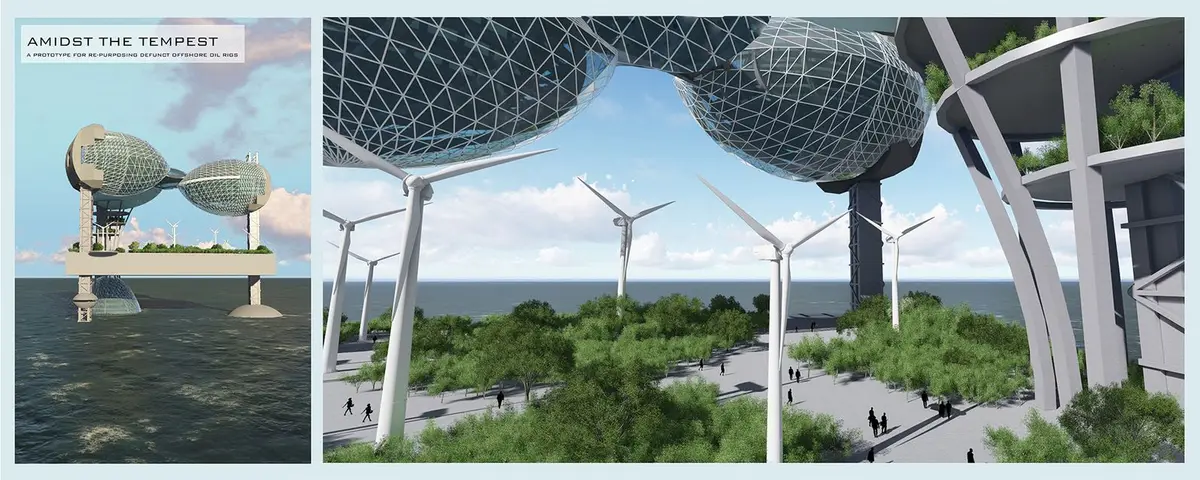
Amidst the Tempest: Turning Defunct Mumbai High Oil Rigs into a Vertical Marine Campus
A UnIATA ’19 entry that keeps the columns and decks of an abandoned Arabian Sea rig and grafts on pods for research, rescue, energy and dwelling.


An offshore oil rig is built for one job: taking value out of the sea. Once the wells run dry, it becomes a steel skeleton standing in water it helped degrade. Amidst the Tempest starts from that uncomfortable fact and reverses it. The proposal keeps the rig and changes what it does. Extraction gives way to regeneration, and a defunct industrial frame becomes the scaffold for a working marine habitat.
Designed by Nithin K for UnIATA ’19, the project sits roughly 160 km west of the Mumbai coast in the Mumbai High oil field. The field was discovered in 1974 and became one of India’s most productive hydrocarbon zones. Decades of drilling have left the Arabian Sea with plastic waste, chemical discharge and oil residues, and the prevailing currents carry all of it toward Mumbai. The designer places the intervention where those currents cross, so the building can work as a filter between the open sea and the city’s shoreline.
Glass Domes That Plant a Garden on an Oil Platform
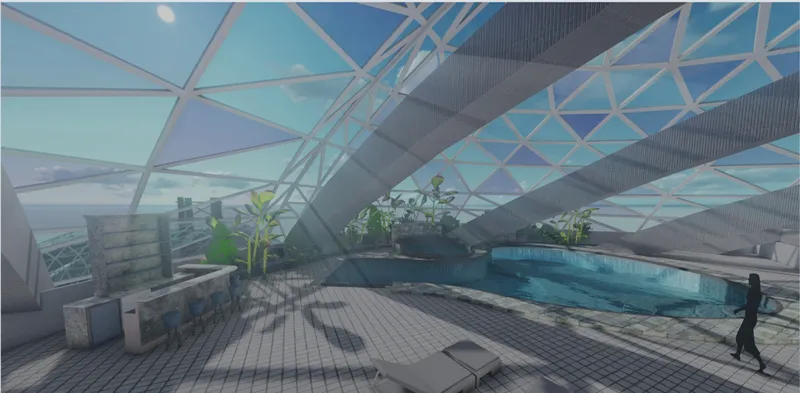
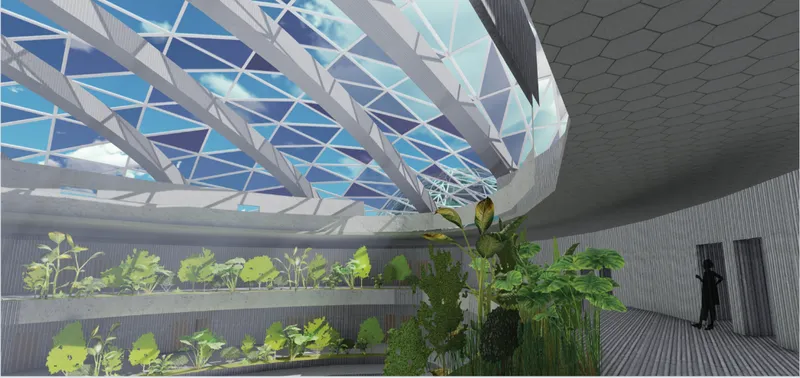
The interior renders open on the project’s most surprising move: softness. Under a triangulated glazed dome, an organic pool winds between planted beds and a stone bar. In a curving gallery nearby, tiered planting climbs toward a glass roof. These spaces belong to the food production decks and public areas in the programme, where aquaponics and controlled agriculture share space with places to rest. On a structure once defined by pipework and hazard zones, the greenery reads as a deliberate correction.
The glazing matters as much as the plants. Each enclosure looks straight out to open water, so occupants never lose sight of the sea the building exists to repair. The dome’s faceted frame also echoes the triangulated lattice of the rig legs below, which ties the new skin back to the inherited engineering instead of disguising it.
A Public Layer That Brings Visitors Offshore

The gaming hall render, with green felt tables, cream chairs and a wall of planting and glazing, makes the leisure side of the scheme concrete. Alongside observation spaces, libraries and educational areas, it forms the tourist and public component of the programme. This is a pragmatic choice. A remote research outpost depends on attention and revenue to survive, and visitors bring both. Mixing leisure with laboratories turns an isolated rig into a destination where the public can witness restoration taking place.
The tension between pleasure and purpose is real, and the designer does not hide it. Placing a card table metres from a planted wall that looks onto a polluted sea quietly asks visitors to consider what offshore architecture should be used for now.
Pods Clustered on an Inherited Deck
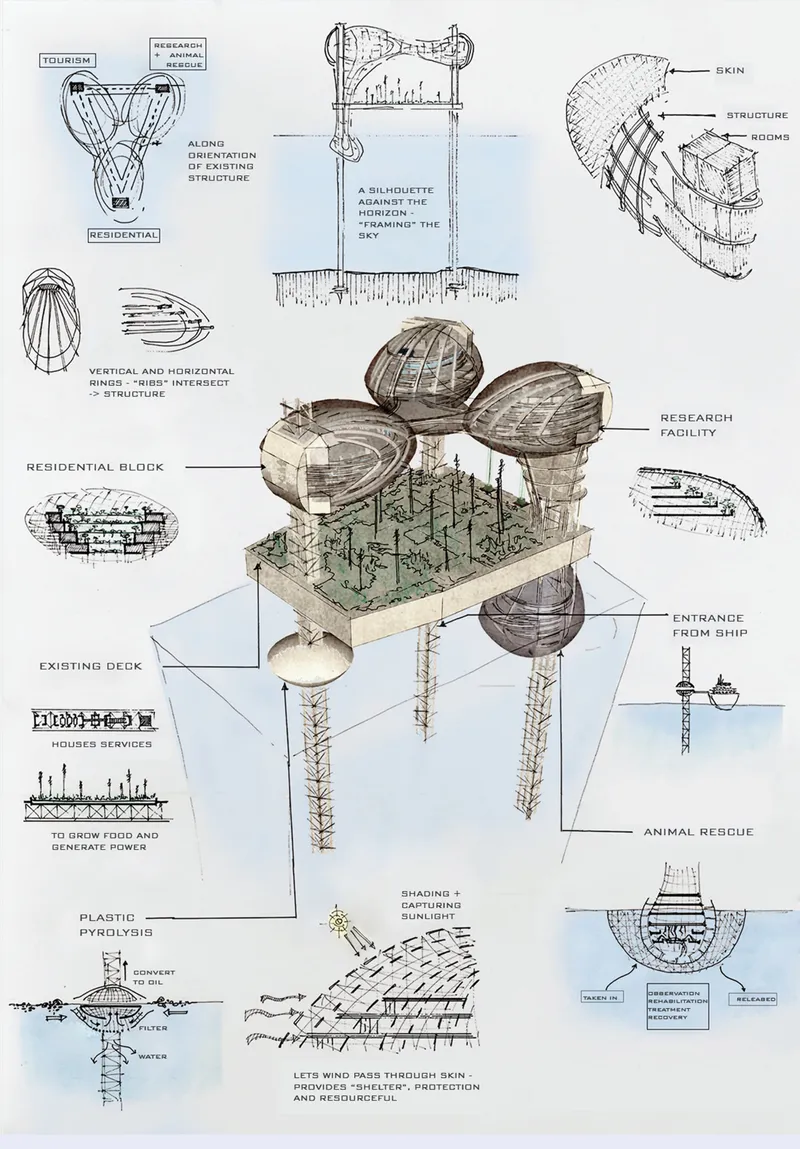
The concept sheet lays out the core strategy in a single axonometric. Three pod volumes sit on a deck raised above the sea on the rig’s lattice legs. The columns, decks and foundations stay in place and receive reinforcement, which cuts embodied carbon and preserves what the designer calls the material memory of the site. The new work arrives as additions, not replacements.
The pods introduce a bio-inspired language that contrasts with the rig’s rectilinear frame. Each one holds a specific programme, and bridges and vertical cores link them. Their curved geometry is also a technical response: it lowers wind resistance on a site exposed to Arabian Sea storms. The form follows the forces the project name refers to.
A Section That Descends from Pod to Seabed

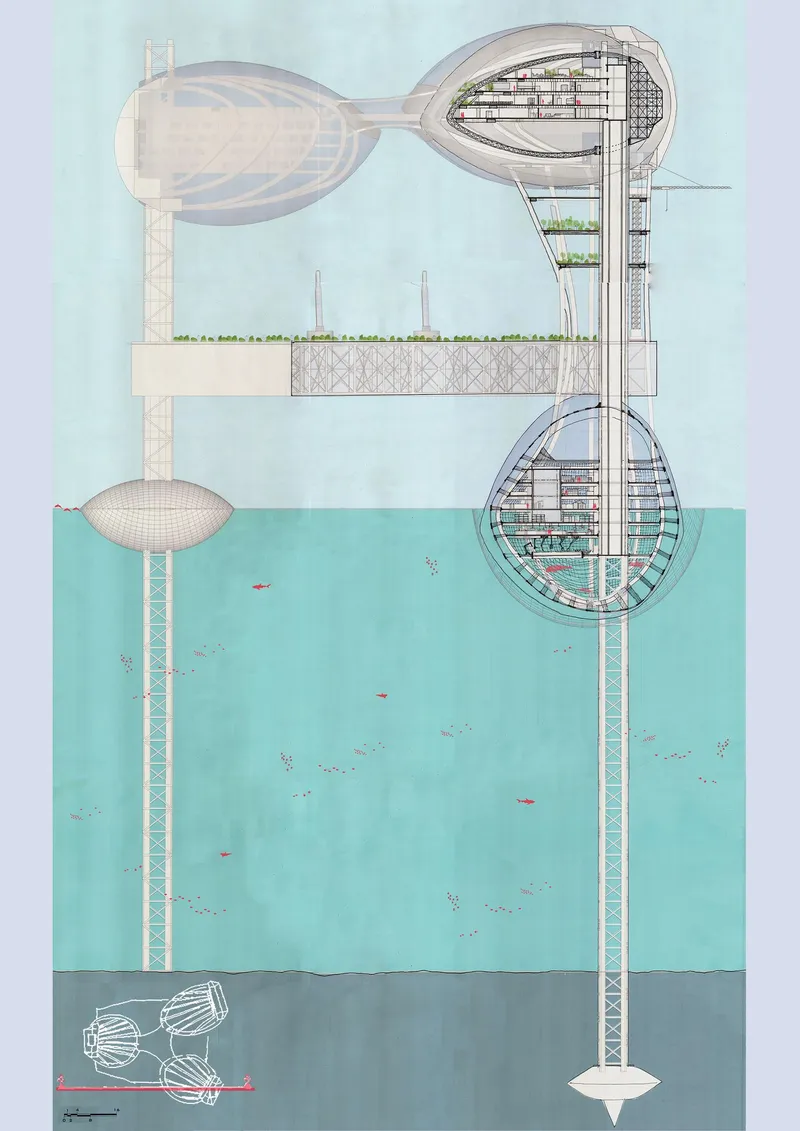
The sections show why the project describes itself as a vertical marine campus. Above the waterline, pods and decks contain residences for researchers, technicians and staff, marine biology and oceanography labs, and planted levels. Below, the lattice towers drop through blue water filled with fish, and a submerged pod houses the aquatic animal rescue and rehabilitation facilities directly in the underwater zone. The rig’s full height becomes usable, from roof to seabed.
This vertical stacking connects the programmes. Plastic gathered from the currents feeds a pyrolysis plant that turns waste into energy, which adds to wind harvesting and solar-integrated skins. Food is grown on the decks. Researchers live above the habitats they study. The section shows a closed loop of scientific, productive and domestic life, an autonomous ecosystem built around legs that once supported drilling equipment.
Why This Project Matters
Hundreds of offshore rigs across the Arabian Sea and Mumbai High now stand idle, and the default responses are costly removal or slow decay. Amidst the Tempest offers a third option that architects should take seriously. Retaining the structure lowers carbon, and siting the building in the path of polluted currents gives it a measurable environmental role. Adaptive reuse here does more than save materials. It treats an existing frame as active infrastructure for repair.
The proposal also stays honest about history. It does not erase the rig or celebrate it; it acknowledges the damage the rig caused and gives it a new task. That position, holding past harm and future repair in one structure, is what lifts the project above a speculative render set. It is a working prototype for how a generation of designers might approach industrial ruins at sea.
View the Full Project
About the Designers
Designer: Nithin K
Enter a Design Competition on uni.xyz
uni.xyz runs architecture and design competitions year-round that reward proposals with spatial conviction and real site intelligence.
Project credits: AMIDST THE TEMPEST - Re-purposing Defunct Offshore Rigs by Nithin K UnIATA ’19 (uni.xyz).


Popular Articles
Popular articles from the community


David Macias Steps a Doorless Stone and Plaster House Down a Tropical Colombian Hillside
In the humid hills of Colombia, Threshold House replaces the front door with an open void and terraces its 850 m² down the slope instead of fighting it.

longwave studio Reorganizes a 112 m² Tainan Apartment Around the Daily Routines of a Family and Two Cats
In Tainan, Taiwan, birch plywood, rust-red furniture and a freestanding plaster wall link arrival, storage, work and family life in one apartment.

Jaramillo Van Sluys Arquitectura and Urbanismo Turn a Demolished Registry Lot in Quito into an Orchard Plaza
In Quito's Centro Histórico, a 2,800 m² plaza exposes the San Agustín convent wall and redraws its lost Augustinian orchard in volcanic stone.

Architekt Andreas Gruber Scatters 23 Dark Timber Chalets Across a South Tyrolean Forest Edge
In Molini di Tures, Amonti Chalets breaks a resort into a hamlet of gabled timber houses, with parking, storage and services pushed into the slope.

Similar Reads
You might also enjoy these articles

Maya Harvest: A Cacao Resort Village Rooted in Mayan Tradition and Local Craft
Situated within a Tabasco cacao plantation, this shortlisted resort proposal merges vernacular materials with hands-on cultural immersion.
Harmonia: A River-Shaped Community That Grows Over Decades in Boa Vista
Curved pathways and modular grid structures along the Branco River create a phased settlement designed to evolve from 2030 to 2050.

The Architecture of Bathing: A Mughal Hammam Reimagined Across the Yamuna
Charlotte May's honorable mention entry for The Black Taj reinterprets Agra's bathing rituals through red sandstone, water, and framed views of the Taj Mah
Om-1: A Wall-Hung System That Moves Your Workspace Off the Desk
Modular plywood boards, magnetic pegs, and utility elements migrate clutter from the horizontal surface to the vertical plane.

Explore Ocean Architecture Competitions
Discover active competitions in this discipline

Design challenge to reuse E-waste

Packaging challenge - Design meets sustainability
Comments (0)
Please login or sign up to add comments
No comments yet. Be the first to comment!