

aniMATE: Biomimicry and Tensegrity in a Workspace Built for 2040
A speculative office concept draws on feather structures and sensor-driven responsiveness to reimagine how adaptive architecture serves collaboration.


What if a building could breathe, sense its occupants, and reconfigure itself the way a bird adjusts its plumage? aniMATE poses that question with conviction. The name, a portmanteau of anima and collaborate, signals its ambition: architecture that is alive with data, responsive to climate, and fundamentally organized around collective human activity rather than static floor plans.
Designed by Zorba, aniMATE is a speculative workplace concept projected toward 2040. It sits at the intersection of biomimicry, tensegrity engineering, and distributed sensor networks, proposing an office ecosystem that adapts in real time to both environmental conditions and the behavioral patterns of the people inside it.
From Linear Plans to Living Systems: A Half-Century of Office Evolution
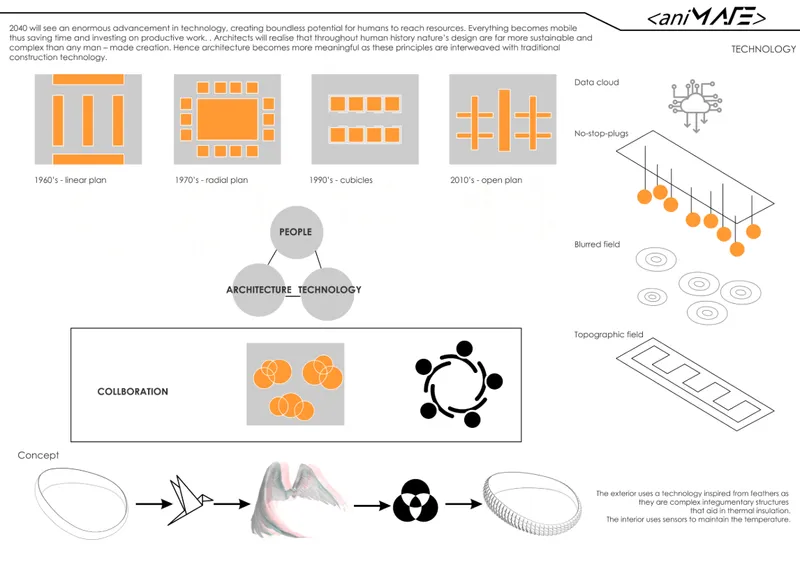
The conceptual diagram above traces four distinct eras of workplace layout: the linear efficiency of the 1960s, the radial connectivity of the 1970s, the cubicle isolation of the 1990s, and the open-plan transparency that took hold in the 2010s. Each model solved one problem while creating another. Linear plans maximized order but killed spontaneity; open plans encouraged interaction but stripped away acoustic privacy. aniMATE reads this history as a trajectory, not a cycle, and argues that the next step is an environment that no longer commits to a single configuration at all.
By 2040, the project contends, workplaces will operate more like ecosystems than buildings. Data cloud systems will maintain seamless information flow, "no-stop plugs" will provide flexible infrastructure that eliminates fixed service points, and topographic fields will layer activities on top of one another rather than segregating them into departments. The diagram makes the argument visually clear: static geometry gives way to fluid, overlapping zones.
Feather Logic: Biomimicry as Structural Strategy
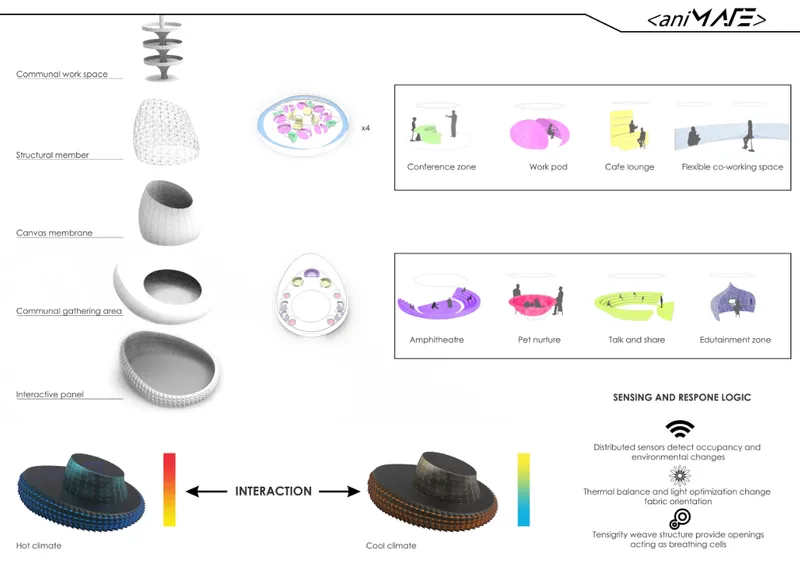
The exterior of aniMATE draws directly from the integumentary structure of feathers, specifically their capacity for insulation, ventilation, and adaptive orientation. This is not decorative biomimicry. The design translates the barb-and-barbule logic of a feather into a tensegrity weave structure whose openings function as breathing cells, regulating airflow through the building envelope. Canvas membranes and interactive panels integrate with these structural members, creating a skin that shifts its fabric orientations in response to thermal and light conditions detected by distributed sensors.
Internally, the sensor network maintains environmental balance without manual intervention. Occupancy detection adjusts ventilation rates; thermal optimization modulates comfort zone by zone. The ambition is a building that minimizes energy consumption not through brute insulation or mechanical overkill, but through continuous, fine-grained calibration, much the way a bird's plumage responds to temperature shifts.
Layered Programs: Amphitheaters, Pet Zones, and Work Pods Under One Roof
aniMATE's spatial organization rejects the conventional floor-by-floor separation of functions. Instead, it layers three broad programmatic zones into an interconnected whole. The communal workspace houses flexible co-working areas alongside conference zones, café lounges, and enclosed work pods. The communal gathering area introduces an amphitheater, talk-and-share spaces, and even a pet nurture zone, acknowledging that future workplaces must account for well-being rituals that current offices rarely accommodate. Edutainment areas round out the program with spaces for learning and shared recreational experiences.
What holds these zones together conceptually is the notion of "blurred fields," areas where one program dissolves into the next. A café lounge might border a brainstorming pod; an amphitheater step might double as informal seating for a co-working cluster. The intent is to dissolve rigid boundaries so that movement through the building generates unexpected encounters, the kind of collisions that open-plan offices promised but rarely delivered because they lacked spatial variety.
Why This Project Matters
Speculative projects live or die by the specificity of their proposals. aniMATE earns attention because it does more than gesture at a "smart building" future. It names its systems: tensegrity weaves, distributed sensor arrays, topographic field planning. It grounds its aesthetic in a precise biological analogy, feather structures, and follows that analogy through to performance logic rather than treating it as a surface motif. The result is a concept that feels buildable in principle, even if 2040 remains the target horizon.
More broadly, aniMATE contributes to an important conversation about what adaptability actually means in architecture. It is not just movable walls or modular furniture. It is an integrated relationship between structure, envelope, environmental systems, and human behavior, all orchestrated through real-time feedback. If the workspace of the future is to outperform the open plan, it will need exactly this kind of systems-level thinking.
View the Full Project
Enter a Design Competition on uni.xyz
uni.xyz runs architecture and design competitions year-round that reward proposals with spatial conviction and real site intelligence.
Project credits: aniMATE.


Popular Articles
Popular articles from the community


Faces of the Soviet Avant-Garde: Turning Moscow's Street Names into an Open-Air Museum
A network of sculptural installations across a Moscow residential district transforms forgotten architect names into spatial encounters with cultural memor

Opera by the Sea Estonia: Three Shells Dissolving Architecture into Tallinn's Coastline
A winning opera house proposal replaces monumental form with interconnected shells that blur the boundary between building, park and Baltic Sea.

Singing Woman: An Opera House That Performs Before the Curtain Rises
Ovidiu Cristian Pavel's conceptual opera house translates Estonia's choral identity into a sculpted waterfront landmark facing the Baltic Sea.

The Amber Palace Opera: A Geological Fiction Surfaces on Tallinn's Baltic Waterfront
Pierre Brillard reimagines a Baltic legend as a public landscape, opera house, and waterfront promenade rooted in Tallinn's coastal identity.

Similar Reads
You might also enjoy these articles

Play: Fragments of Their World: Remembered Architecture Rebuilt as a Modular Playground for Refugee Camps
Tom Gardner abstracts domes, arches and towers from the homelands of displaced families into a kit of child-scaled play parts for camp settlements.
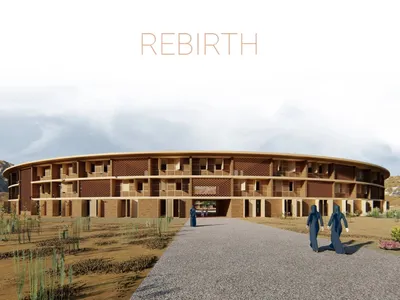
REBIRTH: A Circular Settlement Where Afghan Widows and Their Children Rebuild Life Together
A shortlisted Resile entry turns the circle into a protective ring of timber and brick, gathering homes, classrooms and gardens around a shared landscape.
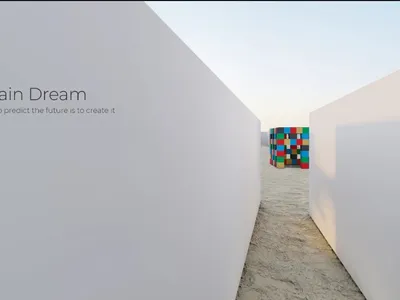
The Main Dream: A Recycled Plastic Kit That Lets Refugee Children Build Their Own Playground
Thirty-centimetre interlocking cubes that connect on three axes turn play into construction, letting children author the spaces they occupy.

Lunar Spiral: A Fibonacci-Driven Moon Settlement Rising from Shackleton Crater
Golden-spiral geometry organises buried infrastructure and orbiting habitable spheres into a lunar base designed to grow as life on the Moon expands.

Explore Futuristic Workspaces Competitions
Discover active competitions in this discipline

Design challenge to equip cities with modern furniture

Design challenge to reuse E-waste

Packaging challenge - Design meets sustainability
Comments (0)
Please login or sign up to add comments
No comments yet. Be the first to comment!