

Band Together
The students’ need for socialization sits at the center of this community-oriented design.

The City: Montreal
With more than 200,000 students living in Montreal1 and a port that handled around 1.8 million containers in 20192, this UNESCO City of Design3 looks like the ideal place to imagine student housing made out of shipping containers. With the prices of rents on the rise and one of the lowest vacancy rates in the last decades, solutions for affordable housing reside in the temporary use of vacant land parcels throughout the city.
 Montreal, voted best student city in 2017.
The Site: Saint-Denis/Des Pins
The chosen site sits at the corner of Saint-Denis Street and Des Pins Avenue in the heart of the vibrant Plateau Mont-Royal neighborhood, popular among the student population. As offices and a museum are located on Des Pins and Saint-Denis is a busy commercial street, it appeared natural to develop a concept that was directed inward to preserve the intimacy of the residents. The communal spaces make the corner of the ensemble at street level, facilitating the transition between public and private spaces.
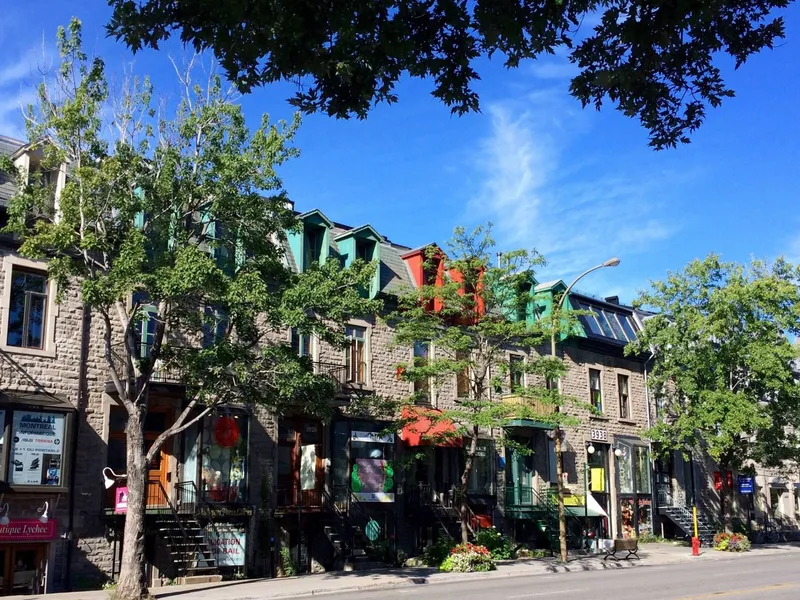 Saint-Denis Street.
The Concept: Band Together
Band Together was designed with the students’ needs at the center. Aside from a place to sleep, they need a spot to study, a place to cook and eat as well as a washroom. Above all, students need to socialize and relax so we made sure the concept answered that aspect.
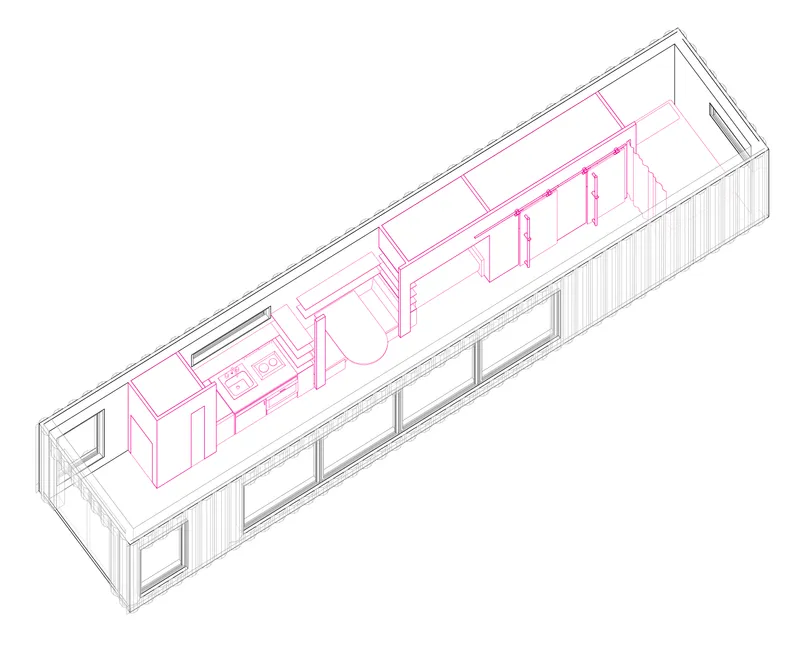 Organized in a band on one side of the unit, the services are organized in pre-made modules that require minimal onsite installation. A 5ft-large space going from one end of the container to the other is then left free to be personalized by the student(s) inhabiting the unit. The sofa can be transformed into an extra bed for a friend that needs a place to crash or has had a little too much to drink. Storage space is included in the design wherever it’s possible such as in the seating, under the bed and overhead. Each unit has large windows that face the enclosed courtyard in order to open up the space and enhance the sense of community. 1-bedroom and 2-bedrooms units are available to the students and each follow those principles.
The consideration of the students’ needs to socialize was included in the conception beyond the units themselves, from the circulation spaces to communal spaces. Stairs are connected to large terraces that connect two units at each level. They foster spontaneous encounters between the students. At street level, the courtyard and indoor communal spaces serve as main gathering places. They can host various activities, from coworking to an art opening to yoga classes. The design includes moveable furniture, potted trees and plants which make the transformation of the space between events and everyday life a breeze, while also responding to the temporary nature of the brief.
The Architecture
The Form
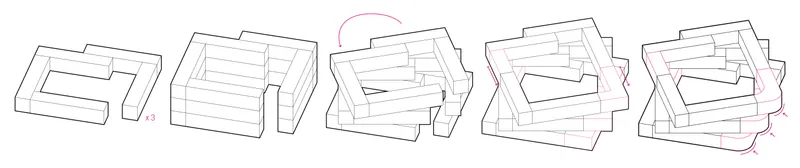
Each container was designed to ensure that the students could personalize their space while also easing the construction process with premade modules. To preserve the band of services, the containers were organized so that the large windows would always face the courtyard. An arrangement made out of 5 containers was multiplied 3 times, then rotated by 15 degrees between each floor. This rotation generated balconies and room for greenery, ensuring generous outdoor space as well as a touch of green above ground level. This unusual form made the positioning of the stairs quite challenging which resulted in the spacing of the containers to add circulation blocks that double as terraces.
The Materials
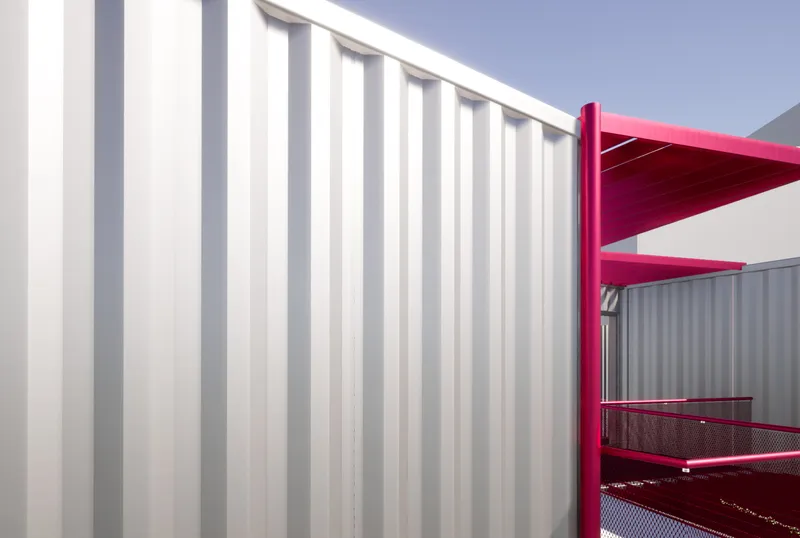 In order to preserve their corrugated appearance, the containers are insulated on the inside as Montreal gets pretty cold during wintertime. They are painted in a light gray shade to ensure that the color doesn’t steal the show of the twisting shape. However, the stairs, terraces and balconies add a pop of color to the ensemble with their metallic mesh in a dark hue of magenta. Light materials such as natural wood are used for the interiors to ensure an airy feel.
Replicability
 The compact nature of Band Together would make its replication quite easy if it was to be installed on a larger site. Each set of 15 containers could be organized following a grid, in a way that the interstitial space can serve as a communal, commercial and/or circulation space. The twisting form would be even more dynamic if replicated, opening up to the sky at intersections. The modular nature of the container and the prefabricated band of services that turn them into residences were thought to ease the construction process. Band Together could then take advantage of other vacant parcels awaiting construction through the city and offer a new housing solution that answer the need for affordable housing in Montreal.
1. Montréal International, “Montreal, Best City for NGOs and International Organizations,” Montréal International, 2018, https://www.montrealinternational.com/en/international-organizations/.
2. Port de Montréal, Twitter, 2020, https://twitter.com/PortMTL/status/1214220887559421955.
3. UNESCO, “Montreal | Creative Cities Network,” UNESCO, 2015, https://en.unesco.org/creative-cities/montr%C3%A9al.

Popular Articles
Popular articles from the community


Singing Woman: An Opera House That Performs Before the Curtain Rises
Ovidiu Cristian Pavel's conceptual opera house translates Estonia's choral identity into a sculpted waterfront landmark facing the Baltic Sea.


ETEH Reworks the Shared Spaces of São Domingos School in Brazil Around Timber, Color and Hanging Plants
At São Domingos School in Brazil, 436 m² of hall, refectory and library are recast with timber joinery, a yellow and blue code and trailing greenery.

The Amber Palace Opera: A Geological Fiction Surfaces on Tallinn's Baltic Waterfront
Pierre Brillard reimagines a Baltic legend as a public landscape, opera house, and waterfront promenade rooted in Tallinn's coastal identity.

Juan García Correa, John González and Claudia Rueda Sink a Circular Amphitheater into a Manizales Engineering Building
On the La Nubia campus in Manizales, Colombia, the S1 Building folds labs and offices into a hillside of ramped lawns that double as a campus route.

Similar Reads
You might also enjoy these articles

Vereda Arquitetos Renovates a 40-Square-Meter Apartment Inside Niemeyer's Copan Building
A compact unit in São Paulo's most iconic residential tower gets a material overhaul that pairs exposed concrete with bold blue Formica.

Shakur's House: Exposed Brick as an Interior Organiser in a 168 m² Mashhad Residence
Brick moves indoors in this Mashhad residence, where masonry walls, glass partitions and teal planes sequence a compact home without closing it off.

Day and Night Park: A Time-Based Urban Newsstand in Beijing
A temporary urban newsstand in Beijing blending travel, light, and reading through poetic colors, compact form, and community-focused design.

Modernist Patio Renovation in El Masnou, Barcelona by Oliver Segura Arquitectura + Cebrià Arquitectura
Modernist patio renovation blending tradition and innovation with a movable pool, leveled floors, and Catalan materials in El Masnou.

Comments (0)
Please login or sign up to add comments
No comments yet. Be the first to comment!