

Behind the Walls: A Prison Reimagined as Biophilic Campus for Reintegration
Clustered timber modules, green bridges, and communal living spaces replace punitive confinement with a restorative correctional landscape.


What if a prison looked less like a fortress and more like a village? "Behind the Walls: A Canopy for Repentance" proposes exactly that: a correctional facility organized as a campus of 10x10m timber modules, each housing seven cells and a communal living space, linked by elevated walkways that thread through planted courtyards. The architecture replaces visual surveillance and isolation with calibrated proximity to nature, shared meals, and a spatial sequence that rewards behavioral progress with increasing autonomy. It is a prison designed not to contain people, but to prepare them for life outside.
Designed by Sophie Renard and be i, the project earned a runner-up distinction in the Switching Prisons competition. Juror Adrian Iredale of iredale pedersen hook architects called it "thoughtful, well resolved and very clear," while Michael Spight of TAG Architects praised its "nice balance between hard and soft elements" and noted that the "views out are uplifting." The scheme takes a clear position: restorative justice can be practiced through spatial design, and biophilic architecture is the vehicle.
A Masterplan Built on Clusters, Not Cellblocks
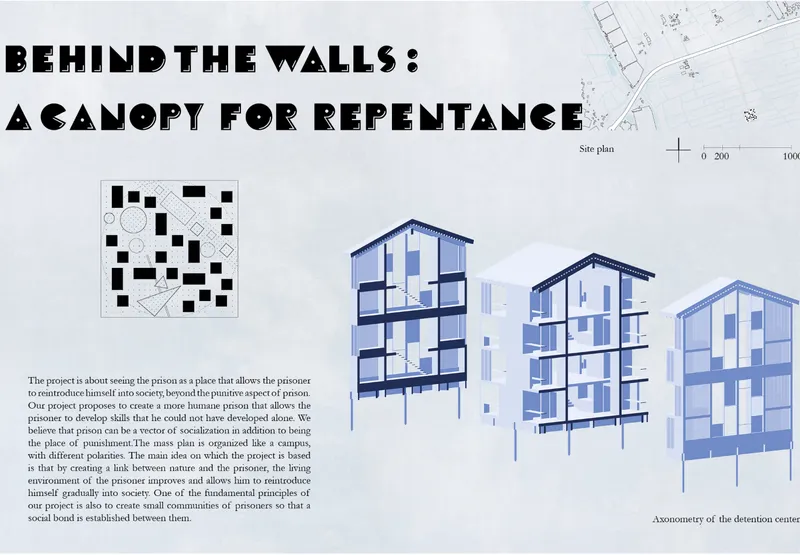
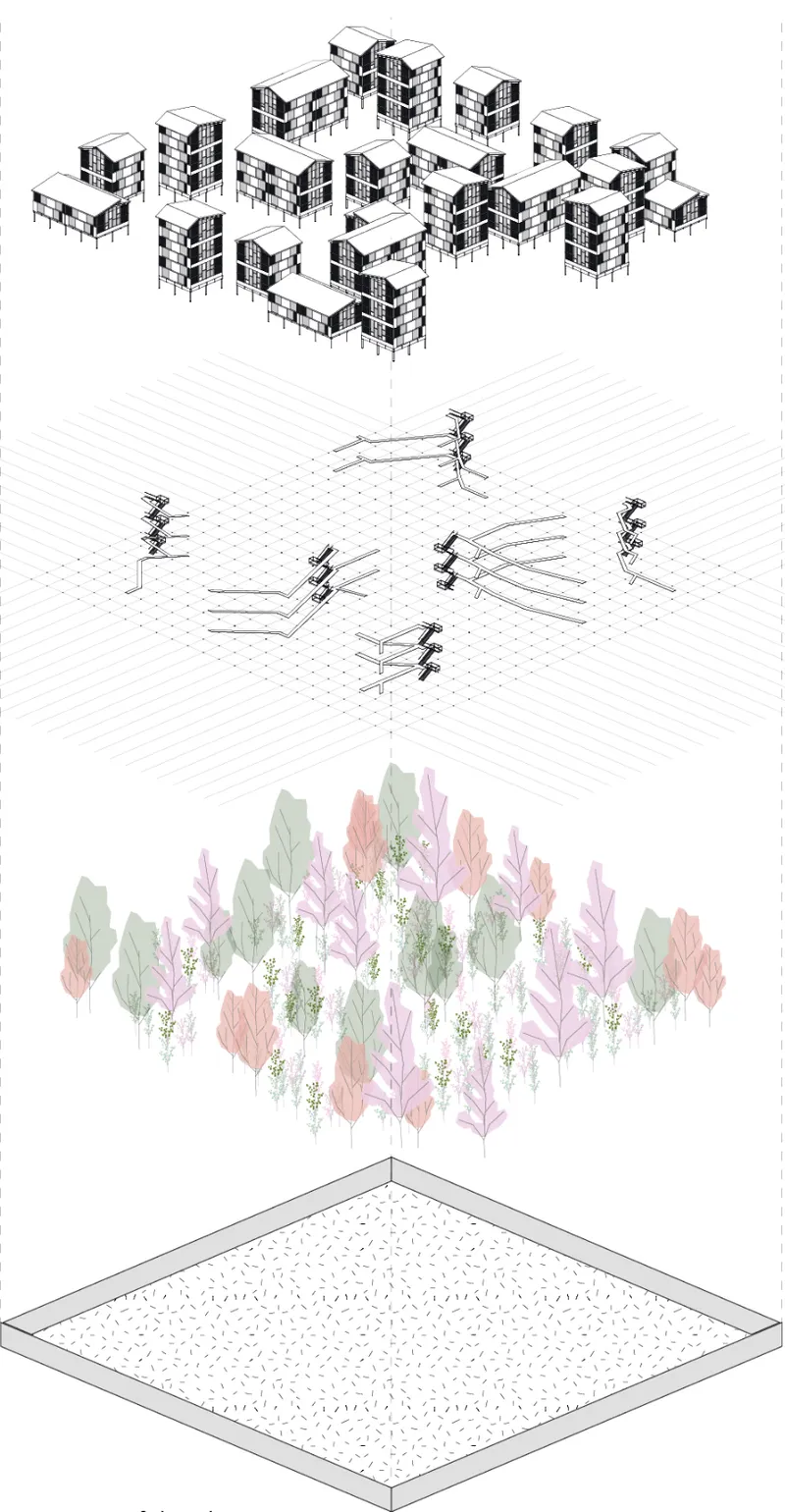
The site plan reads like a small settlement rather than an institution. Detention modules cluster around communal courtyards, each unit functioning as a self-contained micro-community within the larger facility. The exploded axonometric reveals four distinct layers: a paved base, the building clusters, a circulation network of walkways and bridges, and a pervasive landscape layer that saturates the gaps between structures. This layered logic means that vegetation is not ornamental but structural to the experience of moving through the complex.
Each 10x10m module avoids visual overlap between cells, a critical detail that preserves individual privacy without resorting to the oppressive blank walls of conventional prisons. The double-height communal living areas open outward to natural views, grounding daily life in a rhythm governed by daylight and seasons rather than institutional scheduling alone. The arrangement simulates shared living akin to roommate dynamics, where inmates prepare meals and socialize in central spaces, embedding responsibility into the architecture itself.
Timber Walkways as Instruments of Graduated Freedom
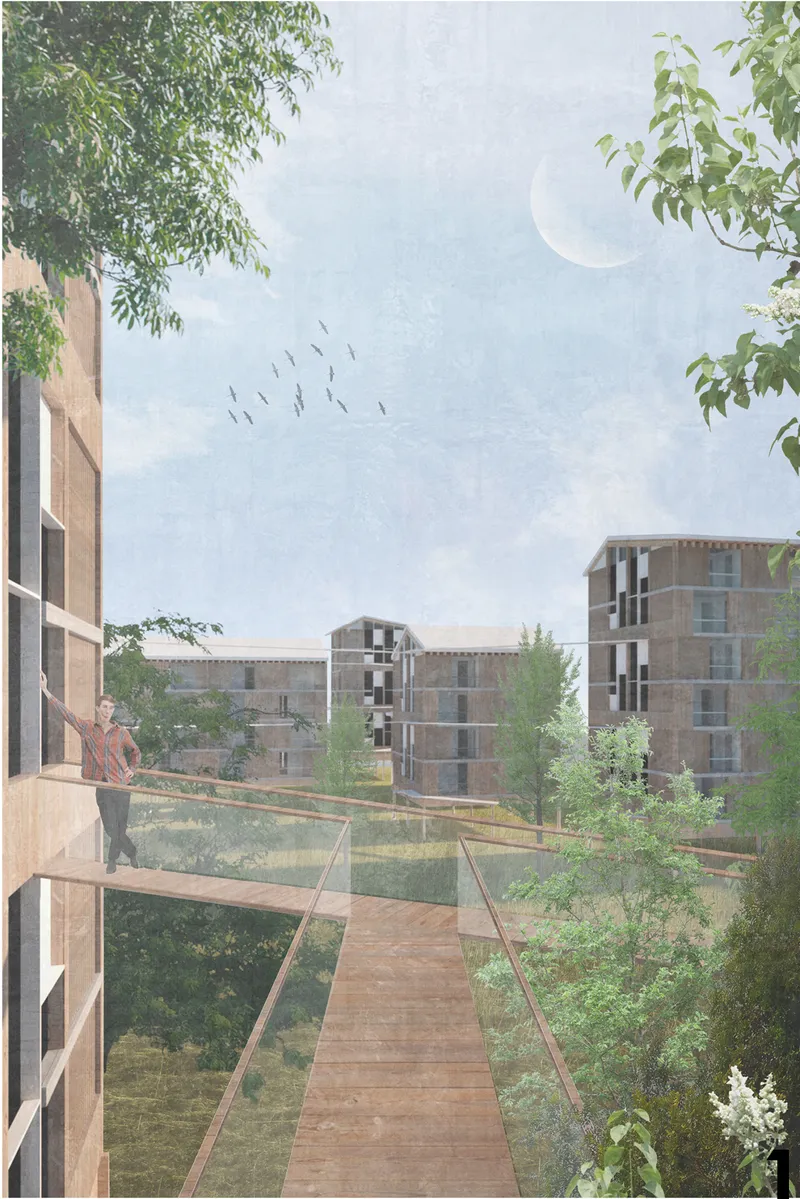
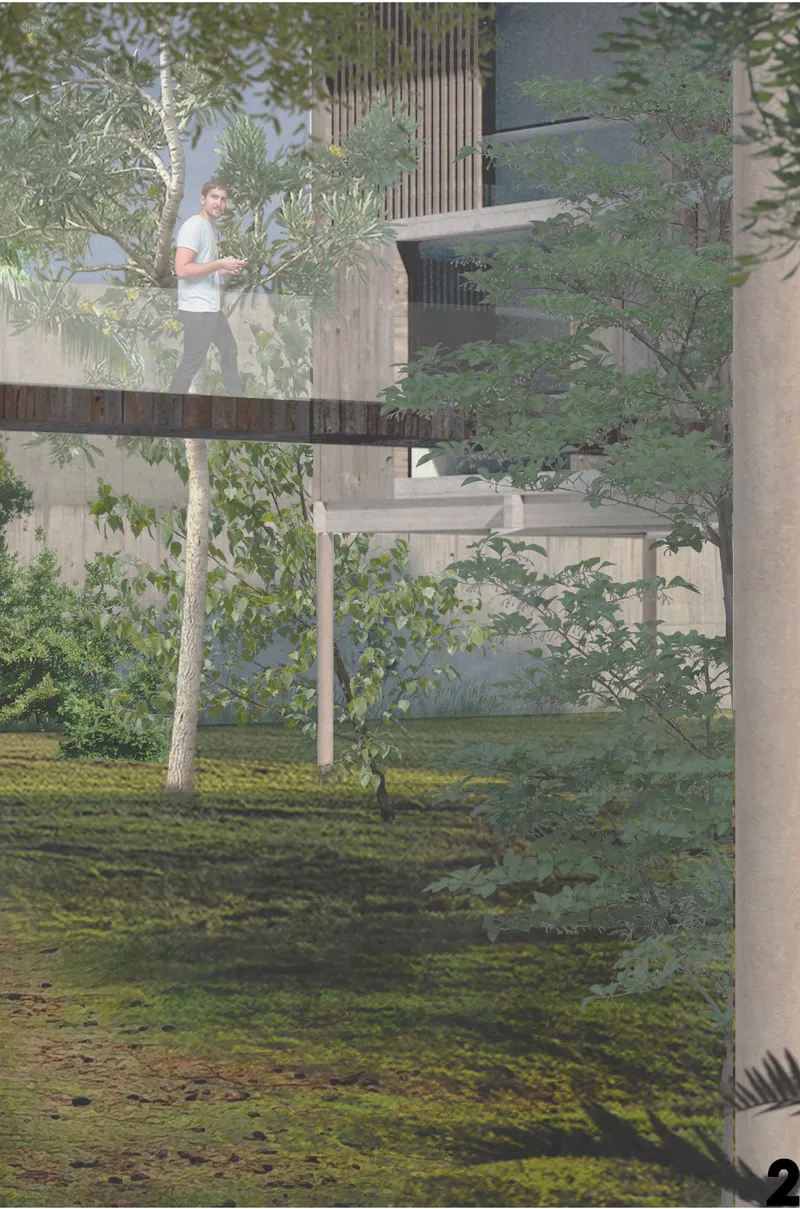
The elevated timber walkways connecting housing blocks are more than circulation. They are thresholds of rehabilitation. As inmates progress in behavior and participation, they gain access to expanded zones: from isolated modules to shared corridors, and eventually to the green bridges that arc between residential buildings. The spatial sequence mirrors psychological rehabilitation, each step outward a tangible marker of reintegration readiness. Birds pass overhead; moss carpets the ground below. The language is unmistakably pastoral, a deliberate inversion of the concrete and steel that define most correctional architecture.
Juror Misak Terzibasiyan observed a "nice solution between nature and architecture," and these walkway views demonstrate why. The timber structures sit lightly in the landscape, elevated to preserve the planted ground plane beneath. Trees grow to eye level and above, so that movement between buildings becomes movement through a canopy. The project's title makes literal sense here: repentance happens under cover of green, not under the glare of fluorescent lights.
A Communal Interior Shaped by Light and Timber
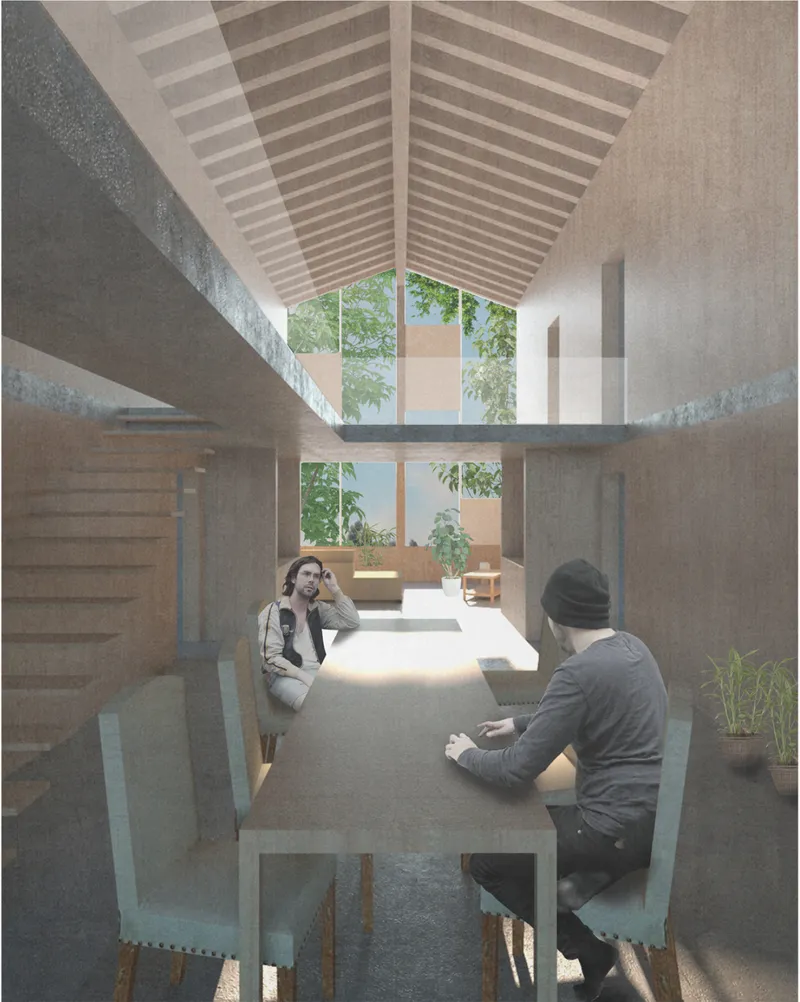
Inside the communal room, exposed timber roof rafters define a generous volume while clerestory windows wash the space with diffused natural light. Two residents converse at ease in an interior that reads closer to a rural community hall than to any recognizable prison typology. The material palette, dominated by natural timber and the warm quality of indirect sunlight, aligns with biophilic design research linking such environments to reduced aggression and improved mental health. There are no bars in view, no visible mechanisms of control. The architecture communicates trust.
The proportion of this space matters. The double-height volume grants vertical breathing room that institutional design rarely affords. Combined with the openness to exterior greenery visible through windows, the room dissolves the boundary between inside and outside, between confinement and community. It is in spaces like this that shared meals and social activities become rituals of normalcy, quietly rebuilding the social habits inmates will need upon release.
Why This Project Matters
Most prison design competitions attract proposals that challenge the typology in theory but struggle to articulate it spatially. Renard and be i avoid that trap by grounding their vision in a legible masterplan, a clear modular logic, and a material strategy rooted in timber and vegetation. The graduated spatial sequence, from cell to module to courtyard to bridge, gives abstract ideas about behavioral progress a concrete architectural form. The jury response confirms the scheme's clarity and balance.
At a moment when overcrowding and recidivism expose the failures of punitive incarceration worldwide, "Behind the Walls" offers a measured counter-argument: architecture can be an active instrument of reintegration rather than a passive container for punishment. The canopy metaphor is apt. It shelters without enclosing. It provides structure without rigidity. And it suggests that the path back to society can begin, quite literally, with a walk through the trees.
View the Full Project
About the Designers
Designers: Sophie Renard, be i
Enter a Design Competition on uni.xyz
uni.xyz runs architecture and design competitions year-round that reward proposals with spatial conviction and real site intelligence.
Project credits: Behind the Walls: A Canopy for Repentance by Sophie Renard, be i Switching Prisons (uni.xyz).


Popular Articles
Popular articles from the community


Opera on the Sea: Driftwood Logic Shapes a Timber Opera House on Estonia's Coast
Trevor Orgill's opera house translates the entangled drift of floating timber into a civic building where wood, water, and music converge.
Opera by the Sea Estonia: Three Shells Dissolving Architecture into Tallinn's Coastline
A winning opera house proposal replaces monumental form with interconnected shells that blur the boundary between building, park and Baltic Sea.
Temporary Home for Dogs: A Reversed Zoo Rethinks Animal Shelter Architecture
In Bucharest, a sinuous corridor and freed landscape flip the logic of containment, designing a shelter that works to make itself unnecessary.
Extended Shell: Retrofitting Kolkata's Balconies as Living Urban Thresholds
A modular retrofit system recovers the social and environmental intelligence of Kolkata's historic verandas for contemporary Park Street residents.

Similar Reads
You might also enjoy these articles

Shakur's House: Exposed Brick as an Interior Organiser in a 168 m² Mashhad Residence
Brick moves indoors in this Mashhad residence, where masonry walls, glass partitions and teal planes sequence a compact home without closing it off.

Day and Night Park: A Time-Based Urban Newsstand in Beijing
A temporary urban newsstand in Beijing blending travel, light, and reading through poetic colors, compact form, and community-focused design.

Modernist Patio Renovation in El Masnou, Barcelona by Oliver Segura Arquitectura + Cebrià Arquitectura
Modernist patio renovation blending tradition and innovation with a movable pool, leveled floors, and Catalan materials in El Masnou.
Alto Residencial Coop: Cooperative Housing Development in Santiago de Compostela by Carbajo Barrios Arquitectos
A linear cooperative housing complex blending white volumes and perforated metal façades, enhancing community living, natural light, privacy, and urban integration.


Comments (0)
Please login or sign up to add comments
No comments yet. Be the first to comment!