
Bestekar
The aim of this project was to design a piece of urban furniture based on a piece of music, or to design a piece of urban furniture that fully embraces music as a function. The location of the urban furniture to be designed was unclear in the project and left to the contestants.

The aim of this project was to design a piece of urban furniture based on a piece of music, or to design a piece of urban furniture that fully embraces music as a function. The location of the urban furniture to be designed was unclear in the project and left to the contestants.
The location to be selected is very important for the urban furniture we will design. Because the most important challenge of this urban furniture design was to be able to choose an artist identified with that region so that the furniture to be designed could be more compatible with the context.In this direction, we chose our location as a street of Ankara, which is the capital of Turkey, this street is ‘Bestekar Street’ (‘’Bestekar’’ means ‘’Composer’’ in English). Bestekar Street is the most important Street located on Tunali Hilmi Street, one of the oldest streets in Ankara and one of the most important streets for Ankara's social life. There are shops, restaurants and cafes, bars and nightclubs on the Bestekar street and Tunalı Hilmi street where young people are more interested. This region can be said as the beating heart of Ankara both day and night.
Bestekar Street gets its name from ‘Nazife Güran’, one of the first Turkish female composers who lived in Turkey in the 1950s, in the early years of Turkey's Republican history, and she composed hundreds of works in the field of classical Western music. Nazife Güran took piano lessons from Prof. Rudolph Schmidt, who is one of the important musicians of the time, and developed herself in this field.
Bestekar Street and Tunali Hilmi Street, which house people of all ages, cultures, races, are used extremely intensively by users at all hours of the day. But despite this density, there are very few places to relax on the streets and streets. By evaluating this situation, we wanted to make our design for the widest location on both Tunali Hilmi Street and Bestekâr Street Road, which is at the exact intersection of these two streets.
In designing our urban furniture in this direction, our goal was both to give this region an identity through music due to the location's musical history and to create a point of rest and peace for users. While we associate the urban furniture we designed with music, we also pay attention to the fact that the urban furniture is functional, durable, safe and aesthetic. At the design stage, we aimed to positively affect the urban identity and the psychological status of users by increasing both the quality of use and the visual quality of the space where the urban furniture is located.
We worked on the piano, which is the instrument that Nazife Güran specialized in, which is the reason why we chose our location while associating the urban furniture we designed with music, and which is one of the basic instruments of classical music. As a result of our conversations and research with some pianists, we have made a coding that will include the basic notes and scales of the piano. A scale is a collection of notes arranged in a specific pattern according to the form of the establishment of a piece of music (major, minor). In classical music, the degrees of the scale are called by different names. These include; A, B, C, D, E, F, G.
The basic scales used in the piano are the Major trio and the Minor trio. Major chords are more associated with joy, while minor chords are more associated with sadness. Apart from these, there are also sound-changing signs called Accidentals. These are; Sharp and Flat. On the piano, the Sharp is the black key just to the right of the note in which it is located, and the raises pitch of a note one seminote while the Flat is the black key just to the left of the note in which it is located, and lowers a note one semitone.
Based on these definitions, we coded the major and minor scales of notes through the piano.
A=1 B=2 C=3 D=4 E=5 F=6 G=7 Sharp (G)= +0.5 Flat(I)= -0.5
If we write our coding in each note in this direction;
A Major: 1/ 3.5/ 5 A Minor: 1/ 3/ 5
B Major: 2/ 4.5/ 7.5 B Minor: 2/ 4/ 6.5
C Major: 3/ 5/ 7 C Minor: 3/ 4.5/ 7
D Major: 4/ 6.5/ 1 D Minor: 4/ 6/ 1
E Major: 5/ 7.5/ 2 E Minor: 5/ 7/ 2
F Major: 6 1 /3 F Minor: 6/ 7.5 /3
G Major: 7/ 2/ 4 G Minor: 7/ 1.5 /4
The material we use in our design is Oak, a tree that grows a lot in Ankara and Turkey, which is a material that is natural and organic, friendly and warm to the person with its texture and color. Oak wood is a material with an aesthetic appearance. It is also suitable for Ankara's cold and hot, rainy, snowy and sunny weather conditions as it is resistant to different climatic conditions. Wood is also an important material in terms of sustainability, as it is a recycled material.
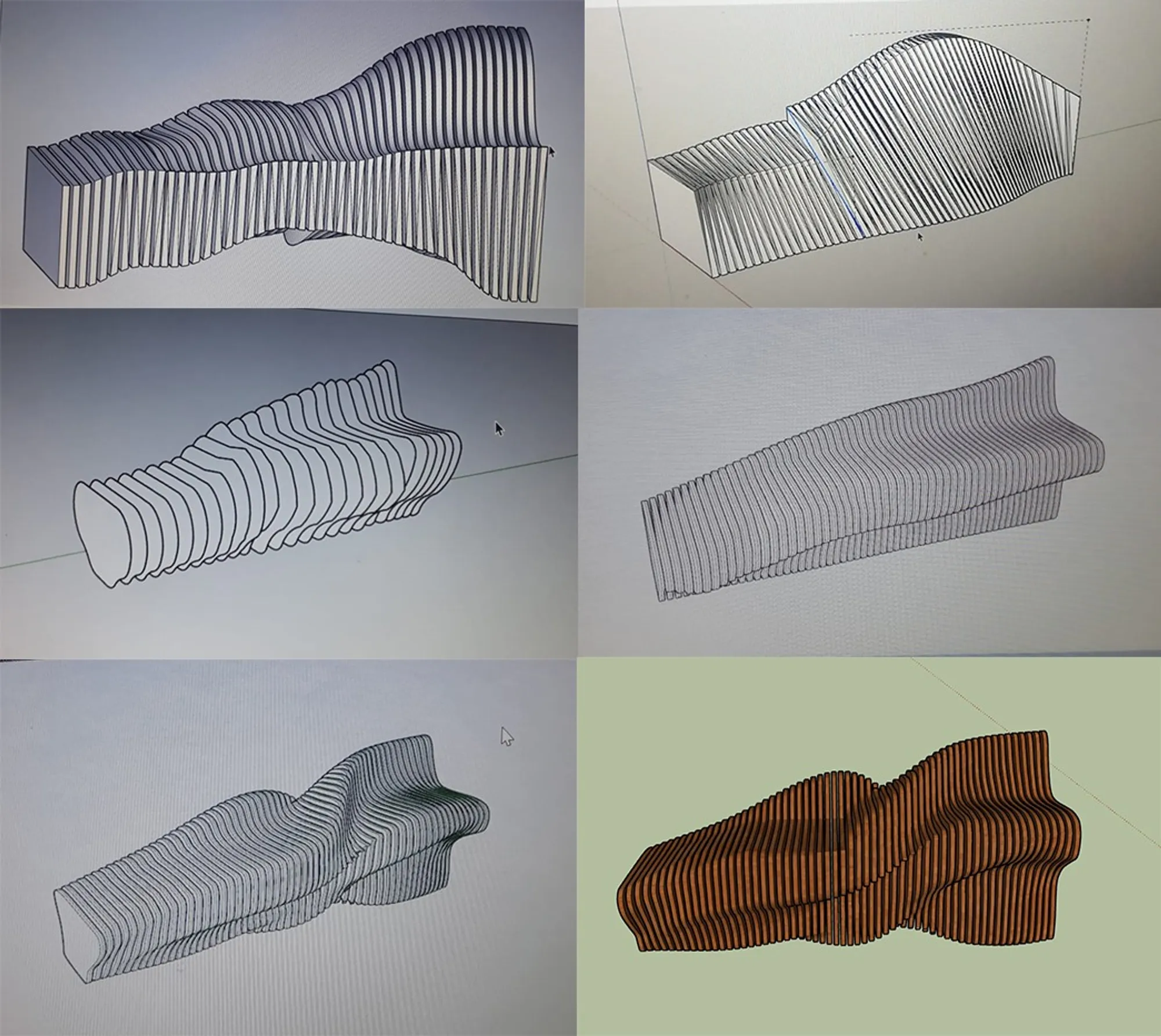
In our design, we understood the importance of color harmony, balance of measure and ratio, being modern, referring to the history of the region, being impressive and working in this direction, paying attention to the criteria that can create differences and affect the level of user appreciation. We designed our furniture forms in harmony with the original, semantic and environmental by coding them with piano notes. In this process, we considered factors such as usability, ergonomics and durability, and we conducted research, land surveys and Article readings on this topic, and talked to expert musicians. By experimenting with sketches and 3-D modeling and making criticisms, we reached the final result. Our design has given the region a sense of mobility, vitality and a contemporary and aesthetic appearance by associating the region with history and music with its form, material selection and color selection.



Popular Articles
Popular articles from the community


The Ocean Hive: Sustainable Architecture for a Self-Sufficient Civilization at Sea
The Ocean Hive imagines sustainable architecture at sea, where modular habitats, algae, wave power and ocean waste sustain a growing colony.

Riyadh For All: Intergenerational Urban Design for Active Aging in Rabat
Riyadh For All reimagines urban design in Rabat with intergenerational co-living, adaptive courtyards, and Moroccan cultural exchange today.

Co-Life: Senior Housing Design That Reconnects Older Adults With the City
Co-Life reimagines senior housing design through healing gardens, shared streets, workshops, and a sustainable community across generations.

Conexión: Biophilic Design Reimagines High-Rise Living in Hong Kong
Conexión reimagines high-rise living in Hong Kong through biophilic design, green facades, shared spaces, daylight, water and nature within.


Similar Reads
You might also enjoy these articles

Day and Night Park: A Time-Based Urban Newsstand in Beijing
A temporary urban newsstand in Beijing blending travel, light, and reading through poetic colors, compact form, and community-focused design.

Modernist Patio Renovation in El Masnou, Barcelona by Oliver Segura Arquitectura + Cebrià Arquitectura
Modernist patio renovation blending tradition and innovation with a movable pool, leveled floors, and Catalan materials in El Masnou.

Alto Residencial Coop: Cooperative Housing Development in Santiago de Compostela by Carbajo Barrios Arquitectos
A linear cooperative housing complex blending white volumes and perforated metal façades, enhancing community living, natural light, privacy, and urban integration.

Vil Genis School by BPA ARCHITECTURE – Massy, France
Vil Genis School in Massy, France, features sustainable design, south-facing classrooms, community integration, accessible spaces, and modern educational architecture.


Comments (0)
Please login or sign up to add comments
No comments yet. Be the first to comment!