

Boma Bliss: Reimagining Play and Architecture in Refugee Camps
Exploring Boma Bliss: innovative humanitarian architecture fostering belonging and creativity for refugee children in Dadaab.


Boma Bliss, an innovative architectural project, was created by Lulu Hasan, Safa Shukkur, and Labeeb Jan, and was awarded the People's Choice Award in the Re-imagining Play Competition. Designed to rekindle a sense of home and belonging, Boma Bliss offers refugee children the opportunity to create a unique play environment that fosters creativity, resilience, and a sense of community. This article explores the architectural ingenuity behind Boma Bliss, its impact on the refugee community in Dadaab, and its broader implications for architecture in humanitarian contexts.
Understanding the Context: Dadaab Refugee Camp
Located in Garissa County, Kenya, Dadaab is home to one of the world's largest refugee camps, housing over 223,420 registered refugees and asylum seekers. The majority of Dadaab's residents hail from Somalia, having fled prolonged conflict and recurrent droughts and floods. The camp, divided into three main sections—Dagahaley, Hagadera, and Ifo—functions like a small city with various public amenities such as schools, hospitals, religious spaces, and markets.
Despite these facilities, the camp's vastness and the lack of clear signposts make navigation challenging, particularly for new arrivals. The camp's design, although comprehensive, often leaves refugees feeling isolated and disconnected from their surroundings. This sense of dislocation is particularly profound among children, who grapple with instability and loss.

Boma Bliss: An Architectural Haven for Refugee Children
Concept and Design
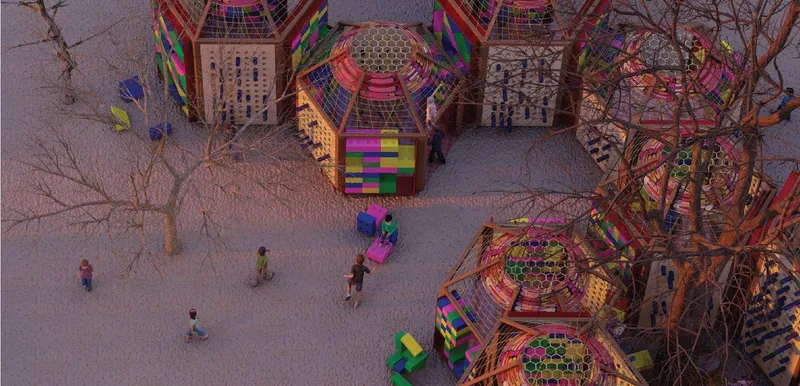
Boma Bliss was conceived as a safe haven where refugee children can reclaim a sense of stability and control over their lives. The design draws inspiration from traditional African homesteads, known as "bomas," which are typically circular and communal in nature. This architectural form fosters a sense of enclosure and security, essential for children who have experienced trauma and displacement.
The play modules within Boma Bliss are hexagonal in shape, chosen for their structural efficiency and ability to facilitate multiple play elements on each wall. Each module is interconnected, forming a cluster that allows for a variety of play activities while fostering social interaction and cooperation among children.
Features and Innovations
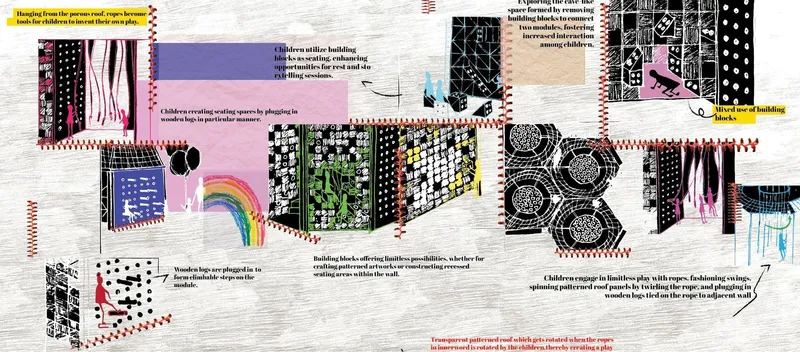
Climbing Structures and Play Walls: The modules feature climbing walls, ropes, and other tactile elements that encourage physical activity and exploration. The transparent roof, crisscrossed with ropes, creates a unique play space where children can invent their own games and navigate their surroundings from a new perspective..
Interactive Building Blocks: The walls of the modules are equipped with building blocks that can be rearranged to create new play configurations. This interactive feature promotes creativity and problem-solving skills as children collaborate to design their own play environments..
Seating and Rest Areas: Integrated seating areas provide spaces for rest and social interaction. Wooden logs and other natural materials are used to create a warm, inviting atmosphere that contrasts with the harsh realities of the refugee camp..
Color and Pattern: The vibrant colors and patterns used in Boma Bliss are not only visually stimulating but also culturally resonant, reflecting the rich heritage of the refugee children. This visual appeal helps create an environment that feels familiar and comforting.

The Impact of Boma Bliss
Boma Bliss has had a profound impact on the children of Dadaab, providing them with a sense of ownership and belonging. By engaging in imaginative play, children are able to process their experiences and build resilience. The collaborative nature of the play modules fosters a sense of community, helping children to form friendships and develop social skills.
Moreover, the presence of Boma Bliss within the camp has had a ripple effect, encouraging other community members to participate in creating a more supportive and inclusive environment. The project has highlighted the importance of play and creativity in the psychological well-being of refugee children, demonstrating that thoughtful architectural design can have far-reaching benefits.

Broader Implications for Humanitarian Architecture
Boma Bliss is a testament to the power of architecture to transform lives, particularly in humanitarian contexts. It underscores the need for designs that are not only functional but also nurturing and empowering. The success of Boma Bliss can serve as a model for other refugee camps and humanitarian projects worldwide, illustrating how innovative architecture can address both the physical and emotional needs of displaced communities.
Boma Bliss, through its thoughtful design and innovative features, has redefined what play spaces can be for refugee children. It has provided a much-needed sanctuary where children can heal, grow, and thrive. As we look to the future, projects like Boma Bliss remind us of the critical role that architecture plays in creating safe, nurturing, and hopeful environments for the most vulnerable among us.


Popular Articles
Popular articles from the community


Opera by the Sea Estonia: Three Shells Dissolving Architecture into Tallinn's Coastline
A winning opera house proposal replaces monumental form with interconnected shells that blur the boundary between building, park and Baltic Sea.

Singing Woman: Contemporary Architecture Inspired by Estonia’s Voice and the Sea
Singing Woman turns Estonia’s song culture into flowing opera house architecture, blending public life, landscape, sea, and national memory.

Temporary Home for Dogs: A Reversed Zoo Rethinks Animal Shelter Architecture
In Bucharest, a sinuous corridor and freed landscape flip the logic of containment, designing a shelter that works to make itself unnecessary.
Extended Shell: Retrofitting Kolkata's Balconies as Living Urban Thresholds
A modular retrofit system recovers the social and environmental intelligence of Kolkata's historic verandas for contemporary Park Street residents.

Similar Reads
You might also enjoy these articles

Day and Night Park: A Time-Based Urban Newsstand in Beijing
A temporary urban newsstand in Beijing blending travel, light, and reading through poetic colors, compact form, and community-focused design.

Modernist Patio Renovation in El Masnou, Barcelona by Oliver Segura Arquitectura + Cebrià Arquitectura
Modernist patio renovation blending tradition and innovation with a movable pool, leveled floors, and Catalan materials in El Masnou.

Alto Residencial Coop: Cooperative Housing Development in Santiago de Compostela by Carbajo Barrios Arquitectos
A linear cooperative housing complex blending white volumes and perforated metal façades, enhancing community living, natural light, privacy, and urban integration.
Vil Genis School by BPA ARCHITECTURE – Massy, France
Vil Genis School in Massy, France, features sustainable design, south-facing classrooms, community integration, accessible spaces, and modern educational architecture.

Explore Refugee Camp Competitions
Discover active competitions in this discipline

Challenge to reimagine the Iron Throne

Photograph architecture without architects

Illustrate the lost glory of Angkor Wat - Render Challenge

Design challenge to reuse E-waste
Comments (0)
Please login or sign up to add comments
No comments yet. Be the first to comment!