
Brewed
Brewed Cafe- Bali
The concept of this project is transparency derived from the mask. My team members and I referenced the Caffè Florian's design and culture. We found that mask culture is very popular in Piazza San Marco. Local residents wear masks of different designs for the carnival. Masks have different characteristics and functions. In carnivals, Bautas are more common. This is a clear mask that covers the entire face. This kind of mask can promote conversation, eating, and drinking while covering up identity. It is a mask that can hide the identity of the neglected without being restricted by social hierarchy and daily customs. Mask culture is also very popular in Bali. However, unlike Venetian masks, they have a strong religious culture and are often used in some ceremonies, such as offering sacrifices to the Holy Spirit. On the other hand, Caffè Florian, as one of the most famous coffee shops in Europe, is also the first coffee shop in history to accept women. It also gives women the same rights as men to enjoy coffee. The original intention of our design is to allow people of different cultural backgrounds to take off the ideological "mask" in our coffee shop and exchange ideas in an equal and tolerant state.
First of all, I have to plan and arrange tasks with my team members. In the early stage, we all analyzed and discussed the development of the history of cafes. Then in order to integrate different concepts, we made Montage and Collage to show the concepts and ideas we want to express. Because these two methods can very well express our concept abstractly, but also show the story to be narrated. The establishment of the concept is obtained after repeated discussions and discharges. Next, we will confirm the various parts of the building through modeling and deliberation. Then we need to design the furniture and to choose the materials and colors. The last step is to deepen the nodes and render the final renderings.
From the initial discussion to the final concept, we have gone through about four iterations. The initial concept developed from the concept of the mask to cover. Then developed from the concept of concealment to ambiguity. Finally, the concept of transparency is derived through ambiguity. From the physical level, the concept of transparency refers to the transparent effect formed by the material. Phenomenological hierarchy refers to the multiple levels and potential sequences created by objects, which can be explained in a variety of ways. The ambiguity effect of the spatial subordinate system.
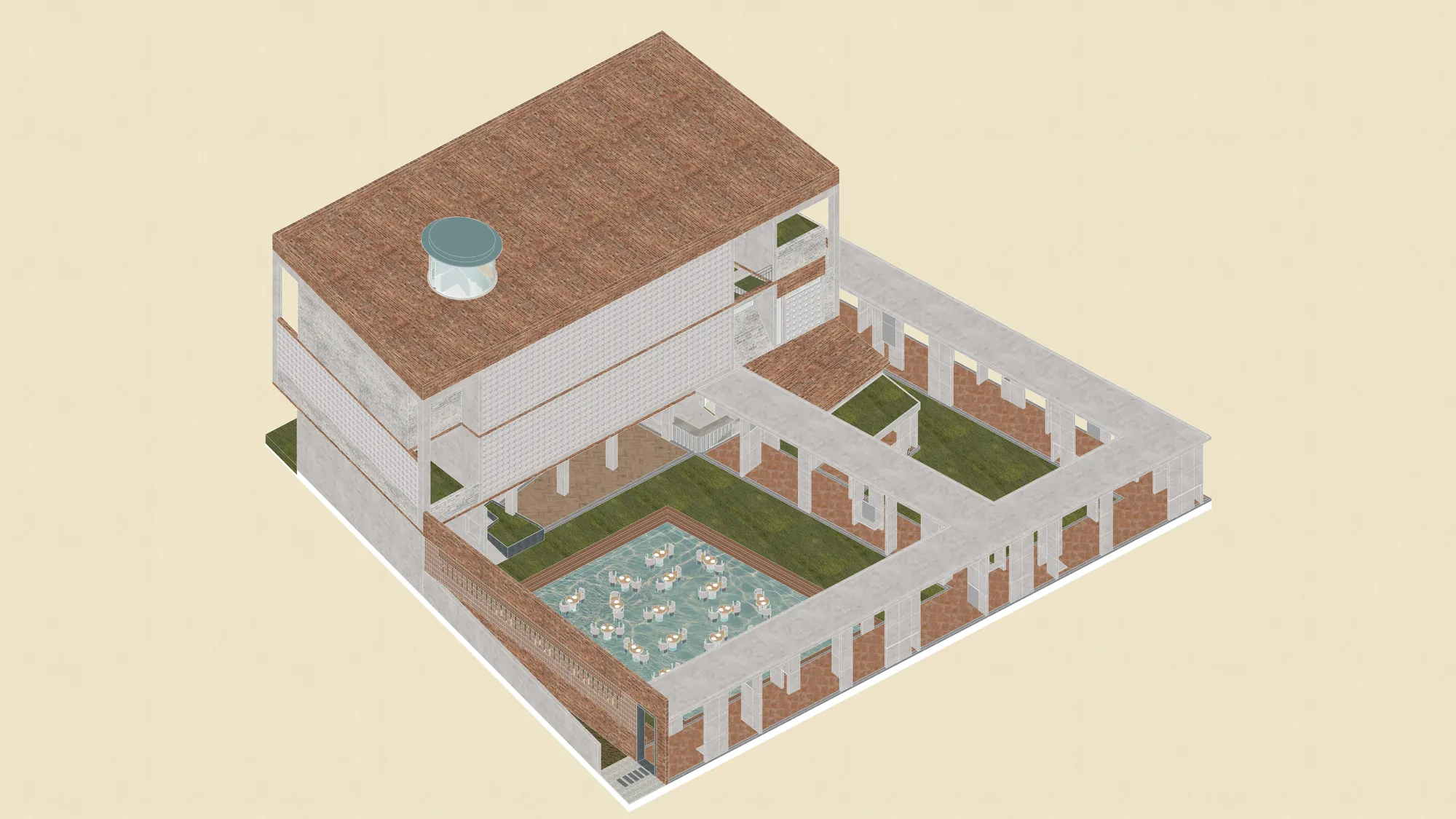
The design of investigation that we used is the translation from the ambiguity inside and outside of the space to the architecture. Ambiguity and concealment are the attributes and functions of masks. Masks can express different ideas by erasing the wearer’s facial features while strengthening certain parts. In our design, we want to use the ambiguity of the mask to combine with the transparency of the architecture to imply the collision between the local culture of Bali and the foreign culture brought by tourists. For the structure, we use slide walls as the main support and use a double-facade to create an inconsistency with the interior space. The concise facade can hide the more complicated internal spatial layout as well. People cannot distinguish the structure of the interior by the appearance of the building. It can increase the ambiguity of the building and let people have different ideas about the interior of the building. On the other hand, we used two grid systems to show people's ambiguity about different grids in the same space of the building. The first floor is designed to have the least transparency, while the second floor is the most transparent, and the third floor has the transparency between the first and second floors. The first floor is the most semi-open space, and less transparency is a place where people can gather and observe well. The second layer has the most transparency, the purpose is to allow people with different backgrounds and cultures to communicate and communicate through coffee as a medium. Let different cultures and histories collide in this space. The third floor serves as a display space for coffee culture, where people can learn about the coffee-making process and culture, and they can also enjoy the scenery outside the window around the glass box in the middle.
In terms of material selection, we used local characteristic orange and gray clay bricks as the main building materials. The combination of modern craftsmanship and traditional materials shows the fusion and change of Bali’s traditional architectural design with modern materials. Grey terracotta bricks can make the building look more calm and mysterious. The orange-red terracotta bricks can add vivid color to the calm building shell. The interior uses a lot of recyclable wood products, and furniture is made of bamboo products. While protecting the environment, it also reflects respect for the local culture of Bali.
With the rapid development of the Internet and the recognition of Bali’s coffee, more tourists will come here and bring foreign culture. The different foreign cultures can communicate and exchange with the local traditional culture. I hope while people enjoy the coffee and historical precipitation brought by superb production technology, they can also have equal and classless exchanges with different cultures.

Popular Articles
Popular articles from the community


Lunar Spiral: Space Architecture Shaped by the Mathematics of the Universe
Lunar Spiral reimagines space architecture through Fibonacci geometry, lunar regolith, levitating habitats, and self-sustaining Moon living.

The Earth Pod: 3D Printed Homes for Resilient Refugee Communities
The Earth Pod reimagines refugee housing through 3D printed homes made from clay, combining resilience, self-sufficiency, and rapid shelter.

Riyadh For All: Intergenerational Urban Design for Active Aging in Rabat
Riyadh For All reimagines urban design in Rabat with intergenerational co-living, adaptive courtyards, and Moroccan cultural exchange today.

Co-Life: Senior Housing Design That Reconnects Older Adults With the City
Co-Life reimagines senior housing design through healing gardens, shared streets, workshops, and a sustainable community across generations.

Similar Reads
You might also enjoy these articles

Day and Night Park: A Time-Based Urban Newsstand in Beijing
A temporary urban newsstand in Beijing blending travel, light, and reading through poetic colors, compact form, and community-focused design.

Modernist Patio Renovation in El Masnou, Barcelona by Oliver Segura Arquitectura + Cebrià Arquitectura
Modernist patio renovation blending tradition and innovation with a movable pool, leveled floors, and Catalan materials in El Masnou.

Alto Residencial Coop: Cooperative Housing Development in Santiago de Compostela by Carbajo Barrios Arquitectos
A linear cooperative housing complex blending white volumes and perforated metal façades, enhancing community living, natural light, privacy, and urban integration.

Vil Genis School by BPA ARCHITECTURE – Massy, France
Vil Genis School in Massy, France, features sustainable design, south-facing classrooms, community integration, accessible spaces, and modern educational architecture.
Explore Cafe and Restaurant Design Competitions
Discover active competitions in this discipline


Challenge to design luxury tourism on rails


VR headsets Storefront design competition

Designing a staircase for a client
Comments (0)
Please login or sign up to add comments
No comments yet. Be the first to comment!