

Bus Stop Design Journal
Design and Thought Process

Initial Thoughts
What initially drew us to this project was the opportunity to rethink an approach to an existing design process. As mentioned in the brief, large infrastructure designs including transportation systems are often developed top-down, prioritizing production and distribution over its local users. As mentioned, “every bus stand installed is an opportunity to solve a need of a locality if we see it bottom-up.” We were also intrigued by the challenge to design a modular bus stand system, which is both more sustainable if we need to adapt to the needs of different neighborhoods, and also more creatively challenging.
Design Challenges
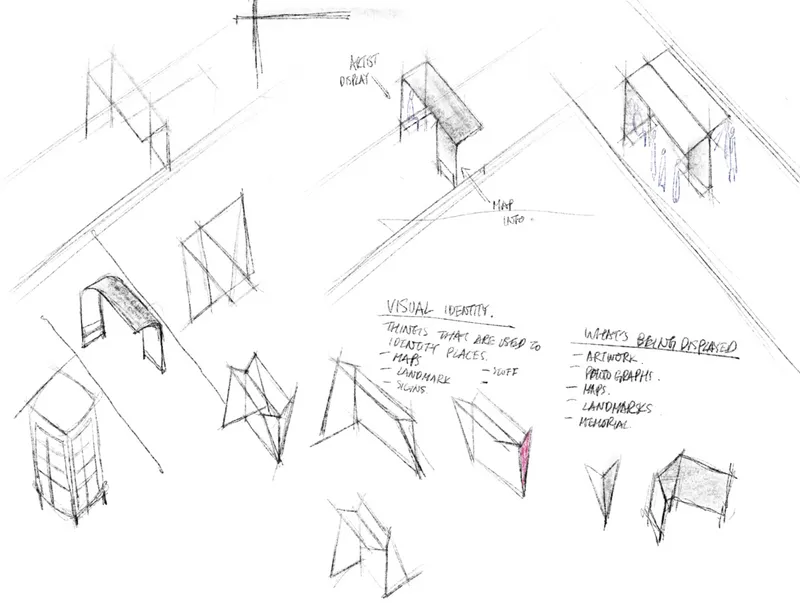
First, we chose the site, downtown Vancouver, the city we are most familiar with and grew up in because we believe it is crucial to understand how the system works in its existing context and the user experience. We discussed our experiences and also sent out surveys to our friends and neighbors in the area to get a census of the existing condition. After some discussion and further research, we arrived at a dilemma. We realized the existing bus stops (our local transportation system: BC Transit) aren’t very problematic and are logically designed and it works fine, so what do we need to do?
Of course, there were shortcomings from the existing bus stop, which we worked on to improve in our design, including the lack of rain coverings for smaller bus stops, no source light at night, lack of security, the insufficient route and schedule information, and the lack of accessibility and seating. These were all issues identified for our site-specific bus stop, however many of the bus stops throughout the city have the same problems.
These were all design issues that could be resolved and iterated. but what we could not overlook was the fact that these were smaller issues, and the lack of these features didn’t necessarily discredit the existing bus stop designs. There are millions of bus stop designs already created; playful, futuristic, sustainable, sculptural, “starchitect-ural” but none of them were objectively “better” for the city, merely another creative design. Thus, we were torn on wanting to keep it similar to the conventional, simple and functional, while also not falling into the same top-down convenient approach.
Arriving at Our Main Concept
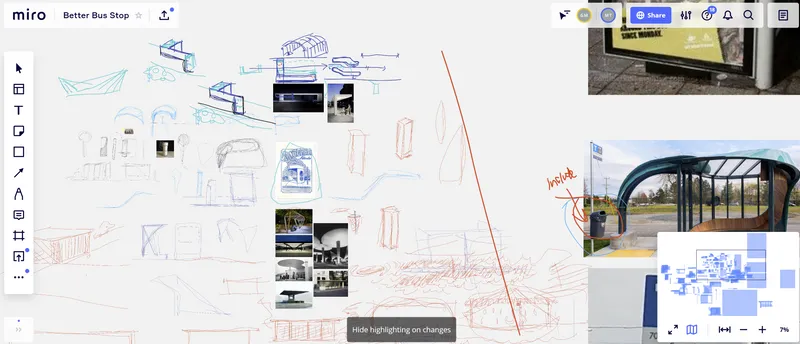
This is when we began to think of a different approach to bottom-up design. We wanted to tackle another aspect of designing for the local user, something more identity-driven. We came up with the idea of utilizing the bus stop as a symbol that represented the local community and could connect its users. Thus, similar to an installation, the glass backing of the bus stop would exhibit the artworks, stories, history, landmarks submitted by local bus-users and residences creating an evolving collection of the stories which would reflect the people unique to each area. Bus stops are everywhere in the city and they are a public space accessible by almost everyone to experience thus we thought it would be a great way to utilize this missed opportunity.
We devised a preliminary system for running this “city-wide exhibition”. Everything will be operated and processed online, through an app or website. Jurors will be selected accordingly and they will be reviewing the submissions from the local area. From children to seniors, everyone is welcome to contribute, essays, paintings, photography, and anything visual can be submitted and reviewed. Once a piece is selected, the work will be credited and a small contributor’s bio will be included in the poster which will then be printed to dimension and inserted into the bus stand. Works can be updated periodically depending on the number of submissions or time of year. Works can also be interconnected throughout different bus stops, routes, or regions. There could be scavenger hunts or a continuous story that extends over several bus stops. The possibilities are endless, and open to the public’s imagination which is a great way to experience your community. There could be organized collaborations or school events for submissions that would really involve entire communities. Most people would love to see their works being recognized and shared while the community can benefit greatly from each other’s willingness to share.

Despite the emphasis on identity, we also focused greatly on iterating the function and form of the bus stop. We started with concepts of how to display the work, and how to bring a sense of identity to the area. We played with the notion of creating structures and forms that would represent different locations such as more industrial design and materials for downtown Vancouver and then more earthy and organic tones for North Vancouver which is a more slow-paced neighborhood, embedded in the mountains. However, we soon realized the possibilities for varying the design to meet the identity of each area are endless and also would not be able to achieve a modular design that could be adaptable. Therefore, we tried to keep the base of the design, clean and concise, giving it identity with the poster displayed inside each stop.
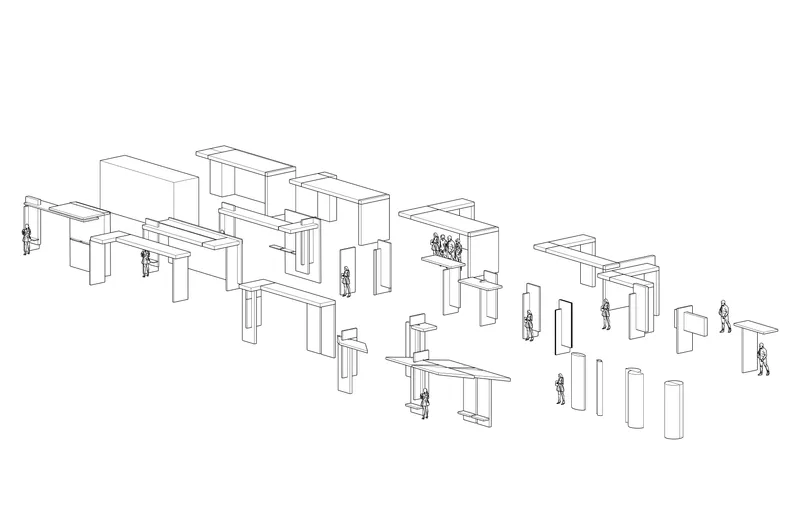
Our final design is adaptable in its modularity, with three main components that can be generally categorized into shelter, information/ identity, and user comfort/ accessibility. Due to the simplicity of the design, the assembly is fast while the variations created from different combinations and arrangements of the three elements are vast. With a small singular unit, the first variation can be very compact to fit on a busy downtown street like on the site we chose for this project, or simply smaller due to lower demands like on a vacant suburban street. More singular units can then also be joined to create the conventional rectangular bus stop with seating. If it is a very popular location, the seating can be extended to fit the demand and also removed over time if the needs change. The overhang can also be used vertically to block wind and snow in colder climates instead of only sheltering from the elements from above. Finally, with the map information and identity poster embedded into each unit, even the smallest stops can have enough information for the user to navigate the city and also have a unique identity. The singular units also have fold-down seating, the digital announcement board, and lights primarily powered by PV panels for the best user experience.
For materials, we designed mainly with only 2x4” composite wood lumbers and studs to encourage upcycling and prevent unnecessary waste for complex geometries. Additionally, British Columbia is greatly abundant in lumber therefore sourcing locally will also contribute to a more sustainable production process. In other countries or regions where wood is not abundant, the simple geometry can be engineered to utilize other local or upcycled resources efficiently such as steel or plastics.
Final Thoughts
Throughout the design process, we have identified and addressed various needs and opportunities of a bus stop from shelter to sustainability, but what we found most compelling was the concept to turn the static bus stop into something interactive and unique to each community.


Popular Articles
Popular articles from the community


Temporary Home for Dogs: A Reversed Zoo Rethinks Animal Shelter Architecture
In Bucharest, a sinuous corridor and freed landscape flip the logic of containment, designing a shelter that works to make itself unnecessary.

Opera by the Sea Estonia: Three Shells Dissolving Architecture into Tallinn's Coastline
A winning opera house proposal replaces monumental form with interconnected shells that blur the boundary between building, park and Baltic Sea.

Singing Woman: Contemporary Architecture Inspired by Estonia’s Voice and the Sea
Singing Woman turns Estonia’s song culture into flowing opera house architecture, blending public life, landscape, sea, and national memory.
Faces of the Soviet Avant-Garde: Turning Moscow's Street Names into an Open-Air Museum
A network of sculptural installations across a Moscow residential district transforms forgotten architect names into spatial encounters with cultural memor

Similar Reads
You might also enjoy these articles

Bao Huynh Watercolor Atelier: A Serene Art Retreat in Hội An
Bao Huynh Watercolor Atelier in Hội An blends multifunctional art spaces, sustainable design, local materials, and family-friendly living in a serene environment.

Atelier Macri Concept Store Interior Design by CASE-REAL
Atelier Macri store features a "ko" counter, walnut wood details, cork displays, blending retail, gallery, and seamless customer experiences.

Manuel Vargas Izquierdo Stadium and High-Performance Sports Center: Architectural Excellence in Jalpa de Méndez
The Manuel Vargas Izquierdo Stadium blends sustainable design, inclusive sports facilities, and cultural-inspired architecture, revitalizing Jalpa de Méndez’s public spaces.

KAKR Buluh Awar Hall: Revitalizing Community and Ecology Through Bamboo Architecture
Community built bamboo hall revitalizes Buluh Awar village, empowering youth, restoring ecology, celebrating vernacular craftsmanship through sustainable architecture and culture.

Comments (0)
Please login or sign up to add comments
No comments yet. Be the first to comment!