CARITAS – Memorial and Educational Center in Brazil
The project, centered on an educational and memorial center, faces the challenge of addressing this theme within the diverse and complex context of São Paulo.

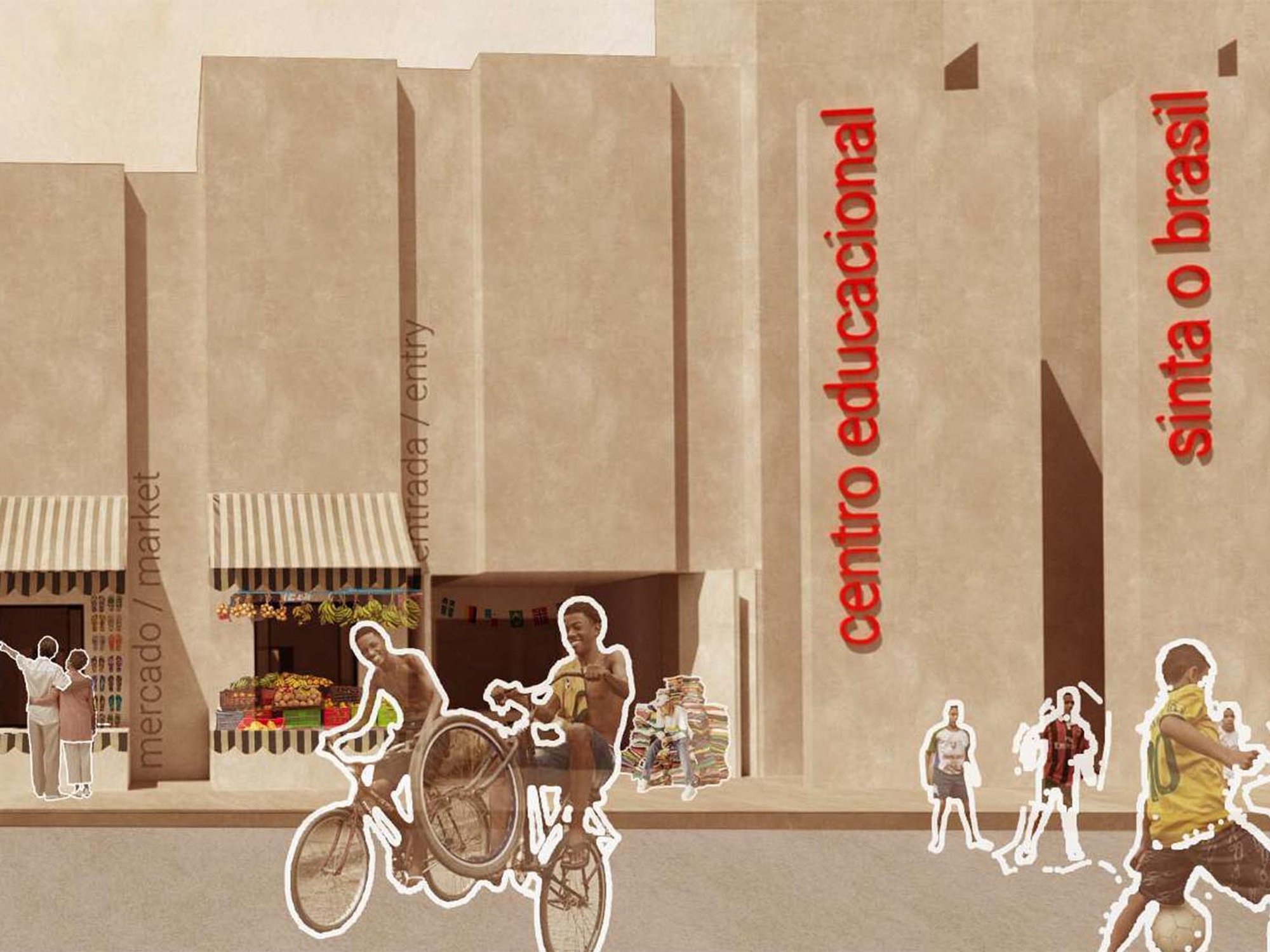
The concept of the proposed design envisions a space that offers a degree of education to tourists and newcomers, while equally serving the local population and its users. A central motif that plays a vital role in the project is the sport for which Brazil is most renowned – football. For Brazilians, football represents a cult; it is believed in, it is lived for. It is both daily life and an escape from it. Matches and the experience of the stands are described as escapism, while for children living in poverty football often provides a springboard out of hardship. The stands are not merely places of observation – they bring people together, they teach, they celebrate, and they share sorrow.
The entire concept has been shaped by several factors – the scale of the location, the idea of integrating stands into programmatic content (and vice versa), and the spatial analysis through the use of cubes, which gave rise to much of the project’s architecture. This process resulted in several types of ‘stands’:
- The classical stand – orthogonal, framed, minimal, with four entrances.
- The circular stand – accessed at ground level and merging with the third type.
- The cubes that ‘grow’ dynamically, rising and descending, serving as places from which sports events can be followed or for entirely different purposes. They create plateaus connected by numerous staircases that resolve the changes in elevation. These cubes grow alongside an existing tall structure, its blank side façade enabling the cubes to attach and expand.
- The existing theatre – its glass façade oriented toward the field, leaving this side open, creating the possibility to watch events directly from the theatre.
- The scaffolding extending from the theatre, leaning against the cubes and adjacent structures, offering potential for new ‘stands’. Inspired by the narrow scaffold seating of theatres, the idea is to prolong this construction to provide additional viewing spaces along the blank façade.
- A building combining housing and a clinic – much like in the Brazilian favelas, with façade openings oriented toward the field, allowing inhabitants to participate in the events. In this way, the residential and medical building temporarily becomes a ‘stand’ from which to watch, listen, and learn.
The content is diverse, yet its essence remains the same – to emphasize the significance of the stands and their impact on Brazilian society:
- A building with a large screen, containing all the elements of a primary school except the classrooms (entrance, halls, toilets, elevators, staff rooms, and technical facilities), as well as the administrative center responsible for the organization of sports and cultural events.
- This building continues into a stand, beneath which classrooms, libraries, and workshops for children are located.
- A monumental vertical communication core – a grand staircase with elevators at its center – serves as the main link between the orthogonal and circular stands. To reach the circular stand, visitors must first pass entrance control, followed by additional control through this vertical circulation. Due to its height, it also functions as a lookout point, enabling staff and security to monitor and maintain order.
- The circular stand, beneath which lies a football school – classrooms, gyms, locker rooms, bathrooms. This stand is separated from the street by rope nets stretched between poles. When no events are held, the nets are removed and this becomes the main access to the field.
- The dynamic cubes constitute a large portion of the structure. From the street, one may enter a market and a café. To access the field from the café, visitors pass through security control. Above the restaurant, workshops and studios are located, responsible for installations and spatial arrangements. Toilets and technical facilities are accessed from the atrium at ground level.
- A six-story building – three floors for housing units, from level ±0.00 to +9.00, and three for a medical clinic accessed from level -3.00 and ground level (-9.00). The ground floor contains five two-bedroom apartments for young couples, while the upper floors hold duplex apartments with three bedrooms for larger families.
- The art museum – the only building physically detached from the rest of the project and not treated as a monumental structure. While the rest of the project is imagined as a homogeneous reinforced-concrete mass, the museum is designed as a skeletal steel structure without solid walls. Its façade is composed of curtain walls and perforated panels inspired by the multiplication of the Brazilian flag. The ground floor is completely open, while access to the exhibition levels is provided by two spiral staircases. The idea is to insert partition walls at certain spots on the ground floor to create a variable display area, enabling anyone at any time of day to paint murals, draw graffiti, or otherwise engage creatively – reflecting the strong presence of Brazilian street art. In addition to well-known Brazilian artworks, the exhibition space would also host a collection dedicated to football, its history, achievements, and legendary figures who shaped the sport.