Civic Engagement Centre, Ahmedabad – A Contemporary Expression of Civic Architecture
A people-centric civic architecture project in Ahmedabad that reinterprets public space through layered streets, cultural exchange, and urban participation.


Civic architecture plays a critical role in shaping how citizens interact with their city. The Civic Engagement Centre, Ahmedabad, envisioned by Vinay Agrawal, explores how built form can actively strengthen relationships between people, culture, and urban space. Rooted in the historic fabric of Ahmedabad’s old city, the project proposes an architectural framework that re-establishes social, cultural, and economic transactions as everyday civic experiences.
In rapidly transforming Indian cities, public life is often compressed or displaced by privatized developments. This project responds by reasserting the value of inclusive, accessible, and participatory civic spaces—spaces that allow people to gather, exchange ideas, and engage with their shared urban identity.
Understanding Civic Engagement in Architecture
The term civic refers to matters relating to a city and its citizens. In architectural terms, civic engagement extends beyond monuments and institutions; it manifests through everyday interactions—on streets, in plazas, and within shared public infrastructure. A healthy city balances private life with public experience, enabling citizens to participate meaningfully in cultural, social, and democratic processes.
The Civic Engagement Centre is designed as a mediator between people and the city. It encourages involvement through spatial openness, programmatic diversity, and architectural cues derived from traditional urban patterns of Ahmedabad. Rather than imposing a singular monumental form, the project dissolves into a network of interconnected spaces that invite movement, pause, and interaction.
Context: Ahmedabad and the Old City Fabric
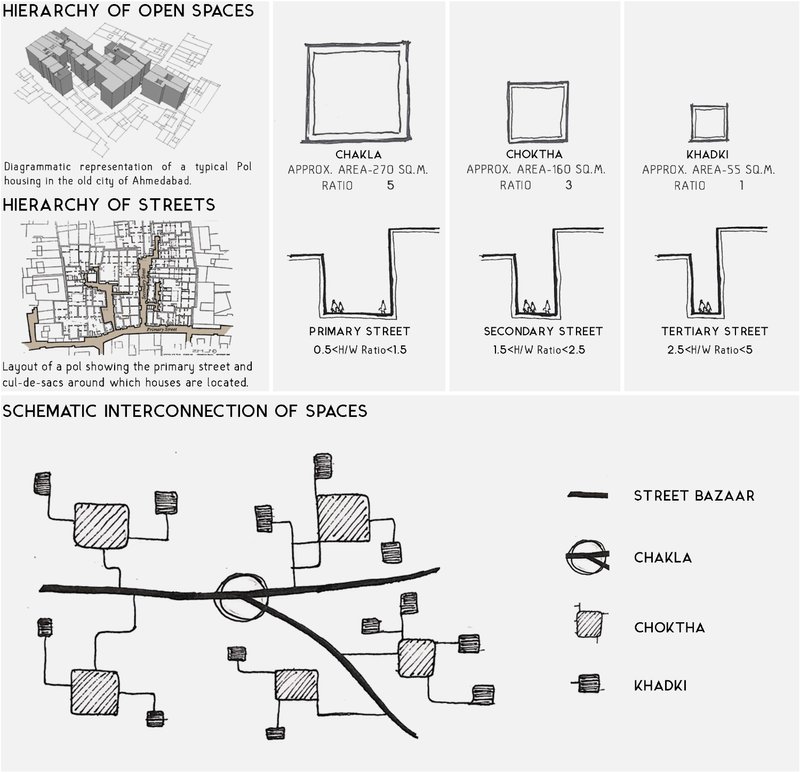
Ahmedabad’s old city is defined by its rich hierarchy of streets and community-oriented spaces. Elements such as pols, chowks, chabutras, otlas, and khadkis collectively shape a dense yet socially vibrant urban environment. These spaces support a wide spectrum of public-to-private interactions, from bustling street bazaars to intimate residential thresholds.
The project draws from this layered urban morphology. By studying traditional street sections, spatial transitions, and social behaviors, the design translates historic principles into a contemporary civic architecture language—one that respects heritage while addressing present-day needs.
Concept: Re-establishing the Transactions of the City
At the core of the project lies the idea of “re-establishing the transactions of the city.” These transactions are not limited to economic exchange but extend to cultural, social, and knowledge-based interactions. The architecture becomes a platform where these layers intersect.
- Cultural transactions emerge through spaces for exhibitions, performances, art studios, and informal gatherings.
- Social transactions are enabled through shared courtyards, stepped platforms, and transitional zones that encourage face-to-face interaction.
- Economic transactions are supported by commercial edges, informal vending areas, and street-facing activities.
- Knowledge transactions take place in libraries, seminar spaces, archives, and educational facilities.
By integrating these layers, the Civic Engagement Centre functions as a living extension of the city rather than a closed institutional complex.
Spatial Hierarchy and Urban Experience
The architectural layout follows a clear hierarchy inspired by the old city:
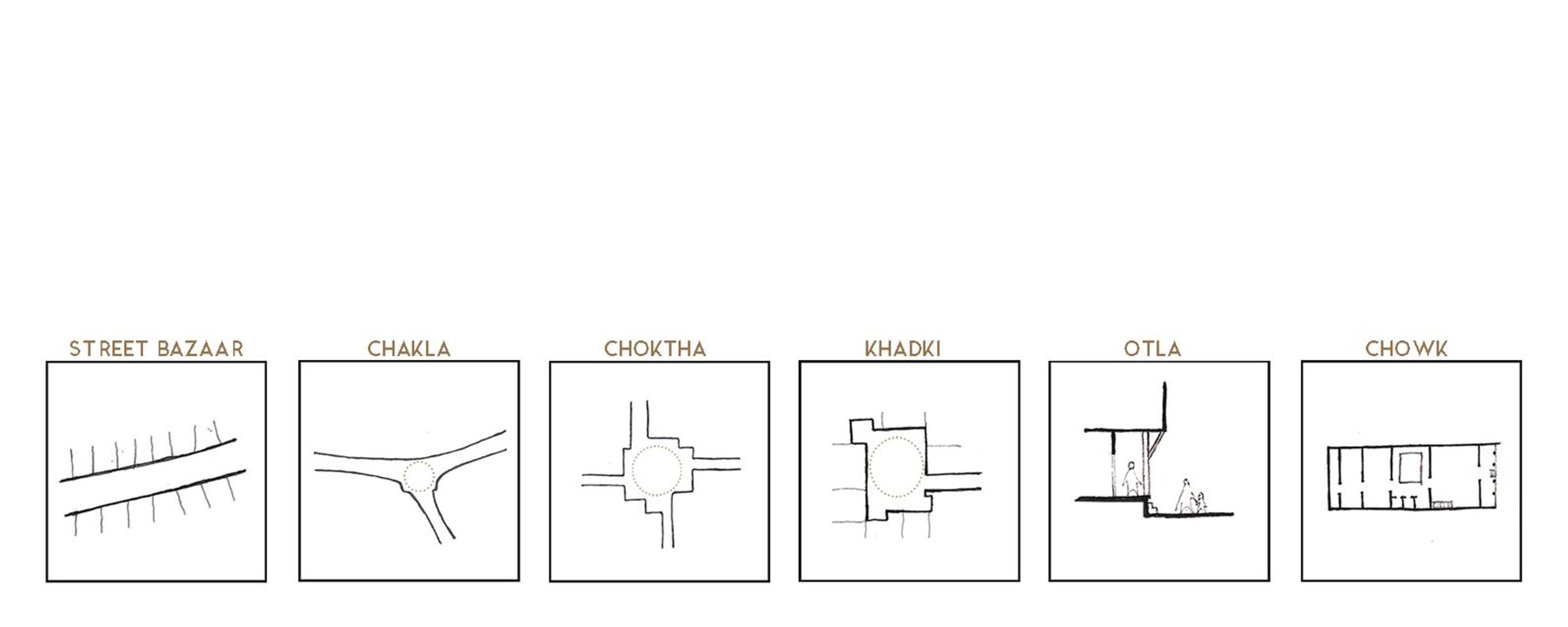
- Street Bazaar (Public): Highly active zones that host movement, commerce, and large-scale public interaction.
- Chakla (Semi-Public): Nodes at intersections where people naturally congregate.
- Chowktha (Semi-Public): Inner community spaces that foster social exchange and climatic comfort.
- Khadki and Otla (Semi-Private): Transitional thresholds between public streets and private interiors.
- Chowk (Private): Quiet, inward-looking spaces that support reflection and smaller gatherings.
This gradation allows users to intuitively navigate between openness and enclosure, making the building accessible to diverse groups while preserving spatial comfort.
Layers of the Street as Architectural Strategy
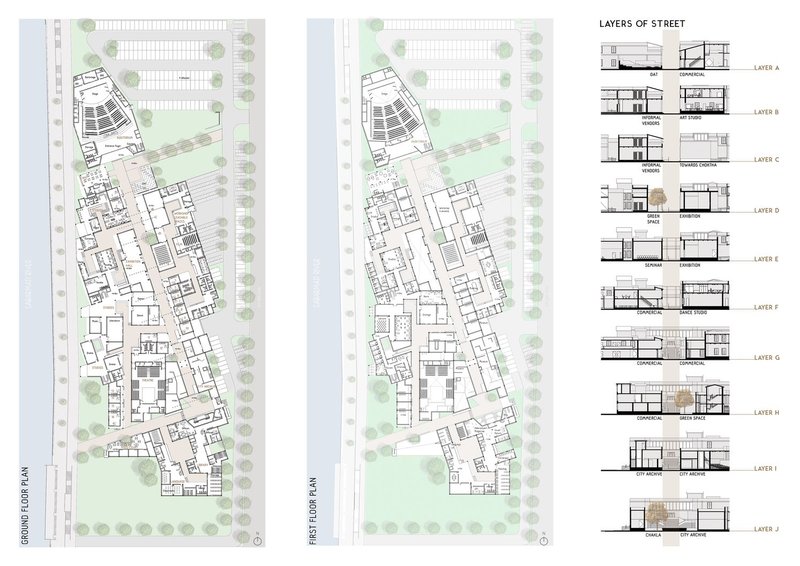
One of the defining features of the project is its interpretation of the street as a layered civic section. Instead of a single façade, the building unfolds vertically and horizontally into multiple layers:
- Commercial and informal activity zones at the lower levels
- Creative studios and exhibition spaces at intermediate levels
- Green terraces, archives, and quieter civic functions above
These layers mirror the complexity of street life in Ahmedabad, transforming circulation corridors into active social spaces. Movement through the building becomes an experience of discovery rather than mere transition.
Site Planning and Environmental Response
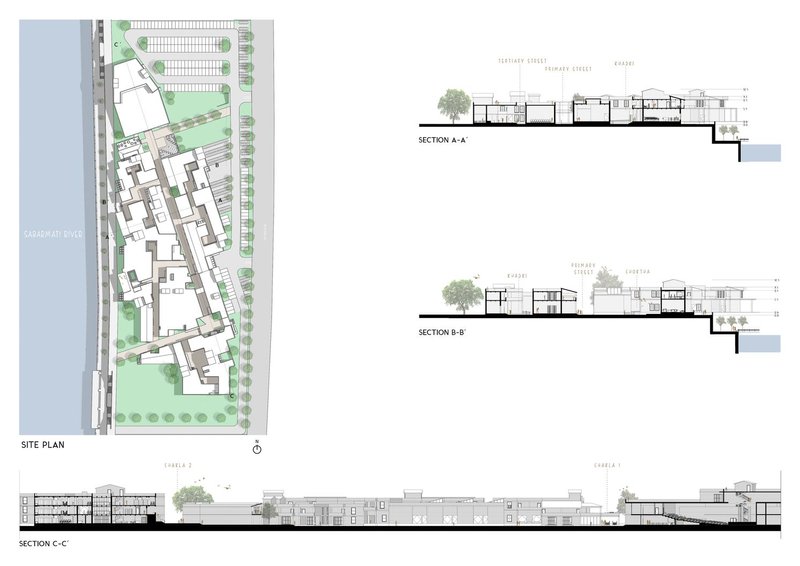
Located near the Sabarmati River, the site planning responds to both urban connectivity and environmental conditions. The linear organization aligns with existing circulation patterns, while landscaped buffers and courtyards enhance microclimatic comfort.
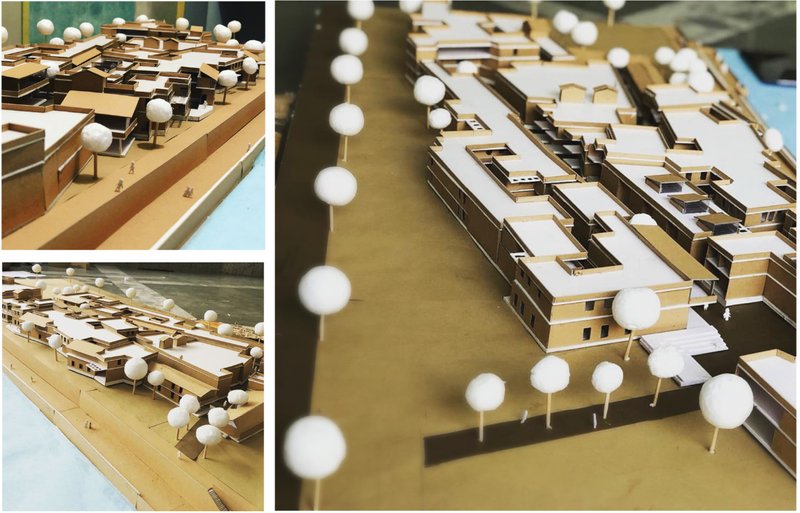
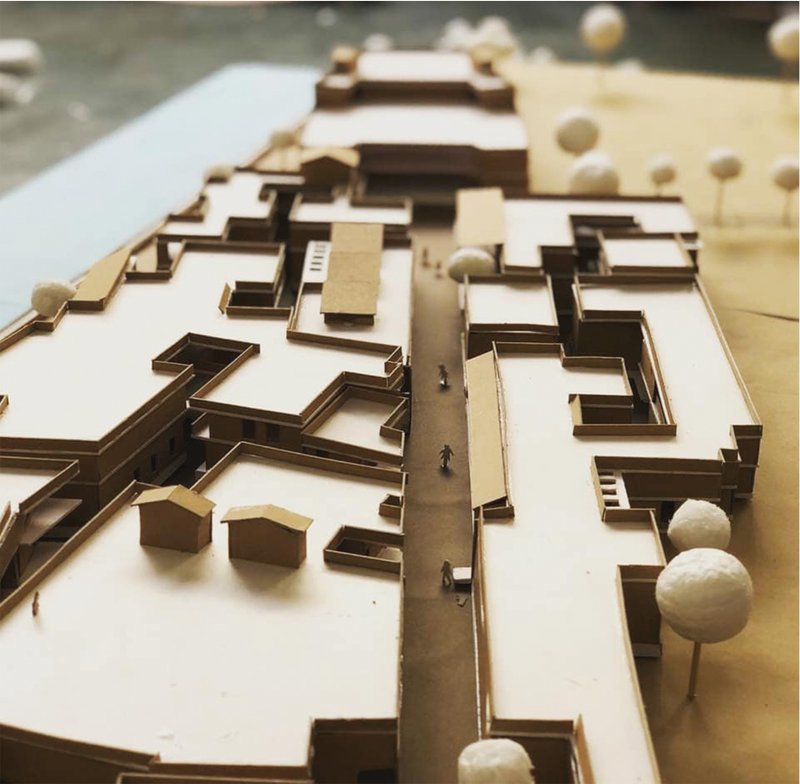
Sectional studies reveal careful modulation of height, light, and ventilation. Shaded walkways, recessed openings, and courtyards reduce heat gain while maintaining visual continuity across spaces. The architectural model demonstrates how civic architecture can remain climate-responsive without relying on excessive technological interventions.
Architectural Expression and Materiality
The massing strategy emphasizes fragmentation over singularity. Volumes are broken down to echo the scale of surrounding urban fabric, preventing the centre from overpowering its context. This approach reinforces the idea that civic architecture should belong to the people rather than dominate them.
Material choices and detailing further support this intention, emphasizing tactile surfaces, human-scale proportions, and visual permeability. The architectural language remains grounded, accessible, and adaptable.
The Civic Engagement Centre, Ahmedabad, stands as a thoughtful exploration of contemporary civic architecture rooted in local context. By reinterpreting traditional urban patterns through modern spatial programming, the project demonstrates how architecture can actively nurture public life.
Rather than functioning as a static institution, the centre operates as an evolving civic landscape—one that invites participation, dialogue, and collective ownership. In doing so, it reaffirms the role of architecture as a catalyst for inclusive, meaningful, and resilient urban communities.