

Surging Atoll 2100: A Miami Research Centre That Plans for Its Own Flooding
A Virginia Key research centre that lets its ground floor flood in phases, trading parking for piers as Miami's sea climbs toward 2100.


Most coastal buildings are designed to keep the water out. Surging Atoll 2100 starts from the opposite premise: the sea is coming in, so the building should know what to do when it arrives. The proposal treats flooding as a scheduled chapter in the building's life rather than a disaster to be averted. Its ground floor begins as parking and services and is gradually surrendered to the ocean, reborn as a water floor of floating piers and aquatic circulation. The result reads less like a fortress and more like a timeline, an architecture that expects to change its relationship with land over the course of a century.
Developed by Joshua Enrico Pagano as a research and design proposal, the project is set on Virginia Key, a barrier island off Miami, a city that sits at the front line of sea-level rise, intensifying hurricanes and coastal erosion. Pagano frames the building as a dual institution: a research centre for climate change and a cultural anchor for the city. That pairing matters. It positions climate science as a public, civic activity rather than something that happens behind closed laboratory doors, and it gives the building a reason to stay relevant as the landscape around it shifts from land-based urbanism toward hybrid land-sea living.
A Section Organised by Water Level
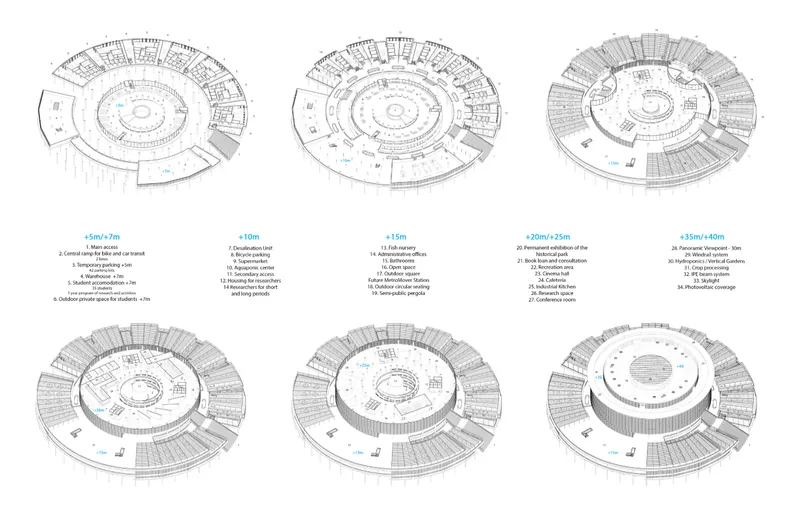
The stacked axonometrics are the clearest way into the project's logic. Each tier of the circular plan is drawn separately, with numbered programme legends climbing from the lowest levels to the dome at the top. What first looks like a conventional floor-by-floor breakdown is actually a set of elevation thresholds. Pagano assigns programmes according to projected sea-level scenarios, so the most critical functions, including the climate research laboratories and educational facilities, sit high in the section, while the lower tiers are designed to absorb and adapt to water intrusion.
The circular, atoll-like geometry does real work here. A ring distributes structural loads evenly and presents no flat face for storm forces to hammer against, which limits exposure to extreme weather. Form, structure and environmental strategy collapse into a single decision, and that economy is one of the proposal's quiet strengths.
Eighty-Two Years Compressed into Four Frames

The aerial sequence from 2018 to 2100 is where the project stops being a building and becomes a territorial argument. Across four stages, the coastal site gains its dome, then a field of wind turbines, then a ring barrier. This is the Virginia Key masterplan made visible: coastline reinforcement through adaptive landscape systems modelled on natural atolls, a protected archipelago shielding the island's existing scientific and educational facilities, and renewable energy and water-management systems built to function as the sea rises. The plan also extends Miami's MetroMover network to the island, a pragmatic gesture that acknowledges a resilient building is useless if nobody can reach it.
Drawing the project as a sequence rather than a single moment is a smart representational choice. It forces the viewer to read resilience as a process unfolding over decades, which is exactly the point Pagano is making about how coastal architecture should be judged.
A Ring That Turns Inward Toward the Skylight
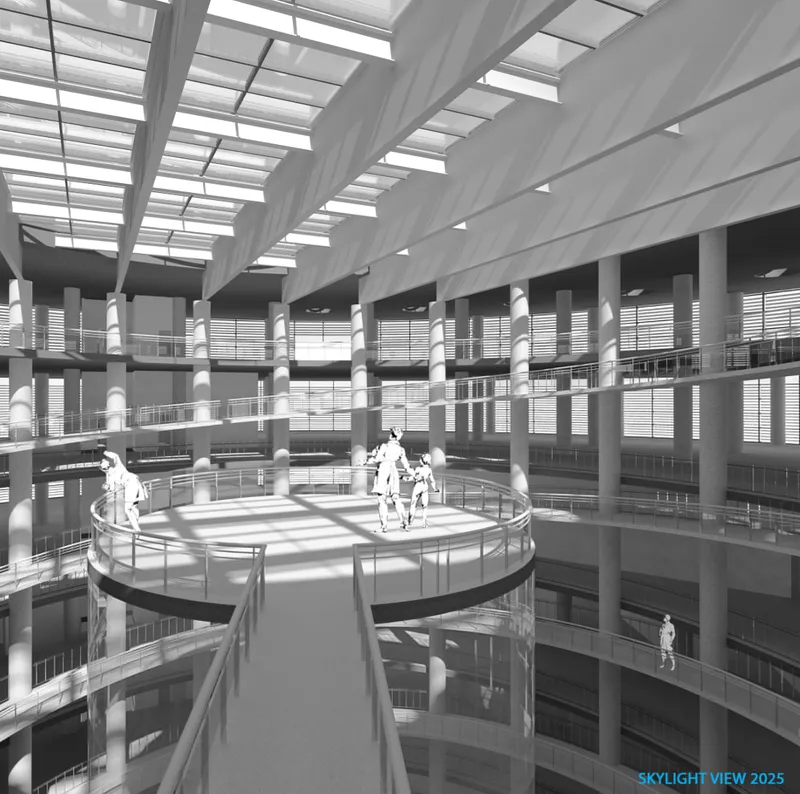
Inside, the circular plan produces a very different mood from the defensive posture of the exterior diagrams. Ring balconies wrap a central platform beneath a skylight, and sunlight cuts diagonal shadows across the visitors gathered below. The space is introverted and communal at once: every balcony looks across the void toward every other, so researchers and the public share a single visual field.
This is where the cultural-anchor ambition becomes spatial. A climate research centre could easily have been a stack of sealed labs; instead the interior stages the building as a gathering room, with daylight from above acting as the organising element rather than any view out to the threatening sea.
On Stilts Above the Lagoon, Under a Dome of Trees

The elevation drawing lifts the domed building onto stilts, and the territorial section beneath it reads from lagoon to barrier to turbine to open ocean. Placed together, the two drawings explain the full defensive gradient: the barrier absorbs the ocean's energy, the protected lagoon becomes the building's immediate setting, and the stilts keep the occupied floors above the projected water line while the ground plane is allowed to flood. It is the masterplan and the prototype speaking the same language at two scales.
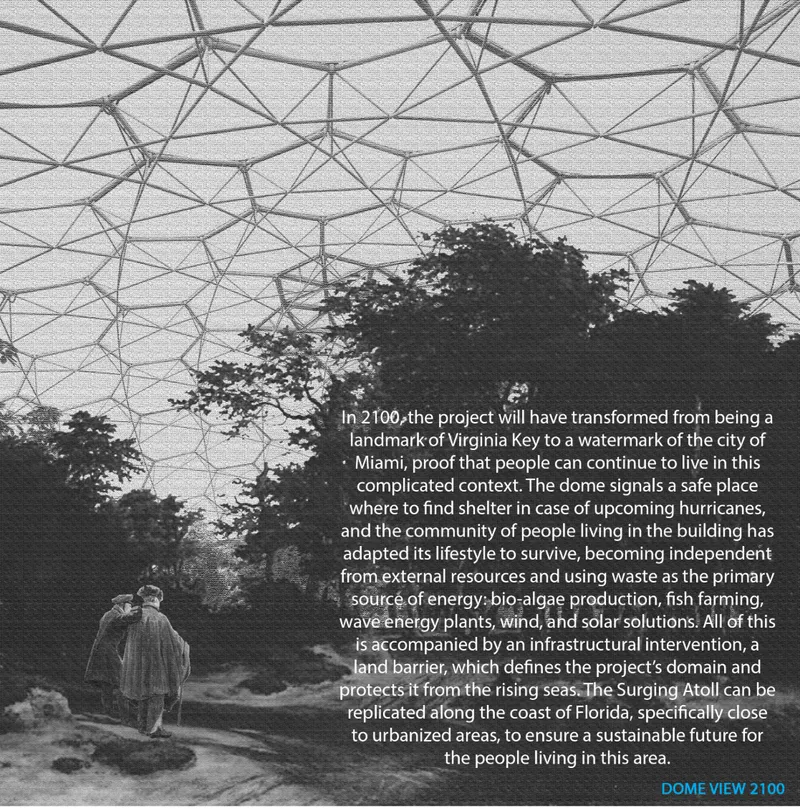
The collage offers the human counterpoint. Looking up through a geodesic dome over dense trees, with two figures walking a path, it suggests the building is meant to be inhabited as a landscape as much as a structure. The image softens the engineering of the section drawings and reminds us that the project's end state is not a bunker but a place people would choose to visit.
Why This Project Matters
Surging Atoll 2100 is valuable because it designs for obsolescence on purpose. The ground floor that becomes a water floor is a small move with large implications: it accepts that buildings on vulnerable coasts will lose ground, and it plans that loss so the institution keeps functioning rather than being abandoned. Too much climate-themed architecture either ignores rising water or answers it with walls; Pagano's phased approach sits in the more honest and more useful middle.
Equally important is the refusal to treat the building in isolation. By tying the prototype to a Virginia Key masterplan, with transit, energy, water management and an atoll-inspired coastline, the proposal frames the island as a living laboratory whose lessons could travel to other parts of Florida and to vulnerable coastlines worldwide. For a student-scale research proposal, that combination of architectural specificity and territorial reach is exactly the kind of thinking the next generation of coastal design will need.
View the Full Project
About the Designers
Designer: Joshua Enrico Pagano
Enter a Design Competition on uni.xyz
uni.xyz runs architecture and design competitions year-round that reward proposals with spatial conviction and real site intelligence.
Project credits: SURGING ATOLL 2100 - Sea level rise: research and design proposal / Case study: Virginia Key, Miami, Florida" by Joshua Enrico Pagano.


Popular Articles
Popular articles from the community


Architekt Andreas Gruber Scatters 23 Dark Timber Chalets Across a South Tyrolean Forest Edge
In Molini di Tures, Amonti Chalets breaks a resort into a hamlet of gabled timber houses, with parking, storage and services pushed into the slope.

GROUP A Strips a 1969 Rotterdam Harbor Headquarters to Its Frame and Wraps It in Timber Louvers
In Rotterdam's M4H harbor district, Ferro Offices reuses a 1969 frame, adds one timber storey and reaches BREEAM-NL Outstanding.

Jaramillo Van Sluys Arquitectura and Urbanismo Turn a Demolished Registry Lot in Quito into an Orchard Plaza
In Quito's Centro Histórico, a 2,800 m² plaza exposes the San Agustín convent wall and redraws its lost Augustinian orchard in volcanic stone.

David Macias Steps a Doorless Stone and Plaster House Down a Tropical Colombian Hillside
In the humid hills of Colombia, Threshold House replaces the front door with an open void and terraces its 850 m² down the slope instead of fighting it.

Similar Reads
You might also enjoy these articles
Healing Façade: A Modular Chapel System That Restores Ethiopia's Sacred Forests
Winner of the Eco-Chapel competition, this circular timber façade collects water from air to rebuild soil and reforest degraded Ethiopian landscapes.
Kaffeebühnen: Where Coffee Shop Architecture Becomes a Civic Stage in Vienna
A linear sequence of timber boxes, transparent shells, and open yards turns the Viennese café tradition into a public performance space.
Eco Chapel: A Modular Forest Pavilion That Grows Like the Landscape It Protects
Hexagonal timber modules weave through existing trees, turning a chapel into a living system for prayer, education, and reforestation.


Urban Forest: A Vertical Ecosystem for 5,000 Workers in Singapore's Changi Business Park
Radially stacked pods and layered green decks turn a 7-acre plot into 47 acres of ecological workspace projected for 2040.

Comments (0)
Please login or sign up to add comments
No comments yet. Be the first to comment!