

Complementary Incisions: Urban Regeneration Architecture in Gran Canaria
Reconnecting city and valley through precise architectural interventions that transform marginal housing into a cohesive urban landscape system.


Complementary Incisions is a compelling exploration of urban regeneration architecture situated in the complex topography of Gran Canaria. Designed by Alejandro Fleitas Valido, the project addresses the spatial, social, and infrastructural fragmentation that defines the Tamaraceite valley and its surrounding marginal settlements.
Rather than imposing a singular architectural gesture, the proposal operates through a series of strategic insertions or “incisions” that stitch together the discontinuities between the city and the ravine. It repositions architecture as a mediating system between geography, informal urbanization, and collective life.


Context: Valleys as Urban Limits
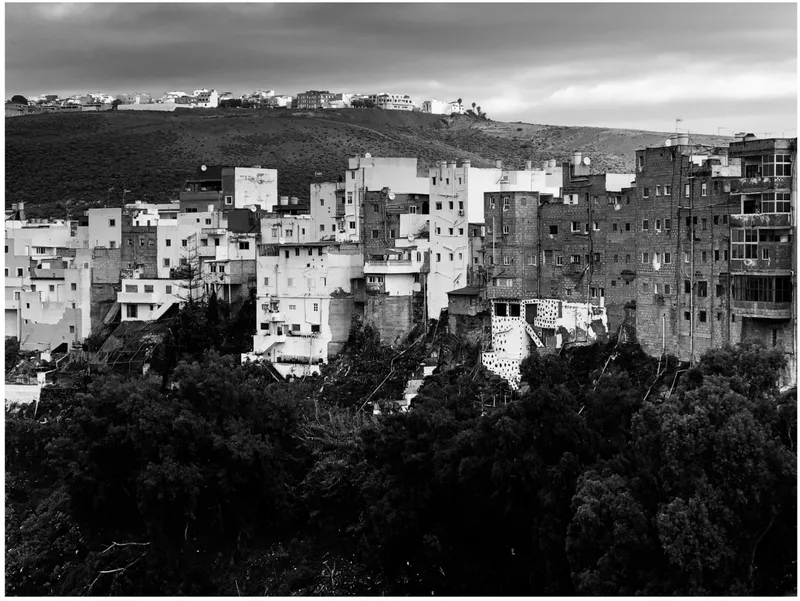
In Gran Canaria, valleys have historically functioned as natural barriers to urban expansion. Their steep topography and complex terrain often exclude them from formal planning processes. As a result, these landscapes become zones of marginalization, where informal and self-built housing emerges over time.
The Tamaraceite ravine exemplifies this condition. Over decades, it has accumulated layers of agricultural remnants, industrial fragments, and unregulated housing developments. What appears as a fragmented and disconnected landscape is, in fact, a nuanced tapestry shaped by historical transitions, economic pressures, and adaptive occupation.
Despite its apparent discontinuity, the valley maintains an underlying spatial logic. Terraces align with the terrain, vegetation follows water patterns, and settlements respond to access routes such as the Carretera de Chile. These latent relationships form the basis for a new architectural strategy.
Margin and Marginality
The project critically examines the distinction between “margin” as a spatial condition and “marginality” as a socio-economic construct. The settlements along the ravine occupy privileged positions in terms of views and proximity to nature, yet remain excluded from formal urban systems.
Self-built housing, particularly in areas like Majadillas, reflects resilience and adaptability but lacks access to public infrastructure, civic spaces, and urban continuity. These neighborhoods exist in a paradox: physically embedded within the city yet functionally disconnected from it.
Complementary Incisions responds to this condition not by replacing the existing fabric, but by enhancing and integrating it. The goal is to transform marginality into opportunity through spatial continuity.
Design Strategy: Complementary Incisions
The central concept of the project lies in introducing a sequence of architectural interventions that operate across scales. These incisions cut through the boundary between the city and the ravine, creating new spatial relationships and circulation systems.
Rather than acting as isolated buildings, the interventions function as connectors. They establish vertical and horizontal sequences that link streets, terraces, and interior spaces. Each insertion is carefully positioned to reinforce existing urban patterns while introducing new public interfaces.
The strategy emphasizes continuity in discontinuity. It acknowledges the fragmented condition of the site while creating a network of spaces that gradually transition between urban density and natural landscape.
Programmatic Interventions
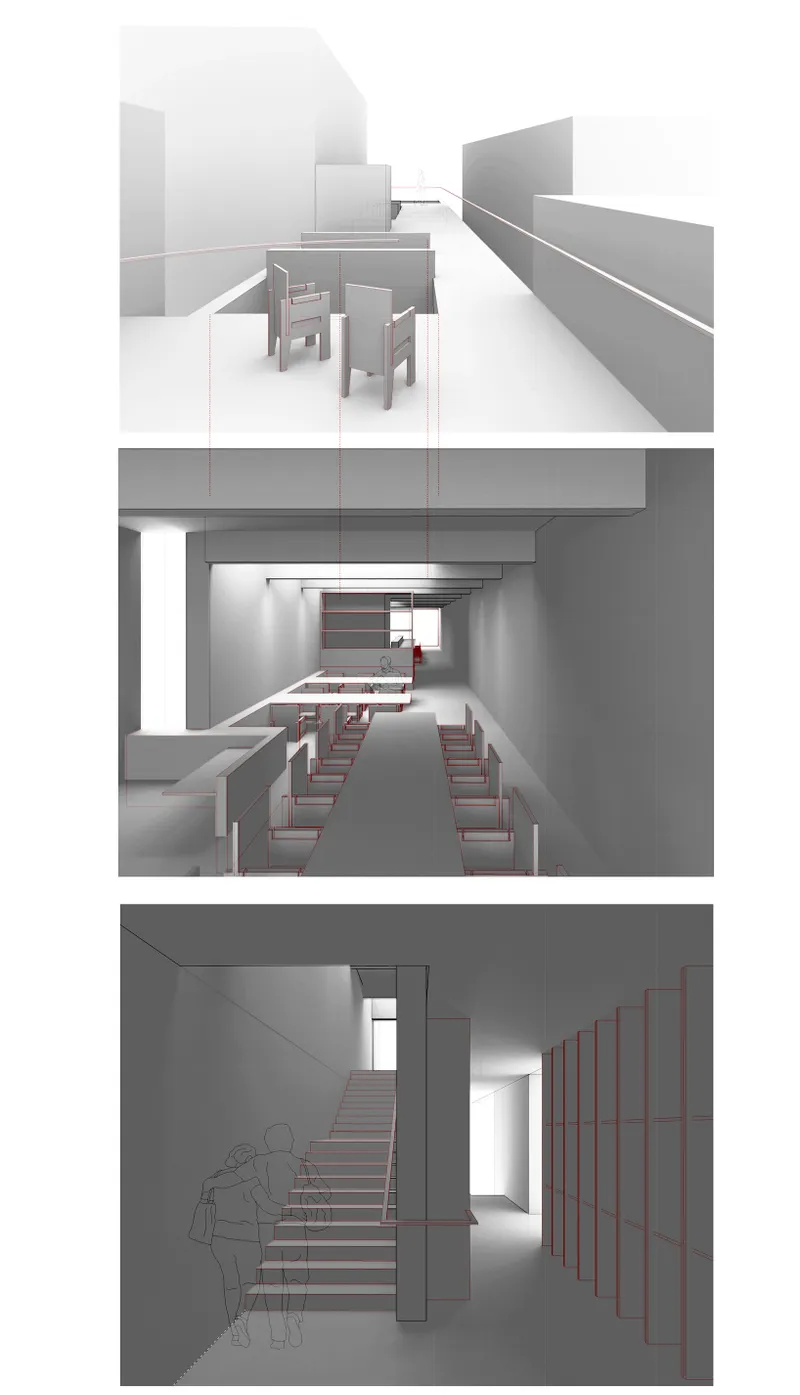
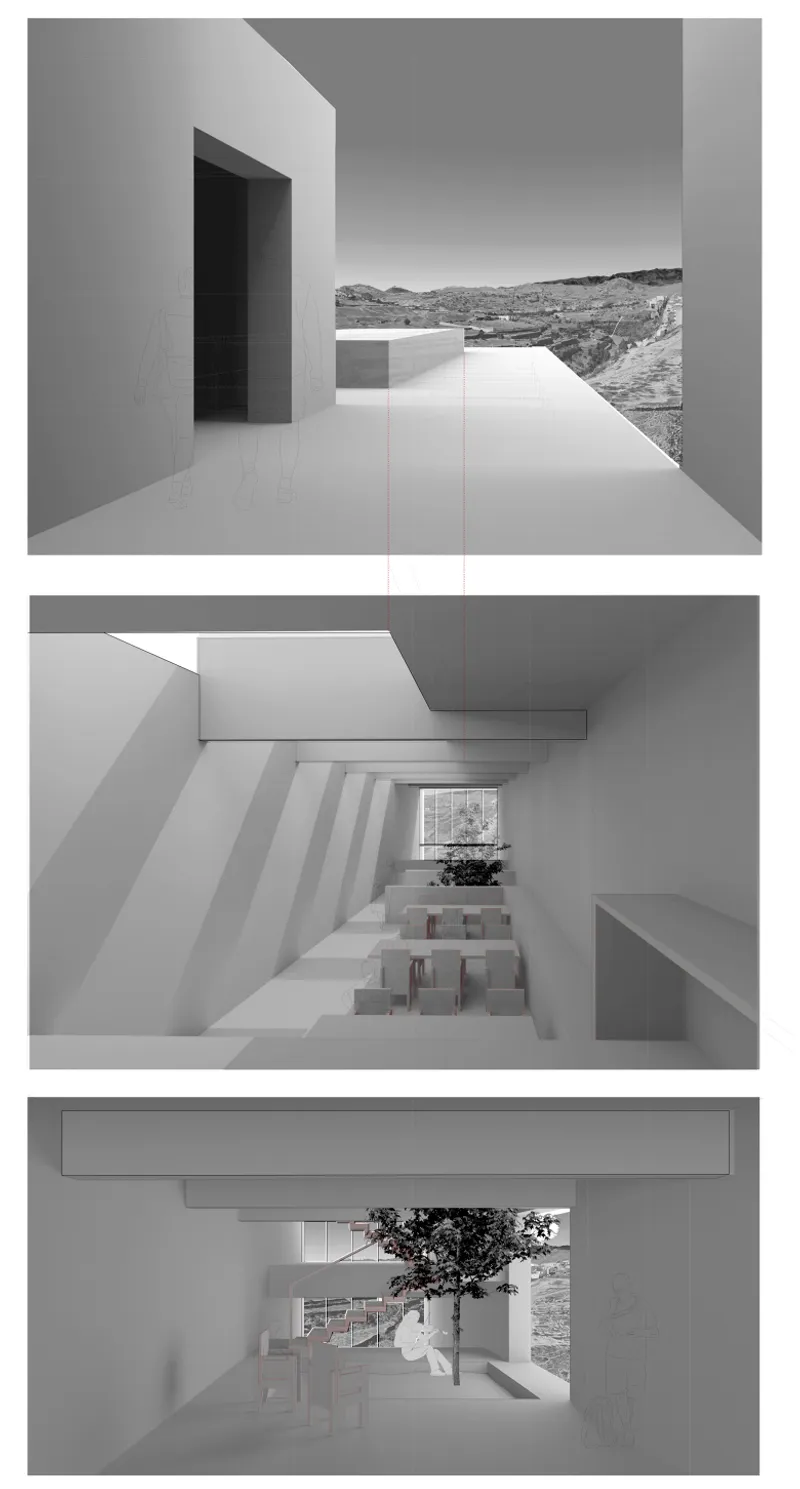
Three primary architectural programs structure the proposal: a restaurant, a library, and an educational center. Each program is embedded within the existing urban fabric and extends toward the ravine, acting as both destination and connector.
Restaurant
The restaurant is designed as a subtle intervention that remains largely invisible from the street. Access is mediated through the roof, allowing uninterrupted visual continuity toward the valley. Internally, a sequence of courtyards and vertical connections introduces light and spatial depth.
The architecture negotiates between enclosure and openness, framing views while maintaining a strong relationship with the terrain. The insertion becomes an experiential journey rather than a singular space.
Library
The library infiltrates the second row of housing, extending the public realm deeper into the urban fabric. Its spatial organization creates a transition from the street toward the ravine, culminating in a grandstand-like reading area overlooking the landscape.
A controlled “crack” between structural elements guides movement and visibility, reinforcing the idea of architecture as a directional system. The library transforms reading into a spatial experience linked to context.
Educational Center
The educational center addresses the edge condition between self-built housing and the valley. Instead of presenting a conventional façade, it invites users to move through a sequence of framed views before entering the building.
This approach redefines access as a spatial narrative. The building becomes a threshold that connects learning environments with the surrounding landscape, reinforcing the role of architecture in shaping perception.
Spatial Sequences and Connectivity
A key contribution of the project lies in its emphasis on sequences. Movement through the architecture is not linear but layered, unfolding through shifts in elevation, light, and enclosure.
These sequences establish new connections between previously isolated areas. Streets regain importance as organizing elements, while intermediate spaces between buildings become active zones of interaction.
The project transforms circulation into an architectural tool. It enables the gradual integration of the ravine into the urban experience, making the landscape visible, accessible, and meaningful.
Urban Regeneration Through Architecture
Complementary Incisions positions urban regeneration architecture as a process of augmentation rather than replacement. It respects the existing fabric while introducing new layers of functionality and meaning.
By focusing on small-scale, strategic interventions, the project demonstrates how architecture can operate within complex socio-spatial conditions. It avoids large-scale disruption and instead builds continuity through precision.
The result is a hybrid condition where city and landscape coexist. The ravine is no longer perceived as a boundary but as an integral component of urban life.
Complementary Incisions offers a nuanced model for urban regeneration in contexts defined by informality and topographical constraints. Through a series of carefully calibrated interventions, it transforms fragmented territories into connected systems.
The project by Alejandro Fleitas Valido redefines the relationship between architecture, landscape, and society. It demonstrates that meaningful urban transformation does not require erasure, but rather an understanding of existing conditions and the ability to work within them.
In doing so, it establishes a powerful framework for future interventions in similar marginal environments across the globe.


Popular Articles
Popular articles from the community


Conexión: Biophilic Design Reimagines High-Rise Living in Hong Kong
Conexión reimagines high-rise living in Hong Kong through biophilic design, green facades, shared spaces, daylight, water and nature within.

Co-life: Sustainable Architecture for Age-Friendly Community Living
Co-life reimagines sustainable architecture for seniors through courtyards, rammed earth, shared gardens, and spaces designed for belonging.

The Musturak Paradise: Senior Living Architecture for a Connected Future in Temara, Morocco
The Musturak Paradise reimagines senior living architecture in Temara via private homes, social spaces, culture, community, and shared care.

Riyadh For All: Intergenerational Urban Design for Active Aging in Rabat
Riyadh For All reimagines urban design in Rabat with intergenerational co-living, adaptive courtyards, and Moroccan cultural exchange today.

Similar Reads
You might also enjoy these articles

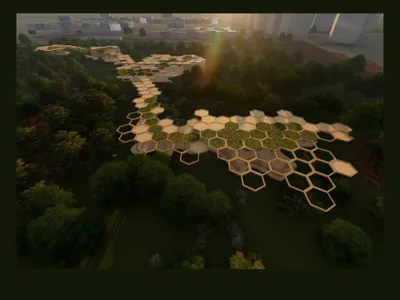
Eco Chapel: A Green Architecture Pavilion Designed in Symbiosis with the Forest
Eco Chapel uses green architecture to weave prayer, learning and reuse into a forest pavilion shaped by modular hexagonal canopies for life.
Kaffeebühnen: Coffee Shop Architecture Designed as a Civic Stage Between Vienna’s City and Park
Kaffeebühnen turns coffee shop architecture into a civic stage, linking Vienna’s park edge, urban life, warm timber yards, and coffee craft.
Healing Façade: Sustainable Architecture for Reforestation, Community, and Sacred Ecology in Ethiopia
Healing Façade reimagines sustainable architecture as a living wall that restores soil, catches water and renews Ethiopia's forest churches.


Urban Forest: A Vertical Ecosystem for 5,000 Workers in Singapore's Changi Business Park
Radially stacked pods and layered green decks turn a 7-acre plot into 47 acres of ecological workspace projected for 2040.


Explore Blocs Competitions
Discover active competitions in this discipline


Challenge to merge furniture with learning

Competition to design a workstation for architects
Comments (0)
Please login or sign up to add comments
No comments yet. Be the first to comment!