
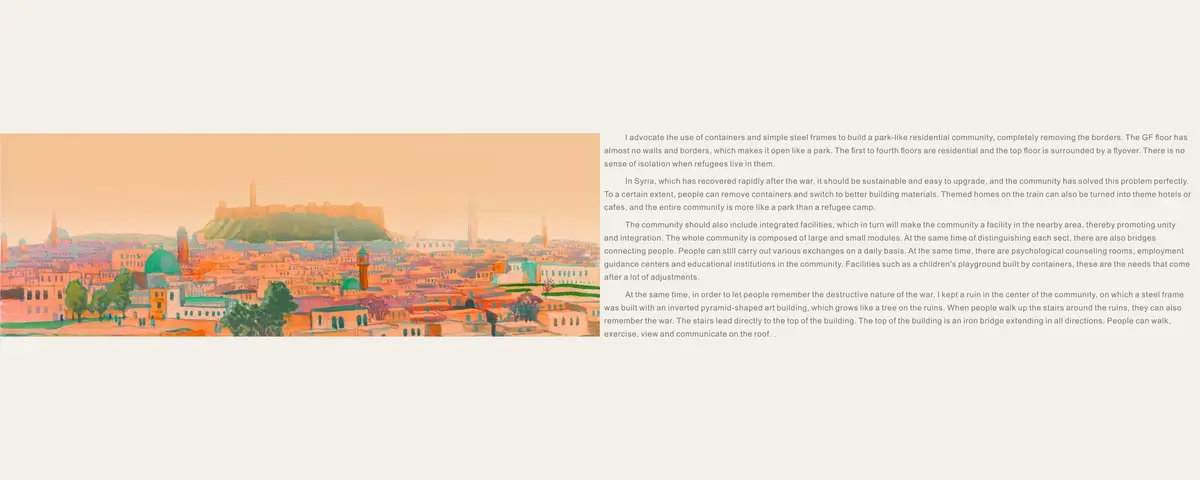
Condensation Park: Modular Refugee Housing That Treats Openness as Therapy
A vertical timber framework replaces the refugee camp model with communal parks, elevated walkways, and a central Hope Tree as anchor.


What if the ground floor of a refugee settlement had no walls at all? Condensation Park stakes its entire thesis on that provocation, stripping away the enclosure that defines conventional camps and replacing it with an open communal park beneath a rising framework of modular residential units. The move is simultaneously structural and psychological: residents who have lived through restriction and forced confinement arrive to a place where the first thing they encounter is unobstructed space, light, and the freedom to move.
Designed by Snow Jiang, the project was shortlisted in the Memory competition on uni.xyz. Drawing directly from post-war data on Aleppo, where 31% of housing was destroyed and 71% of children reported persistent sadness or anxiety, Jiang treats architecture not as a container for displaced people but as an instrument of recovery. The result is a layered vertical community built from modular units, elevated walkways, and a central void called the Hope Tree that organizes both circulation and collective identity.
A Park at Ground Level, a Community Above
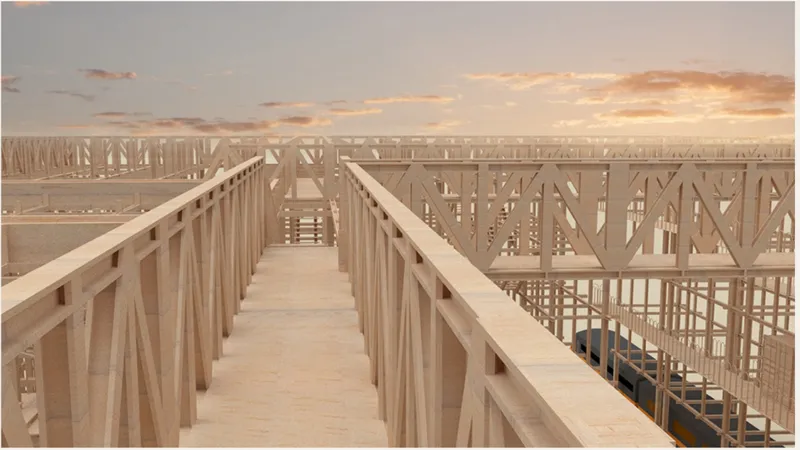
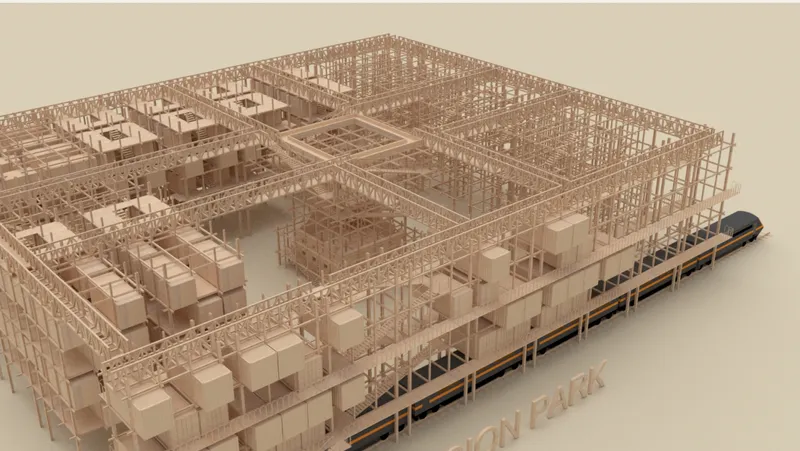
The elevated timber walkway stretching toward the horizon captures the project's defining spatial idea: life happens above a deliberately emptied ground plane. That ground level, referred to simply as the "park," is kept almost entirely free of walls, functioning as a shared landscape for recreation, cultural expression, and casual encounter. Above it, a braced timber frame rises to support stacked residential modules connected by diagonal walkways and open tread stairs. The axonometric model reveals how interior volumes, including a train-platform-like residential axis, nest within the exposed structure. Nothing is hidden; the framework reads as scaffolding for a community still assembling itself.
The open ground floor does real psychological work. For people who have experienced the claustrophobic reality of displacement, whether in overcrowded border camps or destroyed urban neighborhoods, the absence of enclosure at entry level is a deliberate act of spatial generosity. It breaks down the visual and physical barriers that most refugee settlements reinforce, offering instead a legible, breathable threshold between private shelter and public life.
Layered Timber Columns Frame Multiple Worlds
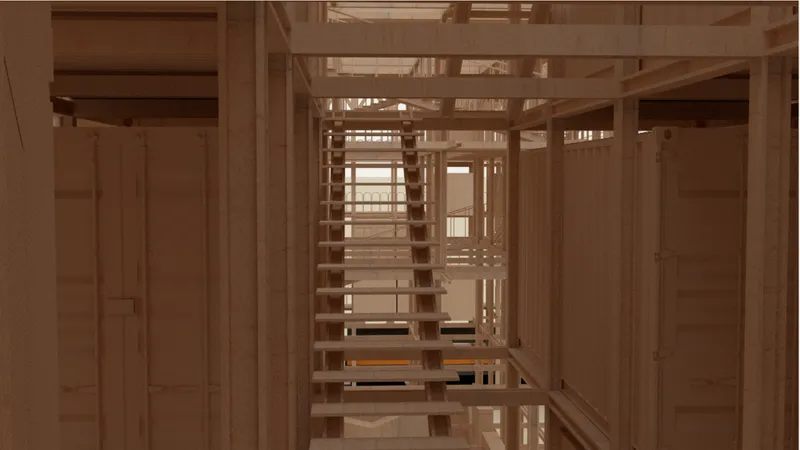

Seen through the forest of timber columns, the interior levels stack and recede, each floor visible from the one below. The physical model under clouded sky reinforces how the structure reads at the scale of a small neighborhood: infill panels slot into a regular timber grid, creating a rhythm of solid and void that lets daylight and air penetrate deep into the plan. The diagonal bracing serves double duty, stiffening the frame while doubling as railings along the elevated walkways that link residential clusters.
Jiang's modular system relies on two unit types. Type A modules are residential, stacking up to four levels and offering configurations from single rooms for individuals to double units for families, each with integrated utilities. Type B modules house communal programs: shared kitchens, bathing facilities, education rooms, healthcare points, and gathering halls. Because both types fit the same structural grid, they can be rearranged to suit available land, population size, or the specific balance of private and collective space a given community needs. The design supports rapid assembly and easy transport, critical qualities for emergency deployment, while remaining robust enough for longer-term transitional living.
Grid, Courtyards, and the Spatial Logic of the Plan
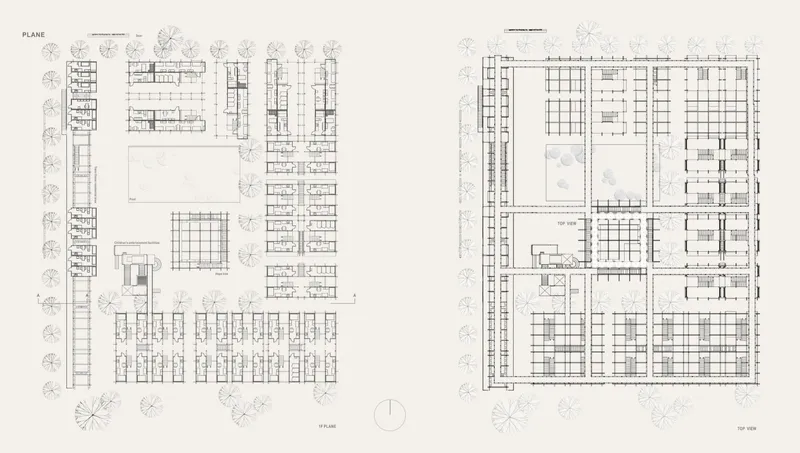
The floor plan drawings reveal the organizational discipline behind the project's apparent informality. A regular grid defines structural bays, but within that grid, courtyards open up at intervals, pulling greenery and sky into the center of the settlement. Tree symbols ring the perimeter, suggesting a landscape strategy that softens the boundary between the built environment and its surroundings. The courtyards are not decorative; they serve as the connective tissue between residential clusters, directing foot traffic through shared outdoor rooms rather than along corridors.
Section and Elevation: The Hope Tree as Vertical Anchor
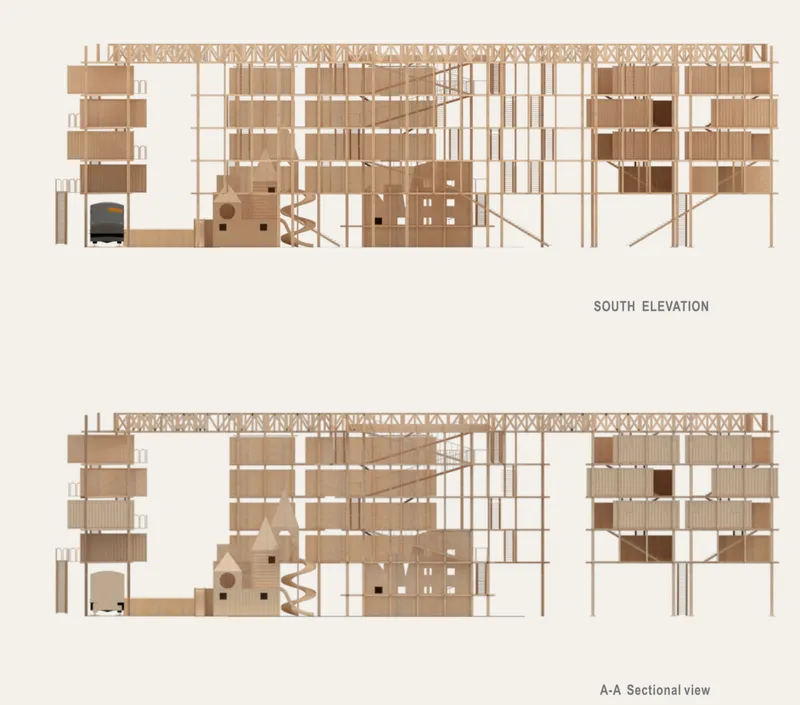
The south elevation and sectional drawing lay bare the project's most evocative element: the Hope Tree. This central void rises through the full height of the structure, flanked by balconies, spiral stairs, and communal activity platforms. In section, it reads as a vertical atrium around which everything else organizes. Jiang intends it as both a wayfinding device and a symbolic anchor, echoing ideas of growth, resilience, and rootedness for a population that has been uprooted. The surrounding walkways and flyovers connect upper-level residential units across this void, turning circulation into a social act. Residents do not simply pass through; they pause, observe, and encounter one another in a space saturated with natural light and open views.
The section also clarifies the layered timber frame's proportions. With residential modules stacking four levels above the open park, the total height remains modest enough to avoid the institutional scale of apartment blocks while achieving a density that makes communal services viable. The spiral stair threading through the Hope Tree void provides an alternative to the elevated walkways, ensuring vertical circulation is never reduced to a single bottleneck.
Why This Project Matters
Refugee housing design too often defaults to efficiency metrics: units per hectare, cost per square meter, speed of assembly. Condensation Park meets those metrics, its modular system is scalable, transportable, and reconfigurable, but it refuses to stop there. By grounding its design in specific trauma data and responding with spatial strategies like the wall-free ground park, the Hope Tree void, and the network of elevated social walkways, Jiang makes a case that dignified architecture and rapid deployment are not mutually exclusive goals.
The project's real contribution is its insistence that openness is not a luxury but a therapeutic necessity. Every design decision, from the exposed timber structure that invites visual connection between floors to the courtyards that dissolve the boundary between shelter and landscape, works toward a single ambition: replacing the psychology of confinement with the experience of belonging. For a competition themed around memory, Condensation Park offers something forward-looking, a framework for building new memories in places where the old ones were destroyed.
View the Full Project
About the Designers
Designer: Snow Jiang
Enter a Design Competition on uni.xyz
uni.xyz runs architecture and design competitions year-round that reward proposals with spatial conviction and real site intelligence.
Project credits: Condensation Park by Snow Jiang Memory (uni.xyz).


Popular Articles
Popular articles from the community


Hill & Cross Opera: Sculptural Opera House Architecture Shaped by Tallinn’s Landscape and Identity
Hill & Cross Opera reimagines opera house architecture in Tallinn through its sculptural hill, civic plaza, glass wave and a luminous cross.

Play: Fragments of Their World
Familiar architecture becomes modular playground design, creating safe spaces where displaced children can learn, connect, imagine and play.

Little Red Riding Hood: Architectural Design as a Journey Through Fear, Light, and Storytelling
Little Red Riding Hood reimagines the fairy tale through architectural design shaped by fear, light, scale, memory, uncertainty, and choice.

Lunar Spiral: Space Architecture Shaped by the Mathematics of the Universe
Lunar Spiral reimagines space architecture through Fibonacci geometry, lunar regolith, levitating habitats, and self-sustaining Moon living.

Similar Reads
You might also enjoy these articles

Bao Huynh Watercolor Atelier: A Serene Art Retreat in Hội An
Bao Huynh Watercolor Atelier in Hội An blends multifunctional art spaces, sustainable design, local materials, and family-friendly living in a serene environment.

Atelier Macri Concept Store Interior Design by CASE-REAL
Atelier Macri store features a "ko" counter, walnut wood details, cork displays, blending retail, gallery, and seamless customer experiences.

Manuel Vargas Izquierdo Stadium and High-Performance Sports Center: Architectural Excellence in Jalpa de Méndez
The Manuel Vargas Izquierdo Stadium blends sustainable design, inclusive sports facilities, and cultural-inspired architecture, revitalizing Jalpa de Méndez’s public spaces.
KAKR Buluh Awar Hall: Revitalizing Community and Ecology Through Bamboo Architecture
Community built bamboo hall revitalizes Buluh Awar village, empowering youth, restoring ecology, celebrating vernacular craftsmanship through sustainable architecture and culture.


Comments (0)
Please login or sign up to add comments
No comments yet. Be the first to comment!