
RE-UTILITY
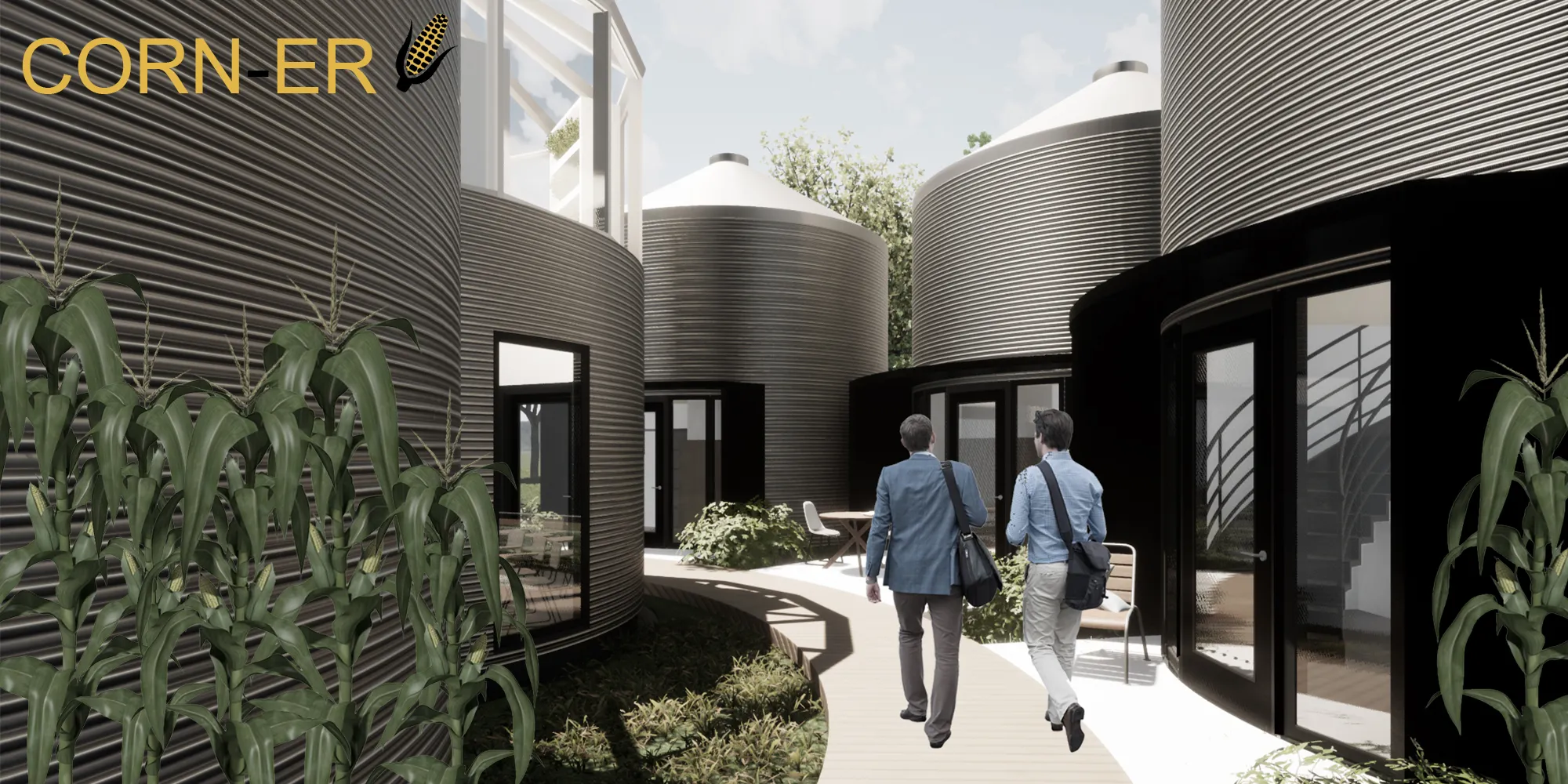
Designing a lodging center by repurposing steel grain bins in an innovative way.

CORN-ER
CONCEPT
The concept behind the project began to form after the analysis of the area around the site in Osage City. That city is located in Kansas which is commonly associated with agriculture production including vastly farmed corn. Therefore whole project is inspired with morphology of corn plant.
IDEA
The idea of the grain bins urban layout refers to the projection of cross-sectioned corn. The core of the cob consists of three silos connected to one main building, accessible to all guests of the lodging center. Around the previously mentioned core of the cob, housing units are located in the form resembling dispersed corn kernels. Each of the buildings has a small, roofed terrace at the main entrance, in the shape that resembles a combination of grains with the core of a corn cob. The entire urban layout of the buildings is connected by a paved path around the main building.
ORGANIZATION OF ELEMENTS
In the main building there is a reception, administration, public toilets and learning center which will be used by guests to study or occasionally for workshops held by experts. The learning room does not have any permanently fixed elements of equipment so that it can be freely furnished for the needs of workshop. Each of the living units have their own living room, kitchenette, toilet and bedroom. Ground floor is the place of social interaction but the first floor is for private rooms. One of the living units is adapted for a disabled person therefore the design is safe and accommodated to all users. All the rooms that a person who is using a wheelchair could need are available and they are located in the ground floor of the adapted apartment. The apartment on the first floor above the adapted apartment could be occupied by the guardian of a disabled person.
CONSTRUCTION
In this project compound construction is used in a way that the existing form of the grain bin is a self-supporting structure. It is made of a corrugated sheet, a conical roof made of thin metal sheet. Living units are equipped with an inner structure that is independent of grain bins’ body structure. That inner structure is meant to provide a support for the inter-story ceiling, and a substructure for thermal insulation, and finishing of external walls and the roof from the inside of the building. The internal structure of the housing units on the ground floor consists of a centrally located steel column and six columns located in the outer wall. Between the central column and the columns in the outer wall, steel beams supporting the ceiling are stretched.
INNOVATIVE ELEMENTS
An innovative, future-oriented element in this project is mini vertical farm located in the top floors of two of the grain bins. Mini vertical farms are light and designed to optimize exposure to sunlight on its four levels on which crops grow. It connects two types of crop cultivation cultures which complement each other that is a traditional allotment garden and a greenhouse.
SUMMARISE
Grain bins were used as a storage units for years and this project repurposes them in a modern way. Moreover innovative solutions such as mini vertical farms are becoming more popular and required in city agglomerations.




Popular Articles
Popular articles from the community


Play: Fragments of Their World
Familiar architecture becomes modular playground design, creating safe spaces where displaced children can learn, connect, imagine and play.

Hill & Cross Opera: Sculptural Opera House Architecture Shaped by Tallinn’s Landscape and Identity
Hill & Cross Opera reimagines opera house architecture in Tallinn through its sculptural hill, civic plaza, glass wave and a luminous cross.

Co-Life: Senior Housing Design That Reconnects Older Adults With the City
Co-Life reimagines senior housing design through healing gardens, shared streets, workshops, and a sustainable community across generations.

Conexión: Biophilic Design Reimagines High-Rise Living in Hong Kong
Conexión reimagines high-rise living in Hong Kong through biophilic design, green facades, shared spaces, daylight, water and nature within.

Similar Reads
You might also enjoy these articles

The Rhythm of Seasons
A Farmers' Market Connecting Nature and the City

More Than a Building-Designing a Living System
More Than a Building-Designing a Living System
Base Beyond
DESERT COMPOUND ARID: TOURISM OF ABSENCE AND ABUNDANCE

Explore Building Design Competitions
Discover active competitions in this discipline




Challenge to reimagine the Iron Throne


Photograph architecture without architects


Illustrate the lost glory of Angkor Wat - Render Challenge


Design challenge to reuse E-waste
Comments (0)
Please login or sign up to add comments
No comments yet. Be the first to comment!