

Crematorium in Mechzavod: Resomation, Daylight and Forest as a Quieter Architecture of Farewell
A water-based resomation facility near Samara where glass, stone and seasonal forest light replace the heavy enclosure of the conventional funeral hall.


Samara is running out of room for its dead. Research cited by the designer projects that within the next decade the city's traditional cemetery plots will no longer meet burial demand, a problem that is spatial, ecological and cultural at once. The Crematorium in the village of Mechzavod answers it with a building that changes the process before it changes the form: the facility is organised around resomation, a water-based alkaline hydrolysis method that cuts carbon emissions, energy use and air pollution compared with flame cremation.
Designed by Екатерина Иванова and published on uni.xyz as Crematorium in the village of Mechzavod in Samara city, the project sits in a wooded setting on the edge of the city. Its ambition goes beyond the technical. Ivanova treats the crematorium as a place of emotional comfort and spatial dignity, using proportion, material honesty and controlled daylight in place of ornament, and letting the surrounding forest carry much of the symbolic weight.
Glass Fins and Concrete Walls Hold the Threshold Between Grief and Daylight

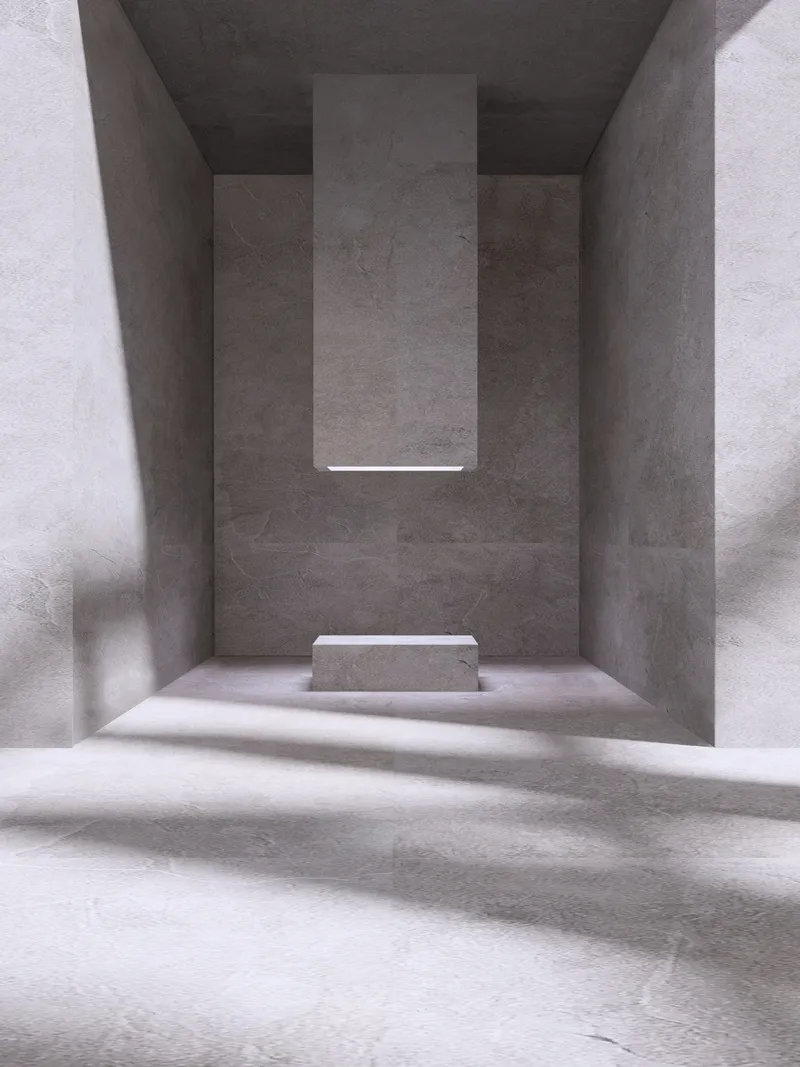
The first two views set out the project's material language plainly. A wall of glass fins runs beside a concrete-walled corridor, a beam grid overhead breaks the sky into a measured rhythm, and sunlit trees fill the view beyond. The corridor is solid on one side and porous on the other, so mourners stay sheltered while the landscape remains in view. In the stone-clad chamber, a suspended slab hovers above a low block, and window shadows cross the floor. The composition is close to liturgical without borrowing any religious iconography: mass, void and a single raking light are enough.
These spaces show what the designer means by treating walls, floors and ceilings as continuous planes. Without cornices, mouldings or decorative transitions, the eye settles on proportion and on the movement of light, which Ivanova describes as an architectural material in its own right. In a building type often remembered for low ceilings and closed rooms, this deliberate openness answers the oppressive mood of many funeral interiors directly.
A Pavilion Measured Through the Hours of a Single Day
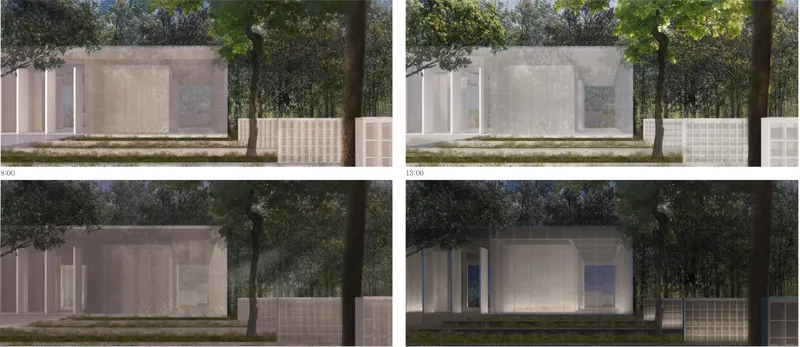
Four views of the glass-walled pavilion, set behind trees and low hedges, follow it from morning to night. The sequence makes a useful argument: a building this transparent never looks the same twice. By day it nearly dissolves into the planting; after dark it becomes a lantern among the trunks. For a programme where families may wait, return or hold ceremonies at different hours, that changing character suits the work. The architecture registers the passing of time instead of sealing visitors away from it.
The hedges and tree line also act as a buffer. The design keeps public approach, ceremonial rooms and service zones apart, and the landscape layering in these views shows how that separation extends outdoors. Privacy comes from planting and depth rather than from blank walls.
Four Seasons Written Into the Elevation Strips


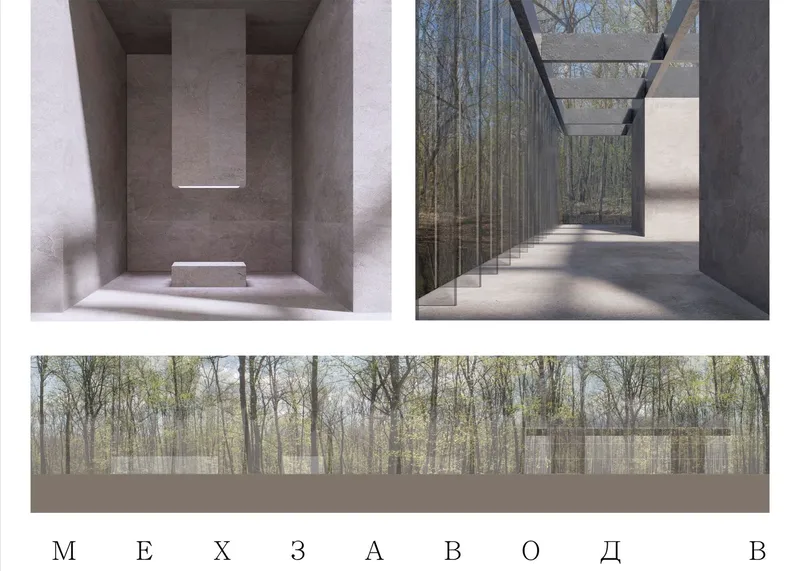
The presentation boards are organised by season, each paired with a long elevation strip running along the bottom. In autumn, the flat-roofed entrance elevation sits on a paved path among yellow trees. In winter, dark textured columns frame a snowy forest above a strip of bare trunks. In spring, a stone chamber and a glazed colonnade appear above a forest elevation coming back into leaf. Together with the summer density described in the brief, the cycle becomes a design parameter, and the building's horizontal proportions keep it low against the trees so the forest stays the dominant figure.
This is where the project's symbolic intent is clearest. Ivanova presents death as part of a broader natural cycle rather than an abrupt end, and the boards make that case visually: the building stays still while everything around it turns. The colonnade and the textured columns give the edge between inside and outside a measured depth, a place to pause before or after a farewell, with the season always in view.
A Ritual Sequence Kept Free of Crossed Paths
Behind the atmospheric imagery sits a careful functional diagram. The plan follows the ritual in order, from arrival and waiting to the farewell ceremony, the technical resomation process and the final handling of remains. Each stage has its own defined space while staying visually connected to the next, and circulation keeps public, private and service flows from crossing. For a resomation facility, which needs specific technical rooms, this separation matters. Visitors should never pass through the machinery of the process, and the layout makes sure they don't.
Why This Project Matters
Most speculative funeral architecture focuses on symbolism. Ivanova's crematorium starts from a harder premise, a city facing a near-term shortage of burial land, and builds its spatial argument on top of a real technological alternative. By making resomation the core of the programme, the project shows how a lower-impact process can bring a calmer, more open building with it, free of chimneys and of the industrial associations that flame cremation carries.
Its restraint is also its strength. Glass, stone, concrete, daylight and a forest that changes four times a year do most of the work, and the ritual sequence is resolved with enough clarity that the emotional atmosphere never has to compete with operational demands. As more cities reach the limits of their cemeteries, this kind of quiet, landscape-bound crematorium offers a credible model for how architecture can handle grief with care.
View the Full Project
About the Designers
Designer: Екатерина Иванова
Enter a Design Competition on uni.xyz
uni.xyz runs architecture and design competitions year-round that reward proposals with spatial conviction and real site intelligence.
Project credits: Crematorium in the village of Mechzavod in Samara city by Екатерина Иванова.


Popular Articles
Popular articles from the community


Opera on the Sea: Driftwood Logic Shapes a Timber Opera House on Estonia's Coast
Trevor Orgill's opera house translates the entangled drift of floating timber into a civic building where wood, water, and music converge.

Singing Woman: An Opera House That Performs Before the Curtain Rises
Ovidiu Cristian Pavel's conceptual opera house translates Estonia's choral identity into a sculpted waterfront landmark facing the Baltic Sea.

Cloaked Colonization: A Mobile Underwater Habitat That Moves Like a Fish
Micah Abaya's shortlisted EHC Pacific entry reimagines ocean settlement as a dispersed network of self-sustaining architectural organisms.

Faces of the Soviet Avant-Garde: Turning Moscow's Street Names into an Open-Air Museum
A network of sculptural installations across a Moscow residential district transforms forgotten architect names into spatial encounters with cultural memor

Similar Reads
You might also enjoy these articles

Maya Harvest: A Cacao Resort Village Rooted in Mayan Tradition and Local Craft
Situated within a Tabasco cacao plantation, this shortlisted resort proposal merges vernacular materials with hands-on cultural immersion.
Harmonia: A River-Shaped Community That Grows Over Decades in Boa Vista
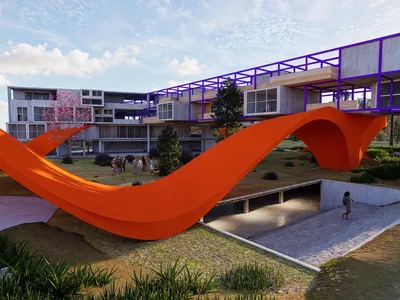
Curved pathways and modular grid structures along the Branco River create a phased settlement designed to evolve from 2030 to 2050.

The Architecture of Bathing: A Mughal Hammam Reimagined Across the Yamuna
Charlotte May's honorable mention entry for The Black Taj reinterprets Agra's bathing rituals through red sandstone, water, and framed views of the Taj Mah

Om-1: A Wall-Hung System That Moves Your Workspace Off the Desk
Modular plywood boards, magnetic pegs, and utility elements migrate clutter from the horizontal surface to the vertical plane.

Comments (0)
Please login or sign up to add comments
No comments yet. Be the first to comment!