
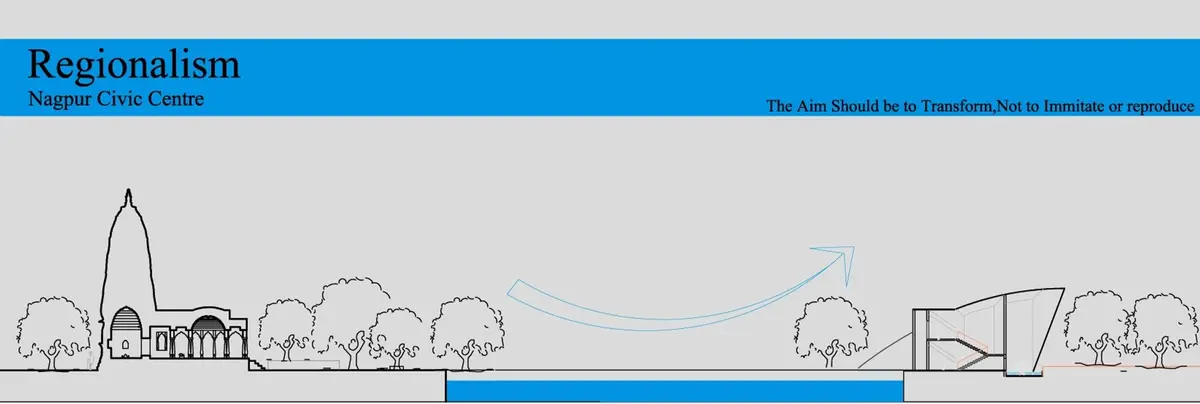
Nagpur Civic Centre: Critical Regionalism Built Around a Kund Turned Public Plaza
Sayali Pitale turns the sacred geometry of the Indian kund into a climate-moderating civic plaza, anchoring a two-tower complex in Nagpur's urban fabric.


Most Indian civic buildings now arrive in the same glass skin, indifferent to whether they stand in Pune, Patna or Nagpur. This proposal pushes back with one strong move: it takes the kund, the stepped water tank that once served as both sacred ground and climatic regulator, and rebuilds it as the public heart of a contemporary civic centre. The towers and podium matter, but the hollow at the centre is the real argument.
Regionalism: Nagpur Civic Centre is a project by Sayali Pitale, framed explicitly through the lens of Critical Regionalism. The site sits near National Highway 53 in Nagpur, the "city of lakes" in Maharashtra's Vidarbha region, at a seam between the old city and its newly expanding districts. Pitale treats that position as a mandate: the civic centre should stitch the two together rather than stand apart as an institutional block, and it should do so in a language that belongs to this place without imitating it.
Learning From Courtyards, Verandahs and Layered Thresholds
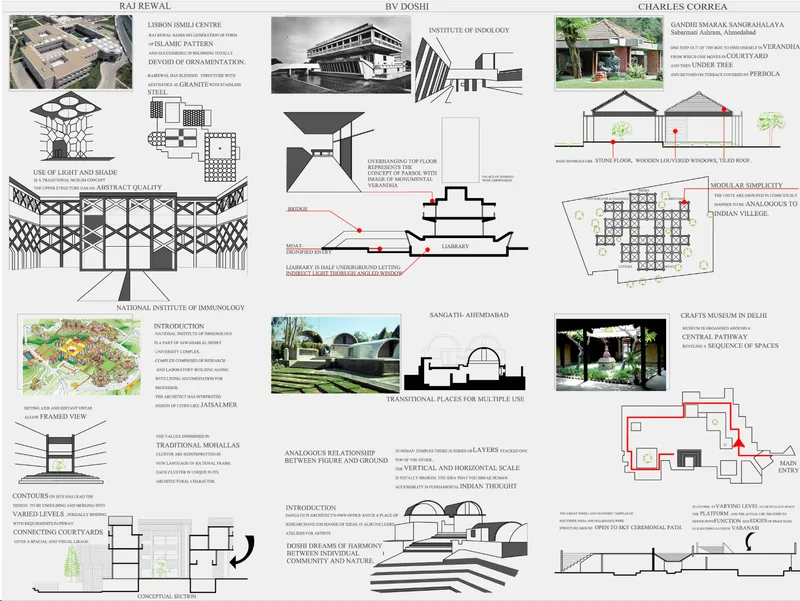
The project opens with homework, and it shows. The comparative board sets the work of three architects side by side, pairing photographs with plans, sections and diagrams that isolate courtyards, verandahs and sequences of layered space. These are the recurring devices of climate-aware Indian modernism: the shaded edge, the open centre, the gradual passage from street to interior.
What makes the study useful is that it extracts spatial principles rather than styles. Pitale is not collecting motifs to apply; she is reading how threshold and enclosure manage heat, light and social life. That distinction is the core of Critical Regionalism, which the project positions as a reinterpretation of local culture and climate within a contemporary framework, not a nostalgic return to vernacular form.
A Kund Opened to the City
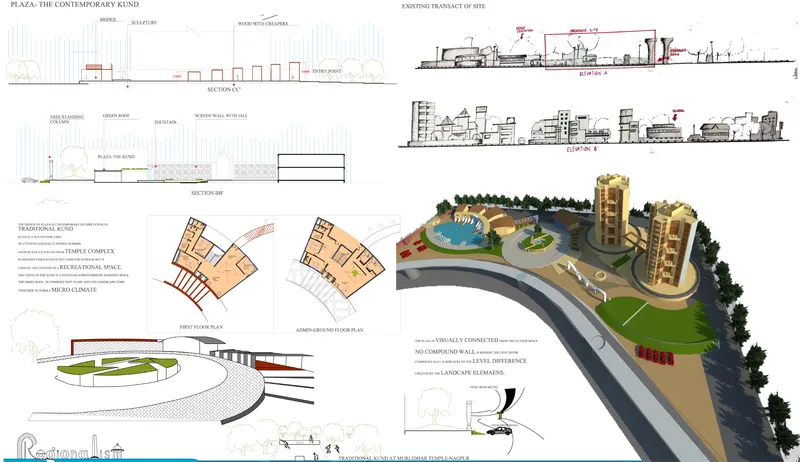
The presentation sheet reveals the plan's organising logic: circular and radial geometries drawn from traditional Indian planning, reorganised into a civic typology. In the aerial view, a curving plaza wraps a pool, with two towers rising behind. The kund, historically a place of gathering and ritual that also cooled its surroundings and stored water, becomes the shared floor of the whole complex, a public room open to the sky.
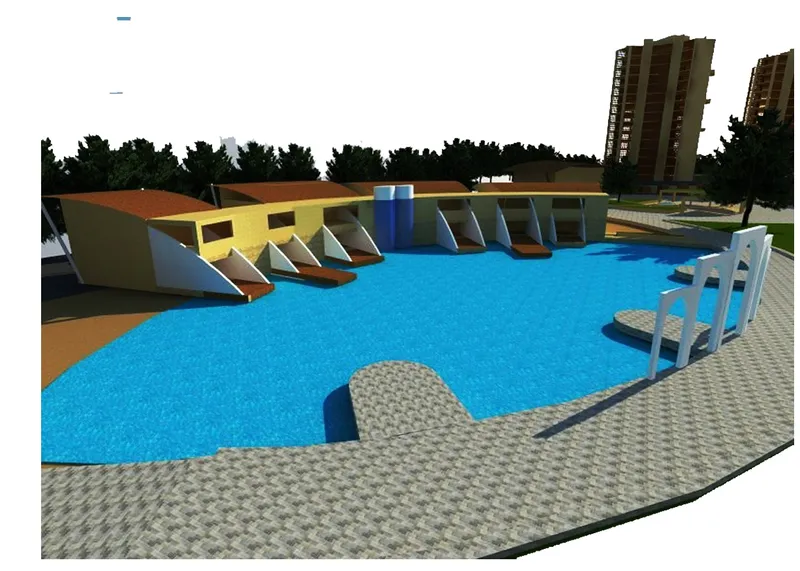
The eye-level render makes the ambition tangible. A curved blue pool is fronted by a terraced pavilion screened with white fins, its paved edge drawing people to the water. The terracing echoes the stepped profile of a traditional tank, and the fins temper direct sun across the facade. Here climate response and symbolism are the same gesture, which is where the concept earns its keep. The water is meant to moderate the microclimate of the plaza while giving the civic centre an identity rooted in Nagpur's long relationship with lakes.
Two Towers Grounded by a Working Podium
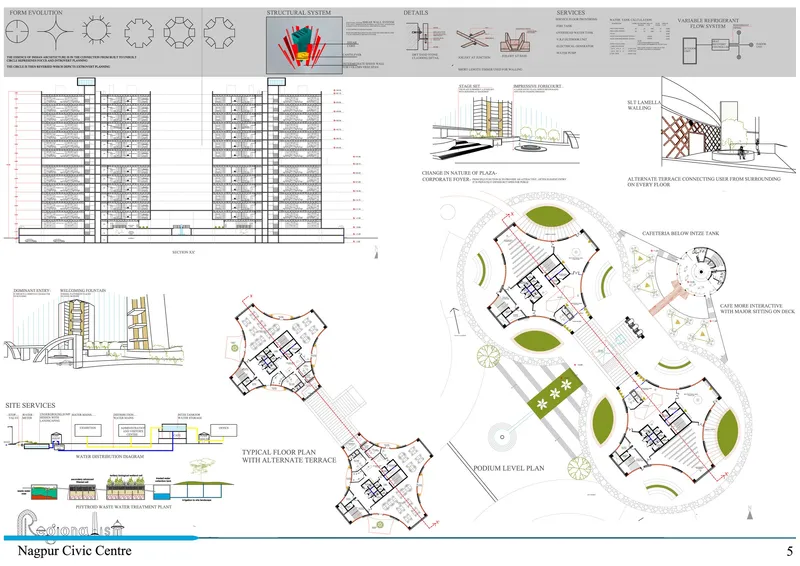
The final board shifts from idea to building. A tower section, a typical floor plan and a podium level plan describe a lobed two-tower complex, with site services diagrams showing how the scheme would actually run. The lobed floor plates carry the curving geometry of the plaza upward, so the towers read as an extension of the ground plan rather than generic office slabs dropped onto it.
The podium is where the programme comes together. Pitale layers cultural, social and commercial uses and refuses to segregate them, grouping built forms into clear hierarchies while keeping visual connections across the site. Circulation is conceived as an experiential journey, so moving between a cultural space and a shop becomes part of the civic experience. This is a civic centre imagined as a participatory platform, not a monumental enclosure.
Why This Project Matters
Indian cities face a real choice between standardised development and buildings that carry the memory of where they stand. Pitale's proposal shows that the second path need not mean pastiche. By abstracting the kund into a plaza, the radial plan into a civic layout and the stepped tank into a terraced pavilion, the project turns inherited forms into working spatial strategies that shade, cool and gather people.
Its strongest lesson is about where a civic building puts its emphasis. Instead of leading with the towers, the scheme leads with the void between them, a public room shaped by water and climate. For a site that bridges the old city and the new, that choice gives the institution a centre that belongs to everyone, and it offers a credible model for how regional identity and modern construction can share the same ground.
View the Full Project
About the Designers
Designer: Sayali Pitale
Enter a Design Competition on uni.xyz
uni.xyz runs architecture and design competitions year-round that reward proposals with spatial conviction and real site intelligence.
Project credits: Regionalism - Nagpur Civic Centre by Sayali Pitale.


Popular Articles
Popular articles from the community


Cube Design Draws an Ecological Corridor Between Two Shenzhen Hills with the Nankai Building
Beside Shenzhen's container docks, the Nankai Building pairs stacked balconies with a climbing green screen to connect two hillsides across its height.

FCC Arquitectura Expands a Portuguese Granite House with a Board-Marked Concrete Wing
In Portugal, JV House pairs a cleaned-up whitewashed and granite dwelling with a timber-shuttered concrete extension, courtyards and a garden pool.

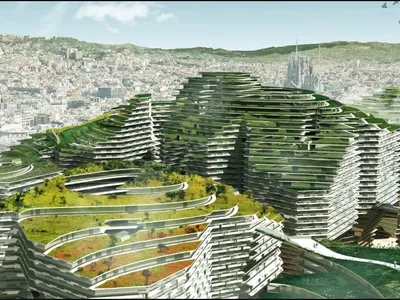
Manzana Morphosis: Stretching Barcelona's Grid into a Living Landscape for 2050
A radical reworking of the Eixample manzana turns density into a tool for generous public space, vertical ecology, and environmental performance.

graciastudio Turns a Viewless Tijuana Lot Inward Around a Courtyard of Concrete, Timber and Trees
In Tijuana, Jorge Gracia's GA2 House stacks a timber-clad private floor over exposed concrete and replaces a missing view with a planted interior patio.

Similar Reads
You might also enjoy these articles
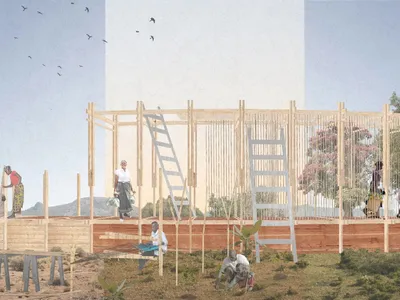
Healing Façade: A Modular Chapel System That Restores Ethiopia's Sacred Forests
Winner of the Eco-Chapel competition, this circular timber façade collects water from air to rebuild soil and reforest degraded Ethiopian landscapes.
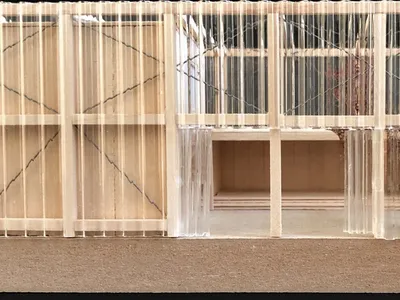
Kaffeebühnen: Where Coffee Shop Architecture Becomes a Civic Stage in Vienna
A linear sequence of timber boxes, transparent shells, and open yards turns the Viennese café tradition into a public performance space.
Eco Chapel: A Modular Forest Pavilion That Grows Like the Landscape It Protects
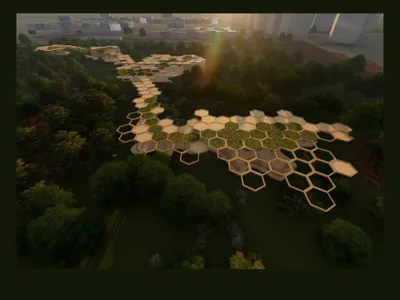
Hexagonal timber modules weave through existing trees, turning a chapel into a living system for prayer, education, and reforestation.


Urban Forest: A Vertical Ecosystem for 5,000 Workers in Singapore's Changi Business Park
Radially stacked pods and layered green decks turn a 7-acre plot into 47 acres of ecological workspace projected for 2040.

Explore Architecture Competitions
Discover active competitions in this discipline

Challenge to reimagine the Iron Throne

Photograph architecture without architects

Illustrate the lost glory of Angkor Wat - Render Challenge

Design challenge to reuse E-waste
Comments (0)
Please login or sign up to add comments
No comments yet. Be the first to comment!