

A Dynamic Network of Agent Studios: Splitting the Bauhaus into 25 Rooms Across Seven Continents
Ali Javid fragments a 10,000 sqm campus into 25 studios of 400 sqm each, turning architecture school into a distributed network of local civic agents.


What if the most radical move a school of architecture could make were to stop being a building? A Dynamic Network of Agent Studios takes the Bauhaus, the twentieth century's most mythologised design school, and dismantles its campus on purpose. The 10,000 sqm institution is cut into 25 studios of 400 sqm each and scattered across 25 countries and 7 continents. Each fragment works on its own ground and still answers to a shared whole. The idea is simple to state and hard to dismiss: architecture is learned best where architectural problems actually happen.
The project, published on uni.xyz by Ali Javid, frames climate change, socio-political upheaval, economic disparity and digital interconnectivity as the conditions a contemporary design school has to answer to. Javid's response is a decentralised pedagogy in which each studio acts as an "agent": an autonomous node that reads its local context, takes on regional challenges with the community around it, and feeds what it learns back into a global framework. Architecture here is not only taught. It is practised as a tool for systemic change.
A Dotted Map and Two Curriculum Wheels
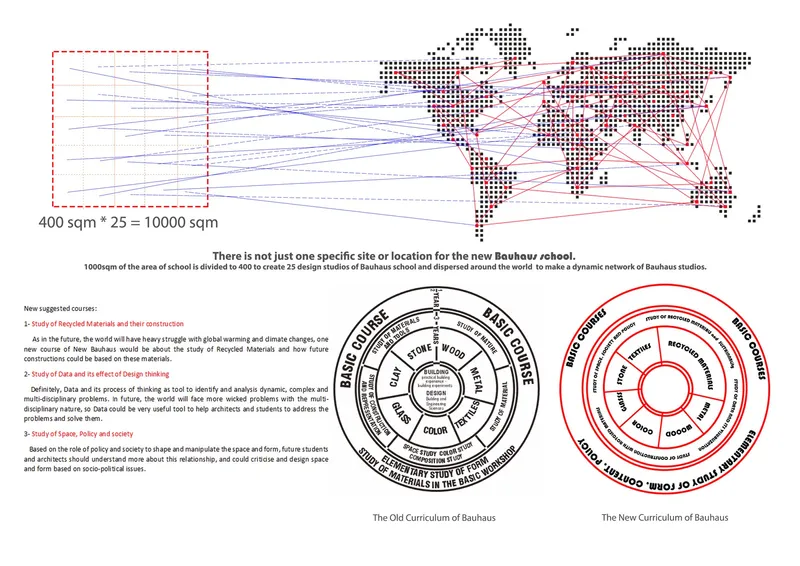
The opening sheet puts the argument in two diagrams. On the left, a dotted world map is threaded with connecting lines, which shows the campus as a network rather than a site. On the right, two circular curriculum wheels set the historical Bauhaus course structure beside Javid's revision. The pairing works because it treats geography and pedagogy as one design problem. Spreading the school across the map only makes sense if what is taught changes as well.
The revision is careful rather than iconoclastic. Foundational studies in materials, form and construction stay in place, and the classic workshop materials of stone, wood, metal, glass and textiles expand into three new territories. Recycled materials brings in adaptive reuse, circular construction and low-carbon strategies. Data and design thinking treats analytics, mapping and digital networks as design material. Space, policy and society asks students to critique and design within governance structures. The Bauhaus wheel keeps turning, but it now takes in the planet's resource crisis and the politics of the built environment.
Twenty-Five Footprints, No Master Plan


The hand-sketched grids are the most persuasive part of the proposal. Twenty-five plans set hexagonal, pentagonal, courtyard and irregular footprints side by side, each sitting among trees. Twenty-five matching sections run through gabled, vaulted, domed and stepped profiles, populated with small figures. Javid could easily have drawn one prototype repeated 25 times. Instead the drawings show a family of studios with no single parent form, which is the decentralised curriculum expressed in plan and section.
The 400 sqm unit is the only fixed variable. Everything else bends to circumstance, whether that is urban infill, rural landscape, industrial reuse or a community centre. The loose, sketched quality of the drawings suits this. They read as a catalogue of possibilities rather than finished buildings, and they leave room for each local studio to complete its own design. Modularity, sustainability and contextual sensitivity are presented less as a style than as a rule of conduct.
Where the Physical Network Meets the Digital One

The final sheet brings the two scales together: sketched plans and sections of studio buildings sit beside the dotted world map, now marked with red nodes and network lines. Each drawing on the left becomes a point on the right. This is where the hybrid typology Javid describes becomes legible. The studios are physically rooted and locally specific, yet they are linked through a shared digital platform that lets knowledge move between continents as easily as it moves between desks in a single school.
The red nodes also carry an argument about access. Distributing the school spatially spreads architectural education beyond the few cities that have traditionally hosted prestigious institutions. It cuts down the inequality built into a single campus and strengthens cultural specificity and local agency. Students stop being passive recipients of a universal curriculum and become civic actors who understand policy, data, material systems and social impact in the place where they work.
Why This Project Matters
The original Bauhaus was itself an argument about bringing art, craft and industry into the same room. Javid's proposal keeps that ambition and reverses the spatial premise: instead of gathering disciplines into one building, it sends the school out to meet the problems where they live. The move from centralised institution to global network is more than a logistical idea. It shows that a design school's form is a statement about who it serves and what it believes architecture is for.
The proposal works best in its refusal to standardise. Twenty-five studios with twenty-five different forms, held together by a shared curriculum and a digital platform, offer a believable model for an education that is plural, situated and politically engaged. Questions of governance, funding and coordination stay open, as they should in a conceptual project. Still, the drawings make a strong case that the next Bauhaus might not have an address at all, only a network of rooms doing useful work.
View the Full Project
About the Designers
Designer: Ali Javid
Enter a Design Competition on uni.xyz
uni.xyz runs architecture and design competitions year-round that reward proposals with spatial conviction and real site intelligence.
Project credits: A Dynamic Network of Agent Studios by Ali Javid.


Popular Articles
Popular articles from the community


David Macias Steps a Doorless Stone and Plaster House Down a Tropical Colombian Hillside
In the humid hills of Colombia, Threshold House replaces the front door with an open void and terraces its 850 m² down the slope instead of fighting it.

LT2A and OPEN Architectes Thread a Brick and Glass High School Through a Wooded Belgian Campus
In Braine-l'Alleud, a 3,000 m² wing for Collège Cardinal Mercier pairs pale brick with a glazed colonnade, deferring to a small chapel and a dense wood.

Architekt Andreas Gruber Scatters 23 Dark Timber Chalets Across a South Tyrolean Forest Edge
In Molini di Tures, Amonti Chalets breaks a resort into a hamlet of gabled timber houses, with parking, storage and services pushed into the slope.

U.GA Architects Wraps an Oval Rooftop Pool in Curved Board-Formed Concrete on Busan's Jeollidan-gil
In Busan's Jeonpo-dong, a 454 m² mixed-use block stacks a neighborhood facility, guest rooms and an oval rooftop pool inside spiraling concrete walls.

Similar Reads
You might also enjoy these articles
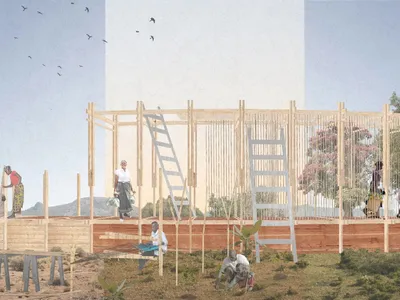
Healing Façade: A Modular Chapel System That Restores Ethiopia's Sacred Forests
Winner of the Eco-Chapel competition, this circular timber façade collects water from air to rebuild soil and reforest degraded Ethiopian landscapes.
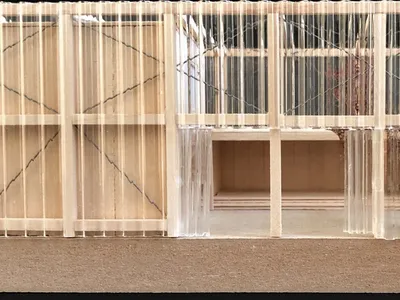
Kaffeebühnen: Where Coffee Shop Architecture Becomes a Civic Stage in Vienna
A linear sequence of timber boxes, transparent shells, and open yards turns the Viennese café tradition into a public performance space.
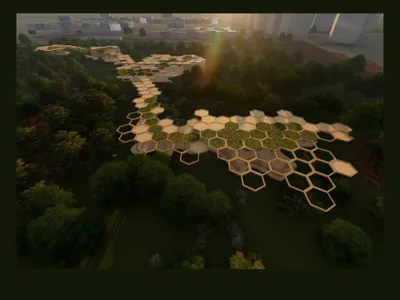
Eco Chapel: A Modular Forest Pavilion That Grows Like the Landscape It Protects
Hexagonal timber modules weave through existing trees, turning a chapel into a living system for prayer, education, and reforestation.


Urban Forest: A Vertical Ecosystem for 5,000 Workers in Singapore's Changi Business Park
Radially stacked pods and layered green decks turn a 7-acre plot into 47 acres of ecological workspace projected for 2040.


Comments (0)
Please login or sign up to add comments
No comments yet. Be the first to comment!