Design of Medieval Underground Museum
Exploring medieval living – beneath the ground


1.Preliminary investigation and research
Before designing, we looked for many data on Turkish historical development and the underground city 'Cappadocia' during medieval times. According to the information and literature, we summarized the formation reasons and process of the underground cities of medieval Turkey and the lifestyle of people living in the underground city.
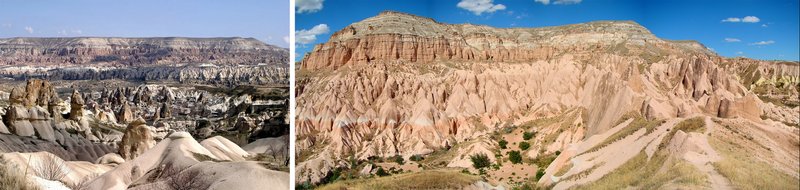
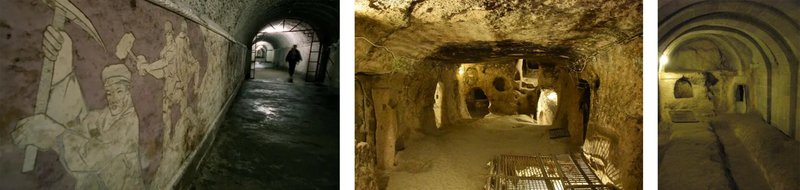
During the medieval times, Byzantine Empire oppressed the Turkish empire, causing Christians to choose Cappadocia to live, which had a special landform and benefit to hide. However, as the enemy continued invading, Cappadocia's land cave can't be hidden, so they explored the underground space to create underground cities to avoid the persecution of war.
Cappadocia's complex terrain:
Cappadocia's existing tunnel system remains:
Then, we referred to Google maps to analyze the site location, natural climate, surrounding buildings, and road system. The analysis indicated that the site is near the city center of Kayseri with convenient transportation system.
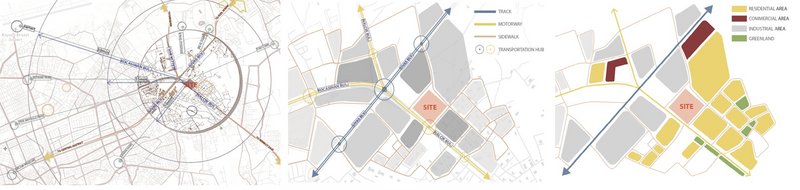
2.design concept:
Facing religious oppression and enemy aggression, Turkish Christians in the Middle Ages chose not to surrender but to find a new place to live, which fully demonstrated their positive attitude towards life. Therefore, in the design of the underground museum, we refined the spirit of never giving up and striving for the survival of the Turks in the middle ages as the spiritual theme of the museum. Then we simulated a day when different people lived underground and showed it in different exhibition rooms of the museum.
3.design process:
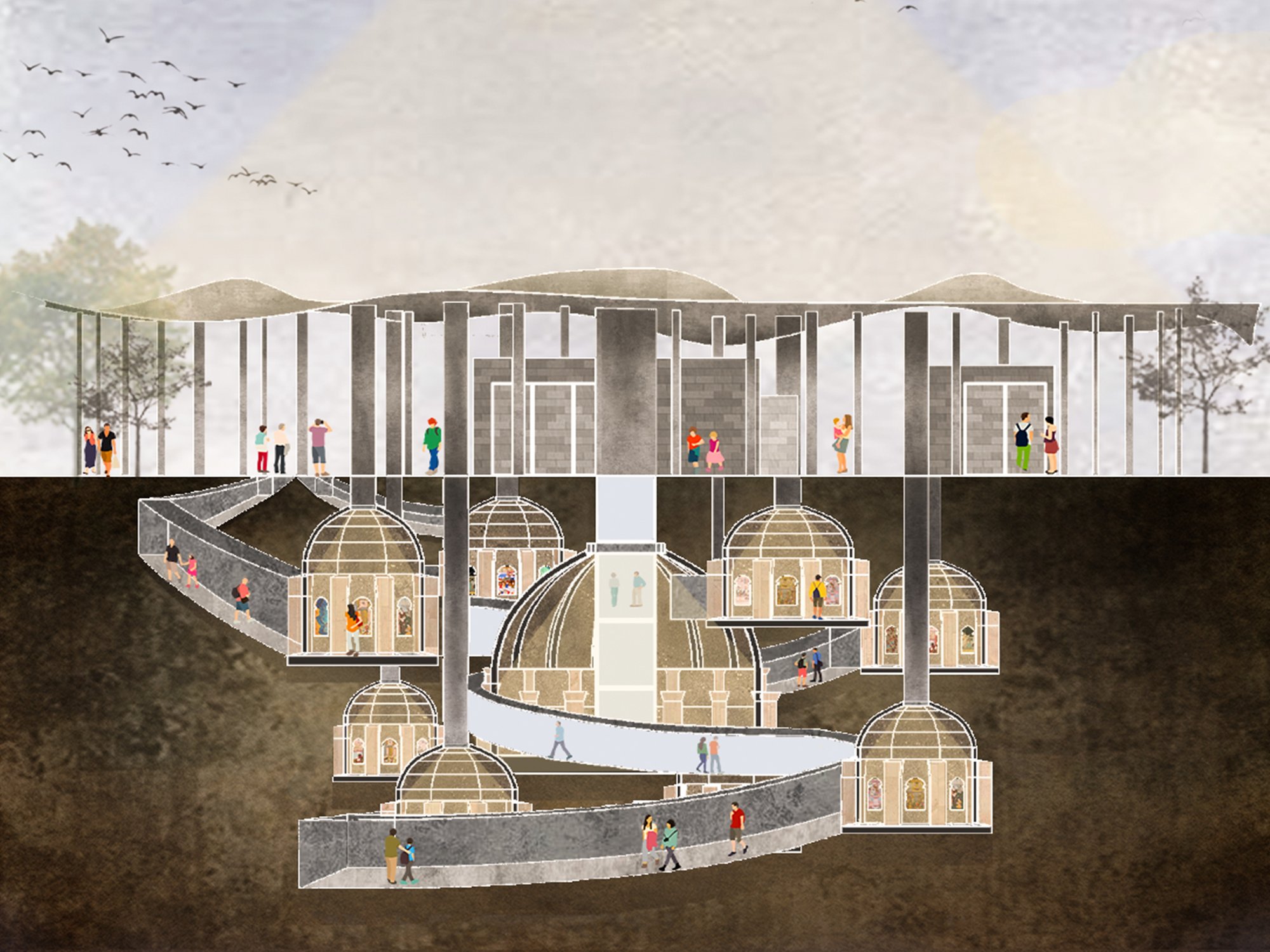
Regarding the design of the concrete shape of the building, we hope it can echo the form of the Cappadocia's underground city to a certain extent. The parts on the ground should be as inconspicuous as possible to make the entrance more concealed, which allows visitors to gradually discover the existence of the entrance during the exploration process. The underground part is like a real underground city in the Middle Ages. There is a main hall in the center, and other rooms are scattered around the main hall.
In the design of the entire venue, we also added an amphitheater, children's play area, maze, parking lot, coffee shop, souvenir shop, and some recreational facilities. While meeting the various needs of tourists, it enriches the entire venue and also allows The museum is more atmospheric. The entrance is located on Sivas. Blvd and the parking lot are located northwest of the entire site. After entering the entrance, the line of sight is blocked by densely planted trees. You can only see the roof of the museum building. You can only reach the museum after passing through the winding road.
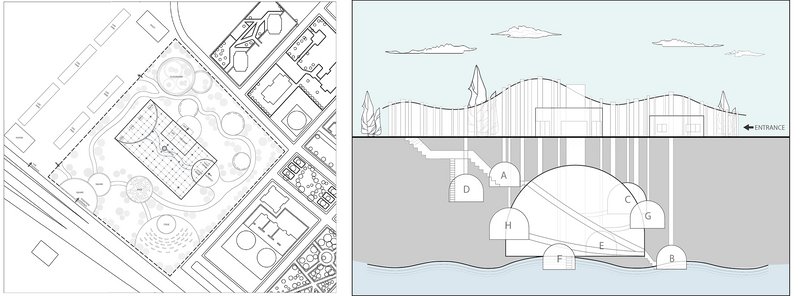
Regarding the design of the roof, we have made a certain response to the natural topography of Cappadocia. At the same time, we have extracted the curved elements of the groundwater in the underground city to form an irregular and thin curved surface, using large and small ventilation with different thicknesses. The tubes or pillars are propped up to form a light space without walls. The dense pillars divide this space into several parts, satisfying the needs of the museum building, and allowing visitors to shuttle through it. Only after exploration can the real entrance of the dungeon be found.
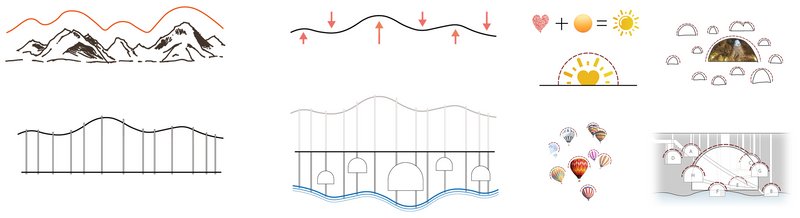
For the underground part, we try to simulate a first-person immersive experience to exploring medieval living. Each room has a circular dome, and the ventilation pipe directly leads to the ground, which is also a way of lighting. The main hall is located the center of the whole underground infrastructure, with other exhibition halls surrounding it, symbolizing the sun and the Turkish spirit. After visiting other small rooms, tourists will go to the main hall to participate in the settlement of gold coins, celebrations, and then take the elevator to the coffee shop and souvenir shop on the ground to back to 'the real word'.
4.visiting route (visit mode):
When entering the underground museum, tourists need to play the role of the medieval Turks and choose different characters (student, priest, housewife, farmer) according to their ideas. And then, they are supposed to change to the character costumes and enter different tour routes. It's worth noting that each tourist has the same amount of gold coins at the beginning. Before looking for the main hall of the final celebration, each one needs to complete the tasks arranged along with the rooms(riddle room, handmade room, painting room, cooking room, florist room, reading room, wine-made room, gift room, and main hall). If you encounter difficulties, you're able to use the initial gold coins to purchase props or summon staff to help you completed.
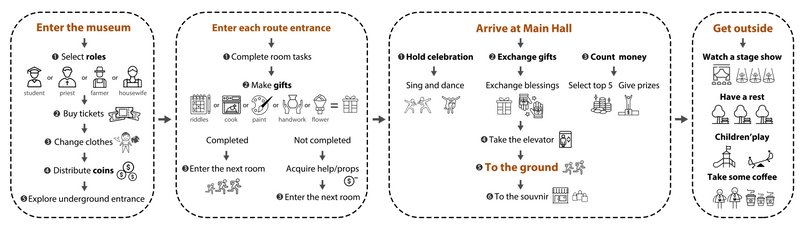
5.The design proposal (The effect is presented):
To show each part of the museum more clearly, we modeled the entire building by sketch up, including the interior of each room. We chose the angle to explain the function of each room. Based on the 3D model, we used Photoshop to show the material, plus a certain amount of light and shadow and characters to make the renderings more realistic. In other renderings, we have also worked hard to create the atmosphere of this underground museum, so that people who see it can more intuitively understand our design and feel the theme we want to express.
In the early Middle Ages, the Byzantine Empire oppressed the Turkish Empire, leading Christians to choose Kappa with a unique landform to live in. They explored underground spaces and built underground cities to avoid war persecution. Even if the Turks in the Middle Ages faced aggression, they did not surrender or give up. Instead, they investigated a new life underground. This positive attitude towards life is worth remembering and inheriting. That's what it was designed for.