Ecological salvation
Ecological salvation

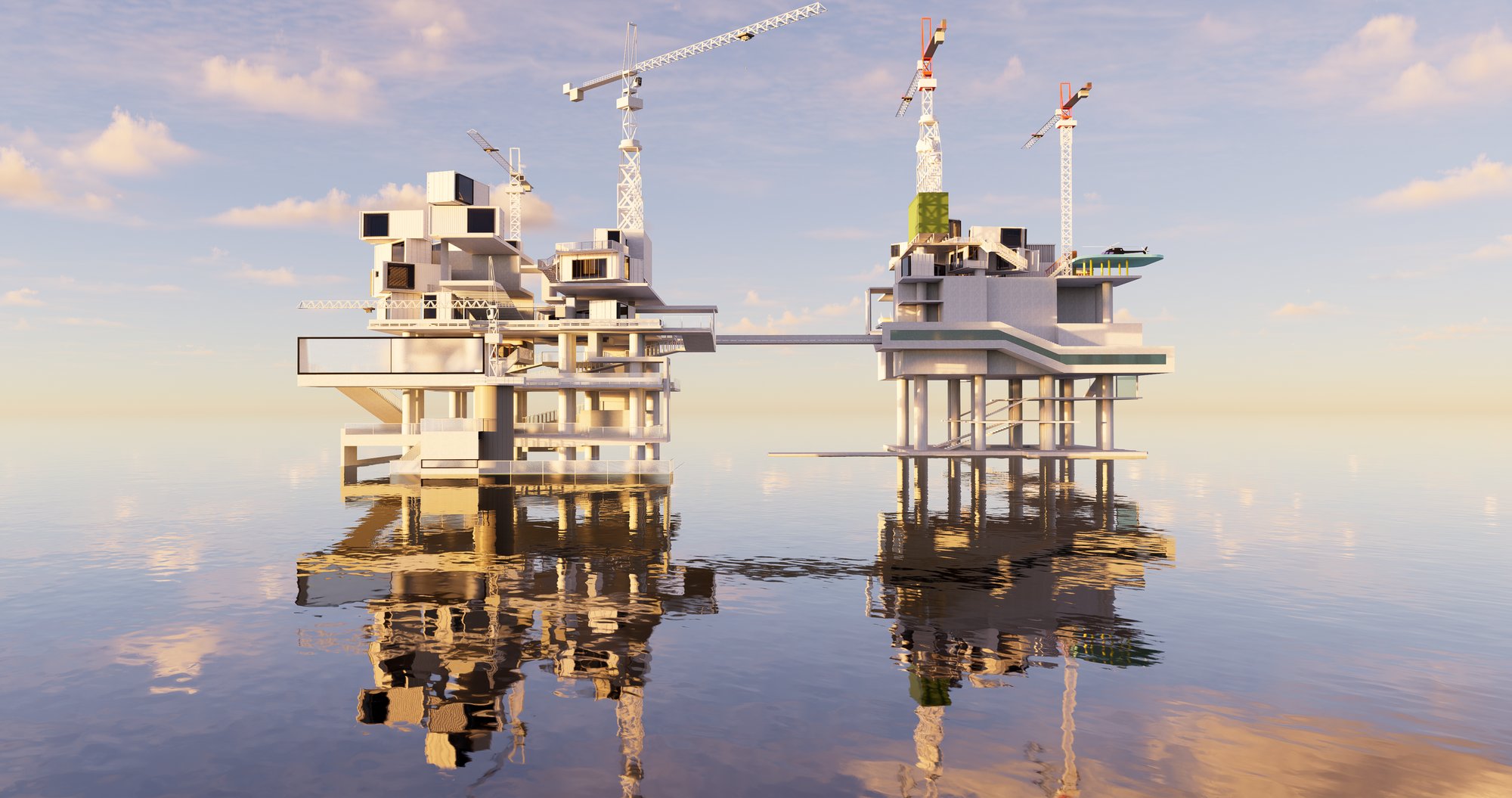
First, considering the historical background of local drilling platforms, we know that Italy has installed nearly 200 oil RIGS in the Mediterranean Sea since 1959. But only a small fraction of those RIGS has been dismantled, and many more still face demolition in the Upper Adriatic. At present, the architectural use of them is still pending due to the significant costs involved. The RIGS, which are about to be shut down, represent permanent industrial scars, monuments to humanity's past SINS. Parts of it were transformed by them, one by one, disintegrated, transformed, unrecognizable.
But people seem to have forgotten this history and need to be reminded again.
So, we plan a continuous flow to remind the pilgrims of the past and cherish the peace of today.
The overall design takes the ecological narrative of "black, white and gray" as the story line. Let people feel the beauty of human original ecological oasis, immersive vertical experience of environmental pollution brought by the sense of depression. When you can't breathe, you can find a light from the dark, which is the self-salvation of human ecological transformation. Strengthen human's protection of the environment and feel the hard-won ecological oasis. The whole system is integrated with the cycle, from light to darkness and then chasing light (nature-pollution-transformation - nature). Under the ecological narrative story, the sea relations of distant relatives are metaphorical; White -- the natural ecological environment corresponds to the distant (far), gray -- sea and land transformation mode corresponds to the Mediterranean (adjacent), black -- pollution problem corresponds to the Adriatic Sea (close).
With the correspondence of black, white and gray as the main narrative line, our whole space is in the form of closed loop, from loose to tight to loosen, and the overall atmosphere is relaxed to depressed and finally redeemed.
In order to embody the body of the sea and land, we contrast the depression brought by the underwater space with the abundant Marine ecology outside, also symbolizing light and dark, only separated by the wall. Let people also deeply feel the hard-won Marine ecology.
The design is transformed into an exhibition space with rich connotations by means of preservation and regeneration. In the process of transforming the oil collection industry platform into ecology and exhibition, we retain and transform the original site's drilling structure, platform and other industrial relics to retain the historical memory of the site. The development of The Times has forced industry to fade from the urban stage, and the memory of industry is fading with the aging of the population. In this dimension, based on the existing contradictions of the site and the demands of the crowd, the design involves solar energy (biodegradable materials), seawater salt reduction, and ocean thermal energy. It is expected to awaken people's memory of nature, enhance people's perception of history, and promote people's emotional communication. Aiming at the problem of small temperature difference between hot and cold sources, we propose a method to increase the temperature of warm seawater by using solar energy as auxiliary heat source. To solve the problem of low thermal energy utilization rate, a new combined cool-electric supply cycle was constructed based on the ocean thermal energy generation cycle, and the jet refrigeration cycle was driven by the lack of steam at the turbine outlet in the Kalian cycle, which realized the cascade utilization of energy. Under the integration of the existing resources of the site, the connection between the sea area of distant relatives is constructed in different areas, and nodes with different themes are set up to enrich the integration of sea area and land and blur their boundaries. People shuttle through the site, feel the cycle of land and sea, explore more history, make more friends, and build a home together.
The exhibition space is central to the design of the Drilling Rig Museum, so this proposal seeks to explore a continuous and interesting space and flow that will attract visitors and allow them to have a complete continuous experience. The main research point of this design is how to connect the vertical wall with the horizontal floor. The twisting of the piece connects the wall and floor slab, creating a continuous transition between horizontal and vertical, which itself serves as an important part of the exhibition flow line, and the twisting place serves as the staircase traffic space. With the help of torsion Angle, torsion position and torsion between pieces, the shape of the body can be further optimized and the detailed structure can be improved.
But every corner, every intersection of darkness and light, will trigger people to think about ecological protection. Reflect on the relationship between man and nature.
People here experience the ecological correspondence between sea and land. Feel the instinct of human yearning for ecology. This will leave the most important warning sign for them to return to land, or to the deep sea.