

ENGRAM: An Athenaeum That Listens, Responds, and Evolves with Its Users
A futuristic knowledge institution where piston-driven walls, shifting geometries, and adaptive research spaces turn architecture into a living partner.


What happens when a building stops being a container for knowledge and starts becoming knowledge itself? ENGRAM answers that question with a spatial proposition that is part research lab, part public landmark, and part responsive organism. The project reimagines the Athenaeum, the classical institution of learning and intellectual exchange, as an architecture that physically recalibrates in response to its users: walls shift through embedded pistons, interior volumes expand and contract, and the building's silhouette changes with environmental conditions. It is less a monument to what we already know and more a machine for discovering what we don't.
Designed by Ayadi Mishra, Ritika Singhal, Vaibhav, and Anchit Agarwal, ENGRAM positions itself at the intersection of architecture, technology, and human behavior. The three-lobed plan, central tower, and 14 flexible exhibition blocks work together as a system that treats spatial experience not as a given but as a variable, one that users, researchers, and designers actively manipulate. In a discipline that increasingly asks buildings to perform rather than simply stand, this project stakes a clear position.
Three Lobes, One Network: A Floor Plan Built on Connection
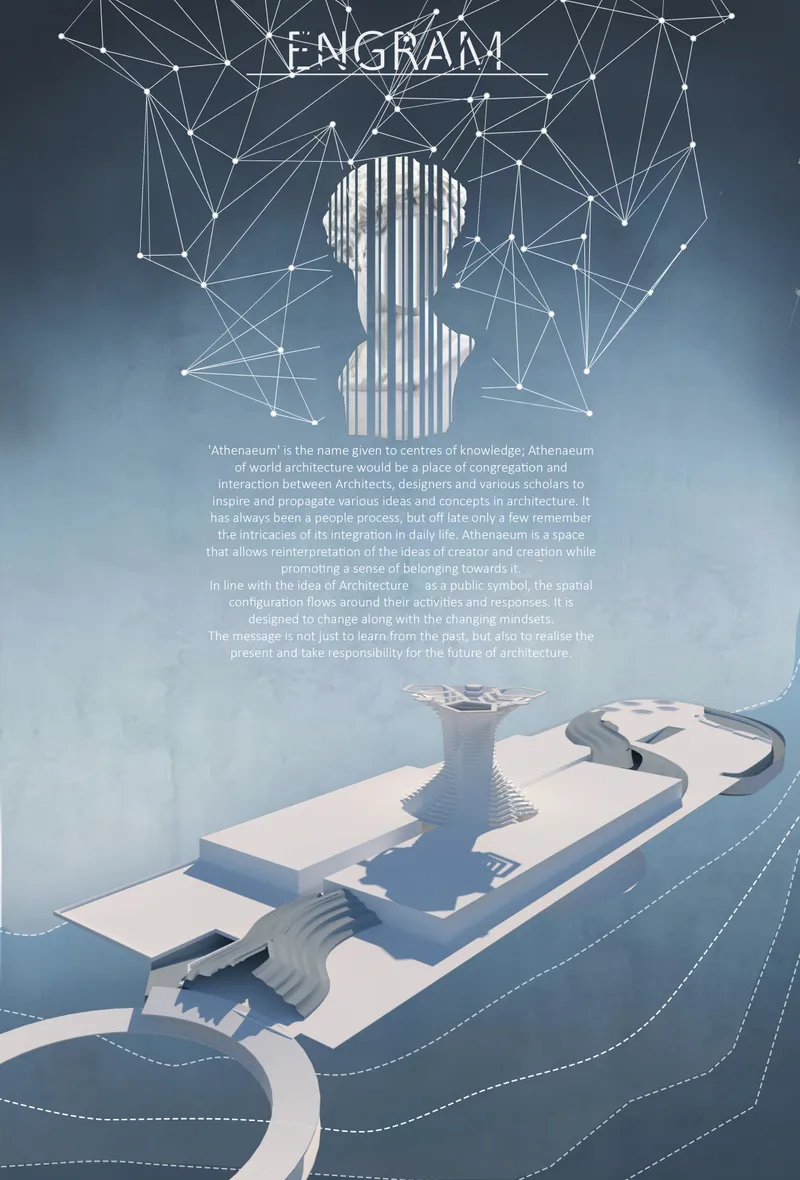
The axonometric view reveals ENGRAM's tri-lobed floor plan overlaid with a geometric network that reads like a neural diagram. Contour lines in blue gradient trace topographic shifts across the site, suggesting that the building does not sit on the ground so much as it emerges from it. Each lobe houses a distinct programmatic cluster, yet the network overlay makes the argument that no zone operates in isolation. Knowledge here is treated as connective tissue, flowing through the plan the way signals travel through synapses.
The geometry is deliberate. Rather than a single monolithic footprint, the lobed configuration creates pockets of interiority and exteriority, allowing public spaces, dynamic research zones, and exhibition areas to overlap without collapsing into one undifferentiated mass. The network lines suggest infrastructure: pathways, data conduits, or structural members that bind the three lobes into a coherent whole.
Programmatic Flow: Stairs, Pathways, and Democratic Ground
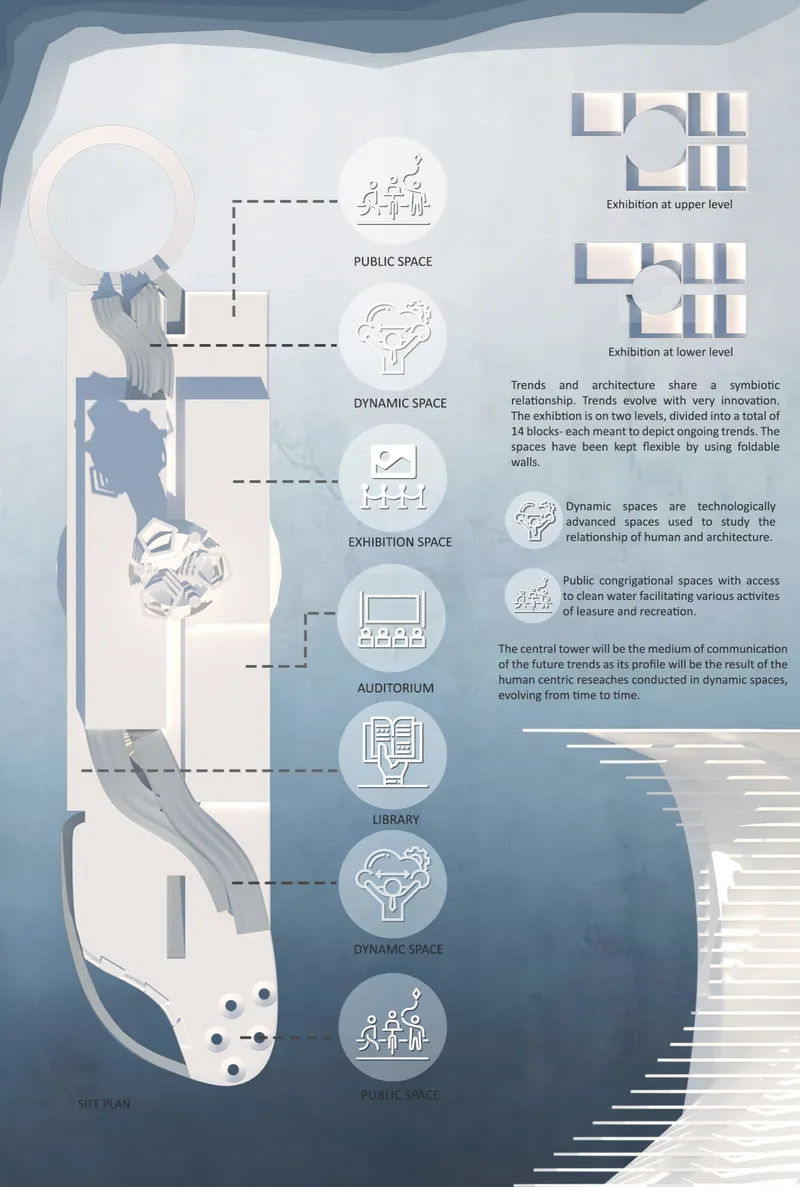
The annotated site plan unpacks how ENGRAM organizes movement. Flowing pathways connect programmatic zones to a stairway system on the right side of the drawing, establishing a clear circulation hierarchy between public, semi-public, and specialized research areas. Open plazas, shaded zones, and seating areas are woven into the connective fabric, ensuring the Athenaeum functions as a genuinely democratic environment. Access to clean water and recreational amenities appears alongside the more cerebral research spaces, a reminder that knowledge work depends on physical comfort as much as intellectual stimulation.
What stands out is the absence of rigid corridors. Movement through the site follows fluid, curvilinear trajectories rather than orthogonal grids, reinforcing the project's core thesis that architecture should adapt to the patterns of human behavior rather than dictating them. The pathways themselves become transitional learning spaces, not merely passages between destinations.
Vertical Assembly: Stacking Knowledge in a Central Tower
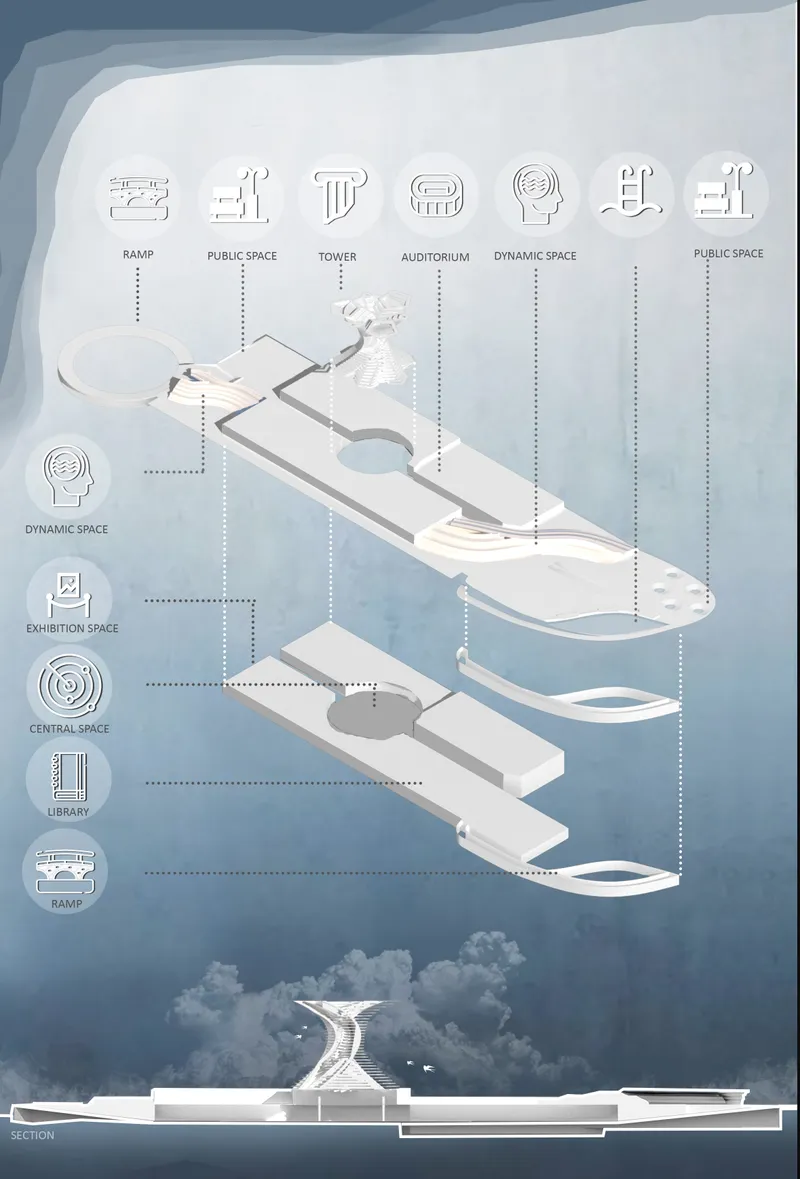
The exploded axonometric drawing pulls the building apart floor by floor, revealing a vertical stacking logic that culminates in the central tower. Below, a sectional cut rendered in stormy, atmospheric light shows how these floors relate to each other spatially and structurally. The tower functions as ENGRAM's architectural heart: a sculptural landmark visible across the site, a vertical beacon whose form derives from what the designers describe as the evolving patterns of human research. Its dynamic silhouette shifts with environmental conditions and user interaction, embodying the constant growth of knowledge in physical form.
The exhibition areas occupy two of these stacked levels, divided into 14 flexible blocks that can be reconfigured to accommodate shifting curatorial demands. This modularity is critical. A building that claims to evolve with its users cannot lock its exhibition program into fixed rooms. The 14-block system gives curators and researchers the freedom to remap the space as new trends and disciplines emerge, turning the exhibition floors into a perpetual work in progress.
Piston Walls and Pixelated Surfaces: Architecture You Can Feel

The interior perspective delivers ENGRAM's most visceral moment. A silhouetted figure stands in an arched passage where the walls are lined with pixelated, copper-colored volumetric surfaces. These are not decorative panels. The design calls for pistons embedded in the walls that physically shift interior volumes, creating real-time spatial transformation as users move through the building. The effect is architectural proprioception: the building senses its occupants and adjusts its body in response.
The copper tonality and the pixelated texture give these surfaces a warmth and tactility that counterbalances the project's high-tech ambitions. Architecture that responds to people risks feeling clinical or alienating. Here, the material palette grounds the adaptive technology in something sensory and approachable. The arched passage form, a nod to classical architectural language, frames the experience as a threshold between the known and the unknown, between static memory and active discovery.
Why This Project Matters
ENGRAM takes the familiar brief of a cultural institution and pushes it toward a genuinely speculative territory without losing programmatic rigor. The combination of adaptive walls, flexible exhibition blocks, and fluid circulation creates a coherent argument: that the architecture of knowledge should be as provisional and dynamic as knowledge itself. The designers do not simply illustrate this idea; they build it into the spatial logic of every floor, pathway, and wall surface.
What elevates the project beyond speculative rendering is the attention to the public dimension. The open plazas, recreational amenities, and democratic access points ensure that ENGRAM is not a fortress for specialists but a commons for anyone willing to engage. In a moment when institutions of knowledge are rethinking who they serve and how, this Athenaeum offers a spatial framework that treats curiosity, not credentials, as the price of admission.
View the Full Project
About the Designers
Designers: Ayadi Mishra, Ritika Singhal, Vaibhav, Anchit Agarwal
Enter a Design Competition on uni.xyz
uni.xyz runs architecture and design competitions year-round that reward proposals with spatial conviction and real site intelligence.
Project credits: ENGRAM by Ayadi Mishra, Ritika Singhal, Vaibhav, Anchit Agarwal.


Popular Articles
Popular articles from the community


The Amber Palace Opera: A Geological Fiction Surfaces on Tallinn's Baltic Waterfront
Pierre Brillard reimagines a Baltic legend as a public landscape, opera house, and waterfront promenade rooted in Tallinn's coastal identity.
Opera by the Sea Estonia: Three Shells Dissolving Architecture into Tallinn's Coastline
A winning opera house proposal replaces monumental form with interconnected shells that blur the boundary between building, park and Baltic Sea.

Tsunami Convergenics: Turning Catastrophic Ocean Forces into Underwater Housing Infrastructure
A speculative underwater settlement off the coast of Onagawa, Japan, treats tsunamis and typhoons as energy sources rather than threats.

Extended Shell: Retrofitting Kolkata's Balconies as Living Urban Thresholds
A modular retrofit system recovers the social and environmental intelligence of Kolkata's historic verandas for contemporary Park Street residents.

Similar Reads
You might also enjoy these articles

Play: Fragments of Their World: Remembered Architecture Rebuilt as a Modular Playground for Refugee Camps
Tom Gardner abstracts domes, arches and towers from the homelands of displaced families into a kit of child-scaled play parts for camp settlements.
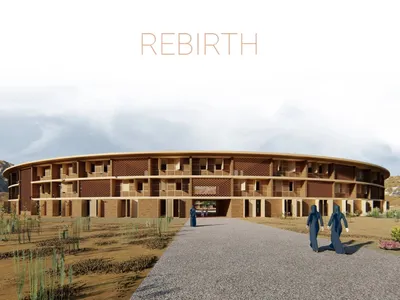
REBIRTH: A Circular Settlement Where Afghan Widows and Their Children Rebuild Life Together
A shortlisted Resile entry turns the circle into a protective ring of timber and brick, gathering homes, classrooms and gardens around a shared landscape.
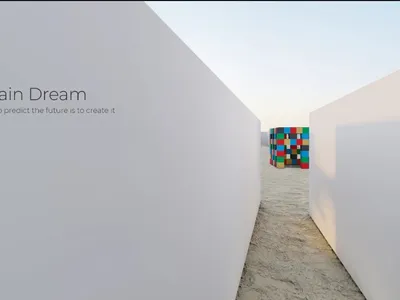
The Main Dream: A Recycled Plastic Kit That Lets Refugee Children Build Their Own Playground
Thirty-centimetre interlocking cubes that connect on three axes turn play into construction, letting children author the spaces they occupy.

Lunar Spiral: A Fibonacci-Driven Moon Settlement Rising from Shackleton Crater
Golden-spiral geometry organises buried infrastructure and orbiting habitable spheres into a lunar base designed to grow as life on the Moon expands.

Comments (0)
Please login or sign up to add comments
No comments yet. Be the first to comment!