

Farmview City Center: Stacking a Micro-City at Dhaka's Busiest Junction
A mixed-use vertical urbanism proposal that layers markets, hotels, offices, and public terraces above Farmgate's transit corridor.


What happens when you compress a neighborhood's worth of daily life into a single vertical structure? Farmview City Center answers that question by treating architecture not as a building type but as urban infrastructure. Sited at Farmgate, one of Dhaka's most congested transit junctions where pedestrian density collides with vehicular throughput, the project stacks open markets, brand retail, food courts, a low-budget hotel, co-working offices, and rooftop community terraces into one continuous form. The ambition is legible: turn a chaotic node into a public-oriented city center where shopping, working, eating, and resting coexist within a single vertical system.
Designed by S. M. Ahasanul Hasib and published on uni.xyz, the project tackles a real planning problem: how to insert density, public space, and economic opportunity into a site that already operates at capacity. Rather than retreating behind a lobby and a security desk, Farmview opens its ground plane to the street, invites pedestrians upward through layered circulation, and treats the entire section as a social diagram.
A Ground Plane That Belongs to the Street
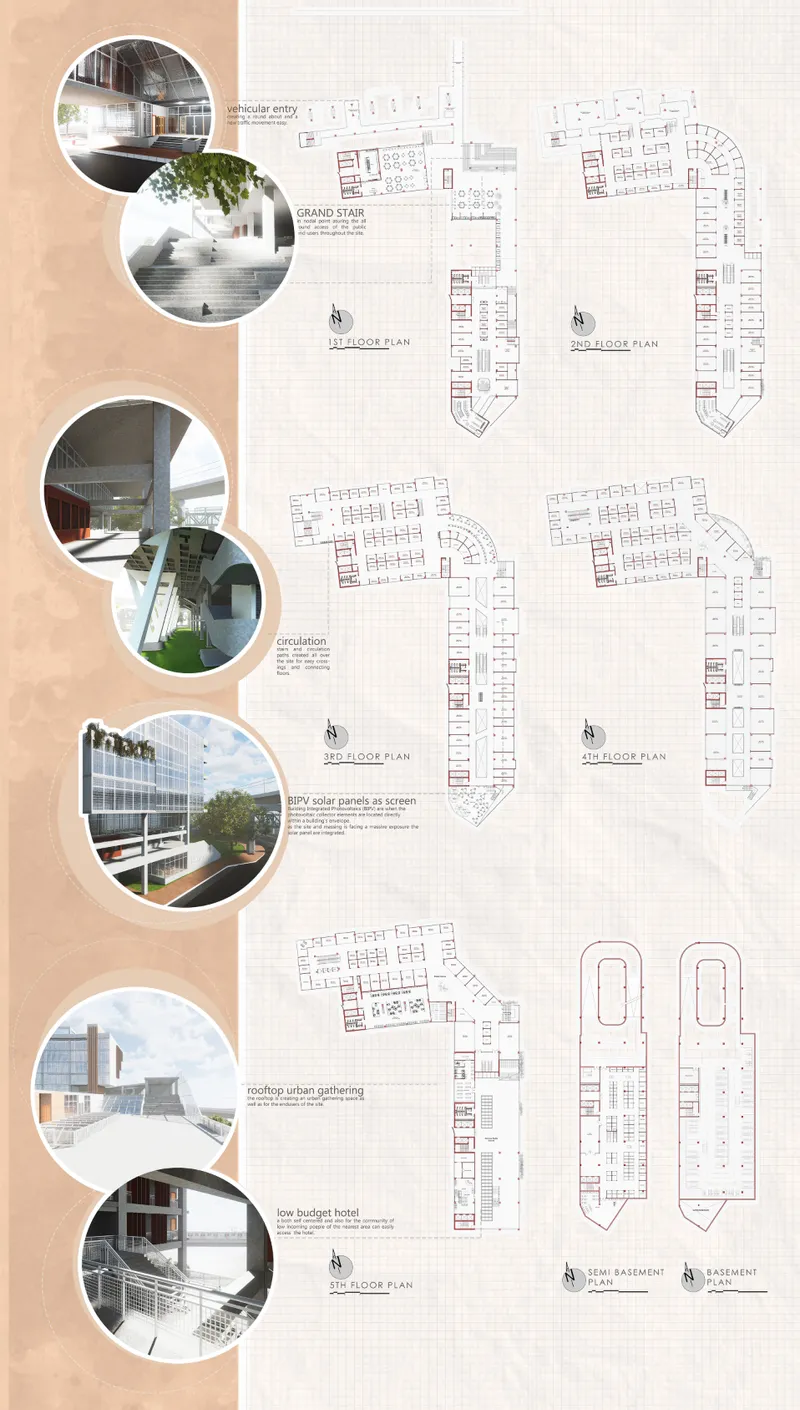
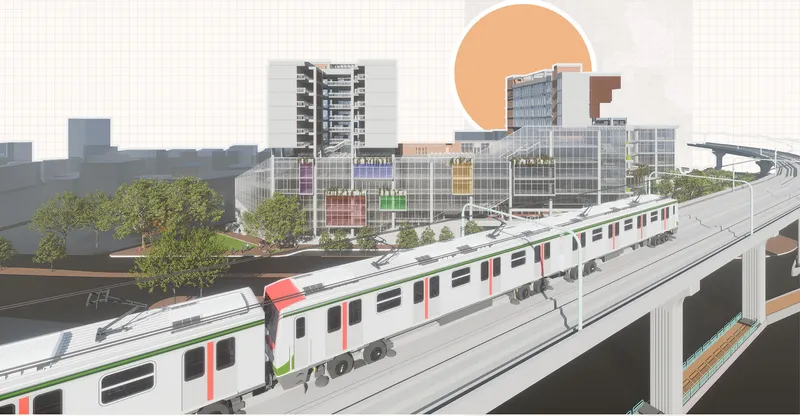
The presentation board and exterior rendering reveal a design strategy rooted in porosity. At grade, the building dissolves into an open street market and public plaza flanked by retail frontages, deliberately blurring the line between city sidewalk and building interior. Vehicular access operates through a dual-entry layout that separates service and drop-off traffic from pedestrian flow, a practical move for a site where buses, rickshaws, and foot traffic compete for every square meter. Circular photograph insets on the board give glimpses of shaded corridors and stepped terraces that extend this ground-level energy vertically, pulling people upward rather than filtering them out.
The glazed podium visible in the rendering does more than admit light. A system of BIPV solar panels doubles as a shading screen across the façade, reducing heat gain while generating energy. The visual effect is an expressive, layered skin that signals the building's environmental agenda without sacrificing transparency. Behind the glass, the lower floors host food courts and shared lounges on the second through fourth levels, creating a gradient from open-air commerce at the base to climate-controlled retail and dining above.
Vertical Programmatic Logic: Reading the Section as a Neighborhood
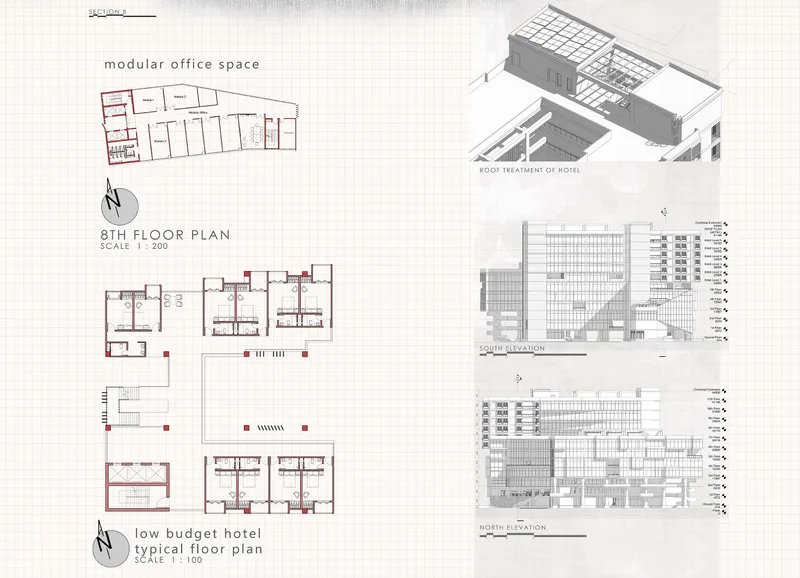
The architectural drawing set lays out the project's programmatic stack with precision. Basement and semi-basement levels handle parking, logistics, and service entries, keeping the mechanical life of the building invisible to its public face. The ground level is reserved entirely for the plaza and open market. Brand stores, food courts, and shared lounges occupy floors two through four. The fifth floor transitions into a rooftop gathering space and hotel reception, while the eighth floor hosts modular offices, co-working zones, and flexible business environments. Each band of program corresponds to a different public: shoppers, tourists, transient workers, startups.
What holds the stack together is a grand central stair that functions as the project's social spine, connecting public levels and encouraging movement between programs. Open atriums and shared terraces punctuate the section, ensuring that no floor feels sealed off from the activity below or above. The inclusion of a low-budget hotel is a deliberate social gesture, offering affordable, dignified accommodation for transient workers and urban dwellers who would otherwise be priced out of the city center.
Massing and Context: How the Towers Meet the Skyline
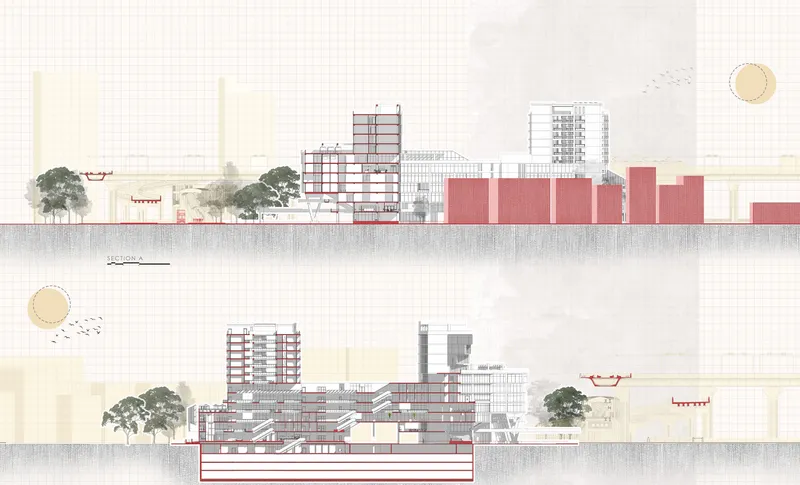
The section drawings expose the relationship between Farmview's massing and its surrounding urban fabric. The multi-tower configuration steps back as it rises, creating rooftop gardens and urban terraces that serve as community gathering spaces at various elevations. These intermediate landscapes reduce the sense of urban alienation that typically accompanies tall, dense developments. Cross-ventilation paths, shaded corridors, and strategic daylight orientation are legible in the section, confirming that passive design strategies are embedded in the geometry rather than applied as afterthoughts.
The surrounding context, visible in the drawings, underscores the project's density challenge. Farmgate is not a greenfield site; it is an existing, intense urban condition. The design responds by absorbing rather than displacing the energy of the junction. Elevated pathways and porous edges extend the public realm vertically, ensuring the building contributes to the life of the street rather than walling it off.
Why This Project Matters
Farmview City Center matters because it refuses to treat mixed-use as a marketing label. The programmatic layering here is genuinely hybrid: a street market shares a structural frame with a hotel, offices float above food courts, and rooftop gardens sit on top of parking garages. Each decision responds to a specific condition of the Farmgate site, from the need for affordable accommodation to the demand for flexible workspaces in a transit-rich location. The result is a building that reads more like a vertical neighborhood than a commercial tower.
For designers working in South Asian megacities, the project offers a useful provocation. It argues that density and public generosity are not contradictions, that a single building can absorb the functions of a district without sacrificing the openness and social richness that make cities worth living in. The BIPV façade, the central social stair, the low-budget hotel: these are not gestures of spectacle but of civic commitment, and they point toward a version of urban architecture that earns its place in the city by giving more than it takes.
View the Full Project
About the Designers
Designer: S. M. Ahasanul Hasib
Enter a Design Competition on uni.xyz
uni.xyz runs architecture and design competitions year-round that reward proposals with spatial conviction and real site intelligence.
Project credits: Farmview City Center by S. M. Ahasanul Hasib.


Popular Articles
Popular articles from the community


Tsunami Convergenics: Turning Catastrophic Ocean Forces into Underwater Housing Infrastructure
A speculative underwater settlement off the coast of Onagawa, Japan, treats tsunamis and typhoons as energy sources rather than threats.

Manzana Morphosis: Stretching Barcelona's Grid into a Living Landscape for 2050
A radical reworking of the Eixample manzana turns density into a tool for generous public space, vertical ecology, and environmental performance.
Opera by the Sea Estonia: Three Shells Dissolving Architecture into Tallinn's Coastline
A winning opera house proposal replaces monumental form with interconnected shells that blur the boundary between building, park and Baltic Sea.

Faces of the Soviet Avant-Garde: Turning Moscow's Street Names into an Open-Air Museum
A network of sculptural installations across a Moscow residential district transforms forgotten architect names into spatial encounters with cultural memor

Similar Reads
You might also enjoy these articles

Play: Fragments of Their World: Remembered Architecture Rebuilt as a Modular Playground for Refugee Camps
Tom Gardner abstracts domes, arches and towers from the homelands of displaced families into a kit of child-scaled play parts for camp settlements.
REBIRTH: A Circular Settlement Where Afghan Widows and Their Children Rebuild Life Together
A shortlisted Resile entry turns the circle into a protective ring of timber and brick, gathering homes, classrooms and gardens around a shared landscape.
The Main Dream: A Recycled Plastic Kit That Lets Refugee Children Build Their Own Playground
Thirty-centimetre interlocking cubes that connect on three axes turn play into construction, letting children author the spaces they occupy.

Lunar Spiral: A Fibonacci-Driven Moon Settlement Rising from Shackleton Crater
Golden-spiral geometry organises buried infrastructure and orbiting habitable spheres into a lunar base designed to grow as life on the Moon expands.

Explore Urban Fabric Competitions
Discover active competitions in this discipline

Design a brochure to showcase the effects of the technosphere

Challenge to illustrate ‘A tale of Two Cities’

Deconstructivism - Illustration Design Challenge
Comments (0)
Please login or sign up to add comments
No comments yet. Be the first to comment!