
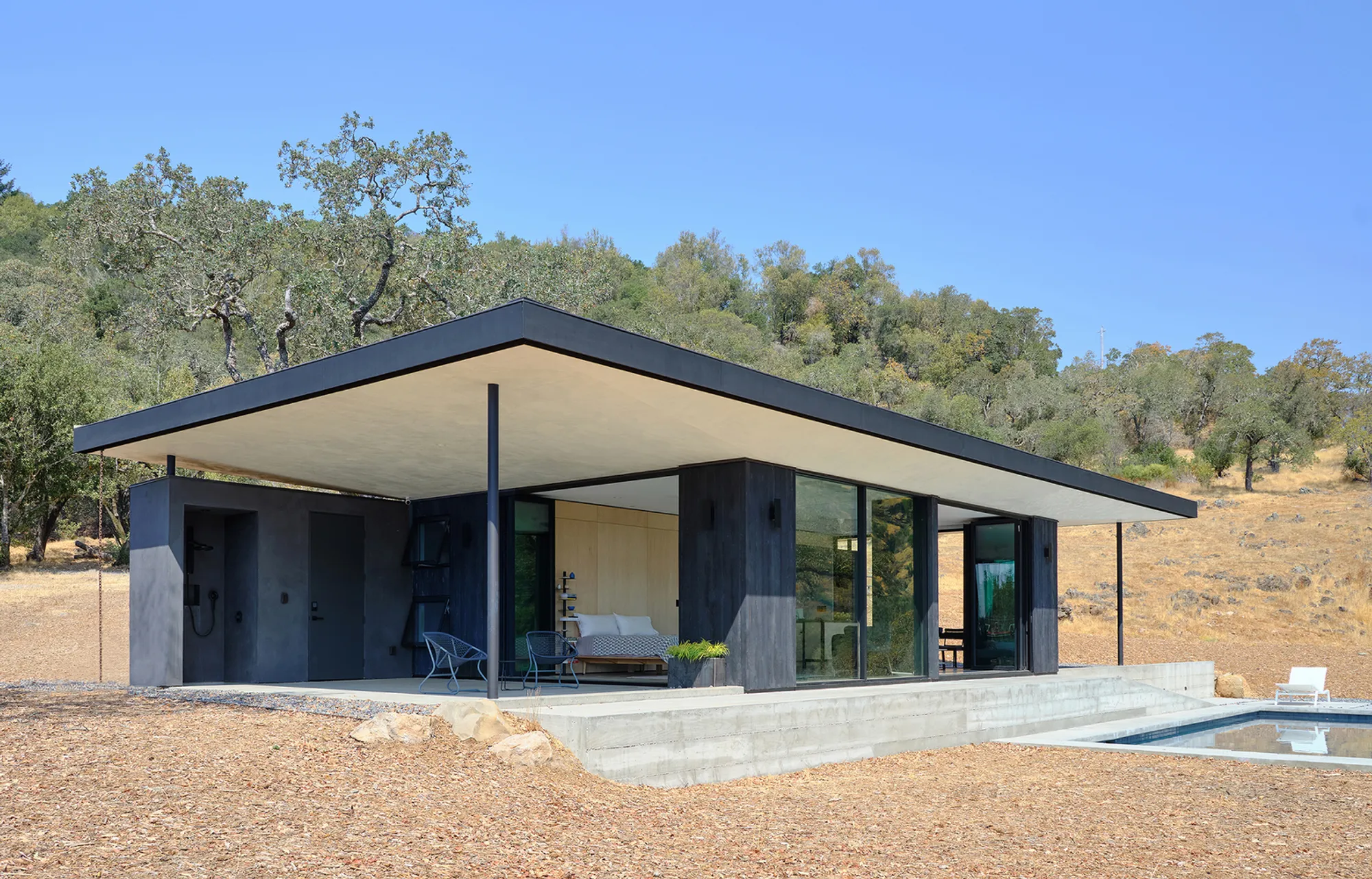
Schwartz and Architecture Disguises a Fire-Resistant Sonoma Retreat as a Volcanic Boulder
At just 816 square feet, the Leit House channels Sonoma Valley's igneous geology into a compact, wildfire-ready pavilion under oak canopies.


Millions of years of volcanic activity left Sonoma Valley littered with blackened rocks: rhyolite, basalt, andesite, pumice. Porous, lightweight, and surprisingly tough, these stones survived the eruptions that made them and the wildfires that periodically sweep through the dry California hills. When the 2017 fires stripped vegetation from a 40-acre estate in the valley, those ancient igneous fragments became newly visible, scattered across a charred but resilient terrain. Schwartz and Architecture, led by Neal J.Z. Schwartz, FAIA, saw in them both a metaphor and a design brief.
The Leit House is 816 square feet of guesthouse turned primary weekend retreat, and it does something that very few buildings its size manage: it reads as a geological event rather than a construction project. Its blackened facades, heavy metal roof, and cementitious walls are all fire-resistant by specification, but they are also deeply site-specific. The building sits beneath mature oaks like another dark stone the earth pushed up. The name gives away the game: "leitmotif" refers to the roof, a dark, massive plane that appears weighty yet resolves, on closer inspection, into something unexpectedly light. It earned an Honor Award in the 2021 Residential Architect Design Awards for Custom Houses Under 3,000 Square Feet, and it deserved it.
Camouflage Through Geology
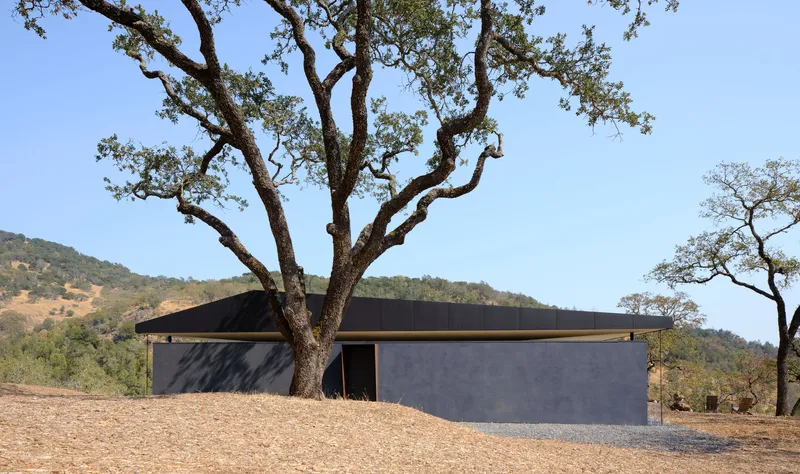
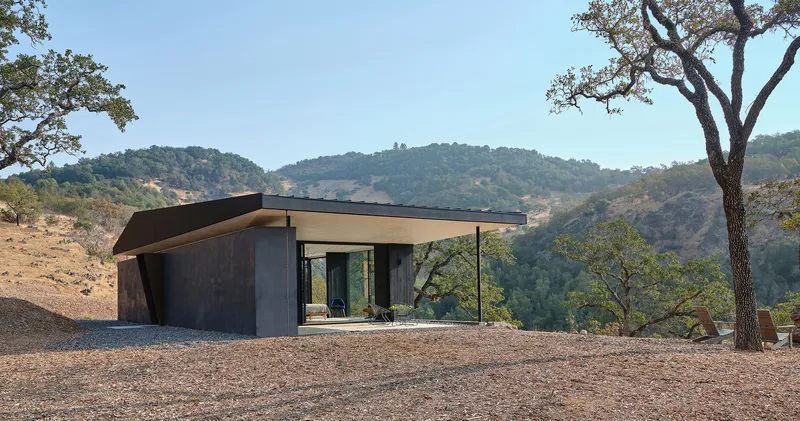

The Leit House does not try to disappear into its landscape through transparency or reflection. It disappears by becoming the landscape. The exterior palette of cementitious stucco, standing seam metal roofing by Metal Sales, and Shou Sugi Ban charred cedar siding produces surfaces that mimic the scorched volcanic rock already present on site. From a distance, the single-story pavilion registers as another dark mass among the oaks and dry grasses, its low profile hugging the slope rather than competing with it.
The stealth approach is deliberate. The architects describe the structure as a sculptural object in the tradition of the igneous boulders it emulates: surprising in its lightness despite appearances of density. Gases trapped in cooling lava created porous, airy stones millions of years ago. The Leit House channels that same paradox, with its heavy roof hovering on slender supports and glass walls that dissolve the mass into views.
The Service Spine and the View


At 816 square feet, every organizational decision counts. Schwartz and Architecture anchored the plan around a dense service spine: a solid wall of storage, utilities, and structure that runs through the building's core. On one side of this spine sit the bedroom and bathroom; on the other, the galley kitchen and covered outdoor dining. The living spaces broaden outward from the spine toward the valley, so the tightest, most functional zones sit in the building's back while openness and light pour into the rooms where people actually gather.
The spine also does structural work. Pre-manufactured roof trusses bear on it, allowing the perimeter walls to open almost entirely to glass. The result is a building that feels considerably larger than its footprint because the eye always reaches past the interior to the rolling hillside beyond.
Living Under the Dark Roof

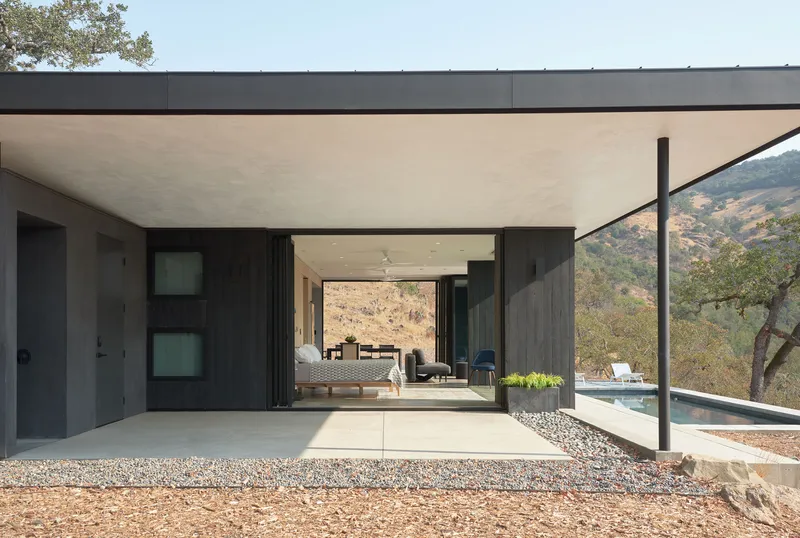
Inside, the palette shifts to warmth. Maple veneer Appleply panels line walls and millwork, and Fireclay tile surfaces the bathroom. The contrast between the charred exterior and the light wood interior is sharp and intentional: you move from a world of volcanic hardness into a space that feels like the inside of a wooden instrument. Full-height glass walls in the bedroom frame an oak grove so directly that the trees become wallpaper.
The covered terrace, with its plywood soffit and folding glass doors, bridges interior and exterior. It functions as the primary living room in warm weather, opening directly to the pool terrace and the hillside. A split-ductless Mitsubishi HVAC system handles climate control, but the building's orientation and overhangs do much of the passive work, keeping direct sun off glass in summer while welcoming it in winter.
Pool, Terrace, and the Threshold Between Shelter and Land

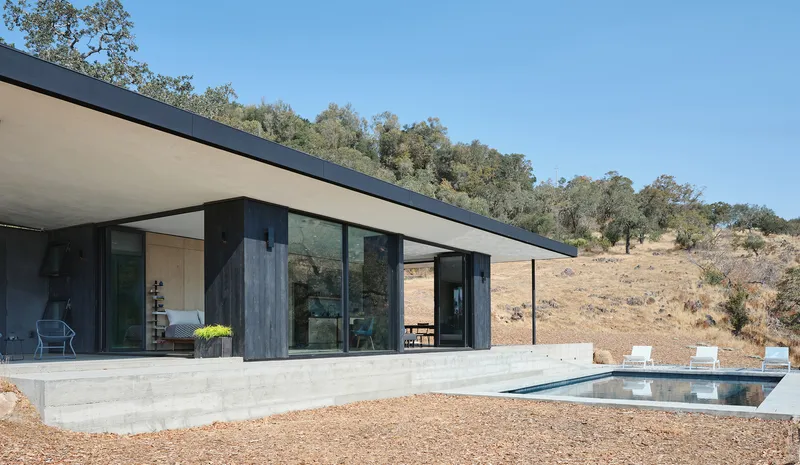

The swimming pool is not a luxury add-on. On a fire-prone site, a body of water close to the house serves a practical purpose, and its concrete terrace doubles as a defensible space. Totem Landscape Services handled the site work, maintaining the dry, native character of the hillside rather than introducing irrigated planting that would increase fire risk.
At dusk, the cantilevered roof overhang frames the pool like a visor. The pavilion's glass walls turn reflective, and the building achieves its most complete imitation of a dark stone catching the last light. The dusk views reveal how carefully the architects calibrated the roof line: it sits just low enough to compress the space between you and the landscape, pulling the distant hills closer.
Material Precision at the Edges

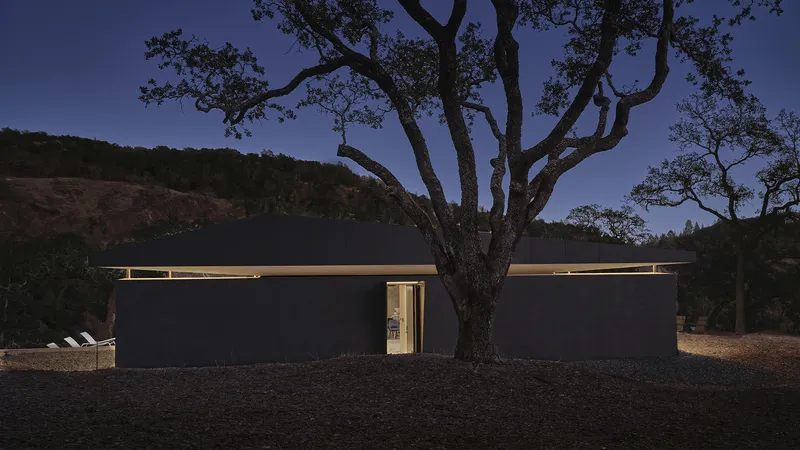
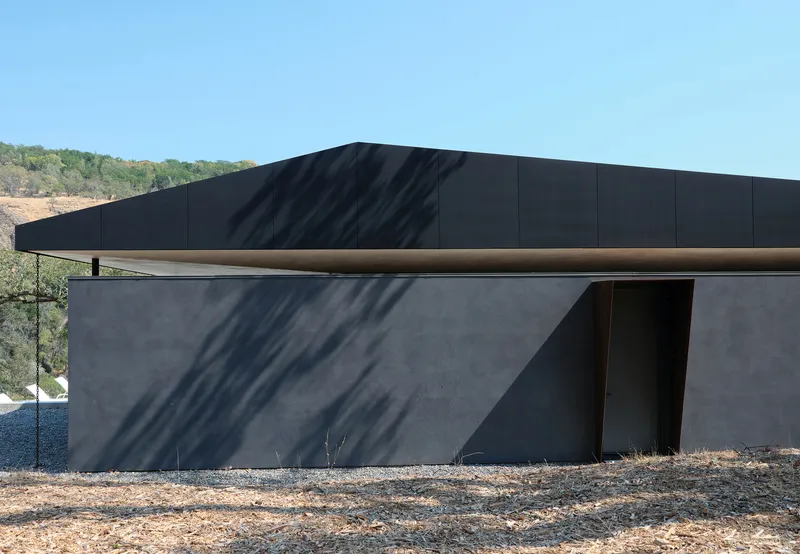
Detailing tells the real story of fire resistance. The standing seam metal roof's ribbed surface and the deep shadow line where it meets the concrete wall are not decorative gestures; they are the junctions where fire-rated assemblies must perform. The recessed glazing behind blackened timber frames creates a layered defense: char-resistant wood on the outside, fire-rated glass behind it, and the thermal mass of concrete at the corners.
The twilight photograph of the rear facade shows the horizontal roof soffit illuminated beneath a mature oak, a detail that could read as pure atmosphere but is also evidence of non-combustible soffit construction. In wildfire territory, embers enter buildings through soffits and vents more often than through walls. Every glowing surface in this image is a fire-rated one.
Plans and Drawings
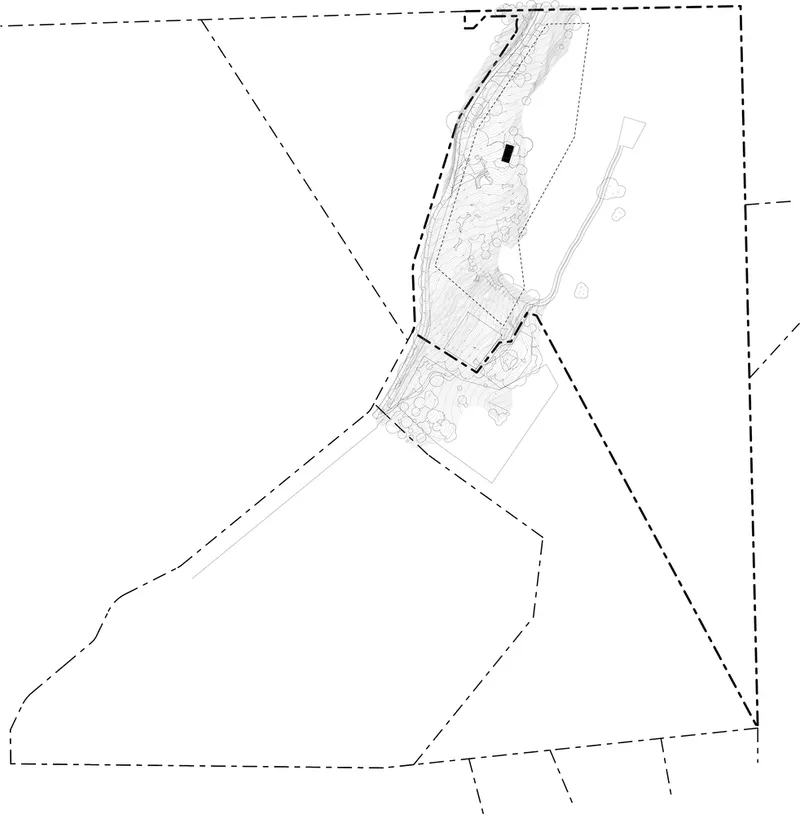
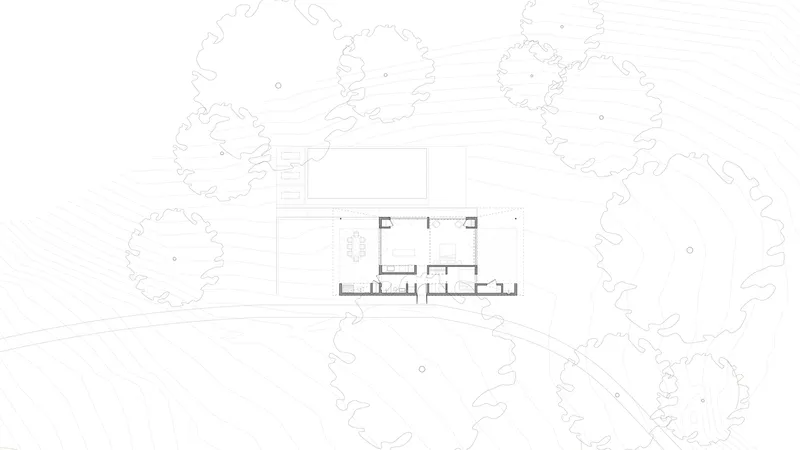

The site plan reveals just how small the building's footprint is relative to its 40-acre parcel. Contour lines wrap tightly around the pavilion, and existing tree canopies are drawn with a care that suggests they were treated as structural elements of the project. The floor plans confirm the service spine logic: a compact bedroom and bathroom suite on one end, an open living and dining area on the other, with the kitchen slotted into the thickness of the wall between them.
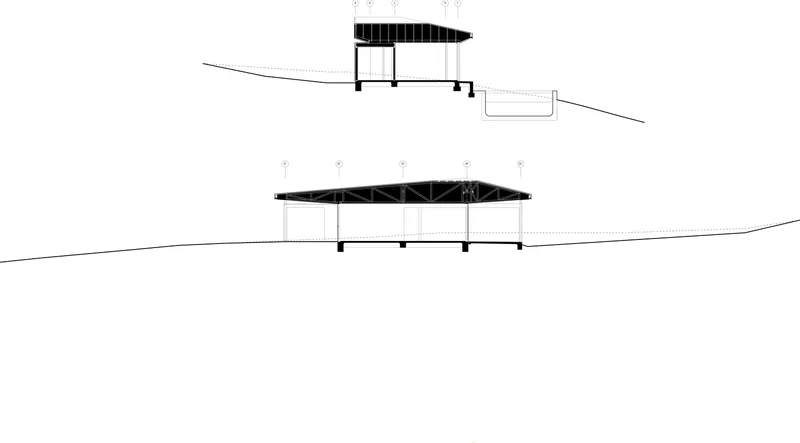
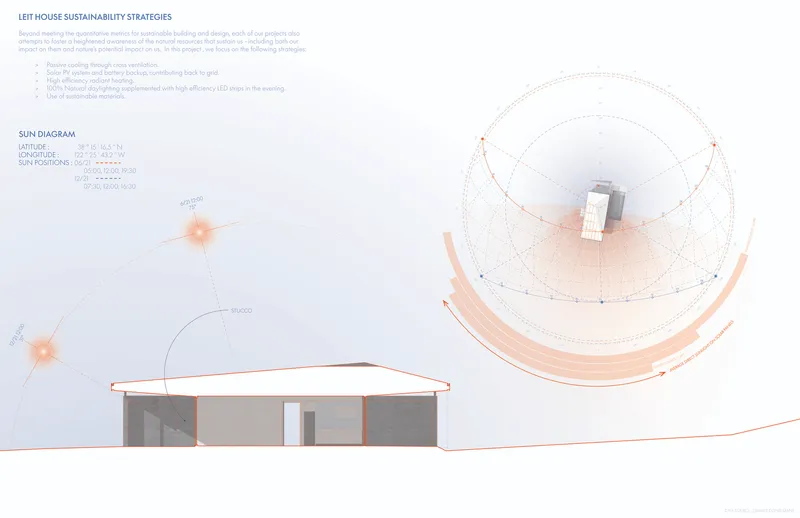
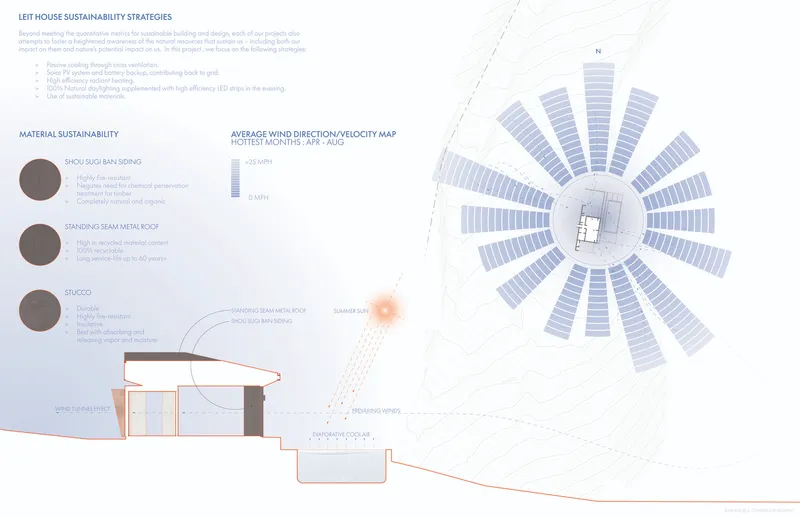
The section drawings show pre-manufactured roof trusses spanning from the service spine to slender perimeter columns, the whole assembly riding a sloped site with minimal grading. The sun diagram and wind map are unusually explicit for a project this small: solar angles dictate the depth of the roof overhang at each orientation, and a radial velocity chart informs the passive cooling strategy. These are the drawings of a team that takes environmental performance seriously enough to quantify it, not just gesture at it.
Why This Project Matters
Fire-resistant construction in California is often discussed in terms of compliance: meet the code, check the box, move on. The Leit House argues that fire resistance can be the generative concept for an entire project rather than a regulatory burden layered on top of a design. Every material choice, from the Shou Sugi Ban cedar to the standing seam metal to the cementitious stucco, pulls double duty as both protective measure and aesthetic statement. The result is a building whose appearance is inseparable from its performance.
At 816 square feet, the house also makes a quiet case for restraint. On a 40-acre site with sweeping valley views, the temptation to build large must have been considerable. Schwartz and Architecture built small instead, proving that a service spine, a glass wall, and a well-detailed roof are enough to make a weekend retreat that feels as expansive as its setting. The Leit House is a stone the architects placed among stones, and it belongs there.
Leit House by Schwartz and Architecture (Neal J.Z. Schwartz, FAIA; Christopher Wayne Baile; Ania Burlinska). Sonoma Valley, California, United States. 816 sq ft (80 m²). Completed 2021. Structural Engineer: Framework Engineering. General Contractor: Eames Construction. Landscape: Totem Landscape Services. Photography by Douglas Sterling Photography.
About the Studio
Share Your Own Work on uni.xyz
If projects like this are the kind of work you want to make, uni.xyz is a place to publish your own, find collaborators, and enter design competitions.




Popular Articles
Popular articles from the community


The Ocean Hive: Sustainable Architecture for a Self-Sufficient Civilization at Sea
The Ocean Hive imagines sustainable architecture at sea, where modular habitats, algae, wave power and ocean waste sustain a growing colony.

Co-Life: Senior Housing Design That Reconnects Older Adults With the City
Co-Life reimagines senior housing design through healing gardens, shared streets, workshops, and a sustainable community across generations.

Co-life: Sustainable Architecture for Age-Friendly Community Living
Co-life reimagines sustainable architecture for seniors through courtyards, rammed earth, shared gardens, and spaces designed for belonging.
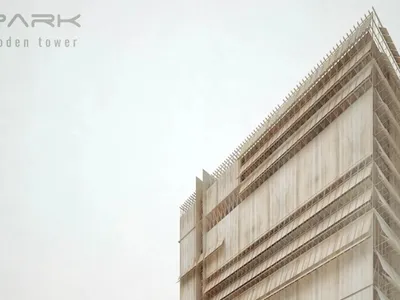
EW PARK: Sustainable Architecture Reimagines the Future of Urban Parking
EW PARK reimagines city parking as a modular wooden tower combining automation, solar energy, electric mobility, and adaptable urban design.


Similar Reads
You might also enjoy these articles


Hodi-Mandai Geram
Project Function: Preservation and revitalization of the Intangible heritage and socio-spatial identity of the Hodi by Housing, Cultural Memory Center, Sacred Grove, landscape, local tourism economy


Olio Towers: A Mid-Rise for Performers That Fuses Housing, Rehearsal, and Stage
Located blocks from Houston's Theater District, this modular tower stacks living units around a central performance atrium.

Oasis: Modular Green Housing Carved into Dhaka's Urban Fabric
A shortlisted Plugin Housing entry reclaims unauthorized settlements in Dhaka with stepped concrete volumes, green roofs, and ventilation-driven design.

Black Hole: A Floating Megastructure for the Post-Physical Era
Emiliano Mazzarotto envisions a spherical, self-scaling arena where e-sports, digital hotels, and holographic stadiums replace traditional public space.


Explore Architecture Competitions
Discover active competitions in this discipline



Challenge to reimagine the Iron Throne


Photograph architecture without architects


Illustrate the lost glory of Angkor Wat - Render Challenge


Design challenge to reuse E-waste
Comments (0)
Please login or sign up to add comments
No comments yet. Be the first to comment!