

Flavorfair: 50 Restaurants Wrapped in a Modular Courtyard of Color and Cuisine
A layered dining complex of retractable kiosks, stepped terraces, and prism-like pavilions where architecture serves as the first course.


What happens when you treat a building like a menu, something layered, seasonal, and meant to be shared? Flavorfair answers with a 50-restaurant dining complex organized around a central courtyard where colorful prism-shaped pavilions can retract, merge, and reconfigure like pieces of a jigsaw puzzle. The architecture refuses to sit still. Its modular kiosks fold open for shared use during food festivals, its terraces stack gastronomic experiences from casual street food at ground level to fine dining and live music on the roof, and its facades breathe through cross-ventilation channels aligned with an ocean breeze. It is a building designed not for permanence but for the productive impermanence of street food culture.
Flavorfair is a People's Choice Award entry by Melek ÇAM for The Chef's Palette competition. The project positions itself between city and sea, acting as what ÇAM describes as a "social hinge" that draws locals and tourists into a single gathering space organized around culinary exploration. Three vibrant entry structures mark the thresholds into the complex, each one a prism-like volume that signals the diversity of cuisines within. From there, a choreographed sequence unfolds: lively street front, calm courtyard core, elevated terraces above.
A Section That Reads Like a Vertical Menu
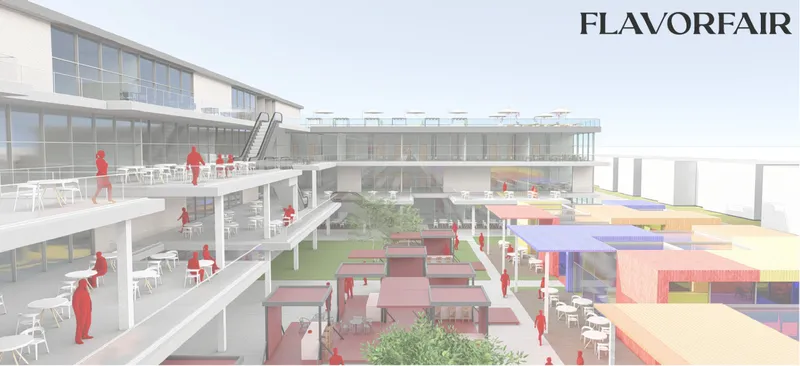
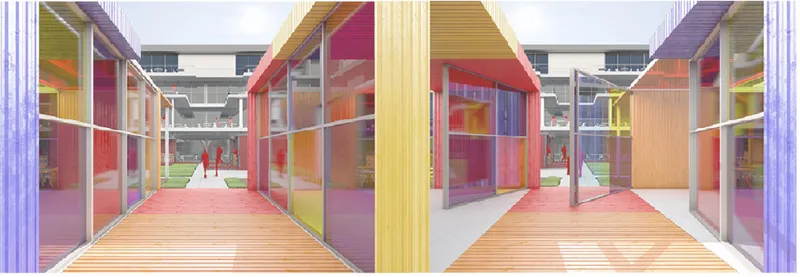
The sectional perspective reveals the project's most compelling spatial move: stacking distinct dining experiences vertically while keeping them visually and socially connected. The ground floor is given over to fast food and casual dining, with retractable fair stands populating the courtyard plaza. Upper levels house ethnic restaurants, seafood terraces, and fine dining spaces, each accessed via elevated circulation routes that free the courtyard below from pedestrian congestion. The rooftop completes the sequence with panoramic views, live music, and community events. Stepped terraces are not passive viewing platforms; they are active zones for eating, learning, and performing.
The interior corridor, with its timber decking flanked by translucent colored panels and glass openings, shows how light becomes a design material in its own right. The colored panels filter daylight into warm tones that shift throughout the day, reinforcing the sensory layering that drives the entire project. Natural ventilation paths run through these corridors, connecting the ocean-facing orientation to the courtyard core and ensuring comfort without relying heavily on mechanical systems.
Pavilions That Fold, Interlock, and Refuse to Stay Put
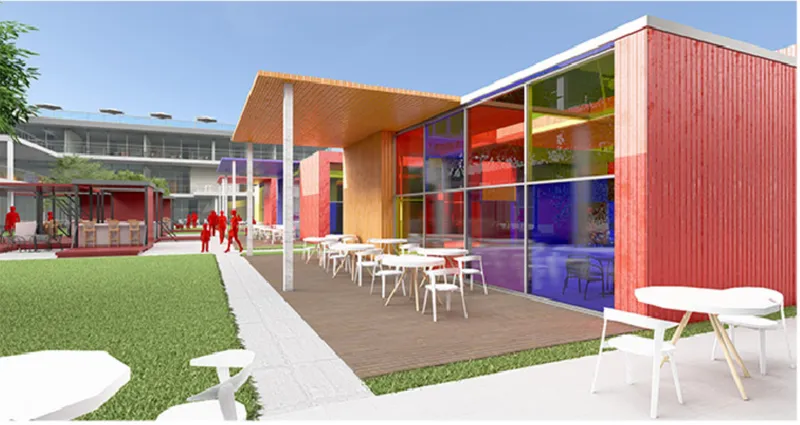
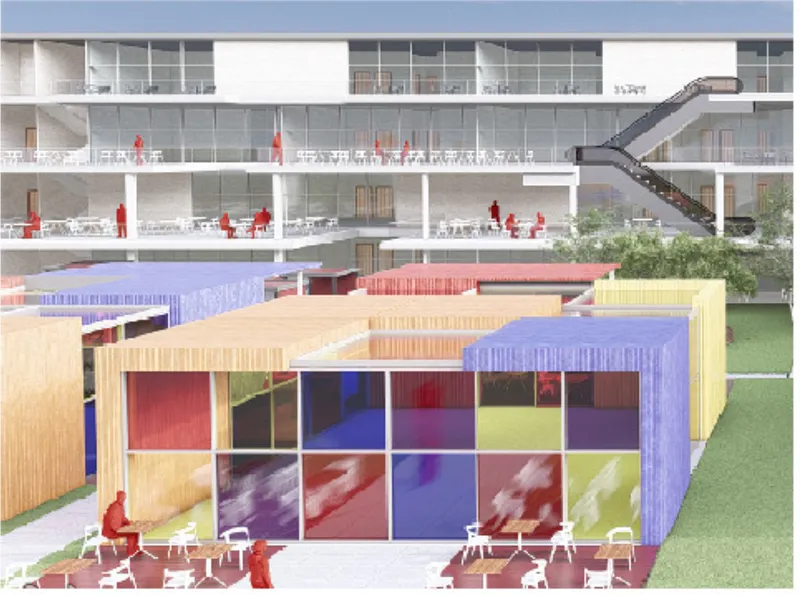
The courtyard pavilion with its corrugated cladding and yellow soffit captures the spirit of Flavorfair's modular system at its most tangible. These kiosks are not fixed. Their surfaces fold and interlock, allowing adjacent units to open up to each other for shared use during festivals or to close down into self-contained restaurants during quieter periods. The retractable fair stands that populate the courtyard can be rearranged into linear or collective combinations, accommodating everything from a weekday lunch crowd to a large-scale food festival. It is a spatial strategy rooted in adaptability, supporting small businesses and local chefs who need flexible footprints rather than permanent leases.
The sectional view through the complex reinforces this reading. Colored pavilions sit beneath the multilevel terraces like market stalls beneath a protective canopy, with trees and planted areas softening the boundaries between built form and open ground. The section makes clear that the terraces above are not separate from the courtyard life below; they are extensions of it, connected by sightlines, shared acoustics, and the constant drift of cooking aromas rising through the open structure.
An Aerial View of Organized Chaos
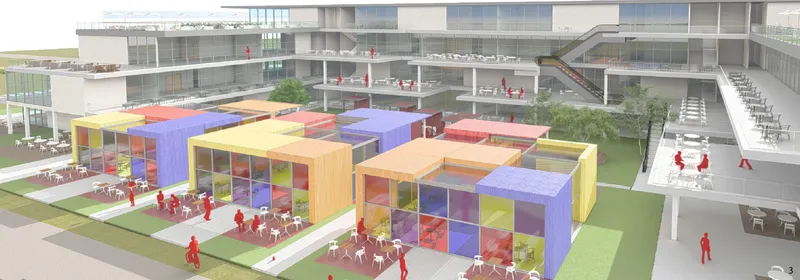
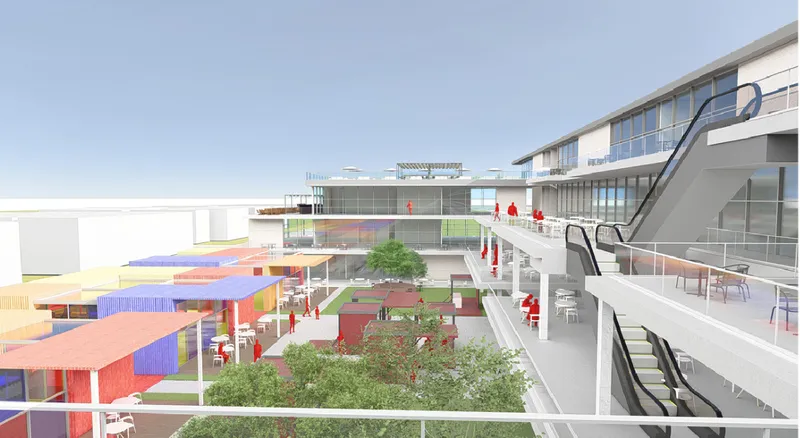
Seen from above, the clustering logic becomes legible. The colored pavilions scatter across the green courtyard in what looks informal but is carefully planned to create pockets of intimacy within a larger collective space. Surrounding buildings frame the complex without enclosing it, maintaining the permeability that is central to ÇAM's concept of a democratic courtyard where every architectural layer converges. The greenery that adorns the terraces transforms the facade into what the designer calls a "living skin," moderating microclimate while visually softening the mass of the stepped volumes.
The white walkway with its escalator provides a more grounded view of this same logic. Looking down over the planted areas and colored pavilions, visitors experience the courtyard as a landscape rather than a food court. The escalator itself signals something important about the project's ambitions: this is not a casual market but a designed sequence, a carefully choreographed journey from street level to sky. The boundary between inside and outside dissolves at every turn, replaced by a rhythm of movement that connects ocean breeze to the aroma of world cuisines, and casual browsing to deliberate exploration.
Why This Project Matters
Flavorfair takes seriously a problem that most dining complexes ignore: the tension between permanence and spontaneity. Fixed restaurants need stable infrastructure. Street food culture thrives on impermanence. ÇAM's modular system, with its retractable stands, interlocking kiosk surfaces, and transformable courtyard layouts, offers a genuine architectural response to this tension rather than a compromise. The project positions small businesses and local chefs at the center of a flexible economic platform, making the architecture itself an engine for cultural exchange rather than just a container for it.
The layered section is equally convincing. By distributing gastronomic experiences vertically and lifting circulation to upper levels, the design preserves the courtyard as a genuine public space rather than a thoroughfare. The ocean-facing orientation, cross-ventilation strategies, and planted terraces demonstrate that sensory richness and environmental performance can coexist. In a competition field focused on culinary architecture, Flavorfair stands out for treating food not merely as a programme but as a spatial principle: layered, seasonal, shared, and always in motion.
View the Full Project
About the Designers
Designer: Melek ÇAM
Enter a Design Competition on uni.xyz
uni.xyz runs architecture and design competitions year-round that reward proposals with spatial conviction and real site intelligence.
Project credits: Flavorfair by Melek ÇAM The Chef's Palette (uni.xyz).


Popular Articles
Popular articles from the community


Extended Shell: Retrofitting Kolkata's Balconies as Living Urban Thresholds
A modular retrofit system recovers the social and environmental intelligence of Kolkata's historic verandas for contemporary Park Street residents.

The Amber Palace Opera: A Geological Fiction Surfaces on Tallinn's Baltic Waterfront
Pierre Brillard reimagines a Baltic legend as a public landscape, opera house, and waterfront promenade rooted in Tallinn's coastal identity.
Opera by the Sea Estonia: Three Shells Dissolving Architecture into Tallinn's Coastline
A winning opera house proposal replaces monumental form with interconnected shells that blur the boundary between building, park and Baltic Sea.
Faces of the Soviet Avant-Garde: Turning Moscow's Street Names into an Open-Air Museum
A network of sculptural installations across a Moscow residential district transforms forgotten architect names into spatial encounters with cultural memor

Similar Reads
You might also enjoy these articles

Play: Fragments of Their World: Remembered Architecture Rebuilt as a Modular Playground for Refugee Camps
Tom Gardner abstracts domes, arches and towers from the homelands of displaced families into a kit of child-scaled play parts for camp settlements.
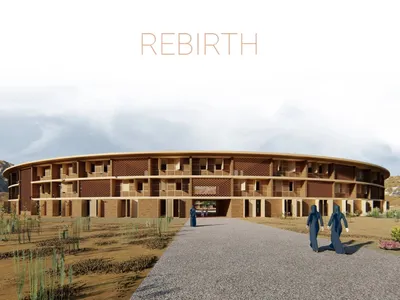
REBIRTH: A Circular Settlement Where Afghan Widows and Their Children Rebuild Life Together
A shortlisted Resile entry turns the circle into a protective ring of timber and brick, gathering homes, classrooms and gardens around a shared landscape.
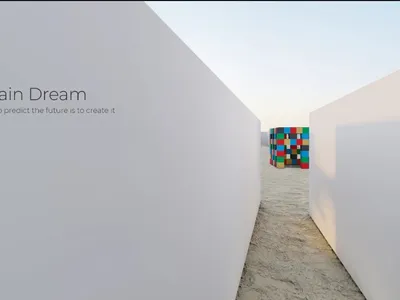
The Main Dream: A Recycled Plastic Kit That Lets Refugee Children Build Their Own Playground
Thirty-centimetre interlocking cubes that connect on three axes turn play into construction, letting children author the spaces they occupy.

Lunar Spiral: A Fibonacci-Driven Moon Settlement Rising from Shackleton Crater
Golden-spiral geometry organises buried infrastructure and orbiting habitable spheres into a lunar base designed to grow as life on the Moon expands.

Comments (0)
Please login or sign up to add comments
No comments yet. Be the first to comment!