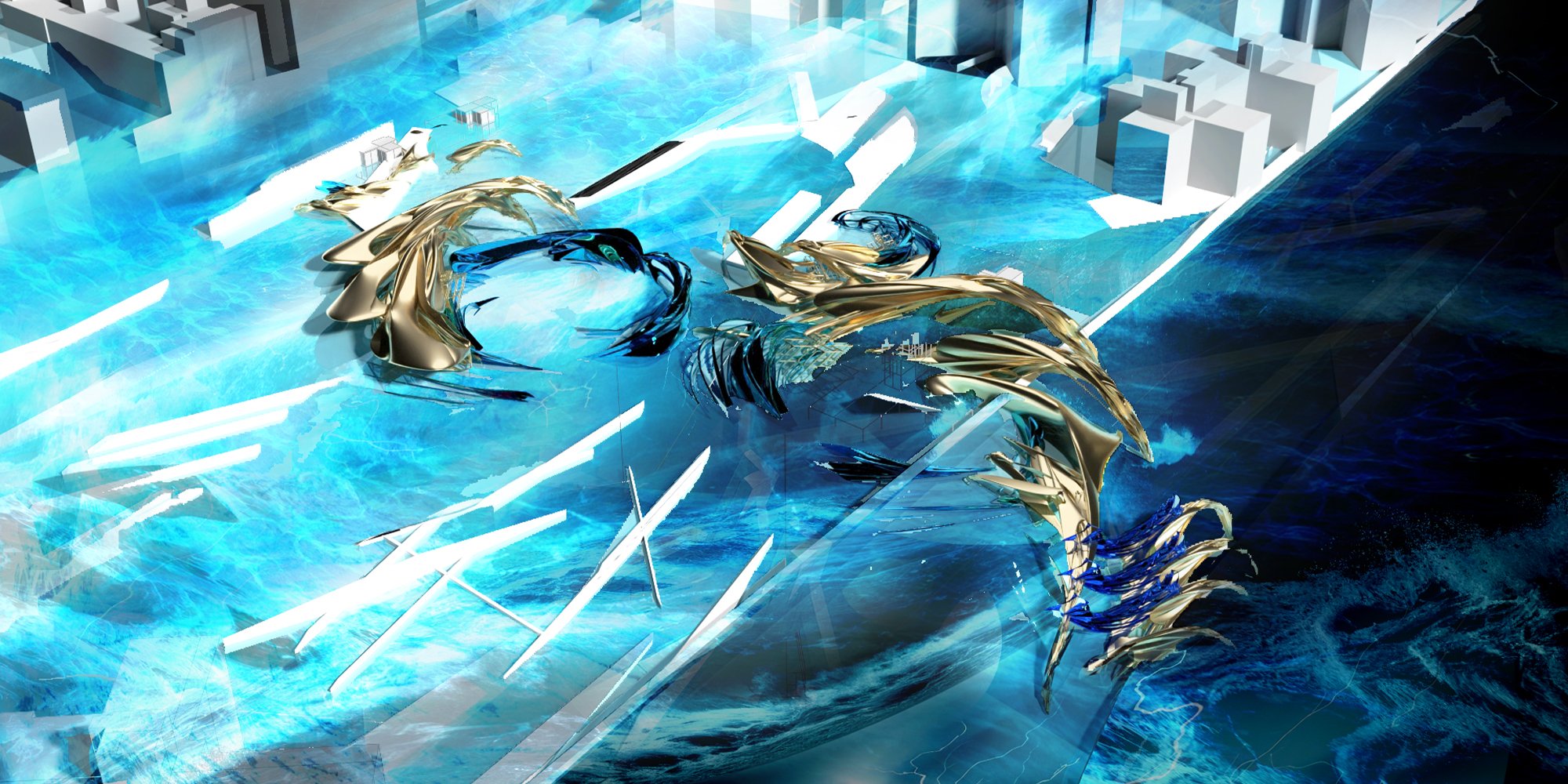
Fluid Syntax
As tides rise, ecologies shift, and storms intensify, cities must move beyond survival and embrace the ability to adapt. Fluid Syntax imagines a future where urban life is no longer static but alive.
Rather than fighting against water, the city collaborates with it, using it to shape space, community, and movement. In this vision, infrastructure is not rigid but flexible. A new Adaptive System Map organizes the city’s social, ecological, and technological systems into a living framework that continuously evolves. Change is not something to resist but something to work with, creating a city that grows stronger through adaptation. The city operates through three interconnected programs that together build a resilient, responsive environment.
The first is the HydroGrid Spine, the technological backbone of the city. This spine consists of hydroelectric channels, desalination hubs, and energy recovery systems woven into an intelligent network. Smart water systems, powered by artificial intelligence, predict and respond to environmental shifts before they happen. Instead of waiting for disasters, the city learns from patterns and acts early. Through this integration, the HydroGrid Spine creates a resilient system that redefines the relationship between the city and its water sources, turning survival into collaboration.
The second major element is The Ripple Quarters, a place where people, plants, and water coexist naturally. Amphibious housing floats and adapts with changing water levels. Rooftop gardens and floating green spaces weave throughout the neighborhood, making agriculture an everyday, visible part of urban life. Instead of resisting the natural cycles of water, the Amphibian Commons celebrates them, reinforcing community resilience through collective stewardship of food, land, and water systems.
Social connection remains at the heart of Fluid Syntax through the Liquid Commons. This network of floating bridges, performance, and communal gathering spaces ensures that even as water levels shift, the city stays connected. Public squares float alongside the tides, remaining accessible to children, elders, and people with disabilities. Liquid Commons is not just about transportation or convenience; it is about preserving social bonds and guaranteeing that the civic life of the city thrives even in the face of environmental uncertainty.
One of the most transformative aspects of Fluid Syntax is the design of its housing clusters. These clusters are not just places to live; they are self-sustaining communities where water collection and energy generation are deeply integrated. Each cluster combines amphibious residences with hydroponic gardens, shared kitchens, water harvesting units, and communal spaces, creating neighborhoods that are resilient, resourceful, and socially connected. These living clusters are the heartbeat of the city, where resilience is built through community rather than isolation. Fluid Syntax proposes a new way of living with water, not against it. Water becomes a collaborator in shaping life, not a force to be feared. Communities grow stronger by moving with change, not against it. Infrastructure becomes a living language, an ongoing conversation between people, place, and environment.