
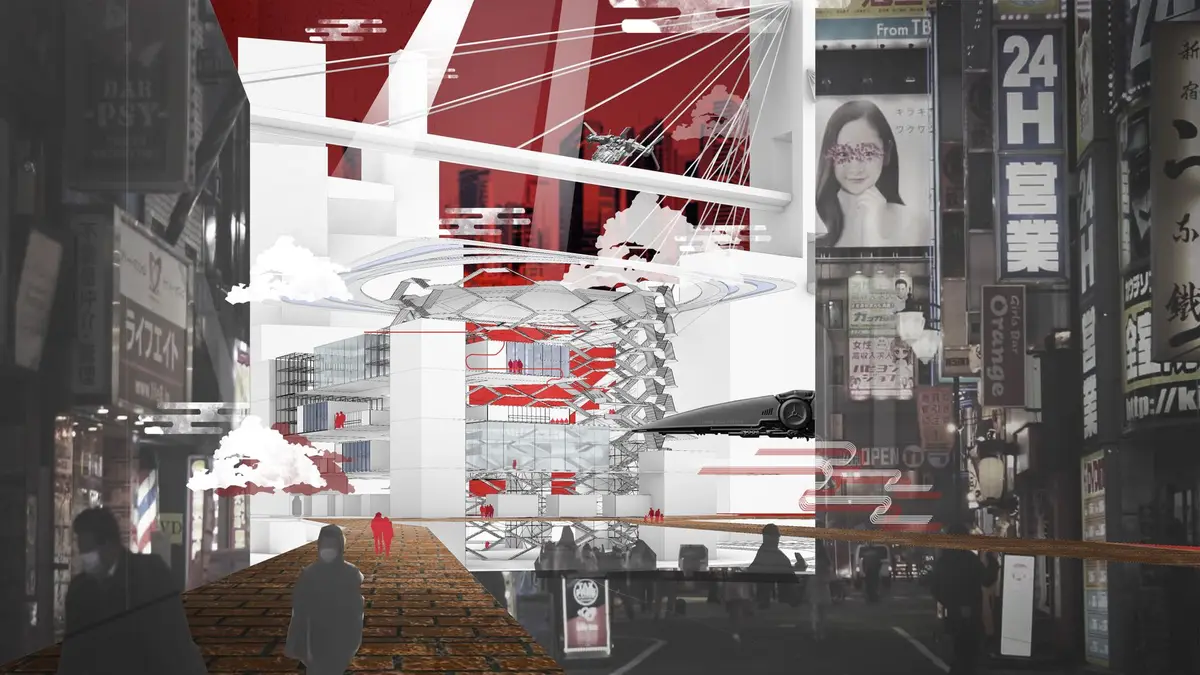
Republic of Gamers: Modular E-Sports Architecture Built Around Social Life
A shortlisted Digital Colosseum entry reimagines the gaming arena as a modular, multi-tiered urban hub for play, spectating, and connection.


What happens when you stop thinking of an e-sports arena as a stadium and start thinking of it as a piece of city? Republic of Gamers takes that question seriously, proposing a modular, vertically stacked gaming hub that absorbs into urban transportation nodes rather than sitting apart from them. Its core move is taxonomic: every activity associated with gaming, from casual spectatorship to professional competition to immersive VR play, gets its own reconfigurable "box," slotted into an octagonal framework that can grow and adapt as gaming culture itself evolves toward 2050.
The project is a shortlisted entry for The Digital Colosseum 2020, a collaboration between Hu Peiwei, 轩 杨, 佳薇 宋, and Zhu Weiqiang. Rather than designing a singular arena for professional matches, the team built their proposal around four user categories: everyday citizens integrating gaming into daily routines, AR/VR players in multiplayer competitive environments, solo players seeking individual experiences, and professional e-sports athletes. That classification drives the architecture from program to section.
An Octagonal Core With Underground Hexagonal Chambers
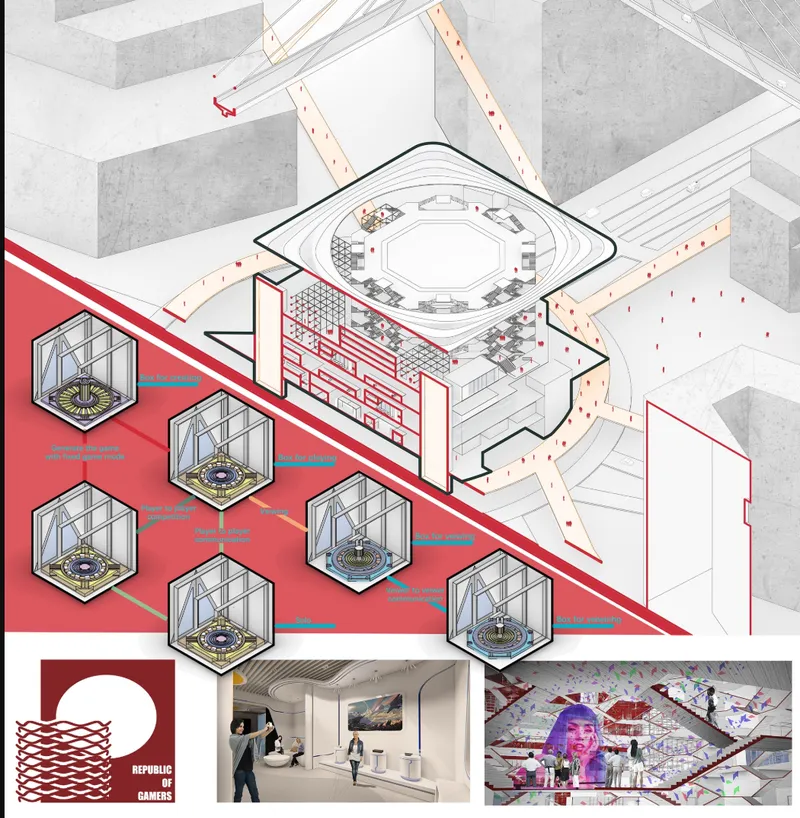
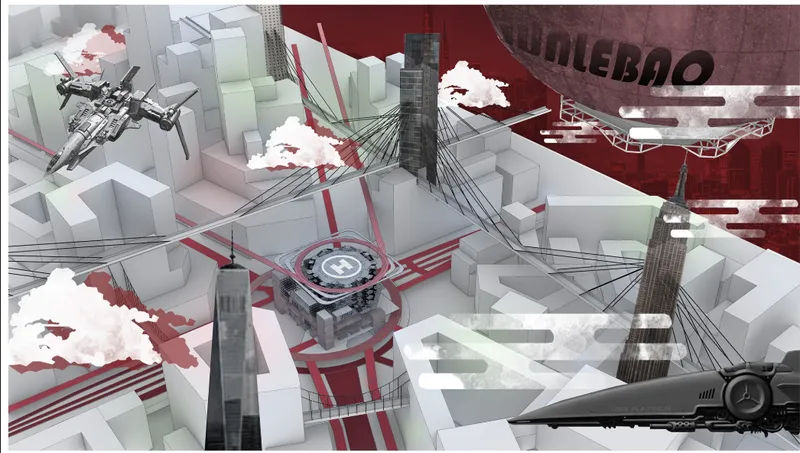
The axonometric drawing reveals the project's structural logic: an octagonal arena volume sits above a network of underground hexagonal chambers, all connected by red circulation bands that read like arterial routes through the building. These bands are not decorative; they organize vertical and horizontal movement, channeling users from the urban ground plane down into subterranean play zones or up into elevated spectator decks. The aerial rendering makes clear how deeply the structure embeds itself into its surrounding urban blocks, with red circulation paths radiating outward to link the arena to adjacent streets and transit infrastructure.
Siting the arena within a transportation hub is a deliberate strategy. The designers argue that e-sports audiences are scattered across cities, so centralizing them at existing nodes of high pedestrian traffic eliminates the need for single-purpose destination venues. The base level promotes spontaneous social interaction, pulling in passersby, while higher levels are dedicated to competition and immersive technology. It is an inversion of the typical stadium approach, where you travel to the event; here, the event meets you where you already are.
Modular Boxes: Layered Circulation Around a Central Volume
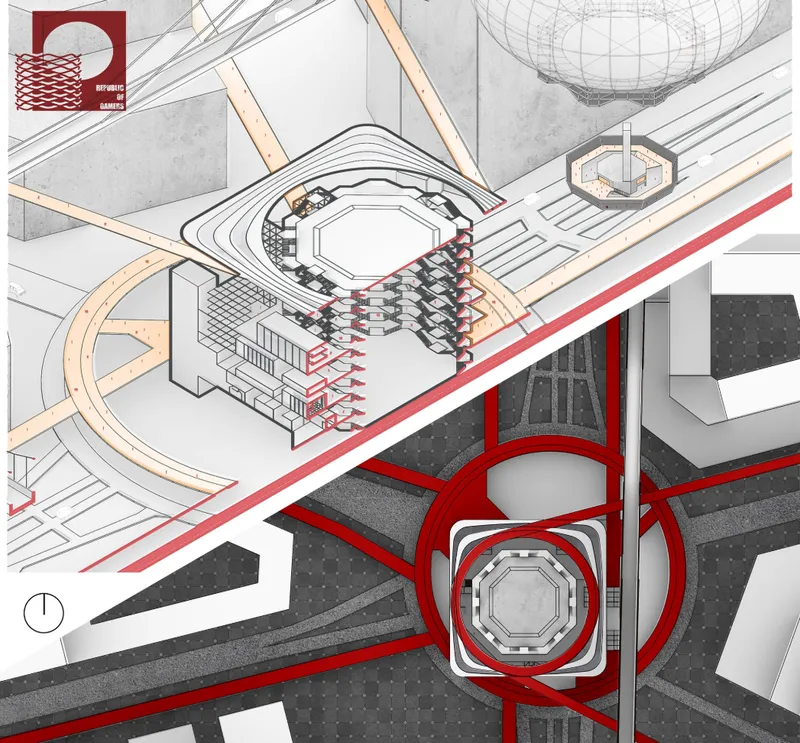
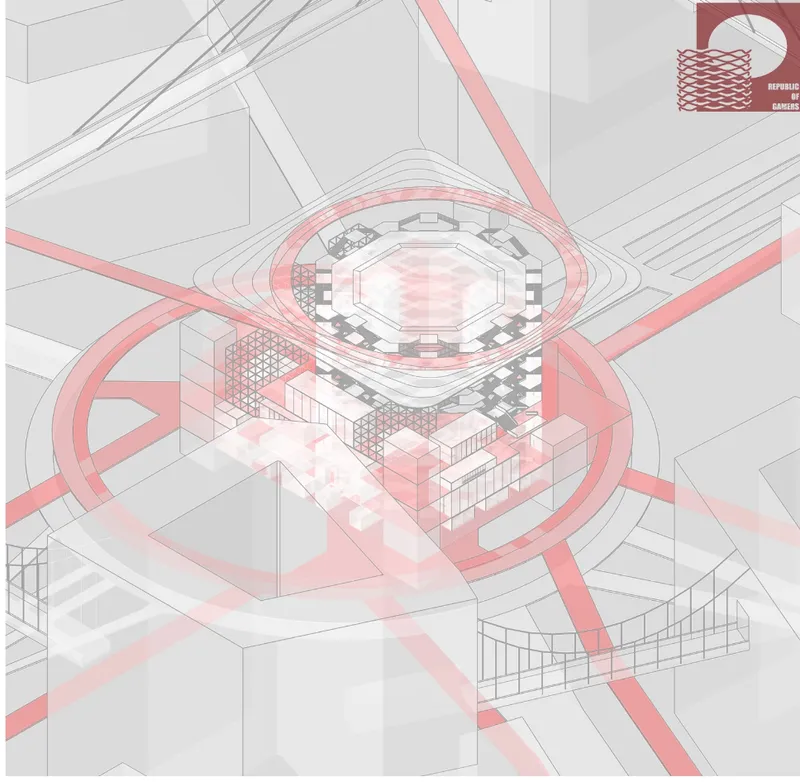
The sectional axonometric peels back the octagonal shell to expose the multilevel spaces beneath: playing zones, creative studios, viewing decks, and spectator areas stacked and interlocked within a single cohesive frame. Red structural highlights trace the load-bearing elements that also serve as wayfinding cues, collapsing structure and circulation into a single legible system. The isometric drawing then focuses on the transparent, layered circulation routes that wrap the central core, showing how visitors move through the building without ever losing visual contact with the activity around them.
The modularity here is the key architectural argument. Each functional "box," whether it houses a private competitive pod, an open-air arena, or an immersive VR installation, can be swapped, added, or reconfigured as new gaming formats and AR/VR capabilities emerge. The designers describe this as "future-proofing": the architecture does not bet on a single technology but instead creates a scaffold flexible enough to absorb whatever comes next. New blocks slot in seamlessly, which means the venue's social purpose survives even as its technological program evolves.
Timber, Blue Light, and the Interior Experience of Play
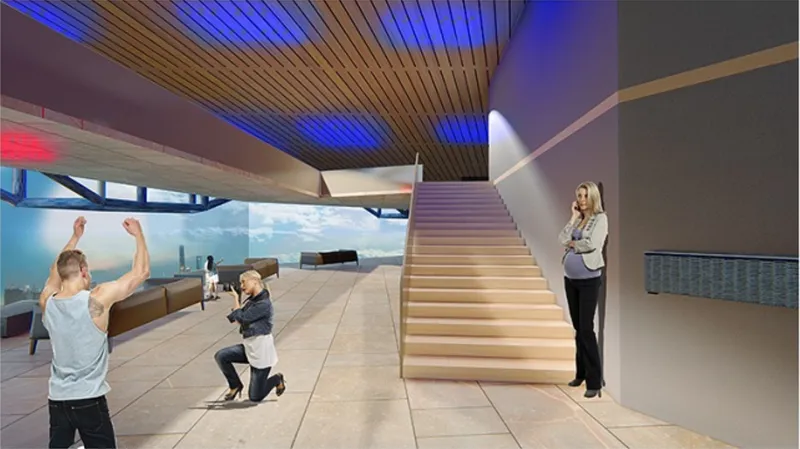
Inside, the mood shifts. A timber-slatted ceiling washed with blue uplighting creates an atmosphere that is calm and focused rather than bombastic, a welcome counterpoint to the neon overload typical of gaming venues. Figures ascend a central staircase beneath this canopy, and the material warmth of the timber grounds the space in something tactile. It is a reminder that even in a building dedicated to digital culture, the physical experience of architecture still matters: the weight of a handrail, the rhythm of slats overhead, the quality of light on skin.
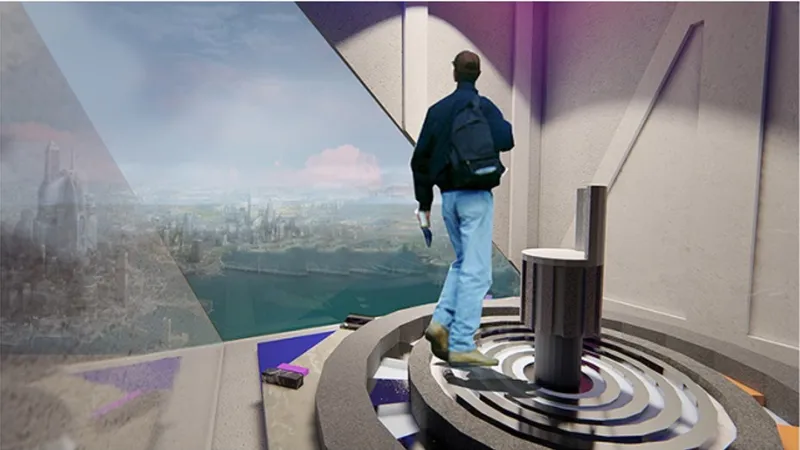
The rendering of a lone figure standing on a circular platform before a panoramic cityscape window captures the solo-play experience the designers explicitly programmed for. Not every gamer wants a crowd. By giving individual users their own contemplative spaces with commanding views, the architecture acknowledges that solitude is as valid a mode of engagement as competition. The circular platform floats in the frame like a stage for one, blurring the line between playing a game and inhabiting a scene.
Gallery Spaces That Treat Gaming as Culture
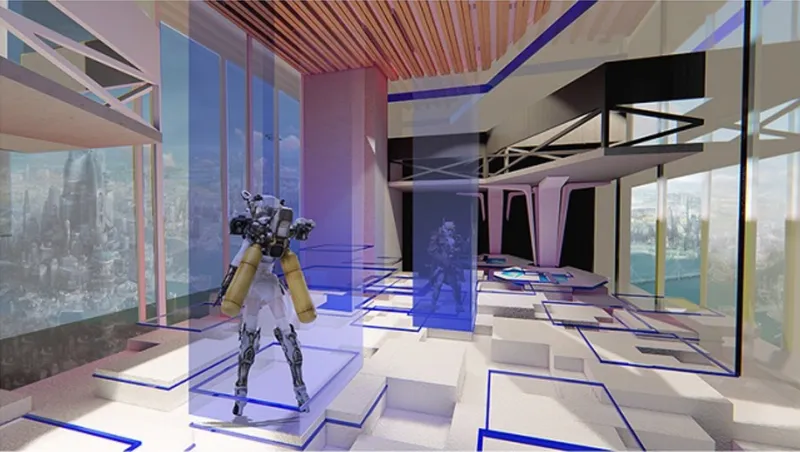
Perhaps the most telling interior is the gallery space: slatted timber ceiling again, glass platforms, and a robotic sculpture on display. This is not a lounge bolted onto an arena. It is a curated cultural environment where gaming hardware, digital art, and speculative technology are exhibited as artifacts worthy of attention. The decision to include gallery-type spaces signals the designers' broader thesis: that gaming is not merely entertainment but a cultural practice deserving the same architectural dignity afforded to art, music, and sport.
Why This Project Matters
Republic of Gamers resists the temptation to design a flashy shell around a conventional arena floor. Instead, it proposes a genuine typological experiment: a building that sorts its users by mode of engagement rather than ticket class, that grows through modular addition rather than wholesale renovation, and that plugs into existing urban infrastructure rather than demanding its own precinct. The four-user framework (everyday citizen, VR player, solo player, professional athlete) is a simple organizational tool, but it produces real spatial consequences, giving each group legible territory within a shared structure.
What resonates most is the project's conviction that social architecture and digital culture are not opposed forces. The base-level zones for spontaneous interaction, the solo platforms overlooking the city, the gallery spaces exhibiting robotic sculptures: all of these suggest that a building for gaming can also be a building for civic life. As e-sports audiences grow and gaming continues to reshape how people spend time together, architects will need frameworks exactly like this one, buildings that treat flexibility not as a buzzword but as a structural principle.
View the Full Project
About the Designers
Designers: Hu Peiwei, 轩 杨, 佳薇 宋, Zhu Weiqiang
Enter a Design Competition on uni.xyz
uni.xyz runs architecture and design competitions year-round that reward proposals with spatial conviction and real site intelligence.
Project credits: Republic of Gamers by Hu Peiwei, 轩 杨, 佳薇 宋, Zhu Weiqiang The Digital Colosseum 2020 (uni.xyz).


Popular Articles
Popular articles from the community


longwave studio Reorganizes a 112 m² Tainan Apartment Around the Daily Routines of a Family and Two Cats
In Tainan, Taiwan, birch plywood, rust-red furniture and a freestanding plaster wall link arrival, storage, work and family life in one apartment.

Juan García Correa, John González and Claudia Rueda Sink a Circular Amphitheater into a Manizales Engineering Building
On the La Nubia campus in Manizales, Colombia, the S1 Building folds labs and offices into a hillside of ramped lawns that double as a campus route.

David Macias Steps a Doorless Stone and Plaster House Down a Tropical Colombian Hillside
In the humid hills of Colombia, Threshold House replaces the front door with an open void and terraces its 850 m² down the slope instead of fighting it.

Cube Design Draws an Ecological Corridor Between Two Shenzhen Hills with the Nankai Building
Beside Shenzhen's container docks, the Nankai Building pairs stacked balconies with a climbing green screen to connect two hillsides across its height.

Similar Reads
You might also enjoy these articles

Gil Mello Arquitetura Tilts a Single Roof Toward the Waterfalls on a Plateau Above Aiuruoca, Brazil
In Aiuruoca, Minas Gerais, a 200 m² house of local labor and reclaimed poles pairs a low valley veranda with a tall mountain one.

U.GA Architects Wraps an Oval Rooftop Pool in Curved Board-Formed Concrete on Busan's Jeollidan-gil
In Busan's Jeonpo-dong, a 454 m² mixed-use block stacks a neighborhood facility, guest rooms and an oval rooftop pool inside spiraling concrete walls.

Felipe Hess Arquitetos Turns a Blind Stone Wall to the Street and Opens a Brazilian House onto a Courtyard and Canal
A canal-front house in Brazil hides behind painted stone and planting, then opens to an olive-tree courtyard, a reed-ceilinged porch and a curving pool.
David Macias Steps a Doorless Stone and Plaster House Down a Tropical Colombian Hillside
In the humid hills of Colombia, Threshold House replaces the front door with an open void and terraces its 850 m² down the slope instead of fighting it.

Explore Architecture of Tomorrow Competitions
Discover active competitions in this discipline

Challenge to reimagine the Iron Throne

Photograph architecture without architects

Illustrate the lost glory of Angkor Wat - Render Challenge

Design challenge to reuse E-waste
Comments (0)
Please login or sign up to add comments
No comments yet. Be the first to comment!