

Gate Between Past and Future: Rebuilding Aleppo's Civic Heart Through Layered Memory
A public square in war-scarred Aleppo stitches collective memory into stone, water, and indigenous planting to reconnect a fractured city with its 5,000-ye


What does it mean to rebuild a public square in a city that has been inhabited for over 5,000 years? In Aleppo, the question is not about erasing the past or freezing it in place. It is about finding a spatial language that lets ruin, remembrance, and renewal coexist. "Gate Between Past and Future" proposes exactly that: a civic landscape on the site of the former Al-Madina market district, reoriented toward the Citadel and woven with memorial surfaces, indigenous planting, and a horizontal architectural bar that acts as both cultural bridge and functional anchor.
The project is a competition entry for Memory on uni.xyz, developed by Zsolt Vasáros DLA, Vivien Bettina Tamas, Laura Penzes, and Judit Bielik. Their approach treats the site not as a blank canvas but as a vessel of collective experience, one that should continue to function as a civic anchor rather than become something unfamiliar or detached. The design team grounded every decision in deep research into the historical, political, and religious layers of the city, allowing those layers to become active drivers of architectural intent.
Stone Inscriptions as Participatory Memory

Scattered throughout the square are memorial installations: benches and low walls engraved with quotations, stories, and artworks by Syrian artists. These are not decorative afterthoughts. They transform passive surfaces into participatory encounters, where a visitor sitting on a stone block is simultaneously resting and reading a fragment of someone's history. The Arabic inscription carved into the seating wall shown here anchors the space in its linguistic and cultural context, making the act of sitting down an act of remembrance.
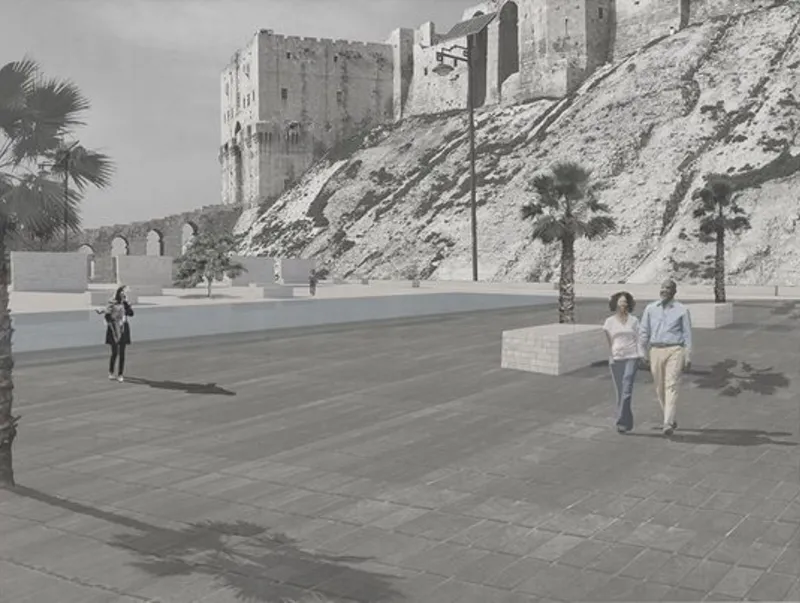
The paving and block geometry reinforce this quiet intensity. Low benches are placed at intervals across the plaza, creating a rhythm of pause points that encourages both solitary contemplation and informal gathering. Afternoon light rakes across the surface, revealing the texture of locally sourced stone and culturally resonant finishes chosen to root the space firmly in Aleppo's material identity.
A Central Axis Pointed Toward the Citadel

The square has been carefully reoriented to highlight the visual and symbolic relationship with the Citadel of Aleppo, a structure that has stood as a sentinel since antiquity. A rectangular stone masonry bench sits at the center of the composition, grounding the space and establishing a clear datum line from which the surrounding landscape unfolds. Indigenous palm trees and Pinus halepensis provide functional shading while maintaining continuity with Syria's natural environment. At the heart of the plan, a reflective water pool improves the microclimate and pays homage to traditional Arabic courtyard design, where water and reflection are recurring spatial motifs.
The Horizontal Bar: Sisha Lounge as Cultural Bridge

One of the project's defining gestures is a long, horizontal architectural bar housing a sisha lounge, café seating, and public restrooms. The element reads as minimalist and transparent, open enough to support urban connectivity while offering a sheltered zone for relaxation and informal gathering. Its low profile enhances the horizontal expanse of the square rather than competing with the Citadel's vertical mass, drawing the eye across the full breadth of the civic space. Block walls frame the covered terrace, filtering light and creating a gradient from the open plaza to a more intimate social enclosure.
The design team conceived this bar not as a standalone building but as an extension of the ground plane, a thickened edge condition that mediates between public spectacle and private comfort. Cafés, restaurants, and traditional sisha bars encourage the kind of communal relaxation that defined Aleppo's historic market culture, now given a contemporary architectural frame.
Ruin as Context, Not Obstacle
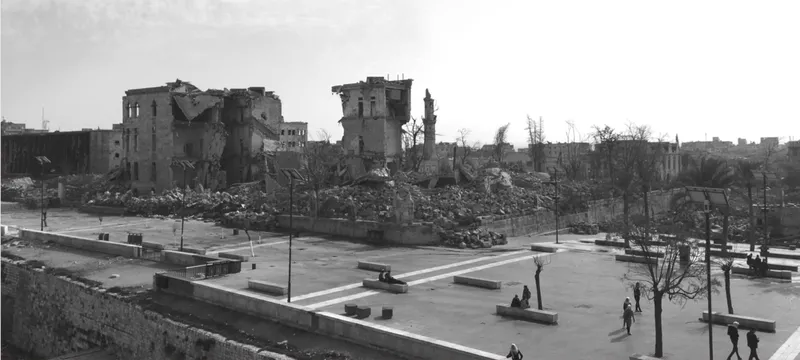
Perhaps the most striking image in the series shows the new plaza sitting directly beside the rubble remains of damaged buildings. The designers do not hide this adjacency. Instead, they let it become a spatial argument: the clean geometry of the stone benches and paving gains its meaning precisely because it exists next to destruction. The former corridors of a now-ruined government building are reimagined as pedestrian walkways, constructed with three distinct materials that each reference a different facet of the city's architectural identity.
This refusal to sanitize the site is what gives the project its emotional weight. The square is not a monument to what Aleppo was, nor a utopian vision of what it might become. It is a threshold between those two states, a gate, as the title suggests, where visitors walk through the evidence of fracture toward something continuous and shared.
Why This Project Matters
Post-conflict reconstruction too often defaults to either nostalgic replication or total erasure. "Gate Between Past and Future" avoids both traps by treating memory as a material, something that can be carved into stone, reflected in water, and sheltered beneath a roof. The design team's insistence on locally sourced materials, indigenous planting, and programmatic continuity with the historic market function shows a disciplined understanding of what it means to design for a place with 5,000 years of accumulated identity.
What distinguishes the project is its operational clarity. The square is conceived as a dynamic civic landscape that adapts to daily use and extraordinary public events alike. Information kiosks, cultural signage, shaded alcoves, and memorial surfaces coexist without hierarchy, creating a space where remembrance and everyday life are not separate activities but aspects of the same experience. For Aleppo, that integration is not a design luxury. It is a necessity.
View the Full Project
About the Designers
Designers: Zsolt Vasáros DLA, Vivien Bettina Tamas, Laura Penzes, Judit Bielik
Enter a Design Competition on uni.xyz
uni.xyz runs architecture and design competitions year-round that reward proposals with spatial conviction and real site intelligence.
Project credits: Gate between Past and Future by Zsolt Vasáros DLA, Vivien Bettina Tamas, Laura Penzes, Judit Bielik Memory (uni.xyz).


Popular Articles
Popular articles from the community


Jaramillo Van Sluys Arquitectura and Urbanismo Turn a Demolished Registry Lot in Quito into an Orchard Plaza
In Quito's Centro Histórico, a 2,800 m² plaza exposes the San Agustín convent wall and redraws its lost Augustinian orchard in volcanic stone.

David Macias Steps a Doorless Stone and Plaster House Down a Tropical Colombian Hillside
In the humid hills of Colombia, Threshold House replaces the front door with an open void and terraces its 850 m² down the slope instead of fighting it.

LT2A and OPEN Architectes Thread a Brick and Glass High School Through a Wooded Belgian Campus
In Braine-l'Alleud, a 3,000 m² wing for Collège Cardinal Mercier pairs pale brick with a glazed colonnade, deferring to a small chapel and a dense wood.

Juan García Correa, John González and Claudia Rueda Sink a Circular Amphitheater into a Manizales Engineering Building
On the La Nubia campus in Manizales, Colombia, the S1 Building folds labs and offices into a hillside of ramped lawns that double as a campus route.

Similar Reads
You might also enjoy these articles


Vereda Arquitetos Renovates a 40-Square-Meter Apartment Inside Niemeyer's Copan Building
A compact unit in São Paulo's most iconic residential tower gets a material overhaul that pairs exposed concrete with bold blue Formica.

Shakur's House: Exposed Brick as an Interior Organiser in a 168 m² Mashhad Residence
Brick moves indoors in this Mashhad residence, where masonry walls, glass partitions and teal planes sequence a compact home without closing it off.

Day and Night Park: A Time-Based Urban Newsstand in Beijing
A temporary urban newsstand in Beijing blending travel, light, and reading through poetic colors, compact form, and community-focused design.

Modernist Patio Renovation in El Masnou, Barcelona by Oliver Segura Arquitectura + Cebrià Arquitectura
Modernist patio renovation blending tradition and innovation with a movable pool, leveled floors, and Catalan materials in El Masnou.


Comments (0)
Please login or sign up to add comments
No comments yet. Be the first to comment!