
HABITAT
Student Housing. Container City

What was the concept behind the project?
Architecture today faces many different challenges. Sustainability is a priority. Climate change is one of the most interesting and pressing challenges for society currently and, of course, for architecture. Other challenges include limited availability of land a growing population. As our cities continue to grow, the impacts of overpopulation are becoming increasingly severe, to both quality of life and environment. Overpopulation generates lack of available land to build, and the price is unaffordable. Architecture must face this challenge creating new ways to build.
The design of HABITAT student housing uses the opportunity to overcome these challenges by creating an affordable, modular and eco-friendly project, without ignoring living quality and spatial organization.
The use of shipping containers is appealing because, it recycles existing materials and reduces waste. Other advantages of this material include short construction time and predictable pricing.
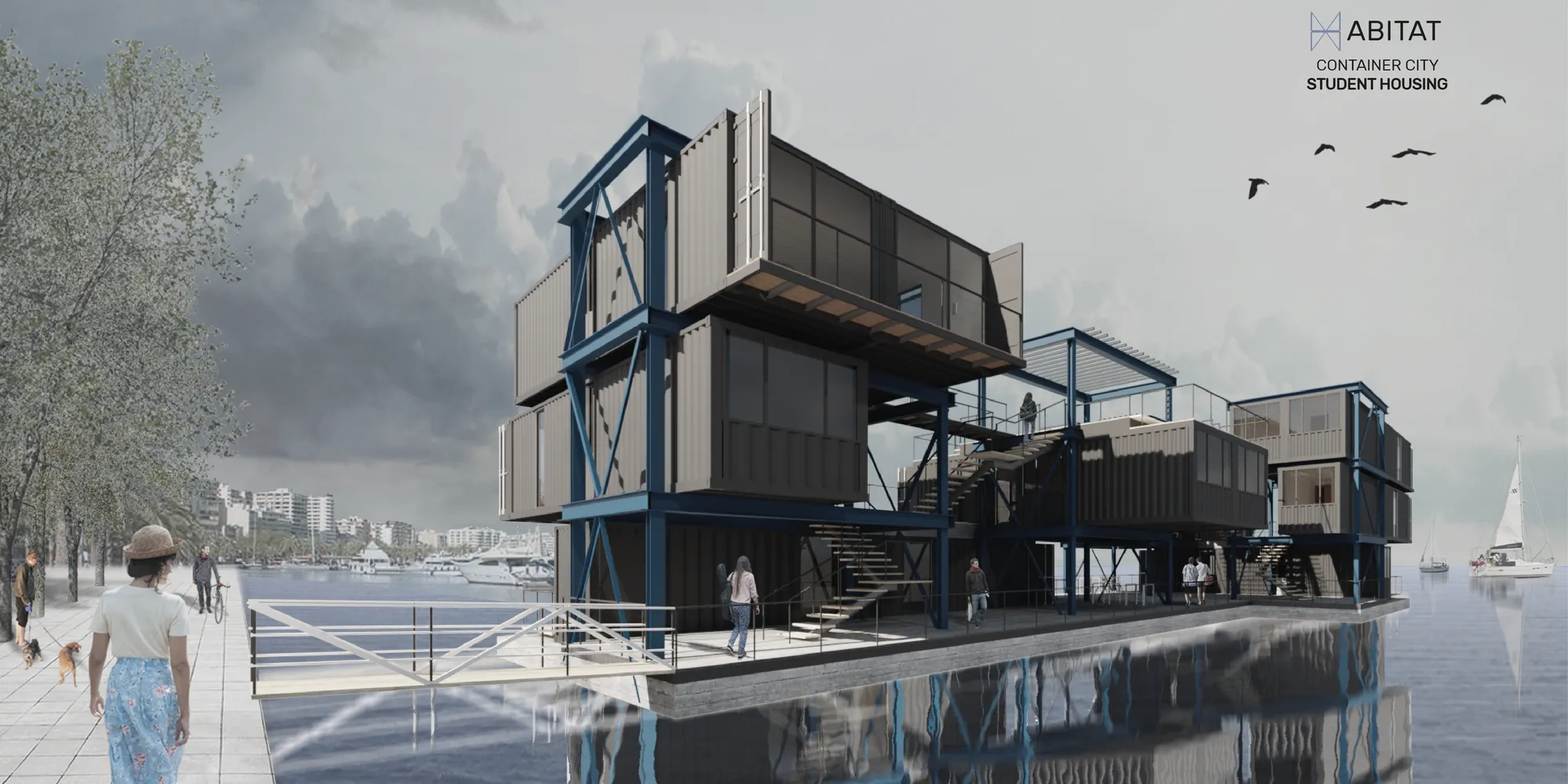
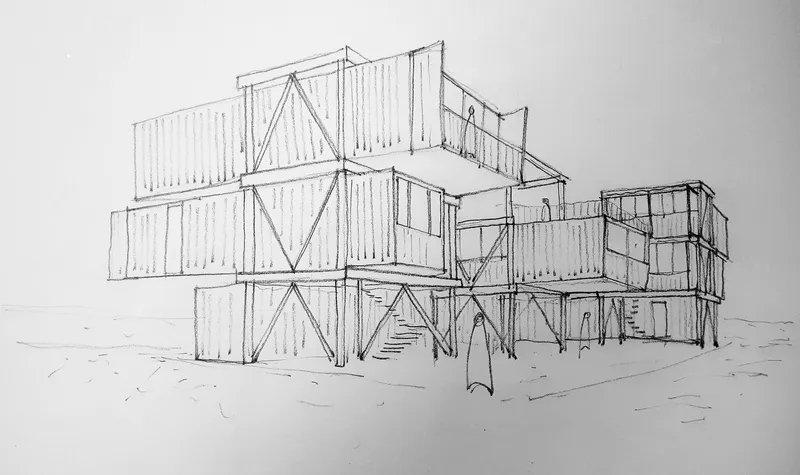
HABITAT is a student housing project that uses fifteen, 40-foot shipping containers, organized over three levels. The shipping container dimensions provide the initial measurements. The proposal is based on a repeated frame system creating a grid. The frame is formed by individual towers, which are located in groups of two. Two different configurations are used within these groups of towers, one of them rotated 90 degrees with respect the other.
Vertical and horizontal axes define the frame, holding each shipping containers and giving the appearance of being suspended in mid-air. This framework generates space both horizontally and vertically, for example, by the vertical communications, provided by the staircases.
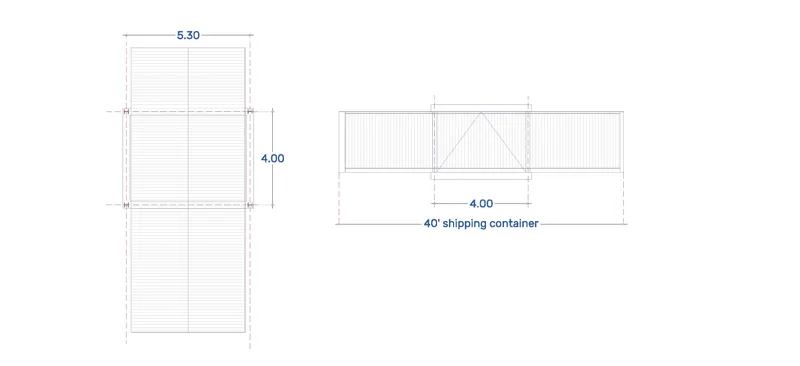
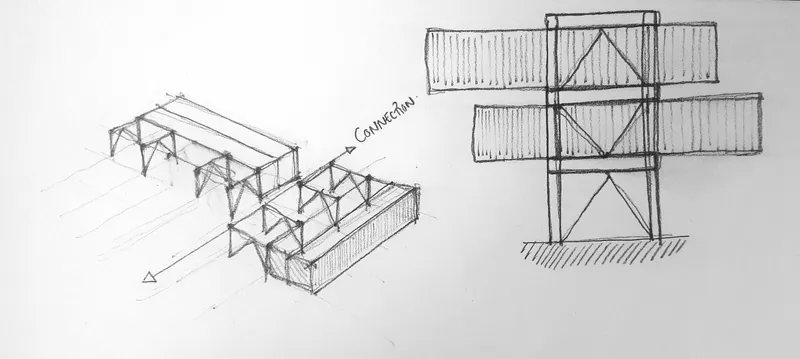
The frame is one third of the length of the shipping container and 5 meters width, it can hold two containers within it. They are bound together, we cannot think about the frame without containers and vice versa.
This grid creates a modular proposal, which can be expanded several times creating different communities. The student housing would also be able to extend in height by repeating the framed system.
What was the intent behind the organization of elements across various levels?
The intent was to configure units to live in. During the process, many different models and organizations were trialled before arriving at the final outcome. Shipping containers provide the opportunity for a modular design, so it is important to retain the modular idea, without generating multiple dwelling typologies and keeping only the essentials.
Therefore, there are 4 typologies, each with different container assembly. Their organisation influenced by accessibility and the design of the common areas. On the ground level, the two first typologies are demonstrated. A ground level location is essential to provide important access for those with physical limitations. The other ground floor typology contains technical rooms.
The remaining two typologies are distributed over first and second levels. One typology is generated by two containers and the other by only one, this final type is configured to provide space for the vertical communication.
Which methods of design investigation?
The first method was to identify different ways to display the container and design diverse dwelling, with the optimal assembly. It is important to always focusing on space efficiency, with an effective utilization of inside and outside spaces. Following a period of detailed research, the dwelling typologies were designed to provide homes to as many individuals as possible, whilst at the same time creating spacious shared spaces with comfortable private rooms.
Provision of natural light is another important factor in the design. Large windows bring natural light into the dwellings, at the same time they provide continuous views of the water and surrounding area.
Finally, the HABITAT proposal will make it possible to provide homes to 19 people, who will be living closely, as family, sharing common areas. Outside space is similarly designed to be a space to share with others. Different level between pavements is used to build the urban furniture and to generate diverse space. The relation between social interactions and the physical characteristics of the common areas has an important value in the proposal. Including both inside and outside space the footprint project is around 240 m2.
What/How were the materials chosen?
It is important to keep an industrial look, in this way containers have a blackened finish, the frame blue steel finish and a wooden flooring is installed on common areas.
HABITAT emphasises sustainability and is an eco-friendly proposal, limiting the environmental impact of buildings by implementing energy efficiency and using sustainable building materials. A thick layer of insulation is used around walls, floors and ceilings to maximise this energy efficiency. Walls are painted bright white with wooden flooring in dwellings to maximize the spacious appearance. Large triple-glazed windows are located around container, allowing natural light to come in.
What is the expansion plan of the project?
HABITAT was conceived as a floating student housing, to provide a solution to limited land availability and also has the advantage of providing safe housing in areas prone to flooding risks. As a modular project, it can be replicated across different conditions and cities around the world.
This grid creates a modular proposal, which can be expanded several times creating different communities. By repeating the frame, the student housing would also be able to extend in height.
Sustainability issue
As mentioned previously, the proposal was conceived as an eco-friendly project. Different strategies have been included to reduce the consumption of natural resources, energy, water, and materials in general, for example thick layer of insulation and triple-glazed windows.
Natural light is maximised to reduce energy requirements. The proposal has incorporated excellent natural ventilation, an important aspect of building design highlighted by the recent COVID pandemic. High quality natural ventilation is an essential feature of building design to ensure the good health of its occupants, particularly in congregate settings, an unforgettable lesson from recent history.
In addition, photovoltaic panels are installed on the roof, they can generate electricity and hot water. In total, 40 solar panels are integrated into the roof, but are also not visible from any point. The collection of rainwater on terraces for re-use it is another strategy, which has been implemented on the proposal.
In summary the HABITAT proposal is an aesthetically appealing, affordable, sustainable modular style housing proposal that provides a healthy community living space for many individuals including those with accessibility needs on small footprint of land. The concept could be used in many different settings and would be a positive addition to our living spaces.


Popular Articles
Popular articles from the community


Lunar Spiral: Space Architecture Shaped by the Mathematics of the Universe
Lunar Spiral reimagines space architecture through Fibonacci geometry, lunar regolith, levitating habitats, and self-sustaining Moon living.

The Musturak Paradise: Senior Living Architecture for a Connected Future in Temara, Morocco
The Musturak Paradise reimagines senior living architecture in Temara via private homes, social spaces, culture, community, and shared care.

Hill & Cross Opera: Sculptural Opera House Architecture Shaped by Tallinn’s Landscape and Identity
Hill & Cross Opera reimagines opera house architecture in Tallinn through its sculptural hill, civic plaza, glass wave and a luminous cross.

The Ocean Hive: Sustainable Architecture for a Self-Sufficient Civilization at Sea
The Ocean Hive imagines sustainable architecture at sea, where modular habitats, algae, wave power and ocean waste sustain a growing colony.

Similar Reads
You might also enjoy these articles

The Rhythm of Seasons
A Farmers' Market Connecting Nature and the City

More Than a Building-Designing a Living System
More Than a Building-Designing a Living System
Base Beyond
DESERT COMPOUND ARID: TOURISM OF ABSENCE AND ABUNDANCE



Comments (0)
Please login or sign up to add comments
No comments yet. Be the first to comment!