

CF Møller Wraps a 30,000 Square Meter Psychiatric Clinic Around Pine Forest in Tampere
A six-fingered plan of brick and timber creates a new benchmark for healing architecture on the edge of a Finnish hospital campus.


Psychiatric facilities have long been the forgotten typology of healthcare architecture. Hospitals get gleaming atriums, cancer centers get donor-funded gardens, but mental health wards tend to inherit leftover wings and fluorescent corridors. The Tampere Psychiatric Clinic, completed in late 2023 by CF Møller in collaboration with Finnish firm ARCO Architecture Company, refuses that inheritance entirely. Sited on the outer edge of the Tampere University Hospital campus where the grounds dissolve into Finnish pine forest, the 30,000 square meter complex delivers 182 single rooms across thirteen wards, all wrapped into a plan shaped like a six-fingered hand radiating from a shared courtyard. It is one of the largest purpose-built psychiatric facilities in the Nordic countries, and it treats architecture itself as a clinical tool.
What makes the project genuinely significant is the precision with which it calibrates privacy, community, and access to nature across a gradient of psychiatric need. Wards range from emergency and forensic psychiatry to outpatient and mood disorder units, yet the building reads as a single, coherent piece of landscape architecture rather than a collection of specialized lockboxes. The material vocabulary of brick, ceramic, and timber draws directly from Tampere's industrial heritage, a city historically known as the "Manchester of the North." Furniture salvaged from the previous Pitkäniemi clinic adds a layer of cultural continuity that no specification sheet could manufacture. Every design decision points toward the same argument: that the spatial conditions of recovery matter as much as the pharmacological ones.
A Plan That Follows the Forest
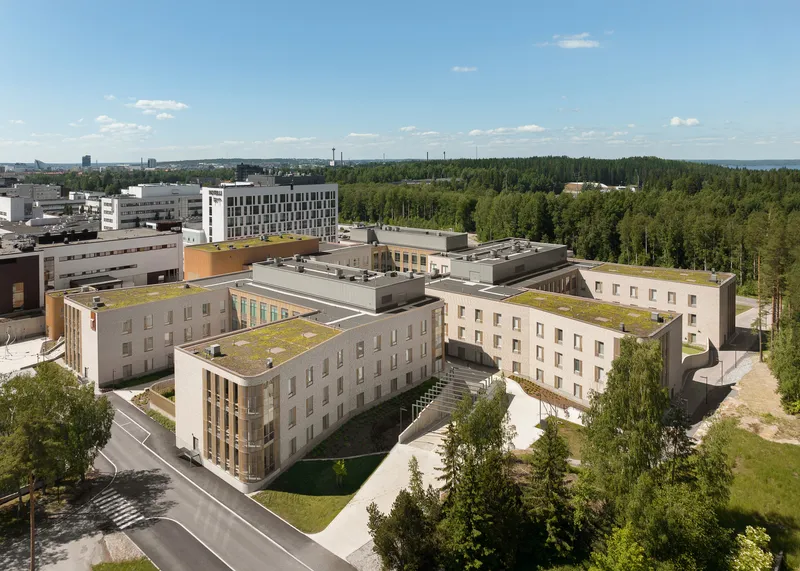
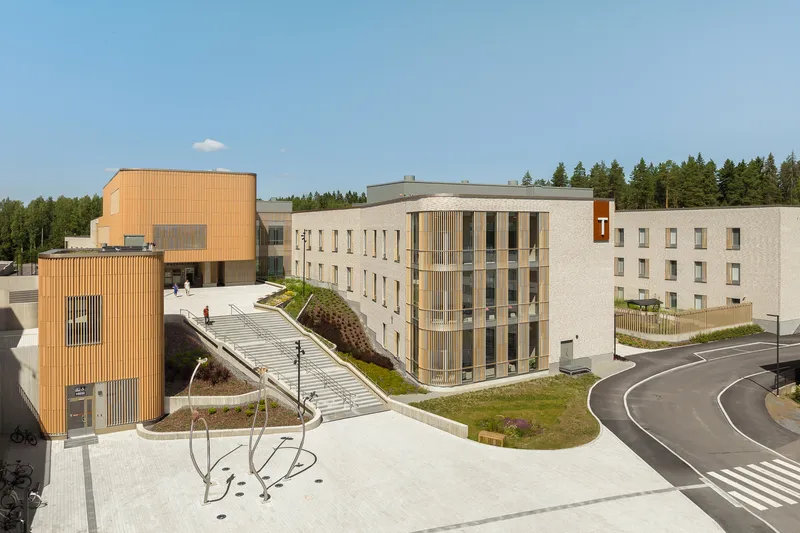
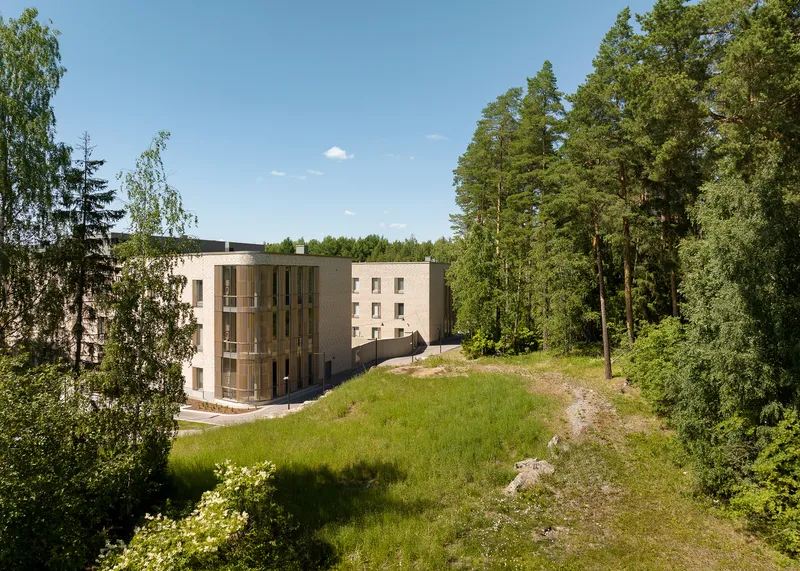
From the air, the clinic's logic is immediately legible. Three U-shaped ward buildings arc around a central courtyard, their fingers reaching into the surrounding pine canopy like the roots of a tree seeking water. The placement is deliberate: by hugging the outer edge of the hospital campus, the complex faces outward toward nature rather than inward toward institutional infrastructure. Patient rooms line the outer perimeter, maximizing forest views, while administrative and staff cores occupy the shared spines between paired departments. The result is a building that gives its most valuable real estate to the people who need it most.
Green roofs soften the roofline from above, and the restrained three-story height keeps the massing below the treeline. The buildings follow existing topography rather than fighting it, stepping down the grassy hillside so that the architecture reads as a continuation of the landscape rather than an imposition upon it. This is not decorative sustainability. It is a spatial strategy rooted in evidence-based design: the principle that proximity to nature measurably accelerates psychiatric recovery.
Brick and Timber at the Forest Edge
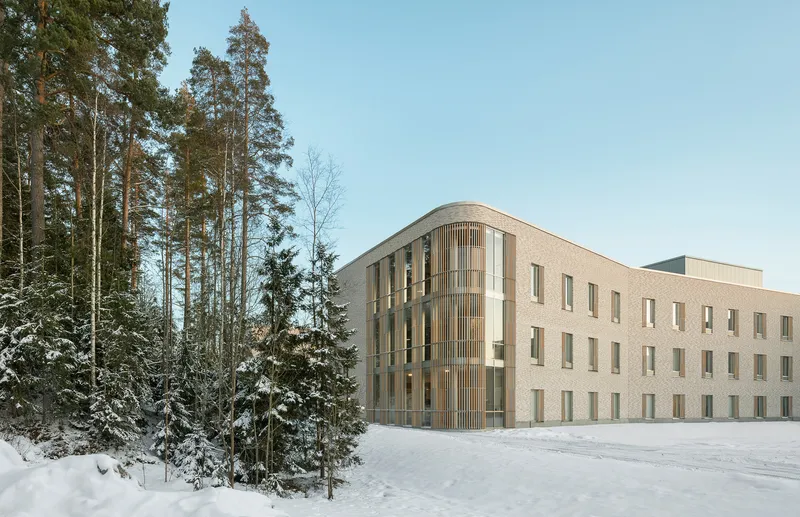
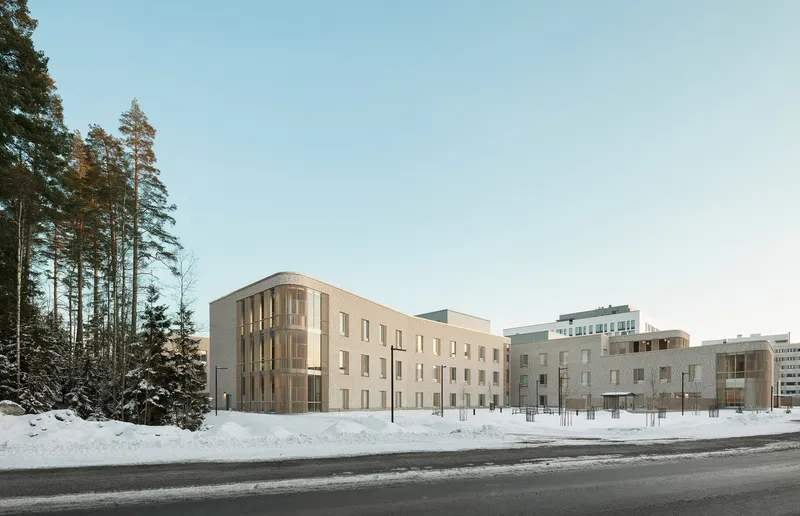
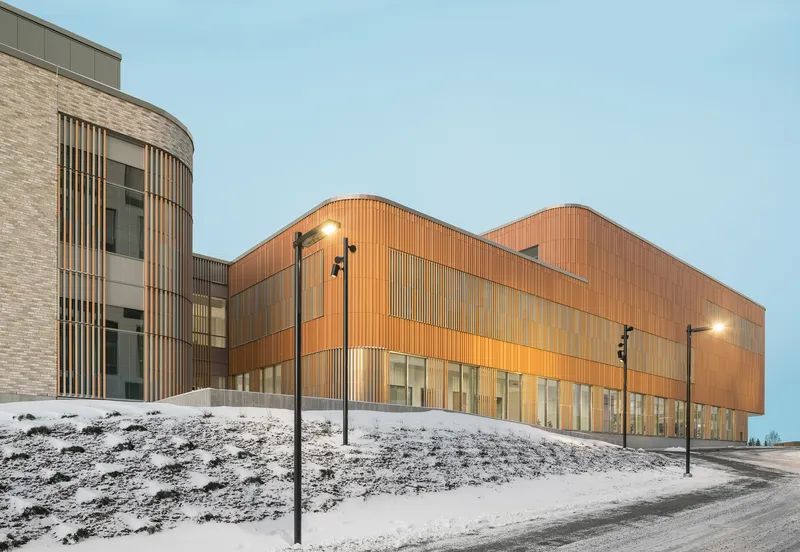
The material palette is carefully limited and deliberately regional. Cream-colored brick gives the facades a solid, grounded presence that echoes Tampere's industrial buildings, while vertical timber screening introduces warmth, rhythm, and a layer of solar protection. The timber brise soleil does triple duty: filtering daylight, providing privacy for patient rooms, and breaking down the visual mass of a very large building into a texture that feels residential rather than institutional.
In winter, when fresh snow settles against the brick and the pine branches frame the facades, the clinic looks almost domestic. That effect is intentional. Psychiatric patients are not visitors; they live here, sometimes for extended periods. The architecture needs to communicate safety and normalcy, not authority. The punched windows, human-scaled proportions, and varied cladding rhythms all contribute to a reading of the building as a place of dwelling rather than confinement.
The Courtyard as Therapeutic Core
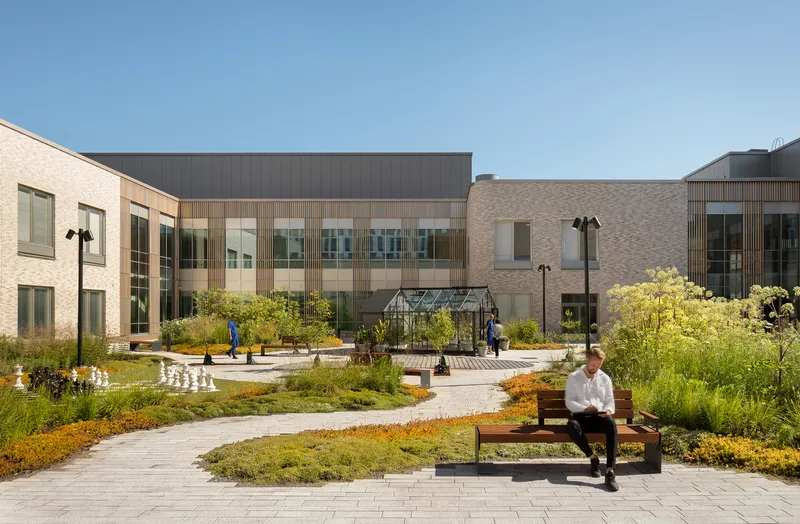
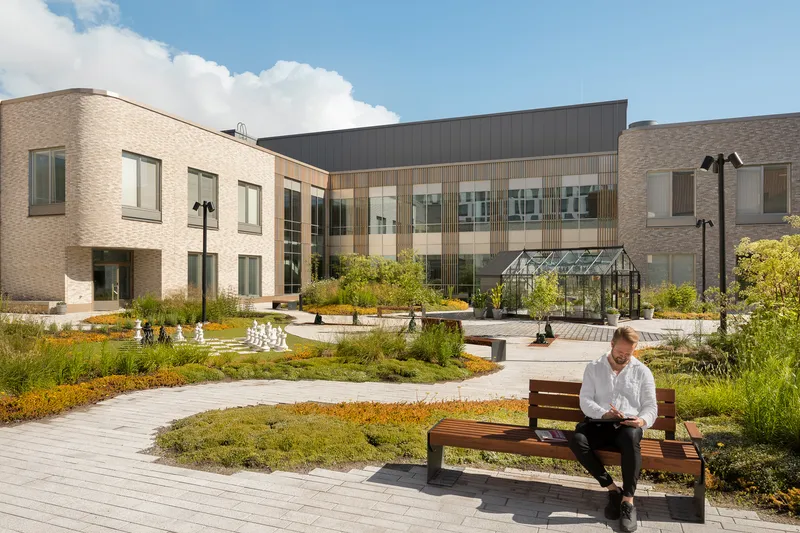
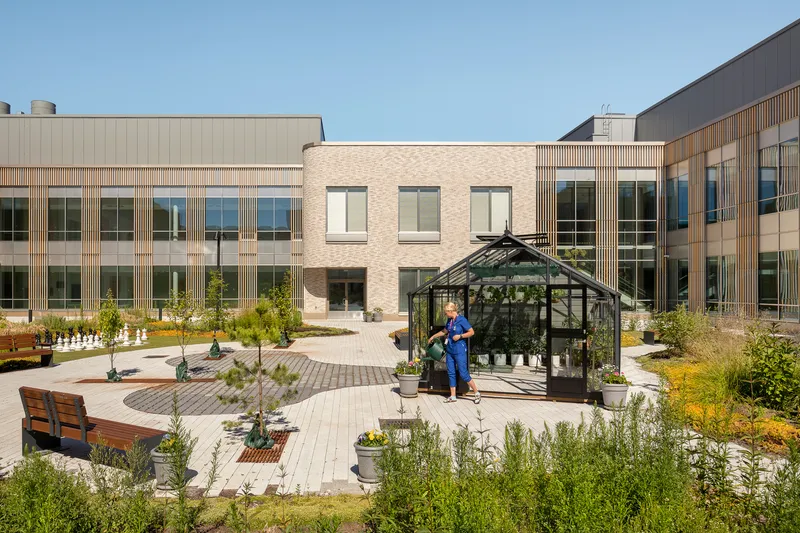
At the heart of the six-fingered plan sits an enclosed courtyard garden that functions as the social and therapeutic nucleus of the entire complex. Planted beds, paver paths, timber benches, and a small glass greenhouse pavilion create a landscape that is simultaneously protected and generous. The courtyard is visible from corridors, common rooms, and the mezzanine lobby, ensuring that nature is a constant backdrop even when patients remain indoors.
The enclosure is not a compromise: it is a design requirement. In psychiatric care, outdoor spaces must be secure without feeling punitive. The U-shaped wings create a natural perimeter, and the varied planting, level changes, and seating options ensure the courtyard supports multiple modes of use, from group activity to solitary reflection. An internal therapy walk wraps around this central space, connecting all thirteen wards in a circuit that encourages movement and orientation without the disorientation of identical hospital corridors.
Interiors That Treat Color and Light as Medicine
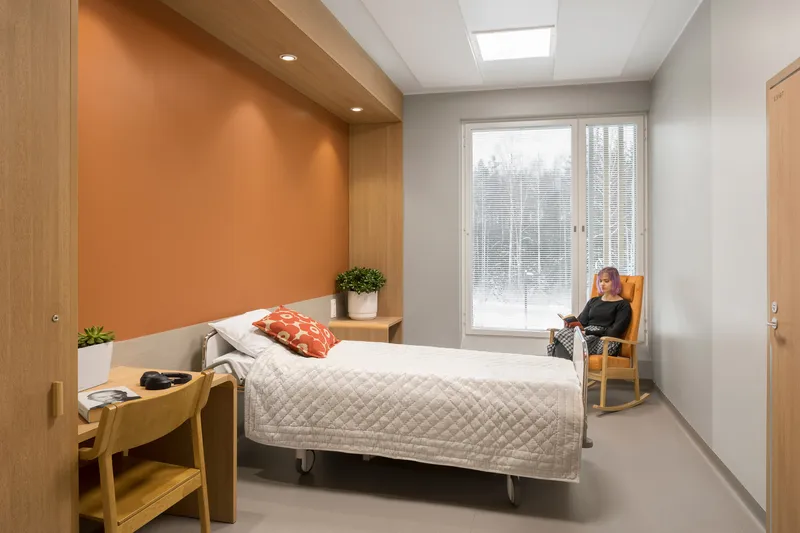
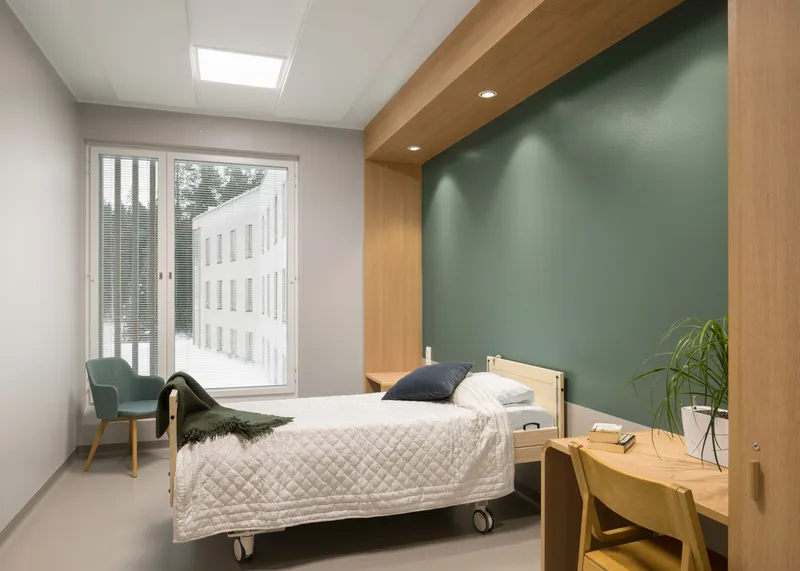
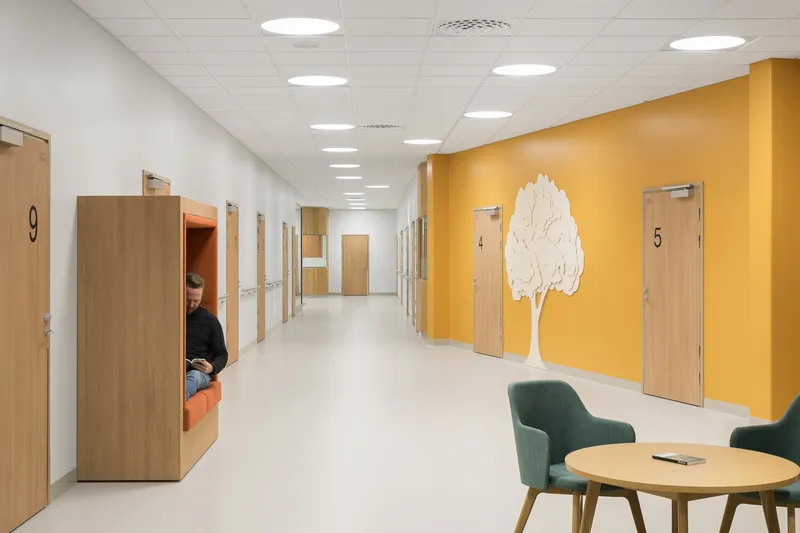
Step inside a patient room and the institutional signifiers vanish. Timber-framed bulkheads, accent walls in warm orange or forest green, and generous windows with deep sills transform what could be a clinical cell into something closer to a modest hotel room. Each room is single-occupancy, reinforcing dignity and personal control, two factors that psychiatric research consistently identifies as accelerators of recovery. The color strategy is not arbitrary: warm yellows and oranges appear in ward corridors, greens in rooms overlooking the garden wings, and neutral timber tones in shared zones. These shifts help patients read the building intuitively and maintain spatial orientation.
Corridor details like the white tree relief on a yellow wall and the forest mural flanking a timber-framed doorway are subtle but purposeful wayfinding devices. They replace the numbered signage and color-coded floor strips of conventional hospitals with imagery rooted in the surrounding landscape. Round ceiling lights and recessed cove lighting eliminate the harsh overhead fluorescence that plagues most psychiatric wards. Every detail communicates the same message: you are in a place designed for your wellbeing, not for administrative convenience.
Shared Spaces That Encourage Presence
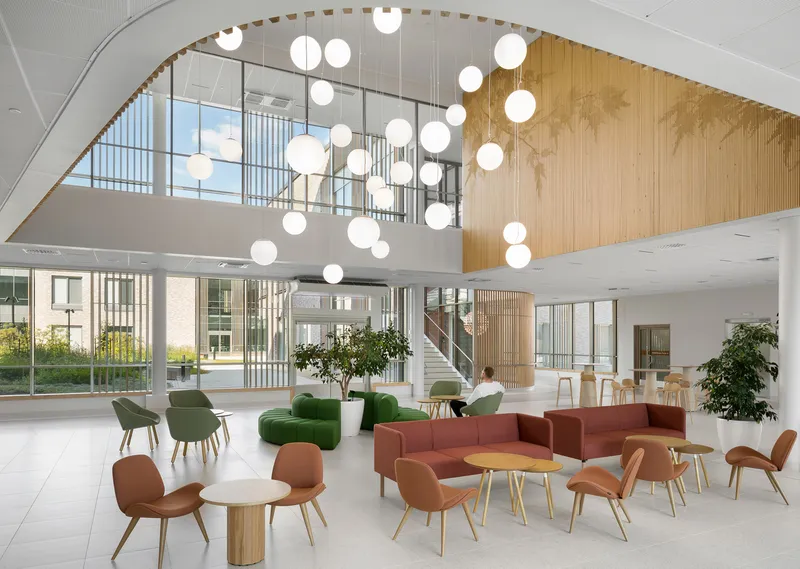
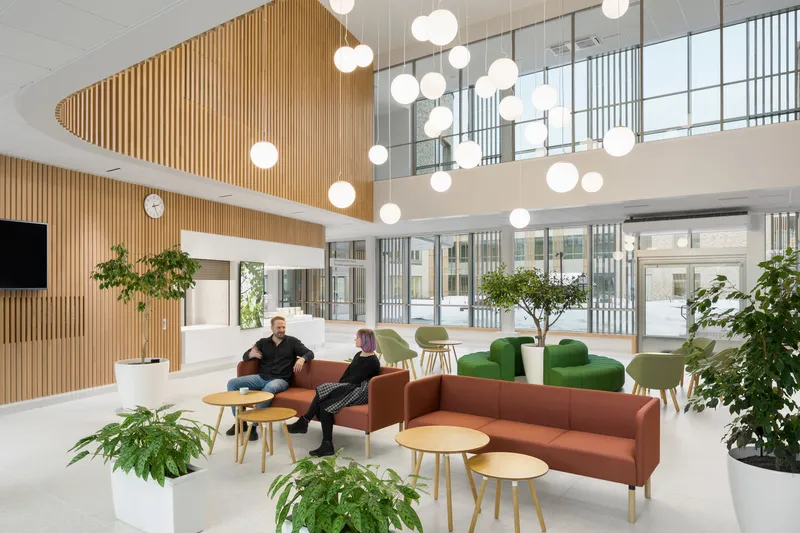
The double-height lobby is the most architecturally expressive space in the complex. Clustered globe pendants hang at varying heights beneath a slatted timber ceiling, while a curved timber wall guides movement toward the mezzanine balcony overlooking the courtyard. The scale is generous without being overwhelming, a difficult balance in a building where many users experience heightened spatial anxiety. Seating groups are arranged to allow conversation or solitude, and the glazed mezzanine brings daylight deep into the plan.
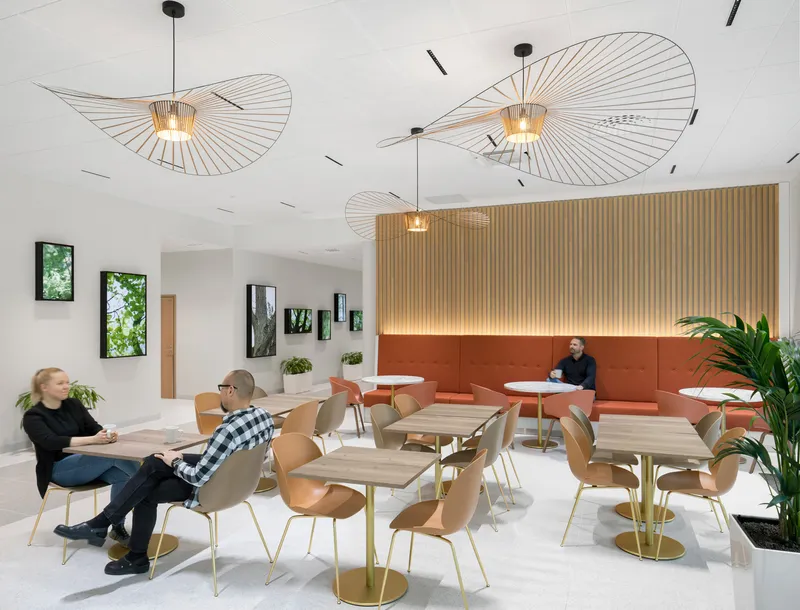
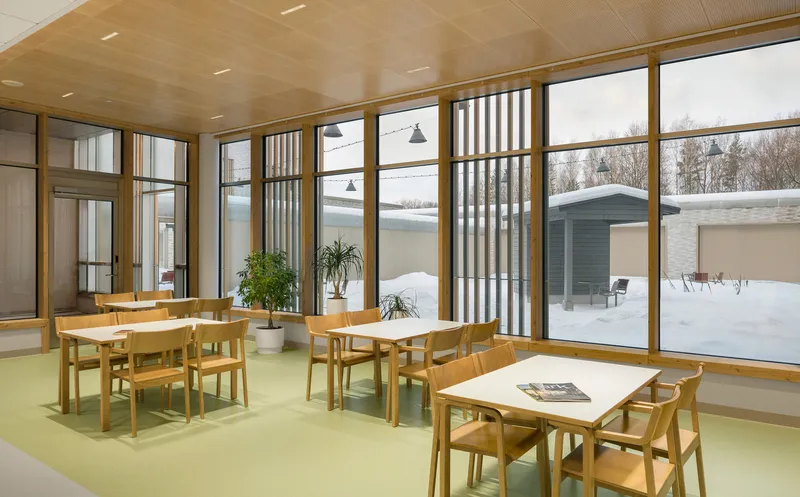
The cafeteria, with its spiral pendant lights, vertical wood slat wall, and orange banquette seating, reads as a genuine social space rather than a hospital canteen. Similarly, the dining room adjacent to the wards uses timber-framed glazing and vertical louvres to filter views of the forest while maintaining a warm enclosure. These rooms matter enormously in psychiatric care. Meals, group sessions, and informal encounters are part of the therapeutic program, and their spatial quality directly influences whether patients engage or withdraw.
Light, Views, and the Window as Threshold
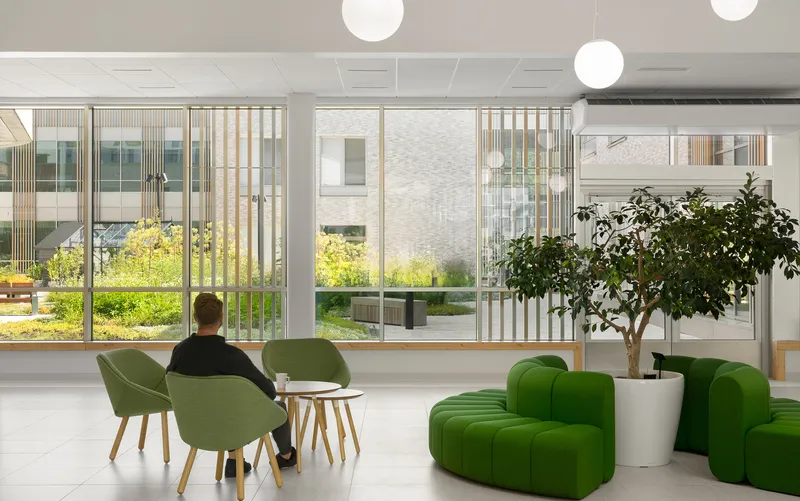
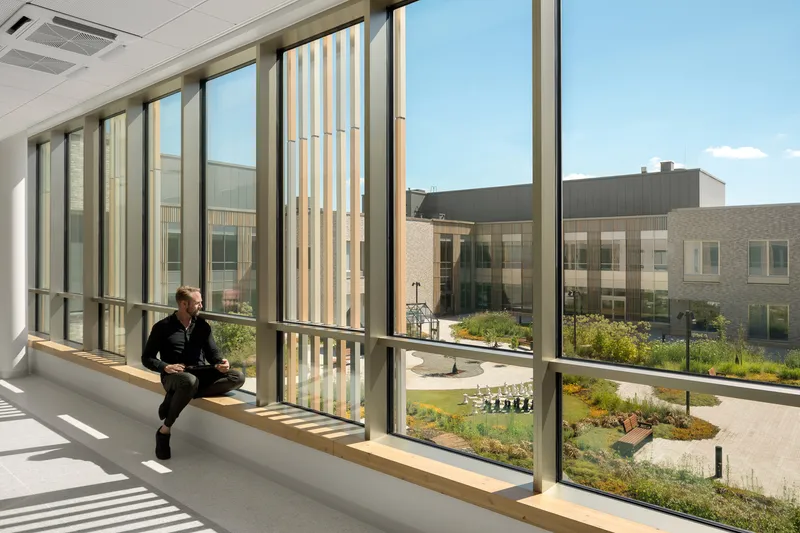
Floor-to-ceiling windows in common areas flood the interiors with natural light and frame the courtyard garden as a living artwork. A window seat overlooking the garden, captured in afternoon sunlight, illustrates the building's commitment to creating moments of pause within the daily rhythm of treatment. These are not decorative gestures. Access to daylight regulates circadian rhythms, a critical factor in managing mood disorders, sleep disruption, and the side effects of psychiatric medication.
The vertical brise soleil that wrap the exterior appear from inside as a soft filter, stripping direct glare while preserving the connection to sky and canopy. In the dining room, the louvres create a gentle striped shadow pattern across the pale green floor, a small sensory reward that conventional psychiatric facilities simply do not bother to provide. The cumulative effect of these daylight strategies is a building that feels alive, shifting in tone and warmth with the Finnish seasons rather than maintaining the static sameness of artificial illumination.
Thresholds and Arrival
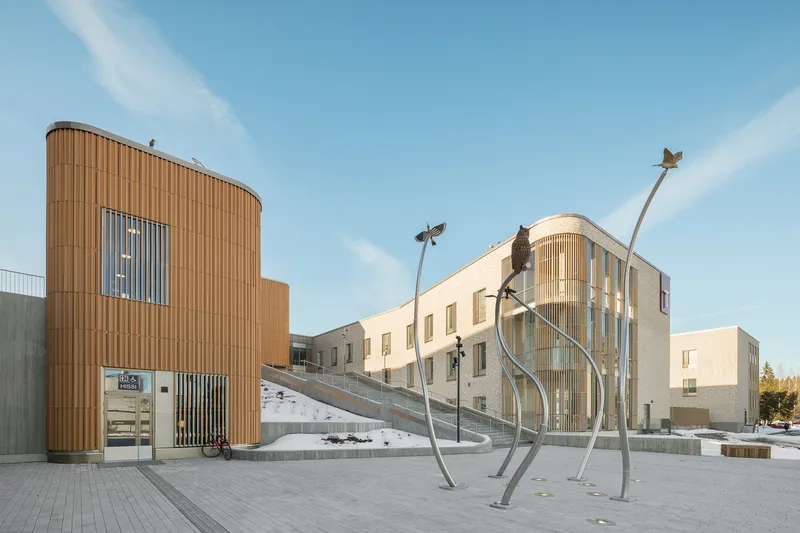
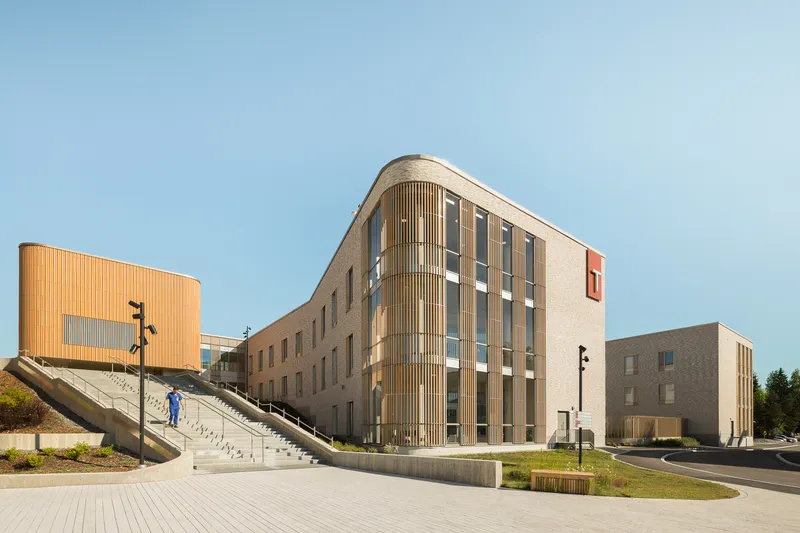
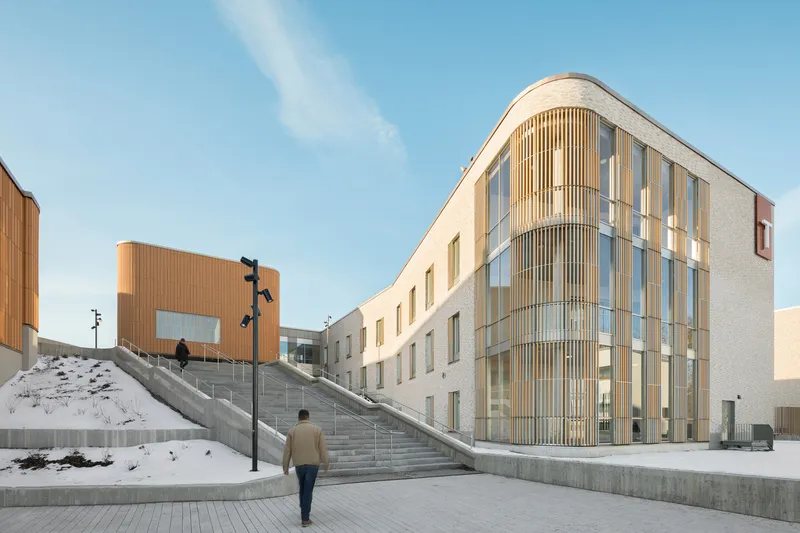
Arrival at the clinic is handled with unusual care. The entry plaza features a sculptural metal bird installation set against the curved, timber-clad volumes, signaling that this is a place invested in culture and craft rather than clinical efficiency alone. Concrete staircases rise gently along the curved facades, and the vertical slat cladding wraps corners smoothly, avoiding the hard edges that characterize typical hospital entrances.
The transition from public to clinical space is gradual. Visitors move from the open plaza into the double-height lobby, then along the therapy walk toward individual wards. At no point does the architecture announce itself as a barrier. This sequential softening of thresholds is a deliberate strategy borrowed from residential and hospitality design, applied here with the understanding that for many patients, the act of entering a psychiatric facility is itself a source of profound anxiety.
Facade Rhythms at Dusk and in Snow
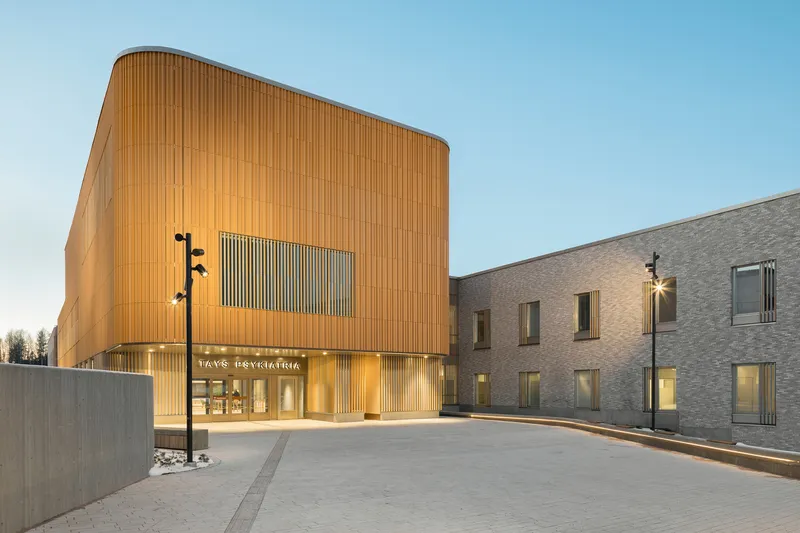
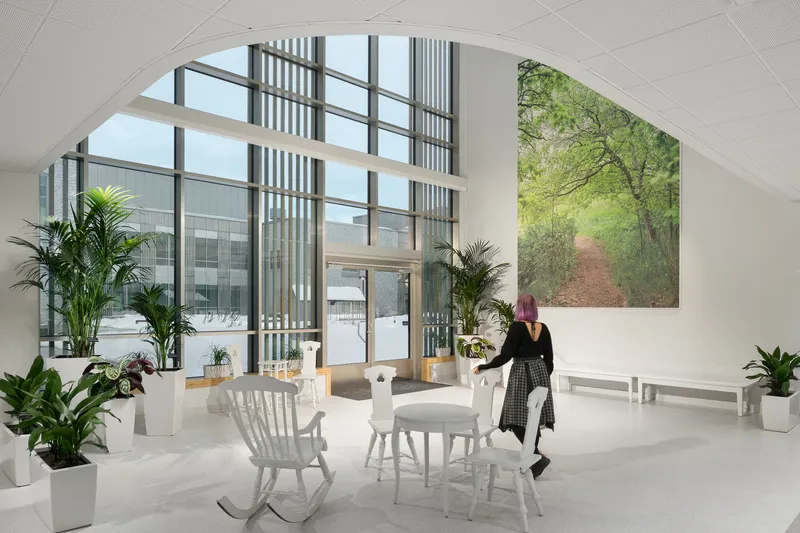
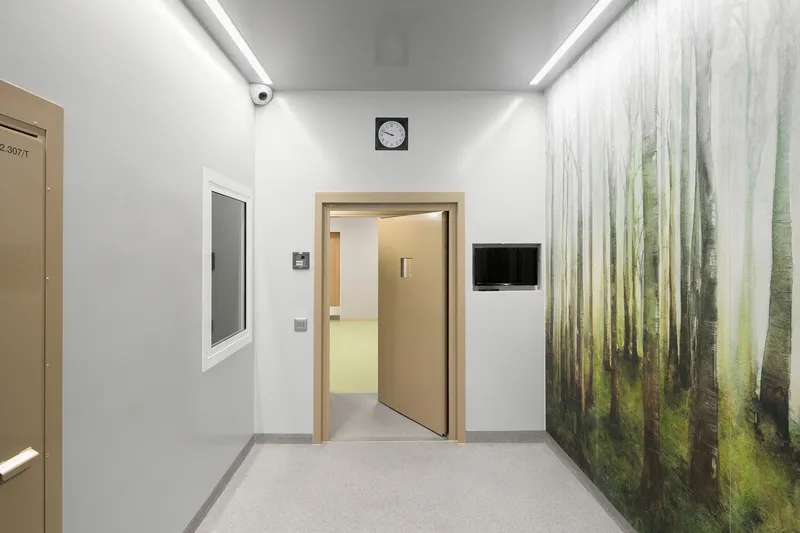
At dusk, the vertical timber slats glow warmly against the darker brick base, and the curved facades reveal their full sculptural quality. The building's ability to change character with the light is not a superficial aesthetic achievement: it creates a daily cycle of visual variety that breaks the monotony of institutional life. Inside, the arched glazing of a ground-floor lounge brings the evening sky into view, while potted plants and a perforated ceiling soften the acoustics and scale. Down the corridor, a forest mural and recessed cove lighting transform a functional passage into an experience that gently directs attention and calms the nervous system.
Plans and Drawings
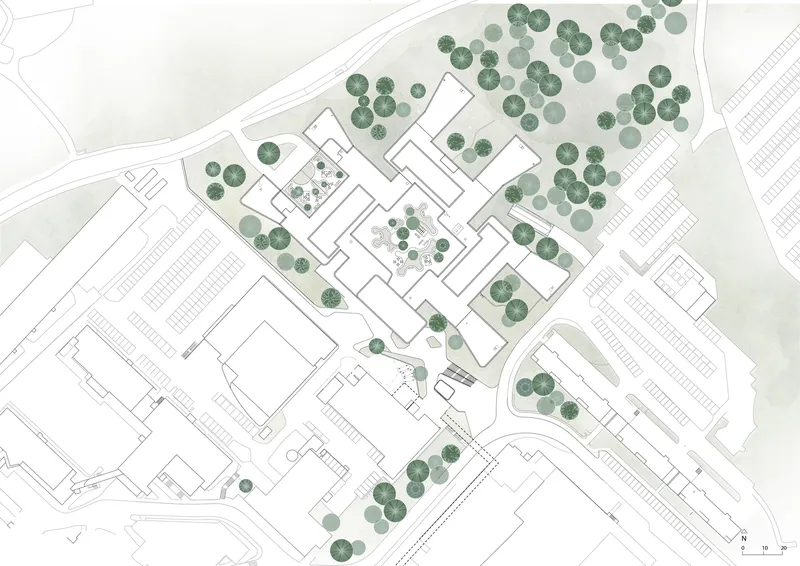
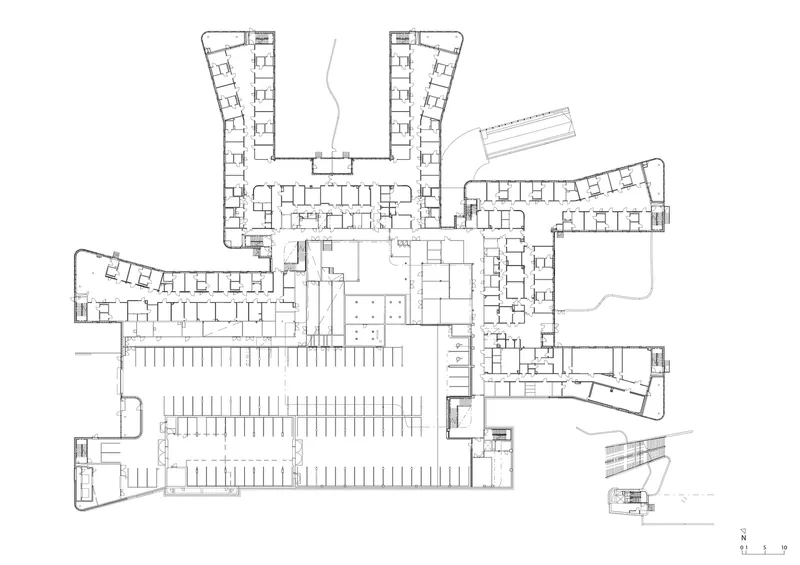
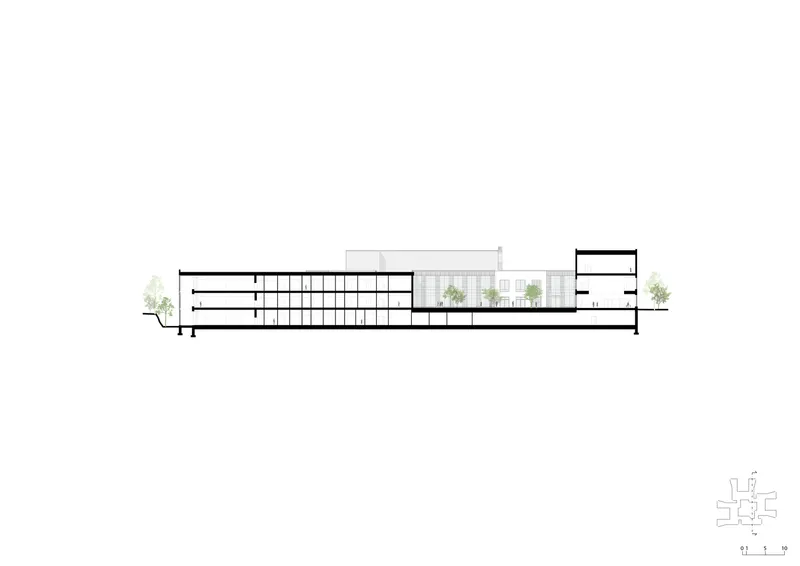
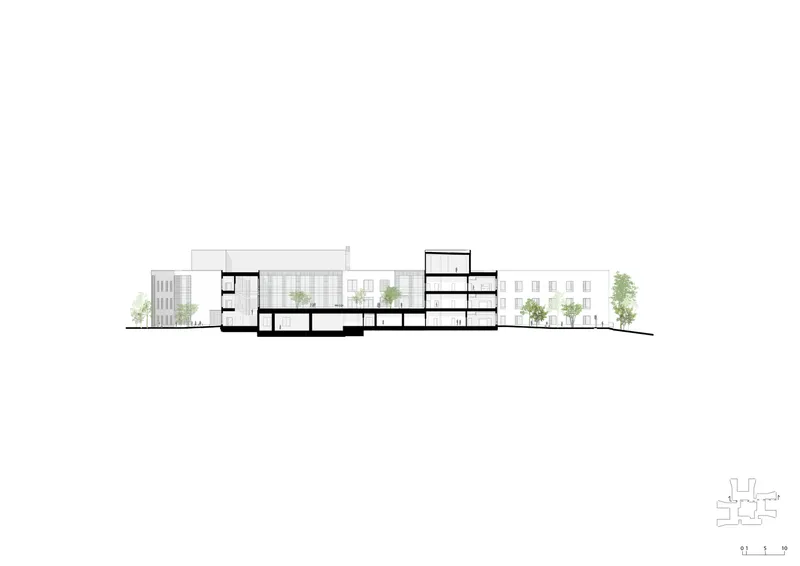
The site plan confirms the clinic's strategic placement at the campus periphery, where tree canopy coverage along pathways creates a green buffer between the institution and the surrounding residential context. The floor plan reveals the pinwheel configuration of wings radiating from the central courtyard, with paired departments sharing structural cores. This arrangement minimizes staff walking distances while maximizing the separation between patient zones, a layout that serves both operational efficiency and therapeutic privacy.
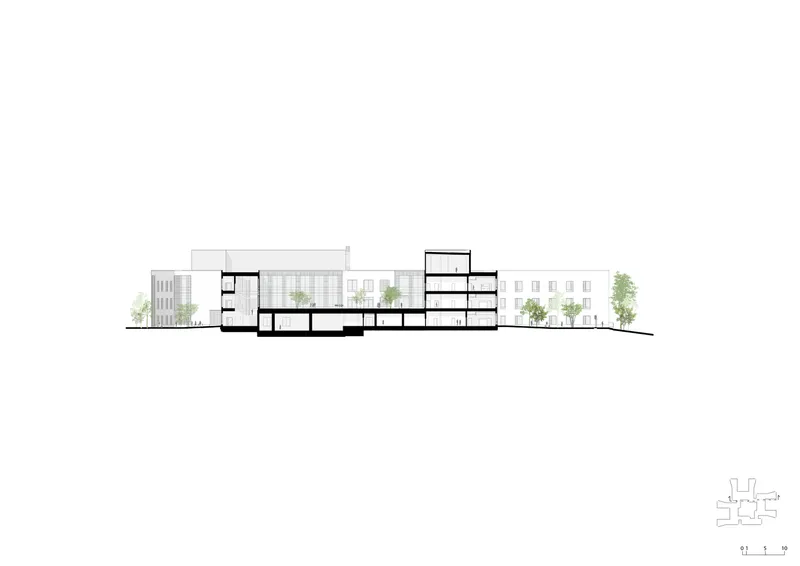
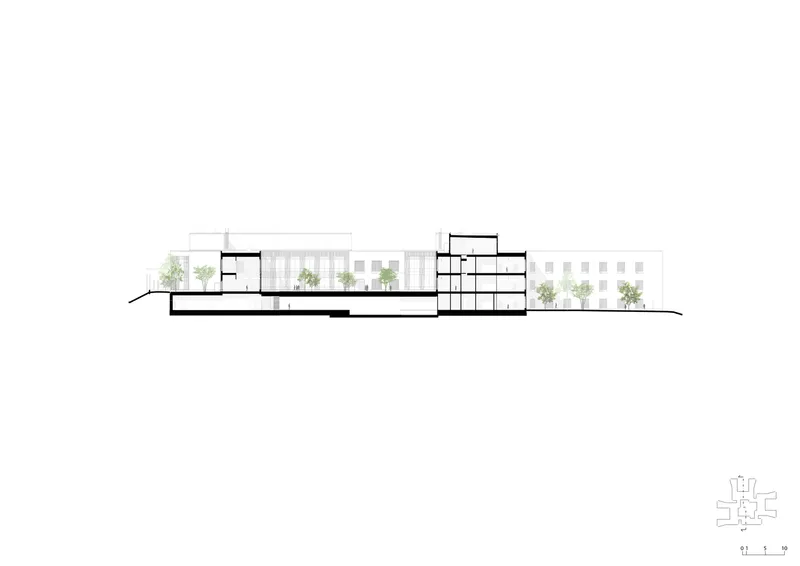
The section drawings expose the building's low-rise horizontal discipline. Planted terraces and green roofs are visible at multiple levels, and a central glazed atrium draws light deep into the plan. The stepped massing follows the sloping site, keeping every wing grounded and approachable. These drawings deserve careful study: they document a building type that is rarely published in such detail, and they offer a replicable model for psychiatric facilities that take spatial quality as seriously as clinical programming.
Why This Project Matters
The Tampere Psychiatric Clinic is important not because it is beautiful, though it is, but because it demonstrates that healing architecture is not a marketing slogan. Every spatial decision, from the six-fingered plan to the timber brise soleil to the salvaged furniture from the old Pitkäniemi clinic, is traceable to a specific clinical or operational rationale. CF Møller and ARCO have produced a building that treats psychiatric patients as full human beings deserving of daylight, nature, privacy, and aesthetic dignity. In a sector where architecture has historically served surveillance and containment, that represents a genuine paradigm shift.
The project also offers a lesson in how evidence-based design can coexist with architectural ambition. The clinic is not a diagram made habitable; it is a richly textured, materially specific building that rewards sustained attention. Its success lies in the integration of landscape, structure, and interior into a continuous therapeutic environment. For architects working on healthcare commissions of any kind, Tampere sets a new floor: if a psychiatric facility can achieve this level of spatial generosity and formal coherence, there is no excuse for the dreary hospitals we continue to build elsewhere.
Tampere Psychiatric Clinic by CF Møller and ARCO Architecture Company. Tampere, Finland. 30,000 square meters. Completed 2023. Photography by Wellu Hamalainen.
About the Studio
Share Your Own Work on uni.xyz
If projects like this are the kind of work you want to make, uni.xyz is a place to publish your own, find collaborators, and enter design competitions.


Popular Articles
Popular articles from the community


Cloaked Colonization: A Mobile Underwater Habitat That Moves Like a Fish
Micah Abaya's shortlisted EHC Pacific entry reimagines ocean settlement as a dispersed network of self-sustaining architectural organisms.

Faces of the Soviet Avant-Garde: Turning Moscow's Street Names into an Open-Air Museum
A network of sculptural installations across a Moscow residential district transforms forgotten architect names into spatial encounters with cultural memor

The Amber Palace Opera: A Geological Fiction Surfaces on Tallinn's Baltic Waterfront
Pierre Brillard reimagines a Baltic legend as a public landscape, opera house, and waterfront promenade rooted in Tallinn's coastal identity.

Opera on the Sea: Driftwood Logic Shapes a Timber Opera House on Estonia's Coast
Trevor Orgill's opera house translates the entangled drift of floating timber into a civic building where wood, water, and music converge.

Similar Reads
You might also enjoy these articles


Hodi-Mandai Geram
Project Function: Preservation and revitalization of the Intangible heritage and socio-spatial identity of the Hodi by Housing, Cultural Memory Center, Sacred Grove, landscape, local tourism economy


Olio Towers: A Mid-Rise for Performers That Fuses Housing, Rehearsal, and Stage
Located blocks from Houston's Theater District, this modular tower stacks living units around a central performance atrium.

Oasis: Modular Green Housing Carved into Dhaka's Urban Fabric
A shortlisted Plugin Housing entry reclaims unauthorized settlements in Dhaka with stepped concrete volumes, green roofs, and ventilation-driven design.

Black Hole: A Floating Megastructure for the Post-Physical Era
Emiliano Mazzarotto envisions a spherical, self-scaling arena where e-sports, digital hotels, and holographic stadiums replace traditional public space.

Explore Architecture Competitions
Discover active competitions in this discipline

Challenge to reimagine the Iron Throne

Photograph architecture without architects

Illustrate the lost glory of Angkor Wat - Render Challenge

Design challenge to reuse E-waste
Comments (0)
Please login or sign up to add comments
No comments yet. Be the first to comment!